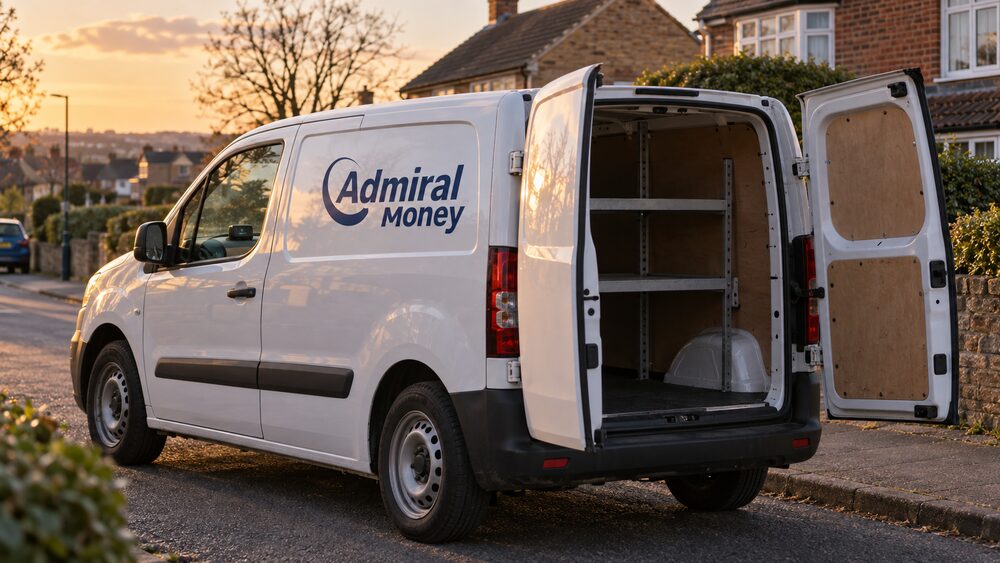
Admiral LittleBox for Van is a telematics policy: a small device is fitted to the van and records how it is driven, and that record feeds into the price at renewal. It is one of the black box or "pay as you drive" policies that the Association of British Insurers describes as using a computer built into the vehicle, a small device fitted by the insurer, or a smartphone app1. Admiral's own version tracks speeding, the times you drive, the smoothness of your driving and your cornering2.
It is aimed at drivers who want their premium to reflect how they actually drive rather than only their age, postcode and claims history. The Financial Ombudsman Service notes that these policies are popular with young and new drivers3, and Which? ranks Admiral's LittleBox car policy 36 out of 66 policies it reviewed2.
The trade-off is that the box stays with the van and the score follows you. A low score can push your renewal price up, and the ombudsman has published cases where drivers were not given enough information about how the score worked before they bought4. This page sets out what the cover includes, who can take it out, how the box is fitted, how the score affects the price, and what to do if something goes wrong. Admiral's own site carries today's prices and the current policy documents.
What Admiral LittleBox for Van covers
LittleBox for Van is comprehensive van insurance with a telematics condition attached: the van carries a device that reports driving data back to the insurer, and the policy is priced and renewed with that data in mind. The underlying cover is a motor policy, so it works in the same way as any other comprehensive van policy, with the box added on top.
What the box adds is a record. Admiral tracks speeding, the times you drive, the smoothness of your driving and your cornering2. That data is used at renewal, and it can also help in other ways: black box technology can be used to help trace a vehicle if it is stolen, or to provide evidence to support you in a claims dispute2.
Two limits are worth knowing before you buy. First, the box measures the driver, not just the van, so anyone who drives the vehicle is feeding the score. Second, telematics policies are not a way of avoiding the usual policy conditions. Admiral's motor policy book shows how tightly some of those conditions are drawn: on policies carrying the relevant endorsement, there is no cover if the vehicle is driven by, or in the charge of, anyone under 25 unless that person is named on the policy schedule, and a separate endorsement sets the same rule at under 305. Non-standard parts and modifications are not covered, and manufacturers' optional extras are covered only if they have been declared and agreed5.
For a van used for work, the important question is what the policy says about the load. Comprehensive van policies commonly exclude any goods or samples carried for trade or business, so a courier or tradesman needs to check that the cover matches what is actually in the back7. If the van is used for business as well as personal journeys, that needs to be declared too.
Levels of cover and the extras included
LittleBox for Van is sold as a comprehensive product, and the level of cover is set by the policy you choose rather than by the box. Admiral's motor policy book sets out the sections that apply to comprehensive cover5. Beyond the core cover, van policies in the wider market are usually built from the same building blocks, and it helps to know what those are when comparing what you have been offered.
Typical add-ons and extras across van and motor policies include:
- Breakdown cover, which can be bought as a standalone policy or bundled with a bank account. Aviva, for example, offers four different options ranging from roadside assistance and a tow to the nearest garage upwards8.
- Legal expenses cover, which pays for pursuing or defending certain claims. Which? reviews these policies separately because the cover varies a good deal between providers9.
- Courtesy or replacement vehicle cover while yours is being repaired.
- Personal belongings cover inside the van, which is usually capped at a modest amount and is not a substitute for contents insurance.
Some of these come free with a packaged bank account rather than as a separate policy. Club Lloyds Silver includes AA Breakdown Family Cover, but there is no cover when travelling in a car, van, minibus or motorcycle exceeding the weight restriction of 3.5 tonnes and a maximum width of 8ft 3in (2.55m), and no cover for business or commercial vehicles10. That matters for van drivers: a van that is used commercially, or that is larger than the weight and width limits, falls outside that kind of bundled cover.
If you are weighing up whether to add breakdown or legal cover to a van policy, the general rules on how add-ons are priced and sold are set out in Breakdown cover explained and Legal expenses insurance and motor legal protection.
Which vans and drivers can get LittleBox cover
Telematics cover is not restricted to cars, but it is not available on every van or for every driver. The insurer decides which device to use based on risk factors such as driving experience or the type of vehicle, and Admiral may fit a black box installed by an engineer, a plug-and-drive unit you fit yourself, or a Bluetooth device you place on the windscreen2. Which one you get is not a choice you make; it follows from the risk assessment.
The policies are most common among drivers with less experience. The Financial Ombudsman Service notes that telematics policies are popular with young and new drivers3, and that is the group for whom a driving score can make the biggest difference to the price. Older drivers with a long no claims history sometimes find that a conventional policy prices better, because there is less for the box to prove.
There are practical eligibility points to check before you buy:
- Who else drives the van. Admiral's policy book shows that on policies with the relevant endorsement, there is no cover if the vehicle is driven by anyone under 25, or under 30 on the other endorsement, unless they are named on the schedule5.
- What the van is used for. Business use, carrying goods for trade, and hire or reward all need to be declared, and comprehensive van policies commonly exclude goods or samples carried for trade7.
- Where the van is kept. Overnight parking arrangements affect the risk and the price.
- Modifications. Non-standard parts are not covered, and optional extras need to be declared and agreed5.
If you are not sure whether your use of the van counts as business use, the rules are explained in Business use and commuting on your car policy and Van cover for personal and business use.
How the LittleBox is fitted and what happens when you change van
The device is fitted at the start of the policy. Depending on the risk assessment, it may be a black box installed by an engineer, a plug-and-drive unit you fit yourself, or a Bluetooth device you place on the windscreen2. The insurer tells you which applies to your policy.
Changing van mid-policy is the point where telematics cover differs most from an ordinary policy. The box is attached to the vehicle, so moving to a new van means the device has to be dealt with. Some providers charge a fee if you buy a new vehicle and want to continue using your black box2. That fee is on top of any change to the premium itself, which will be recalculated for the new vehicle.
If you cancel or simply do not renew, most providers disconnect the box remotely rather than sending an engineer out, so there is usually nothing for you to do. You could be charged, though, if you decide to get rid of the box yourself2.
Your driving score shapes the price at renewal
The score is the point of the policy. Admiral tracks speeding, the times you drive, the smoothness of your driving and your cornering, and that record feeds into what you pay when the policy renews2. A good record can be rewarded in several ways: black box insurers can discount your premium if you have a track record of safe driving, and can offer bonuses such as retail vouchers, money back on your premium, or bonus miles monthly or quarterly on mileage-based policies2.
Night driving is one of the things that counts against a score. The Financial Ombudsman Service has published a case involving a driver called Farhan whose telematics score was low, and one reason was that he was driving regularly at night. He was told that if someone drove regularly at night they would need very good scores in other categories to get a high enough score overall4. For a van driver working shifts or making early deliveries, that is a real consideration.
Mileage matters too. On mileage-based policies, providers may charge per mile, plus an annual or monthly fee to cover the vehicle while it is parked2. That structure suits low-mileage drivers and penalises high-mileage ones, which is the opposite of how a conventional policy behaves.
The score is not the only thing that moves the price. Admiral has said that the FCA introduced new pricing regulations in 2022 which affected everyone's car insurance price, and the rules that stop insurers charging existing customers more than new ones are explained in Insurance pricing rules: the ban on price walking. Admiral's own fee record is mixed: Which?
Making a claim on a LittleBox van policy
A claim on a LittleBox van policy runs like any other motor claim, with one addition: the driving data can be used as evidence. Black box technology can help trace a vehicle if it is stolen, or provide evidence to support you in a claims dispute2.
The deadlines are the same as for any motor policy, and they are strict. Your policy will require you to report the accident within a reasonable time, and what counts as reasonable differs between policies12. If you do not give your details at the scene, the accident must be reported to the police as soon as possible and within 24 hours13. If the police do not attend the scene, or if someone else's property has been damaged, the accident must be reported to the police within 24 hours14. If the police do not attend and you need to produce your certificate, that must be done within seven days of the accident at a nominated police station12. If the van is stolen, the police must be informed immediately and your insurance broker told as quickly as possible15.
The ombudsman has dealt with van claims where the details mattered. In one case, a van was stolen while the owner was working on a digger a few metres away, with the van doors open and the keys nearby. The complaint was upheld and the insurer was told to meet the claim16. In another, a settlement was offered without VAT on a van that was written off, and the ombudsman found that as a commercial vehicle the van would be liable to VAT17.
If a claim is rejected, the general routes are set out in Why insurance claims are rejected and what you can do and Making a car insurance claim after an accident.
Complaints and extra support from Admiral
If something goes wrong with a LittleBox van policy, the first step is Admiral's own complaints process. If that does not resolve it, the Financial Ombudsman Service can look at the complaint, and it has published decisions on telematics policies specifically, including a case where a consumer felt they were not given enough information when buying a telematics policy4.
The ombudsman's published complaint volumes give a sense of scale. In Q1 2026/27 it recorded 283 complaints about commercial vehicle insurance, 25 about motor insurance, 48 about caravan insurance, 5,783 about credit cards and 2,103 about personal loans18. Earlier periods show how the figures move around: 26 new complaints about mini-bonds in Q3 2025/2619, 122 about packaged bank accounts in Q1 2025/2620, and 5,863 about overdrafts across 2025/2621. The ombudsman also publishes annual complaints data and insight covering the whole market21.
If a dispute ends up in court, a letter before a small claims court claim must set out what you want from the party you are claiming from, and is written in compliance with the Practice Direction on Pre-Action Conduct22. Free one-off legal advice may be available if you are taking a small or fast track claim23. Complaints about poor servicing of a vehicle can be framed under the Consumer Rights Act 2015 or the Supply of Goods and Services Act 198224.
Who stands behind the policy
Admiral's policies are issued by EUI Limited, which is authorised by the Financial Conduct Authority with firm reference number 3093785. The company is active on the Companies House register, company number 02686904, incorporated on 12 February 19926. EUI Limited trades under a number of names that consumers will recognise from the high street and from adverts, including Admiral, Elephant, Diamond, Bell, More Th>n and Gladiator5. Littlebox appears among its previous names5.
That matters for two practical reasons. First, if you need to check that the firm you are dealing with is authorised, the FCA Register entry is the place to do it. Second, if the insurer fails financially, protection depends on the licence and the firm, not on the brand on the paperwork. The general rules are set out in What happens if your insurer goes bust.
On the road, all UK motor policies provide the minimum cover required by law in other European Union countries, or the minimum cover required by UK law if that is higher13. That is a floor, not full cover, and the rules differ by country, as explained in Does my car insurance cover me abroad?. In Northern Ireland the same broad framework applies, with the detail set out in Car insurance in Northern Ireland.
Admiral is one of the insurers listed in our Insurers directory, and its brand page is at Admiral.
Sources24 cited
- Pay as you drive insurance Association of British Insurers
- How black box car insurance works Which?, 2026-01-22
- Black box insurance (telematics) Financial Ombudsman Service
- Consumer feels they weren't given enough information buying a telematics policy Financial Ombudsman Service, 2026-09-26
- Admiral motor policy book Admiral, 2023
- EUI Limited, company number 02686904 Companies House, 2026-09-26
- Club Lloyds Silver account Lloyds Bank, 2026-09-27
- Silver account Lloyds Bank, 2026-09-27
- TransUnion credit score shake-up: what the changes mean for you Which?, 2026-09-06
- FSCS general insurance limit review Bank of England, 2023-11-02
- Motor insurance case study 82/10 Financial Ombudsman Service, 2009-12
- I've been in a car accident: do I have to claim on my insurance? Which?, 2026-03-31
- Motor insurance explained nidirect, 2026-05-27
- Accident checklist British Insurance Brokers' Association, 2026-09-26
- Vehicle theft British Insurance Brokers' Association, 2026-09-26
- Letter before small claims court claim Which?, 2025-06-18
- Settlement offered without VAT on a van written off in an accident Financial Ombudsman Service, 2026-09-26
- Quarterly complaints data Q1 2026/27 Financial Ombudsman Service, 2026
- Quarterly complaints data Q3 2025/26 Financial Ombudsman Service, 2025
- Quarterly complaints data Q1 2025/26 Financial Ombudsman Service, 2025
- Annual complaints data and insight 2025/26 Financial Ombudsman Service, 2025
- How to get free legal advice about your civil case Advicenow, 2025-11
- Letter to complain about the poor servicing of a vehicle Which?, 2025-06-18
- I had a flight cancellation: can I claim compensation? Which?, 2026-06-09






 MoneyHelperFree, impartial money and pensions guidance, set up by government
 Financial Ombudsman ServiceFree, independent help when a complaint about a firm is not put right
 FSCSProtects your money if a bank, insurer or investment firm fails
 Citizens AdviceFree advice on money, consumer and legal problems in England and Wales
 GOV.UKOfficial information on tax, benefits and government services