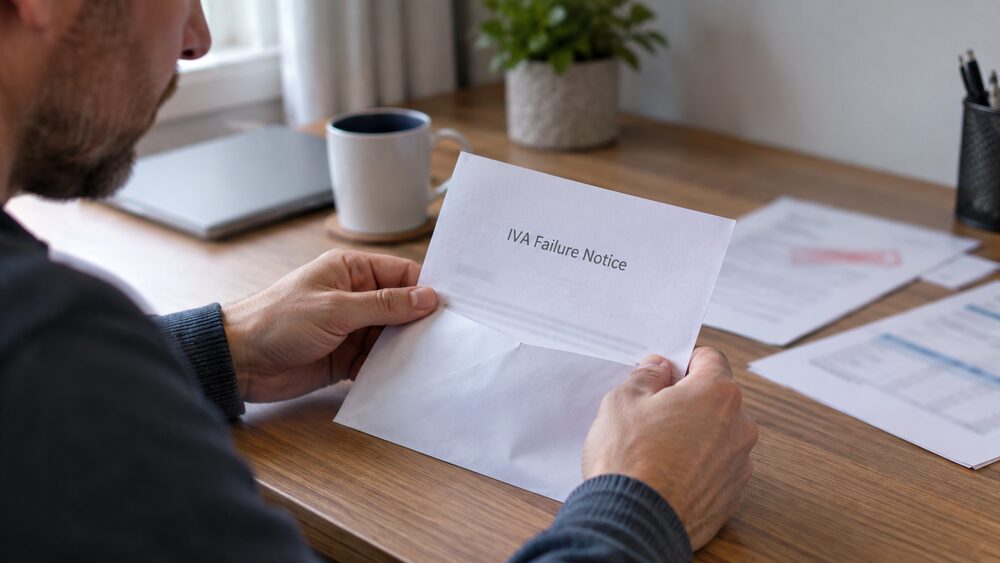
An individual voluntary arrangement (IVA) is a legally binding deal with the people you owe money to. You pay an agreed amount for a fixed term, and whatever is left of the debt at the end is written off. That write-off only happens if you finish the arrangement. If it fails, the protection disappears with it.
An individual voluntary arrangement (IVA) is a legally binding deal with the people you owe money to. You pay an agreed amount for a fixed term, and whatever is left of the debt at the end is written off. That write-off only happens if you finish the arrangement. If it fails, the protection disappears with it.
When an IVA fails, your debts are reinstated, less the payments your creditors have already received1. None of the debts are written off, creditors can contact you again, and they can add back the interest and fees that were frozen while the arrangement was running2. Your insolvency practitioner may also be required by your creditors to petition for your bankruptcy1.
The most common trigger is missed payments. Many IVA proposals state that three missed payments in any twelve month period is an automatic fail3. The second is a rejected variation: if you ask creditors to change the terms and they refuse, or you keep missing payments without contacting your practitioner, the IVA fails and bankruptcy may be the only realistic option left4.
Why an IVA fails: missed payments and rejected changes
An IVA is supervised by a licensed insolvency practitioner, and you can only get one with their help7. That practitioner is the person who decides whether a missed payment is a breach, and the person you need to tell before the situation gets worse.
Missing a payment does not always end the arrangement immediately. Missed payments are added to the end of the IVA term, so the arrangement simply takes longer to complete2. Missing payments can also lead to a breach notice, which is the formal warning stage9. What turns a bad month into a failure is silence: if you consistently miss payments without contacting your practitioner, the IVA will fail4.
Many proposals build in a hard rule. Where the IVA proposal states it, three missed payments in any twelve month period is an automatic fail3. That is why the timing of any contact matters so much. A payment you cannot make in March may be recoverable if your practitioner knows in February.
The other route to failure is a variation that creditors reject. A variation is a formal request to change the terms, usually to reduce the monthly payment or extend the term. If creditors do not accept it, the IVA fails4. Creditors vote on variations, and the outcome depends on the reasons you give and the evidence behind them.
Your debts come back, minus what you have paid
The central point about a failed IVA is that nothing is written off. If you do not finish your IVA, none of your debts will be written off, you will have to pay them all back, creditors will contact you again, and they can add any missed interest and fees2. The debts are reinstated less any payments received by the creditors1.
That last phrase matters. The payments you made during the IVA are not lost to the debt: they reduced what you owe. What does not come back is the money that went on fees. If your IVA fails, any fees paid up to that point will not be recoverable4. Fees paid cannot be recovered if your IVA fails, and they are also not refunded if you pay your creditors in full during the term10.
There is one narrow exception. Under the IVA Protocol 2025, where a breach occurs before the first payment to creditors, if the IVA was not the most suitable solution or breach was likely, any payments made by the consumer should be refunded and the protocol IVA terminated12. This applies to protocol IVAs and to breaches at that early stage, not to a failure years into the arrangement.
For comparison, an IVA that runs its course ends differently: once an IVA is complete, the individual is released from the debts they owed before the IVA began, with any unpaid balance written off13. Any remaining debt is written off by your creditors when the arrangement has completed14.
| What happens | IVA completes | IVA fails |
|---|---|---|
| Unpaid debt | Written off13 | Reinstated, less payments received1 |
| Interest and charges | Stay frozen while it runs15 | May be added back1 |
| Fees already paid | Not refunded11 | Not recoverable4 |
| Creditor contact | Ends | Can restart2 |
Bankruptcy and other action creditors can take
While an IVA is in place, creditors cannot take action to recover debts included in the IVA and they cannot add interest15. They also cannot take any further enforcement action against you, such as petitioning for your bankruptcy4. Failure removes both protections at once.
After a failed IVA, creditors can request your bankruptcy16. The insolvency practitioner dealing with your IVA can petition for your bankruptcy if the people you owe agree to it, though this is rare5. Creditors may also ask your IVA supervisor to petition for your bankruptcy, which guidance describes as unlikely to happen17. The consistent picture across the sources is that bankruptcy is a real risk after failure, but not the automatic next step.
One procedural detail makes the risk sharper. Normally a creditor must serve a statutory demand before starting bankruptcy proceedings, and can start proceedings 21 days after it is served18. After a failed IVA that step can be skipped: the people you owe can make you bankrupt without a statutory demand if you had an IVA that has now failed19. The insolvency practitioner or creditors can make you bankrupt without sending you a statutory demand20.
Joint debts behave differently again. Joint debts can be included in an IVA, but the creditor will still pursue the joint owner of the debt for full repayment, because both borrowers are liable for the whole amount21. A failed IVA does not change that, and it means a partner or ex-partner can be chased even where your own arrangement covered the debt.
Before it fails: asking your insolvency practitioner for a variation
The most useful thing to know about a failed IVA is how often it can be avoided. A variation is the formal route: your practitioner puts changed terms to your creditors, and they vote on them. If they accept, the arrangement continues on the new terms. If they do not accept a variation, or payments are consistently missed without contacting the practitioner, the IVA will fail4.
Variations are usually used to deal with a drop in income, a job loss or an unexpected expense. The evidence you provide matters, because creditors decide on the reasons given. Your practitioner can only put a case together if they know what has changed, which is why the contact needs to happen before the payment is missed rather than after.
There is a second reason to raise problems early. An IVA may not suit everyone: guidance notes that the IVA would fail if you cannot keep to the payments for the full term, and that it may not suit those with income that goes up and down22. If your income is irregular, that is a conversation to have at the start, not in month eighteen.
If the IVA does fail and bankruptcy follows, the route back is not closed. Where you agree an IVA instead of bankruptcy, your insolvency practitioner deals with the annulment for you23. That is the reverse journey, but it shows the practitioner remains the central figure in either direction.
Where to get help and how to complain
Free, impartial debt advice is available before and after a failure. StepChange Debt Charity does not charge for advice, and there is no charge for advice and support before you set up an IVA11. Once an IVA is in progress you make payments to your trustee or insolvency practitioner25. Debt Advice Foundation is a registered UK charity offering free, confidential support and advice on any aspect of debt, including IVAs10.
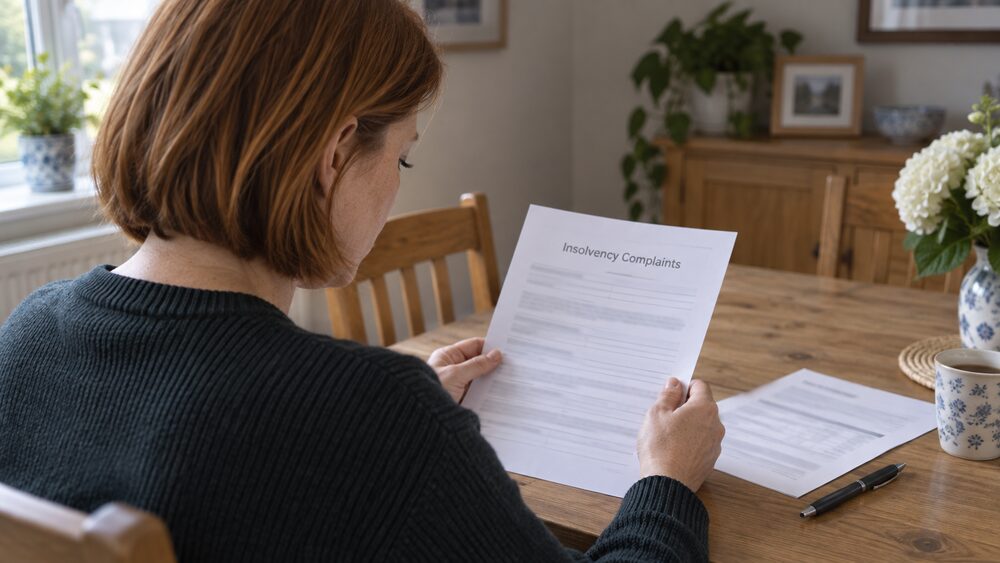
If you are unhappy with how your IVA has been handled, the complaint route is specific. Write to your insolvency practitioner, explaining the problem or grievance, and write to the practitioner's regulatory body if you do not like their response26. Complaints about the practitioner's regulated work should be completed online at gov.uk/complain-about-insolvency-practitioner, and if the matter is not settled you can complain to the regulatory body that licenses them27. Complaints about the work of an insolvency practitioner should be made via the Insolvency Complaints Gateway, which ensures complaints are investigated by the right regulatory body28.
Your IVA is also a matter of public record. Details of IVAs are listed on a public register called the Individual Insolvency Register17, and the register is used by credit reference agencies to update your credit rating29. In England and Wales the register is the Individual Insolvency Register; in Northern Ireland it is the Register of IVAs22.
Sources29 cited
- Straight talking IVAs Debt Advice Foundation, 2026-04-21
- How an IVA affects me StepChange Debt Charity, 2026-09-25
- What happens if I don't keep up the payments on my IVA? Debt Advice Foundation, 2025-08-15
- Individual voluntary arrangements (IVAs) Debt Advice Foundation, 2026
- Creditors making you bankrupt StepChange Debt Charity, 2026-09-25
- Individual voluntary arrangement StepChange Debt Charity, 2026-09-25
- IVA tips StepChange Debt Charity, 2026-09-25
- Paying off an IVA early StepChange Debt Charity, 2026-09-25
- How can an IVA fail? StepChange Debt Charity, 2026-09-25
- What does an IVA cost? Debt Advice Foundation, 2025-08-15
- IVA costs, fees and charges StepChange Debt Charity, 2026-09-25
- IVA Protocol 2025 GOV.UK, 2025-04-01
- Individual voluntary arrangements R3, 2026-07-20
- Options for dealing with debt Advice NI, 2026
- Individual voluntary arrangements (England and Wales) National Debtline, 2026-09-25
- IVA or DMP StepChange Debt Charity, 2026-09-25
- How an IVA affects your credit rating StepChange Debt Charity, 2026-09-25
- Government debt advice StepChange Debt Charity, 2026-09-25
- Voluntary bankruptcy StepChange Debt Charity, 2026-09-25
- Statutory demands (England and Wales) National Debtline, 2026-09-25
- Credit and loans on an IVA StepChange Debt Charity, 2026-09-25
- What is an IVA? StepChange Debt Charity, 2026-09-25
- Cancelling bankruptcy StepChange Debt Charity, 2026-09-25
- Meeting of creditors StepChange Debt Charity, 2026-09-25
- IVA insolvency practitioner StepChange Debt Charity, 2026-09-25
- Sending documents for your IVA StepChange Debt Charity, 2026-09-25
- What is an insolvency practitioner? R3, 2026-07-20
- Debt consolidation and debt management StepChange Debt Charity, 2026-09-25
- Individual voluntary arrangements (IVAs) nidirect, 2025-09-12







 StepChangeFree debt advice and solutions from a charity
 National DebtlineFree debt advice by phone, webchat and online
 MoneyHelperFree, impartial money and pensions guidance, set up by government
 Citizens AdviceFree advice on money, consumer and legal problems in England and Wales
 Citizens Advice ScotlandFree advice across Scotland