
If your income drops or you lose your job while you are in an individual voluntary arrangement (IVA), the first thing to do is tell your insolvency practitioner (IP) straight away. Losing your job does not automatically cause the IVA to fail, and payments may be lowered for a time, or you may be able to get a short break from repayments1.
If your income drops or you lose your job while you are in an individual voluntary arrangement (IVA), the first thing to do is tell your insolvency practitioner (IP) straight away. Losing your job does not automatically cause the IVA to fail, and payments may be lowered for a time, or you may be able to get a short break from repayments1.
Your IP has some discretion to reduce your payments. If that is not enough, they can approach your creditors for a variation of the amount you pay each month or the length of the IVA3. Under the IVA Protocol 2025 standard terms, the supervisor can reduce your regular contribution by up to 20% without referring back to creditors4.
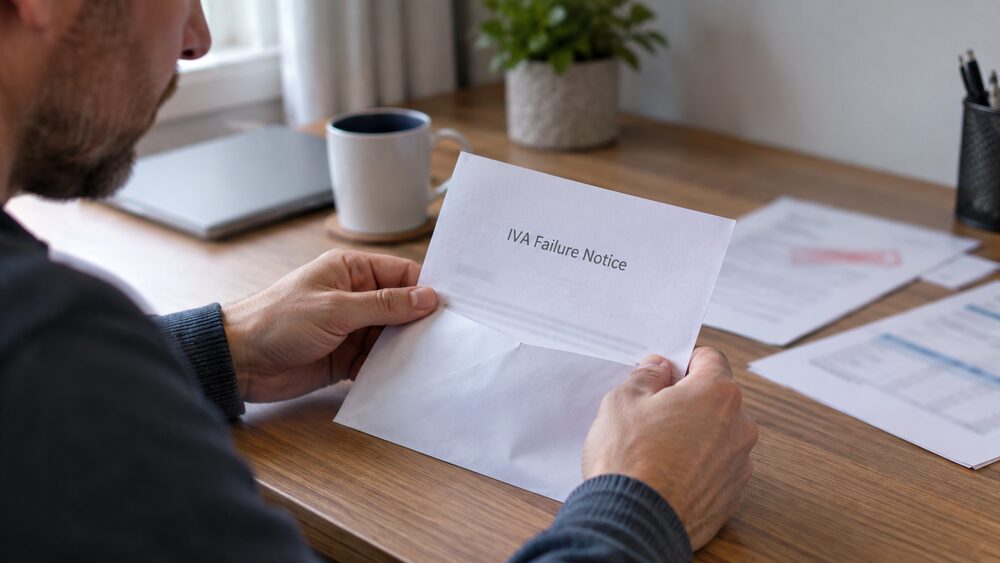
What you must not do is simply stop paying. Stopping payments breaks the terms of the IVA agreement and the IVA could be cancelled or ended5. If the IVA fails, your debts are reinstated less any payments received by the creditors, interest may be added back on, and your IP may be required by your creditors to petition for your bankruptcy6.
Tell your insolvency practitioner as soon as your income drops
The single most important step is contact. Your IP reviews your situation each year while you are on an IVA, and if your income changes, your IVA payments might change9. But you do not have to wait for the annual review. If you lose your job, tell your IP straight away2.
Your IP has some discretion to reduce your payments where you have legitimate reasons for not being able to continue making the agreed monthly payments. Failing that, they can approach your creditors for a variation of the amount you pay each month or the length of the IVA3.
You cannot apply for an IVA yourself. You need the help of a qualified insolvency practitioner, and that same practitioner is the person who manages any change to your payments once the IVA is running10. You make payments to your IP once your IVA is in progress11.
If you are struggling to gather the paperwork your IP needs, tell them. Sending documents for your IVA is part of the process, and delays in providing evidence of a change in income can slow down a variation request12.
How IVA payments can be lowered or paused
There are two broad routes: an informal reduction using your IP's discretion, and a formal variation agreed with creditors.
Under the IVA Protocol 2025 standard terms and conditions, the supervisor has discretion to reduce your regular contribution by up to 20% without referring back to creditors4. That covers modest drops in income. For anything larger, or for a change to the length of the IVA, your IP approaches creditors for a variation3.
A payment break is the other option. You may get a payment break if your situation changes15, and you may be able to take a payment break to help cover short term emergency costs16. A break is not automatic: it depends on your IP and, in many cases, your creditors agreeing.
The IVA Protocol is an agreement in which IVA providers and creditors pledge to use standard forms, terms and conditions to make the process easier and simpler17. That matters here because it sets the 20% discretion figure and standardises how variations are handled.
What a lower payment means for fees and creditors
IVA fees are part of the reduced monthly payments you make to your creditors18. There are no upfront fees: the nominee fee, supervisor's fee and disbursements are all taken from your monthly payments15. After the first five payments, the IP typically gets 15% of your monthly repayments and your creditors get 85%, excluding VAT8.
That split matters when your payment falls. A lower monthly payment means a lower cash amount going to both the IP and your creditors. Any fees have to be approved by creditors18, and the fees and outlays have to be approved by creditors at the Meeting of Creditors, where they sometimes reduce such fees and outlays19.
An IP will charge a fee for negotiating with your creditors and managing your IVA5. If your IVA fails, you will be back to square one having paid fees, and at that point the only option realistically available to you will be bankruptcy20.
Your creditors agreed at the outset to freeze interest and write off any outstanding debts21. A variation does not undo that agreement, but it does change the terms on which it runs. If creditors do not accept a variation, or if you consistently miss payments without contacting your IP, your IVA will fail and you may be left with bankruptcy as the only realistic option available to you22.
| What changes | Effect on fees | Effect on creditors |
|---|---|---|
| Payment reduced by up to 20% | IP share falls in cash terms; fee split unchanged4 | Creditors receive less each month8 |
| Formal variation agreed | Fees still need creditor approval18 | Creditors agree new amount or term3 |
| Payment break | No payment means no fee taken that month18 | Creditors receive nothing during the break16 |
| IVA fails | Fees already paid are not refunded20 | Debts reinstated less payments received6 |
Will my IVA last longer if my payments go down?
It can do. IVAs usually have a five-year term, but your IVA may have a six-year term if you are a homeowner7. IVAs normally last five years23, and the typical term is five years24.
If your monthly payment is reduced, one way to keep the total paid to creditors roughly the same is to extend the term. That is a variation, so it needs creditor agreement3. The alternative is to accept that creditors receive less overall, which they may or may not accept.
A lump sum IVA is a different structure: instead of monthly payments over five years, you pay a single agreed sum, often from a third party25. That route is not a way to reduce an existing monthly payment, but it is one of the options an IP may discuss if your circumstances have changed fundamentally.
If you cannot keep up: when an IVA may fail
An IVA would fail if you cannot keep to the payments for the full term, and it may not suit those with income that goes up and down26. If you do not stick to the terms of your IVA, it may fail, and creditors can add interest and charges and restart recovery action6.
If creditors do not agree that your reasons for missed payments are valid, then the IVA will fail and the IP may initiate bankruptcy proceedings. You may also be liable for any fees paid by your creditors to your IP up to that point, and your creditors will once again be entitled to pursue you for the outstanding debt3.
If your IVA fails, your debts will be reinstated less any payments received by the creditors, interest may be added back on, and your IP may be required by your creditors to petition for your bankruptcy6. Under the IVA Protocol 2025, creditors will no longer be prevented from pursuing repayment of outstanding balances directly, and the consumer will be liable for interest and charges accrued during the term of the protocol IVA27.
An IVA can be cancelled at any time before the IVA agreement commences. An IVA is deemed to have commenced upon acceptance of the proposal by creditors, after which it cannot be cancelled and only terminates on breach of the terms19.
Getting free help and making a complaint
Free IVA help is available from any registered debt charity such as Debt Advice Foundation24. There are free advice services that can help29, and there is a free government helpline, Make the Call30. StepChange does not charge you for advice, but you make payments to your insolvency practitioner once your IVA is in progress11.
If you are in Scotland, free advice services can help with debt, including protected trust deeds29. In Scotland, a protected trust deed is a similar solution to an IVA, with different benefits, risks and fees25.
If you want to complain about your IVA provider, complaints about the insolvency practitioner's regulated work should be completed online at gov.uk/complain-about-insolvency-practitioner. If the complaint is not settled, you can complain to the regulatory body that licences the insolvency practitioner12. Resolver is a free online service providing information and guidance on complaints31.
Before you complain, it helps to have your facts straight. Free legal help at the court is available if your case reaches that stage29, and free advice services can help you understand what your IP should have done29.
Sources31 cited
- IVA and job loss StepChange, 2026-09-25
- IVAs and employment PayPlan, 2026-02-26
- What happens if I don't keep up the payments on my IVA? Debt Advice Foundation, 2025-08-15
- IVA Protocol 2025 standard terms and conditions GOV.UK, 2025-04-01
- Insolvency Service research into IVAs GOV.UK, 2024-10-17
- Straight talking IVAs Debt Advice Foundation, 2026-04-21
- How does the IVA process work? Debt Advice Foundation, 2026-09-26
- How much will I have to pay into my IVA? Debt Advice Foundation, 2026-04-21
- Check what an IVA is Citizens Advice, 2026-09-25
- Individual voluntary arrangements (IVAs) Advice NI, 2026-08-30
- IVA companies StepChange, 2026-09-26
- Sending documents for your IVA StepChange, 2026-09-25
- What is an IVA? StepChange, 2026-09-25
- Individual voluntary arrangement StepChange, 2026-09-25
- IVA Creditfix, 2026
- How can an IVA fail? StepChange, 2026-09-25
- What am I expected to do when I'm in an IVA? Insolvency Service, 2023-03-23
- IVA costs, fees and charges StepChange, 2025-08-15
- IVA FAQ McCambridge Duffy, 2026-09-26
- Who pays the IVA fees? Debt Advice Foundation, 2026-04-21
- What is an IVA? Debt Advice Foundation, 2025-08-15
- IVA Debt Advice Foundation, 2026
- Getting an IVA StepChange, 2026
- Where can I get free IVA help? Debt Advice Foundation, 2025-08-15
- Lump sum IVA StepChange, 2026-09-25
- IVA impact on your life PayPlan, 2026-02-26
- IVA Protocol 2025 GOV.UK, 2025-04-01
- Cancelling bankruptcy StepChange, 2026-09-25
- Debt advice Shelter Scotland, 2026-01-16
- Making ends meet Consumer Council, 2026
- Complaining about your lender National Debtline, 2026-09-25





 StepChangeFree debt advice and solutions from a charity
 National DebtlineFree debt advice by phone, webchat and online
 MoneyHelperFree, impartial money and pensions guidance, set up by government
 Citizens AdviceFree advice on money, consumer and legal problems in England and Wales
 Citizens Advice ScotlandFree advice across Scotland