Missing one IVA payment does not end the arrangement. An individual voluntary arrangement protects you from further action by your creditors as long as you keep up with payments, and a single slip is normally something your insolvency practitioner can deal with. What changes the picture is the pattern: a notice of breach will be issued if you miss three or more contributions, not necessarily consecutively, without prior approval and in line with the terms of your IVA1.
Missing one IVA payment does not end the arrangement. An individual voluntary arrangement protects you from further action by your creditors as long as you keep up with payments, and a single slip is normally something your insolvency practitioner can deal with. What changes the picture is the pattern: a notice of breach will be issued if you miss three or more contributions, not necessarily consecutively, without prior approval and in line with the terms of your IVA1.
Many IVA proposals go further and state that three missed payments in any twelve month period is an automatic fail2. The terms that bind you are the ones in your own proposal, so the first thing to do is read what it says about missed payments, then contact your insolvency practitioner before the next one falls due.
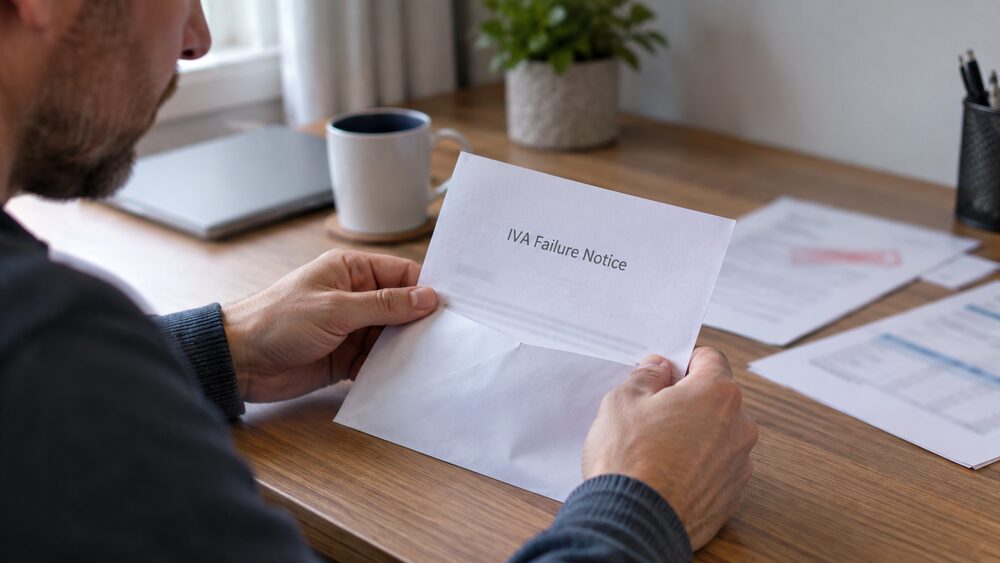
The reason to act early is that the consequences of failure are severe. If your IVA fails, none of your debts will be written off, you will have to pay them all back, creditors will contact you again and can add any missed interest and fees3. The sections below set out what happens at each stage, what you can ask for, and where to get free help.
Missing one IVA payment does not end the arrangement
An IVA is a formal agreement to pay an agreed amount towards your debts over a set period, after which any remaining debt will be written off by your creditors when the arrangement has completed7. If the payments you make are not enough to pay your debts in full by the end of your IVA, you will not have to pay the rest8. That write-off is the whole point of the arrangement, and it is what is at stake if payments stop.
The protection runs alongside the payments. An IVA protects you from further action as long as you keep up with payments, and it is recorded on the IVA register9. Your IVA will remain on the register until it is completed or terminated10. Your IVA usually ends when the agreed amount has been repaid11.
A single missed payment is a problem to be managed, not a termination. The practical question is whether the miss was approved in advance. A breach notice is issued where contributions are missed without prior approval, so a payment holiday agreed with your insolvency practitioner is a different situation from one that simply did not leave your account. If money is short this month, the call to make is to your practitioner, not to your bank.
Should I contact my insolvency practitioner before I miss a payment?
Contacting your practitioner in advance is what keeps a missed payment out of the breach process. The rules turn on prior approval, so an arrangement agreed beforehand is treated differently from a payment that is simply missed. Waiting until three payments have gone by removes most of your room to manoeuvre.
There is a second reason to make the call early. Your insolvency practitioner has some discretion to reduce your payments or, failing that, can go back to your creditors and try to renegotiate your monthly payments, which is called a variation5. That discretion is exercised when there is a good reason, for example a change in circumstances such as reduced income5. A practitioner who knows about a job loss or a drop in hours in the same month it happens has options. One who finds out three months later has a breach to administer.
If you are behind on other bills as well, it helps to know which debts the IVA does and does not cover. Debts that were missed at the start of the arrangement may still be possible to add, and sometimes a second creditors' meeting is required if the debt is significant12. Creditors you left off the list are a separate risk: you must provide a full list, and any creditor missed out can apply to the court to have your IVA cancelled11.
Three missed payments: the formal breach notice
The breach notice is the formal step. A notice of breach will be issued if you miss three or more contributions, not necessarily consecutively, without prior approval and in line with the terms of your IVA1. One provider of IVAs puts the same threshold plainly: if three payments are missed, a formal breach notice may be issued14.
The notice is not the end of the arrangement. It tells you how you broke the terms and what you can do to put it right, what the problem is and how long you have to fix it5. The remedy period is the part to focus on: it gives you a month to repay the arrears or to ask your creditors to agree a variation to the IVA4.
If you do not fix the breach, the next step is a creditors' meeting. Your supervisor arranges a meeting of creditors if you do not fix the breach, and the people you owe can cancel your IVA at this meeting5. That is the point at which the arrangement can end, and it is decided by your creditors rather than by your supervisor alone.
Asking for a variation when you cannot keep up
A variation is the formal route to changing what you pay. Your insolvency practitioner has some discretion to reduce your payments or, failing that, can go back to your creditors and try to renegotiate your monthly payments, which is called a variation5. It is used where there is a good reason you have been unable to continue making payments, such as a change in circumstances5.
The variation is a proposal to the people you owe, and they decide. If creditors do not accept it, or if payments are consistently missed without contacting your insolvency practitioner, the IVA will fail and you may be left with bankruptcy as the only realistic option available to you5. That is why the conversation with your practitioner needs to happen while there is still something to propose, rather than after the breach notice has expired.
There is a separate, quicker route if the problem is a one-off. The remedy period in a breach notice gives you a month to repay the arrears or to ask your creditors to agree a variation4. Repaying the arrears clears the breach without changing the terms of the arrangement at all, which is usually the simpler outcome where the money can be found.
If your income has dropped for a sustained period rather than a single month, the variation is the tool designed for it. If you are in Scotland, none of this applies: IVAs are not available in Scotland6, and the equivalent options are the Debt Arrangement Scheme, protected trust deeds and sequestration.
Do IVA fees go up if I miss a payment?
The fee itself does not rise, but the arrangement can stretch. The IVA can be extended if you miss payments15, and missed payments are added to the end of the IVA term16. In practice that means a longer period of payments rather than a larger monthly bill, and it delays the point at which the remaining debt is written off.
The bigger financial risk sits in failure rather than in arrears. If your IVA fails, you will be back to square one having paid fees, and at that point the only option realistically available to you will be bankruptcy17. Where creditors do not agree that your reasons for missed payments are valid, the IVA will fail, the insolvency practitioner may initiate bankruptcy proceedings, and you may also be liable for any fees paid by your creditors to your practitioner up to that point, while your creditors will once again be entitled to pursue you for the outstanding debt2.
Fees are paid out of the agreed monthly payment rather than charged on top, and there is no charge for the debt advice that comes before an IVA13. You need to get free debt advice before applying for an IVA18. If you are comparing providers, the fee structure is one of the things to check, along with what happens to the fee if the arrangement ends early.
When an IVA fails and bankruptcy becomes the realistic option
Failure has a defined set of consequences, and they are worth reading before they happen rather than after. If your IVA fails, your debts will be reinstated less any payments received by the creditors, interest may be added back on, and your insolvency practitioner may be required by your creditors to petition for your bankruptcy5. None of your debts will be written off, you will have to pay them all back, and creditors will contact you again and can add any missed interest and fees3.
Bankruptcy is the realistic fallback. If creditors do not accept a variation, or payments are consistently missed without contacting your insolvency practitioner, the IVA will fail and you may be left with bankruptcy as the only realistic option available to you5. Creditors can request your bankruptcy if your IVA fails9, and breaking the terms of an IVA is one of the routes by which someone can be made bankrupt19. One charity's guidance is more measured on how often this happens: if your IVA fails, the people you owe may ask your IVA supervisor to petition for your bankruptcy, but this is unlikely to happen20.
The other consequence is that creditors restart interest and charges, and they can also add these for the period the IVA was in place. They can take recovery action, and in rare cases make an application to make you bankrupt21. Because the debt is not reduced by the amount paid, some of which covered the insolvency practitioner's fees, the position after a failed IVA can be worse than the position before it started.
Getting help and making a complaint
Free, impartial help exists and is the right first stop. You need to get free debt advice before applying for an IVA18, and the same services can advise you when one is going wrong. If you are struggling with payments across several bills, it helps to know which to prioritise: priority and non-priority debts sets out the order that protects your home, energy supply and council tax position.
If you are unhappy with how your IVA has been handled, there is a formal route. Complaints about the insolvency practitioner's regulated work should be completed online at gov.uk/complain-about-insolvency-practitioner, and if the matter is not settled you can complain to the regulatory body that licences the insolvency practitioner22. That is a different route from the Financial Ombudsman Service, which handles complaints about financial firms rather than insolvency practitioners.
The ombudsman's approach to missed payments in other contexts shows the kind of remedy a consumer can expect where an administrative error causes payments to be missed: where pension payments were not received on time because of an administrative error, it might tell the firm to pay the missed payments, plus interest up to the date of payment23. Complaints are made by filling in the ombudsman's complaint form24, and it can consider cases where someone lost money because of an admin error or a delayed transfer or payment into an ISA account. In the first quarter of 2026/27 the ombudsman opened 50 complaints about payment instruments.
If your IVA has already failed, the consequences and the options that remain are set out in what happens when an IVA fails, and complaining about an insolvency practitioner covers the escalation route in more detail. Where the problem is a drop in income rather than a dispute, reducing IVA payments after income drops or job loss deals with variations specifically.
Sources24 cited
- How an IVA affects me StepChange Debt Charity, 2026-09-25
- What happens if I don't keep up the payments on my IVA? Debt Advice Foundation, 2025-08-15
- Paying your IVA StepChange Debt Charity, 2026-09-25
- IVA questions PayPlan, 2026-04-21
- How can an IVA fail? StepChange Debt Charity, 2026-09-25
- Pay off an IVA early StepChange Debt Charity, 2026-09-25
- IVA or DMP StepChange Debt Charity, 2026-09-25
- IVA or bankruptcy StepChange Debt Charity, 2026-09-25
- Straight talking IVAs Debt Advice Foundation, 2026-04-21
- Who pays the IVA fees? Debt Advice Foundation, 2026-04-21
- IVA affect credit rating StepChange Debt Charity, 2026-09-25
- Bankruptcy Debt Advice Foundation, 2026
- What is an IVA? StepChange Debt Charity, 2026-09-25
- Individual voluntary arrangement StepChange Debt Charity, 2026-09-25
- How we help: individual voluntary arrangement StepChange Debt Charity, 2026-09-25
- IVA companies StepChange Debt Charity, 2026-09-26
- Sending documents for your IVA StepChange Debt Charity, 2026-09-25
- Bankruptcy income payment agreement StepChange Debt Charity, 2026-09-25
- What debts to pay first StepChange Debt Charity, 2026-09-25
- UK income tax rates Which?, 2026-04-06
- Personal pensions Financial Ombudsman Service, 2026-09-26
- Wedding insurance Financial Ombudsman Service, 2026-09-27
- Lifetime ISA Financial Ombudsman Service, 2026-09-26
- Quarterly complaints data Q1 2026/27 Financial Ombudsman Service, 2026







 StepChangeFree debt advice and solutions from a charity
 National DebtlineFree debt advice by phone, webchat and online
 MoneyHelperFree, impartial money and pensions guidance, set up by government
 Citizens AdviceFree advice on money, consumer and legal problems in England and Wales
 Citizens Advice ScotlandFree advice across Scotland