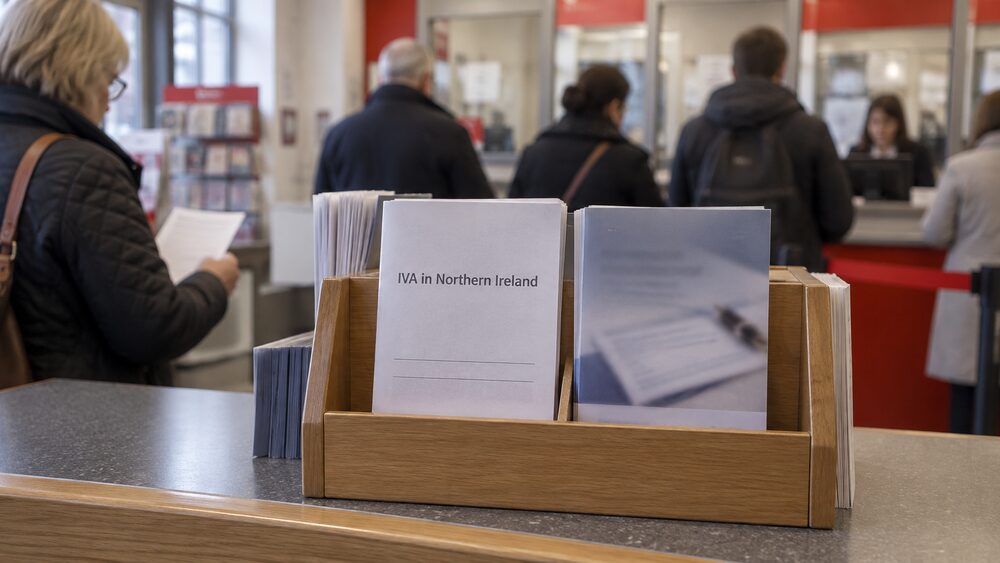
Yes. An individual voluntary arrangement (IVA) is available in Northern Ireland, and it is the most common formal personal insolvency procedure there. In June 2026 there were 136 IVAs in Northern Ireland, alongside 20 bankruptcies and 33 debt relief orders (DROs)1. In August 2026 the figures were 117 IVAs, 16 DROs and seven bankruptcies2.
Yes. An individual voluntary arrangement (IVA) is available in Northern Ireland, and it is the most common formal personal insolvency procedure there. In June 2026 there were 136 IVAs in Northern Ireland, alongside 20 bankruptcies and 33 debt relief orders (DROs)1. In August 2026 the figures were 117 IVAs, 16 DROs and seven bankruptcies2.
An IVA is a legally binding agreement with the people you owe money to. You make payments, usually monthly, over a set period, and at the end the remaining debt covered by the arrangement is written off. It is one of three formal routes open to Northern Ireland residents, and it sits alongside informal options such as payment arrangements and debt management plans.
The practical question is rarely whether an IVA exists in Northern Ireland, but whether it is the right route for your circumstances, and where to get free advice before committing. Advice NI runs a free, confidential debt service across Northern Ireland, and its advisers can talk you through every option before you decide anything.
IVAs are available in Northern Ireland
An IVA is available in England, Wales and Northern Ireland3. The Insolvency Service describes the procedures it covers as those "that are available in England, Wales and Northern Ireland"8, and providers of self-employed IVAs confirm the same territorial extent9. Scotland has its own equivalent, the protected trust deed, which is why IVAs are not offered there.
Northern Ireland has its own insolvency framework and its own register. IVAs in Northern Ireland are recorded on the Register of IVAs in Northern Ireland, separate from the Individual Insolvency Register used in England and Wales4. That matters if you are checking whether an IVA has been recorded, or if a lender or employer asks you to prove your position.
The volume of IVAs relative to other procedures is the clearest sign that the route is well established. In June 2026, Northern Ireland recorded 136 IVAs, 20 bankruptcies and 33 DROs1. Two months later, in August 2026, the figures were 117 IVAs, 16 DROs and seven bankruptcies2. IVAs outnumbered both other formal routes in each of those months.
If you want the mechanics of how an IVA works, how payments are set and what happens at the end, the IVAs explained page covers that in detail. What follows here is what is specific to Northern Ireland: the alternatives, the free advice available, and the protection you can get while you decide.
IVAs and the other debt solutions in Northern Ireland
Northern Ireland residents have the same three formal options as people in England and Wales: an IVA, a DRO and bankruptcy. The DRO and the IVA are both available in England, Wales and Northern Ireland10. Bankruptcy in Northern Ireland runs under its own rules, covered on the Bankruptcy in Northern Ireland page.
The three differ mainly in size of debt, what you own, and how long the process lasts.
| Solution | Who it tends to suit | What it involves |
|---|---|---|
| IVA | People with debts and some income or assets who want to avoid bankruptcy | Payments over a set period, then remaining covered debt written off3 |
| DRO | People with low income, few assets and smaller debts | A moratorium, then debts written off, subject to eligibility10 |
| Bankruptcy | People whose debts and circumstances do not fit the other routes | A formal insolvency with a trustee and a discharge process2 |
Alongside the formal routes there are informal options. An informal arrangement with creditors is exactly that: not legally binding, but it can be set up quickly and does not carry the same consequences as a formal procedure11. A debt management plan is another route, and Advice NI advises on debt management plans among a range of debt solutions4.
Which one fits depends on your income, your assets, how much you owe and who you owe it to. That is a calculation, not a rule of thumb, and it is the reason free advice comes before any decision. The debt solutions across the UK page sets the options side by side, and the DROs explained page covers the route most often confused with an IVA.
Getting free debt advice from Advice NI
Advice NI is the main free debt advice provider in Northern Ireland. Its Debt Action service provides free, confidential help and advice for anyone struggling to deal with money and debt4, and it offers debt advice in each council area throughout Northern Ireland5. Its members can provide free, confidential help and advice for anyone struggling to deal with money and debt, covering debt related issues and a range of debt solutions including debt management plans, plus advice on benefits, housing, employment, tax and consumer rights4.
The scale of the service is worth knowing if you are wondering whether it is set up for your kind of problem. In the last year the Advice NI network dealt with over 288,000 enquiries, with over 75% being social security related, generating almost £150 million in unclaimed benefits and entitlements. Its debt service dealt with approximately £46m in debt, with an average debt per client of just over £11,00012.
Free and independent advice about informal arrangements is available from organisations like Advice NI6, and free and independent advice organisations exist more widely, though some financial advisers charge a fee13. There are also free advice services that can help more generally7. If you are weighing up whether to use a free charity or a firm that charges, the free debt charities or fee-charging companies comparison sets out the difference.
Advice NI debt advisers are approved intermediaries who can help apply for Debt Relief Orders on your behalf5. That is a specific legal role, and it means the service can act for you in a DRO application rather than only advising on it.
Breathing Space: 60 days of protection from creditors
Breathing Space is the scheme that pauses creditor action while you get advice and put a plan in place. It gives people legal protections from their creditors for 60 days, with most interest and penalty charges frozen, and enforcement action paused2. The protections cover contact from creditors, enforcement action being taken, and any interest or fees added to the debts15.
Standard breathing space protects people who have problem debt from enforcement action for up to 60 days7. Independent guidance describes the same period as usually 60 days, during which you cannot usually be contacted by creditors6.
If you are in England or Wales and want the detail, including what it does and does not stop, the Breathing Space page covers the 60-day protection, and does Breathing Space stop bailiffs, court action and eviction covers the enforcement question specifically.
Debt help for sole traders and small businesses
An IVA can cover business debts as well as personal ones. It could help you deal with your debts if you are a sole trader or partnership with business or personal creditors, or both, or the director of a limited company with personal debts you cannot afford to pay in full16. Self-employed IVAs are available in England, Wales and Northern Ireland9.
Advice NI runs a Business Debt Service, which is Northern Ireland only17. Its helpline number is the same freephone number, 0800 915 4604, and the email address is advice@adviceni.net4.
There is a separate small claims process in Northern Ireland for smaller debts. It applies where your debt is less than £5,00018. That is a court route for recovering money owed to you, not a debt solution, but it comes up for sole traders chasing unpaid invoices.
For short-term living costs while a business stabilises, the Finance Support Service in Northern Ireland can provide help towards short-term living costs in the form of loans and grants19. The Newly Self-Employed Support Scheme, an extra scheme in Northern Ireland, provided a one-off £3,500 taxable payment to eligible businesses that were ineligible for SEISS20. Both are worth knowing about because business debt rarely arrives alone.
Contacting Advice NI: phone, chat, text and local centres
There are several ways to reach the service, and they have different hours.
| Channel | Detail |
|---|---|
| Freephone | 0800 915 4604, Monday to Friday 9 to 54 |
| advice@adviceni.net4 | |
| Text callback | Text ACTION to 81025 for a call back21 |
| Online chat | Monday to Friday, 10am to 4pm6 |
| Local offices | Offices throughout Northern Ireland, which you can visit or telephone22 |
Advice NI has offices throughout Northern Ireland, which you can visit or telephone for advice22. If you would rather not give your name at first, you can remain anonymous, and advice can be given by telephone, face to face or by email, with creditors contacted on your behalf or through template letters with your permission4.
Advisers will never share any information without consent and will ask permission before adding information to a client record or sharing it with other organisations4. Debt advisers can help you communicate with organisations to work out a payment plan and prioritise your debts23.
If you need advice on employment rights as well as debt, the Labour Relations Agency and Advice NI offer free, confidential and impartial advice on all employment rights issues for residents of Northern Ireland16. Advice NI also offers free, confidential and impartial advice and information to help you manage your money18.
If you need to complain about Advice NI itself, you can contact the service on 0800 915 4604 or email advice@adviceni.net17. Complaints about benefit decisions go elsewhere: for Universal Credit in Northern Ireland the route is NI Direct20, and if you are refused Pension Credit or think it has been calculated wrongly, you can ask the Northern Ireland Pension Centre to look at the decision again and, if still unhappy, appeal to an independent Appeal Tribunal24.
Sources24 cited
- Commentary: monthly insolvency statistics, June 2026 GOV.UK, 2026-06
- Commentary: individual insolvency statistics, August 2026 GOV.UK, 2026-08
- Personal insolvency procedures R3, 2026
- Options for dealing with debt Advice NI, 2026
- Debt relief orders Advice NI, 2026
- Cost of living Advice NI, 2026-09-26
- Existing debt Consumer Council, 2026
- Insolvency Service research into individual voluntary arrangements (IVAs) GOV.UK, 2024-10-17
- A self-employed IVA with PayPlan PayPlan, 2026-04-16
- Writing off credit card debt StepChange, 2026-09-25
- Informal arrangements nidirect, 2025-10-01
- Advice NI response to UC Bill LCM Northern Ireland Assembly, 2026-01
- Money worries Bank of Ireland UK, 2026-09-25
- Free debt advice contacts Which?, 2025-08-26
- Consumer Council PDF Consumer Council, 2026-09-26
- Free debt advice contacts Which?, 2026
- Help and advice on illegal lending Consumer Council, 2026
- Northern Ireland small claims StepChange, 2026-09-25
- Consolidating debts nidirect, 2025-09-11
- Debt advice Shelter Scotland, 2026-01-16
- Consumer protection rights GOV.UK, 2026-09-25
- Move UC common problems Advice NI, 2026
- Debt and mental health Advice NI, 2026
- Applying for Pension Credit nidirect, 2026-07-06






 StepChangeFree debt advice and solutions from a charity
 National DebtlineFree debt advice by phone, webchat and online
 MoneyHelperFree, impartial money and pensions guidance, set up by government
 Citizens AdviceFree advice on money, consumer and legal problems in England and Wales
 Citizens Advice ScotlandFree advice across Scotland