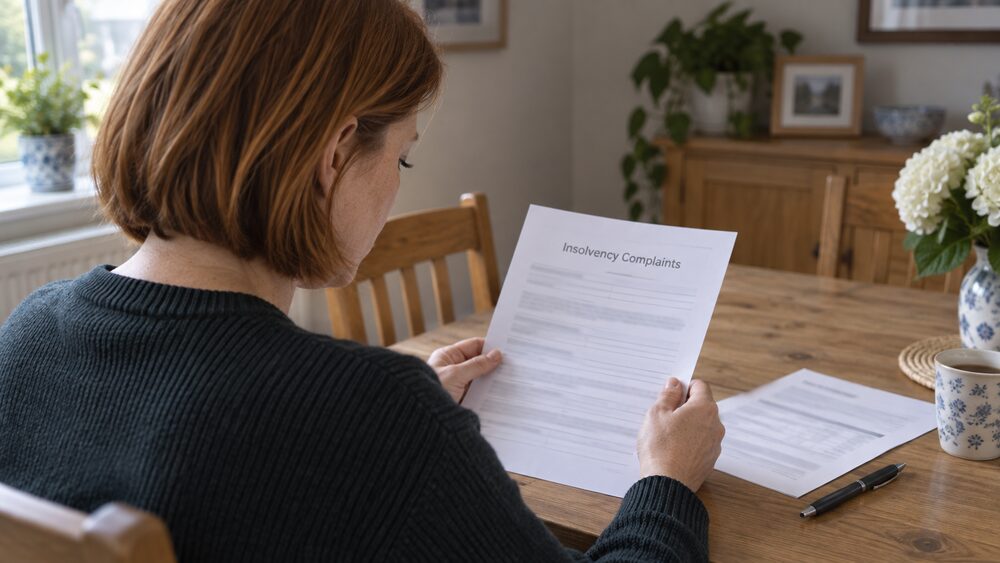
If you are unhappy with how an insolvency practitioner has handled your case, you have a clear route to complain. Start with the practitioner's firm and give it the chance to put things right. If that does not settle it, complaints about an insolvency practitioner's regulated work go through the Insolvency Complaints Gateway, a single online form run by the Insolvency Service that makes sure your complaint is investigated by the right licensing body1.
If you are unhappy with how an insolvency practitioner has handled your case, you have a clear route to complain. Start with the practitioner's firm and give it the chance to put things right. If that does not settle it, complaints about an insolvency practitioner's regulated work go through the Insolvency Complaints Gateway, a single online form run by the Insolvency Service that makes sure your complaint is investigated by the right licensing body1.
An insolvency practitioner is the licensed specialist who oversees formal insolvency procedures. Apart from the government's Official Receiver, only licensed insolvency practitioners are allowed to oversee UK insolvency procedures2. They supervise individual voluntary arrangements (IVAs), act as trustee in bankruptcy, and manage other arrangements, so the person handling your case is regulated and answerable to a professional body.
That matters because it gives you somewhere to go beyond the firm itself. This page sets out who to complain to, how the Gateway works, how the right licensing body is chosen, what to do about an IVA supervisor or a bankruptcy trustee, and where the route differs in Scotland.
Complain to the insolvency practitioner's firm first
Every complaint route in UK financial services starts in the same place: with the organisation you are unhappy about. The Financial Ombudsman Service tells consumers to complain to the company involved first, because it needs the chance to put things right1. The same principle applies to insolvency. Before you escalate, write to your insolvency practitioner explaining the problem or grievance, and write to the practitioner's regulatory body only if you do not like their response3.
A useful complaint is specific. Set out what went wrong from your perspective, give dates, name the people you spoke to, and say how you would like the problem resolved. Put "Complaint" at the top so it is logged as a formal complaint rather than a general query1. Keep a copy of everything you send and note when you sent it.
Insolvency practitioners' reports about their cases are filed with Companies House and are publicly available, so the record of what was said about your case can be checked4. That can help you pin down exactly what you are disputing.
If the firm cannot settle your complaint, you can complain to the regulatory body that licenses its insolvency practitioners5. The Gateway, described below, is the single route that gets your complaint to that body.
The Insolvency Complaints Gateway: how to complain online
Any complaints about the work of an insolvency practitioner should be made via the Insolvency Complaints Gateway, which ensures complaints are investigated by the right recognised professional body2. The Gateway is operated by the Insolvency Service, and complaints should be made firstly to this single Gateway rather than to individual bodies1.
To use it, complete and submit the online complaint form. If you cannot access the form, you can contact the Insolvency Service Enquiry Line at insolvency.enquiryline@insolvency.gov.uk or call 0300 678 00151. There is no charge for complaining this way.
The Gateway is not open to everything. It cannot consider disagreements with decisions in insolvency cases, commercial or legal disputes, complaints that are not about an insolvency practitioner, non-insolvency work, matters more than three years old, complaints about Official Receiver or Insolvency Service staff, or matters that have already been complained about to the Accountant in Bankruptcy in Scotland1. If your complaint falls into one of those categories, the Gateway will not take it forward, and you will need the route that fits instead.
Who licenses insolvency practitioners in the UK?
Only licensed insolvency practitioners, apart from the government's Official Receiver, are allowed to oversee UK insolvency procedures2. To obtain a licence, insolvency practitioners must first pass a set of demanding exams called the Joint Insolvency Examination Board exams and be required by their regulator to have a certain level of insolvency experience2.
Licences are issued by recognised professional bodies. The work of these bodies is overseen by the government's Insolvency Service, and the Insolvency Service may also apply sanctions to an insolvency practitioner directly2. Regulation for insolvency practitioners is set by the Insolvency Service4.
That structure explains how the Gateway chooses who investigates. Because each practitioner is licensed by one recognised professional body, the Gateway can send your complaint to the body that actually holds that practitioner's licence, rather than you having to work out which one it is2.
There is a further layer. If you are unhappy with how a recognised professional body handled your complaint, you can raise it with the Insolvency Service, but only after that body has completed its investigation and you have used all the steps in its process to challenge the outcome1. Some bodies can only investigate insolvency-related complaints that are referred to them by the Insolvency Service6.
Complaints about an IVA supervisor or bankruptcy trustee
An IVA is supervised by a licensed insolvency practitioner7. Once your IVA is approved, the practitioner becomes the Supervisor: they review your IVA at least once a year, collect and pass on your payments, and make sure you stick to the terms of the IVA8. Payments are managed by an insolvency practitioner, and you make regular payments to them, which they share out between your creditors as agreed in your IVA9.
Because the supervisor is an insolvency practitioner, a complaint about how your IVA is being run follows the same route: the firm first, then the Gateway. If the firm cannot settle it, you can complain to the regulatory body that licenses its insolvency practitioners5.
Bankruptcy works differently depending on who is acting. Where the trustee is a private insolvency practitioner and the issues cannot be resolved by speaking to them, the route is to contact their governing body10. Where misconduct is suspected before a person was made bankrupt, the complaint goes to the official receiver handling the insolvency11. Suspected illegal working as a company director is reported to the Insolvency Service11.
One limit is worth knowing. If you are insolvent, the Financial Ombudsman Service may say that any compensation from your complaint should be paid to the trustee or practitioner of your insolvency arrangement rather than to you directly12. That does not stop you complaining, but it can change where any money ends up.
Does the Insolvency Complaints Gateway cover Scotland?
No. Insolvency and bankruptcy in Scotland are handled under different rules, and there is different guidance for Scotland13. The Gateway cannot consider matters that have already been complained about to the Accountant in Bankruptcy in Scotland1.
In Scotland, if you are unhappy with how your case is being managed, you can talk to your trustee or make a complaint to the Accountant in Bankruptcy14. The same route applies to bankruptcy in Scotland: make a complaint to Accountant in Bankruptcy15.
So the split is straightforward. If your case is being handled in Scotland, the Accountant in Bankruptcy is the body to approach, not the Insolvency Complaints Gateway. If your case is elsewhere in the UK, the Gateway is the route. This is one of the areas where the rules genuinely differ between nations, and it is worth checking which applies to you before you send anything.
Example: complaining about a StepChange IVA
StepChange is a well-known debt charity, and its IVA service shows how the complaint route works in practice. StepChange Voluntary Arrangements is a registered trading name of a wholly owned subsidiary of StepChange Debt Charity8. Its insolvency practitioners, Clare Lindley and James O'Carroll, are licensed to act as insolvency practitioners in the UK by the Insolvency Practitioners Association8.
On fees, StepChange does not charge for advice, but you make payments to your insolvency practitioner once your IVA is in progress16. Its IVA fees come out of the agreed monthly payment, with no charge on top and no up-front fees17. All the money it makes from IVAs is "gift aided" back to the charity, so it states that it does not make a profit from them17. For the last five years, 85% of the people who have had an IVA with StepChange have successfully completed it and become debt free17.
If you are unhappy with a StepChange IVA, the route is the same as any other. Any complaints about the insolvency practitioner's regulated work should be completed online at gov.uk/complain-about-insolvency-practitioner, and if the complaint is not settled you can complain to the regulatory body that licenses the insolvency practitioners6. StepChange itself says that if it is unable to settle your complaint, you may complain to the regulatory body that licenses its insolvency practitioners5.
What can I do if the firm cannot settle my complaint?
If the firm cannot settle your complaint, the next step is the regulatory body that licenses its insolvency practitioners5. The Insolvency Complaints Gateway is the single route that gets your complaint to the right body, so you do not have to identify the licensing body yourself2.
If you remain dissatisfied after that body has investigated, you can raise concerns about the body itself with the Insolvency Service, but only once the body has completed its investigation and you have used all the steps in its process to challenge the outcome1. That is the top of the ladder for a complaint about an insolvency practitioner's regulated work.
Where a complaint is about a decision in your case rather than the practitioner's conduct, the Gateway will not take it, because it cannot consider disagreements with decisions in insolvency cases or commercial or legal disputes1. Those are matters for the court process or the insolvency regime itself, not the complaints route.
Free, impartial help is available if you are unsure where to start. The Insolvency Service publishes guidance on getting help with insolvency13, and free debt advice charities can explain how a complaint fits with the rest of your case. If your complaint is about a debt solution more broadly, our guide to debt solutions across the UK sets out how the different options work, and free debt advice explains where to get it.
Sources17 cited
- Insolvency practitioners: guidance on how to complain about an insolvency practitioner GOV.UK, 2025-12-23
- What is an insolvency practitioner? R3, 2026-07-20
- IVA and the insolvency practitioner StepChange, 2026-09-25
- What is an insolvency practitioner? R3, 2026-09-26
- Paying your IVA StepChange, 2026-09-25
- Sending documents for your IVA StepChange, 2026-09-25
- Individual insolvencies, August 2026 GOV.UK, 2026-09-18
- IVA companies StepChange, 2026-09-26
- What is an IVA? StepChange, 2026-09-25
- What if I am unhappy with the way my bankruptcy is being managed Accountant in Bankruptcy, 2026
- Complain about someone bankrupt GOV.UK, 2026-09-27
- Compensation Financial Ombudsman Service, 2026-04-01
- Get help with the Insolvency Service GOV.UK, 2026-09-27
- Not happy with how your case is being managed Accountant in Bankruptcy, 2026-07-15
- Bankruptcy information document Accountant in Bankruptcy, 2026
- IVA tips StepChange, 2026-09-25
- Individual voluntary arrangement StepChange, 2026-09-25







 StepChangeFree debt advice and solutions from a charity
 National DebtlineFree debt advice by phone, webchat and online
 MoneyHelperFree, impartial money and pensions guidance, set up by government
 Citizens AdviceFree advice on money, consumer and legal problems in England and Wales
 Citizens Advice ScotlandFree advice across Scotland