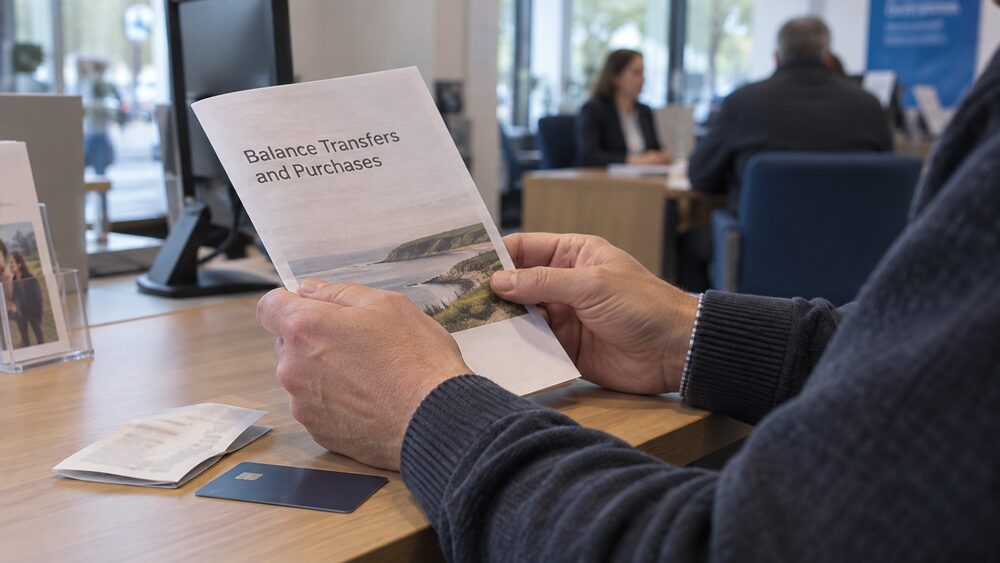
A balance transfer card can give you a long interest-free run on debt you move across from another card. That deal normally covers only the transferred balance. New purchases you make on the same card are usually charged interest at the standard purchase rate, and that interest can start from the day each transaction appears on your account if you do not clear the whole balance.
A balance transfer card can give you a long interest-free run on debt you move across from another card. That deal normally covers only the transferred balance. New purchases you make on the same card are usually charged interest at the standard purchase rate, and that interest can start from the day each transaction appears on your account if you do not clear the whole balance.
The trap is that the two offers run on different clocks. The interest-free period for purchases is typically much shorter than the interest-free period for balance transfers1. So a card advertising a long 0% run on transfers can still charge interest on a coffee bought on the same plastic.
There is also a fee for moving the debt. Most cards charge a fee for a balance transfer and this fee is added onto your balance2. Typical figures run from around 2% to around 5% depending on the card, and the longest 0% deals often carry the higher end of that range.
Purchases on a balance transfer card can be charged interest
A balance transfer card lets you move an existing card balance onto a new card that offers 0% interest on that balance for a fixed period, usually for a fee8. The promotional rate attaches to the debt you moved. It does not attach to the card as a whole.
That distinction is where most of the cost sits. Interest on any new purchases you make will quickly add up during the introductory period6. The reason is mechanical rather than punitive: card providers can apply different rates to purchases, balance transfers, money transfers and cash transactions, and they do9. A card can therefore carry a 0% rate on one balance and a standard rate on another at the same time.
If you pay off the whole amount owed on the card by the due date, you will not be charged interest on your purchases7. That is the ordinary credit card rule, and it still applies on a balance transfer card. The difficulty is that "the whole amount" means the entire balance, including the transferred debt. Paying only the transferred portion, or only the minimum, leaves a purchase balance outstanding, and interest on purchases is then charged from the day the transaction appears on your account rather than from the statement date10.
The Financial Conduct Authority found that of consumers looking for a balance transfer card, only 20% of respondents stated that they considered both the introductory offer on balance transfers and the balance transfer fee11. The purchase rate is a third term that gets less attention still.
Balance transfer fees: typically around 3% to 3.5%
Moving the debt is rarely free. Most credit card providers charge 2% to 3% of the amount you are transferring as a one-off fee12, and independent guidance puts the typical figure at around 3%3. Some cards do not charge a fee at all, but others charge up to 5% for each balance transfer5.
The fee is usually added to your balance rather than billed separately, so it becomes part of what you owe2. On a £2,000 balance with a 3% fee, that is a £60 transfer fee13. Nationwide states that interest is charged on the balance transfer fee from the day it is applied, at the balance transfer rate you applied for14, which means the fee itself can sit outside the interest-free part of the deal.
| What the source describes | Figure | Source |
|---|---|---|
| Typical fee on most cards | around 3% | 3 |
| Most providers | 2% to 3% of the amount transferred | 12 |
| Range across cards | some free, others up to 5% per transfer | 5 |
| Longest 0% deals | typically around 3% to 3.5% | 4 |
| Average fee on fee-charging cards, February 2023 | 2.65% | 5 |
| Average fee on cards with the longest interest-free periods, February 2024 | 3.38% | 15 |
The averages have moved around. The average fee for transferring a balance to a fee-charging card was 2.65% in February 2023, compared with 2.42% the year before5. By February 2024 the average balance transfer fee for cards with the longest interest-free periods was 3.38%, up from 2.97% in February 202315. The FCA recorded the median balance transfer fee dropping from around 3% to 2.7% in the second half of 201416, a reminder that these figures shift with the market rather than being fixed.
Some cards set a floor as well as a percentage. Nationwide's Select Credit Card charges 2.4% of the amount of each balance transfer, with a minimum of £517, and the M&S Rewards Credit Card charges 3.49% with a minimum of £518. On a small transfer the minimum can outweigh the percentage.
Avoiding interest on new purchases
The cleanest way to keep the two apart is not to spend on the transfer card at all. If you do spend on it, the rule is unforgiving: to avoid standard interest you need to pay your full balance, excluding any promotional balances, each month, or interest is charged on new purchases from the day the transaction appears on your account10.
That wording matters. The promotional balance is carved out of the calculation, so clearing the transferred debt does not clear the purchase debt. You have to clear the purchase side in full, every month, on top of whatever you are paying down on the transfer.
A separate card for everyday spending, repaid in full each month, keeps the two balances from mixing. So does a debit card. The point is not which card is better; it is that a 0% transferred balance and an interest-bearing purchase balance behave differently and are easier to manage when they are not on the same statement.
There is a wider reason to be careful. Moving the debt to a card with low or 0% interest could help you pay off the debt faster12, but only if the money that would have gone on interest goes to the principal instead. New spending on the same card works against that, because it adds a fresh balance that the promotional rate does not cover.
Why a small purchase can trigger a charge
A purchase does not have to be large to cost money. Because interest on purchases runs from the transaction date when the balance is not cleared in full, a modest amount left outstanding can attract a charge for the whole period it is unpaid, not just from the next statement.
The interest-free period on purchases is also shorter than most people assume. Most credit cards offer an interest-free period on what you have bought if you pay off your bill in full20, but that is a conditional promise, not a fixed window. On a balance transfer card the interest-free period for purchases is typically much shorter than the interest-free period for balance transfers1, so the two can end months apart.
Cash withdrawals sit outside all of this. On a balance transfer card you will usually be charged a 3% fee, and you will also pay interest from day one, even if you have a 0% interest offer19. The same applies on other cards in the same range21. There is no interest-free window on cash.
When the interest-free period ends
The interest-free period only lasts for a certain amount of time, usually six to nine months on standard deals6. Longer promotional periods exist, and the Bank of England's Credit Conditions Survey for 2026 Q1 found that the length of interest-free periods on credit cards for balance transfers increased in Q1, and was expected to increase further in Q222.
When the period ends, whatever is left on the card starts to attract interest at the standard rate. If you have not cleared the card balance by the end of the offer period, you will have to start paying interest on it23. The purchase balance and the transferred balance may reach that point at different times, and the purchase side usually gets there first.
The practical question is what happens to anything still owing. On a card where the promotional rate has expired, the standard rate applies to the remaining balance, and the cost of that balance then depends on how quickly it is repaid. Paying more than the minimum shortens that tail; paying only the minimum stretches it.
If the debt is proving hard to clear, free and impartial help is available. StepChange, Citizens Advice and Business Debtline all offer guidance on credit card debt and debt consolidation, and Macmillan's money pages cover the options for people affected by cancer. In Scotland, Citizens Advice Scotland publishes the same cost and charge guidance for Scottish consumers24.
Where the protection sits
A balance transfer is a credit agreement, so the usual consumer protections apply. If a provider treats you unfairly, the Financial Ombudsman Service can look at a complaint, and firms must follow the FCA's rules on how promotional rates and fees are presented.
What protection does not do is cover the gap between the two offers. No rule requires a provider to extend the 0% rate on a transferred balance to purchases made on the same card, and no rule caps the transfer fee. The fee is a commercial term, disclosed in the summary box and the terms, and it is the borrower's job to weigh it against the interest saved.
That is why the comparison that matters is not "0% or not" but the total cost: the transfer fee, the length of the promotional period, the standard rate that follows, and the purchase rate that applies to anything new you spend. A card with a longer 0% period and a higher fee can cost more than a shorter deal with a lower one, depending on how much you transfer and how fast you repay.
If you are weighing up whether to move a balance at all, the balance transfer credit cards explained page sets out how the deals work, and balance transfer fees: how they are charged covers the fee mechanics in more detail. For the wider picture on how interest is calculated across a card, see how credit card interest is charged.
Sources24 cited
- What is a balance transfer? HSBC, 2026
- Understanding your balance TSB, 2026
- Should I get a credit card? Which?, 2026-09-18
- Average credit card interest hits record high Which?, 2026-05-16
- 8 things you need to know about balance transfer credit cards Which?, 2023-02-06
- Credit cards and debt nidirect, 2025-11-06
- The costs and charges of credit cards Citizens Advice, 2026-09-25
- Applying for credit cards Experian, 2026
- What are interest rates? Halifax, 2026-09-27
- Transfer to bank: balance transfers Barclaycard, 2026
- Credit card market study: final findings report Financial Conduct Authority, 2016-07
- Paying off credit card debt StepChange, 2026-09-25
- Credit card debt StepChange, 2026-09-25
- Credit card interest rates Nationwide, 2026
- Why your credit card could be costing you more in 2024 Which?, 2024-02
- Credit card market study: interim report Financial Conduct Authority, 2014
- Select Credit Card rates and details Nationwide, 2026
- M&S Rewards Credit Card M&S Bank, 2026-09-25
- Purchase and balance transfer card RBS, 2026-09-25
- Credit card interest explained Which?, 2026-09-18
- Balance transfer credit card RBS, 2026-09-25
- Credit Conditions Survey 2026 Q1 Bank of England, 2026
- Balance transfers for new customers Santander, 2026
- The costs and charges of credit cards (Scotland) Citizens Advice Scotland, 2026-09-25








 MoneyHelperFree, impartial money and pensions guidance, set up by government
 StepChangeFree debt advice and solutions from a charity
 National DebtlineFree debt advice by phone, webchat and online
 Financial Ombudsman ServiceFree, independent help when a complaint about a firm is not put right
 Citizens AdviceFree advice on money, consumer and legal problems in England and Wales