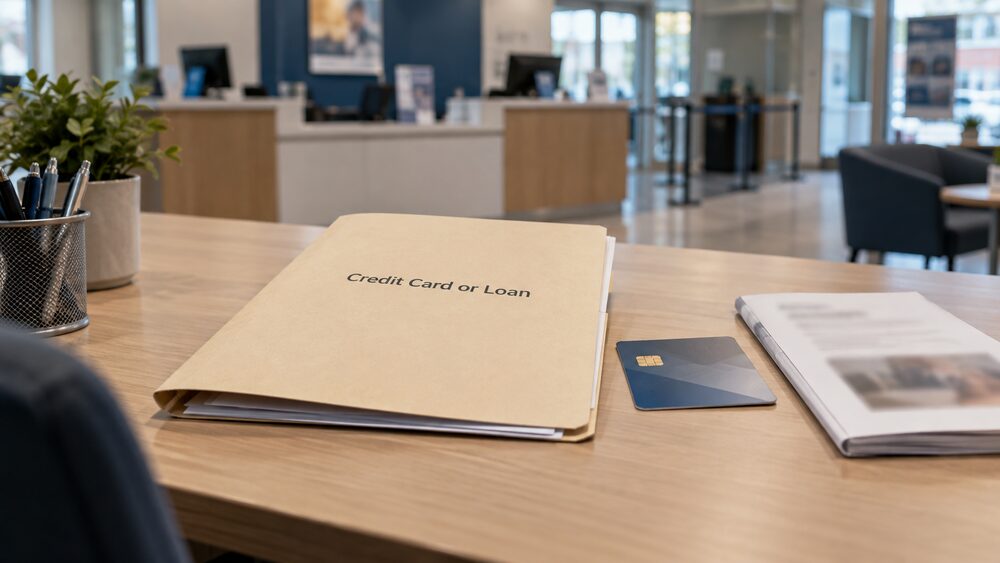
If you need to borrow money, the two routes most people weigh up are a credit card and a personal loan. They behave very differently. A credit card gives you a spending limit you can draw on as you choose, and charges interest on whatever you leave unpaid. A personal loan pays a lump sum into your account, and you repay it in fixed monthly instalments over an agreed term.
The cost gap matters. Credit card interest is usually charged at a higher rate than a personal loan, and the rate you are offered varies between providers1. Official figures put the interest charged on credit card debts at usually as high as 15%2. Certain types of borrowing, including revolving credit on your credit card and payday loans, also charge higher interest than other forms3.
Which one fits depends less on the headline rate than on what you are buying, how long you need the money, and how you would manage if your income changed. A card suits short-term flexibility you can clear quickly. A loan suits a known sum repaid on a fixed schedule. This page sets out how each works, what protects you, and where to get free help if repayments become hard.
Credit cards usually cost more in interest than personal loans
The core difference is how interest is charged. A credit card charges interest on the balance you carry, so the cost depends on how much you leave unpaid and for how long. A personal loan charges interest on the whole sum from the day it is paid out, but at a rate fixed when you take it out.
Credit card interest is not one rate. The amount of interest varies between providers, so it pays to shop around1. Cards also carry different rates for different transactions. There is a purchase rate for buying things, a balance transfer rate for moving what you owe from one card to another, and a cash transaction rate for taking money out of a cash machine or getting cashback at a till8. The interest rate for cash advances is usually higher than the interest rate for purchases9.
Store cards sit in a similar place. The interest charged on a store card can be higher than on bank loans or credit cards, so it is worth checking which is cheaper overall1. Credit union loans are a different option again, but they are often more expensive than personal loans from a bank or building society10.
The practical point is that a credit card only costs you interest on what you do not repay. If you clear the balance in full each month, the borrowing can cost nothing. A loan costs interest on the full amount for the whole term, whether or not you would rather pay it off early. That is why a card can be cheaper for a short gap and a loan cheaper for a planned, longer repayment.
How a credit card works for borrowing
A credit card is a revolving credit facility. You are given a limit, you spend against it, and as you repay, the available credit comes back. Credit cards can be used to buy goods anywhere, including over the phone, online or by post1. You can get one from banks, finance companies and larger supermarket and store chains1.
It is worth being clear about what is not a credit card. Debit cards and prepayment cards are not credit cards: when you buy something on these, you are using money already in your bank account or loaded onto the card1.
Two features shape the cost. First, some credit cards have a credit limit, meaning you will be charged if you go over it4. Second, the minimum repayment each month is set low, which means a balance can take a long time to clear if you only pay the minimum.
When you apply, the provider will check your credit record with a credit reference agency to see if you are credit worthy11. Providers do not have to give you a credit card, and your application may be refused if your credit score is low or you are not eligible11. Your credit file tracks how you use loans, credit cards, bank accounts, mobile phone contracts, car insurance paid in monthly instalments, and some utility companies12.
If you already hold card debt and want to reduce what it costs, the two common routes are taking out a personal or consolidation loan, or transferring your balances onto a low interest credit card13.
How a personal loan works for borrowing
A personal loan is a fixed sum borrowed for a set term, repaid in equal monthly instalments. The rate is agreed when you take it out, so the monthly payment is known from the start. That predictability is the main difference from a card, where the cost depends on how much you leave outstanding.
Personal loans sit within a wider group of borrowing. Loans include personal loans, payday loans and short-term loans14. Payday loans are a distinct, higher-cost form: they charge higher interest than other types of borrowing3.
A common use of a personal loan is consolidation. With a debt consolidation loan, you pay off your creditors with money you borrow, then make monthly payments to pay off the loan instead of your credit cards13. That can simplify several payments into one, but it does not reduce the debt itself, and it moves unsecured card debt into a loan with its own term and rate.
Credit unions are another source of loans. They offer loan products suited to your individual needs and at rates you can easily afford15. They are often more expensive than personal loans from a bank or building society10. If you are weighing up where to borrow, taking out credit from a credit union or getting a loan from a bank are both options to consider for a planned purchase16.
Credit card or personal loan: which fits your borrowing
The choice comes down to the shape of what you are borrowing for, not to a single best answer.
A credit card tends to fit borrowing that is short, flexible and likely to be cleared quickly. Because interest is charged only on what you leave unpaid, a card you clear in full each month costs nothing in interest. It also carries purchase protection that a loan does not, which matters if you are buying goods you might need to return or dispute.
A personal loan tends to fit a known, larger sum repaid over a set period. The fixed instalments make budgeting straightforward, and the rate is agreed upfront. The trade-off is that you pay interest on the full amount for the whole term, and the money is paid to you rather than to a retailer, so it does not carry the same purchase protection.
| Feature | Credit card | Personal loan |
|---|---|---|
| How you receive the money | Spending limit you draw on as needed1 | Lump sum paid to you13 |
| Interest charged on | What you leave unpaid | The full sum for the term |
| Repayment | Minimum set each month, you choose more | Fixed monthly instalments |
| Typical cost | Usually as high as 15% on card debts2 | Rate agreed when you take it out |
| Purchase protection | Section 75 can apply6 | Not the same protection |
There is no rule that says one is right for a given purchase. What matters is whether you can clear the balance before interest builds, and whether a fixed repayment fits your income. If you are unsure whether you can keep up repayments, that uncertainty itself is worth weighing before you borrow.
Protections when you borrow from an FCA-regulated lender
Both credit cards and personal loans sit inside a regulated system, and knowing what that gives you helps you judge a lender before you sign.
Personal loans and credit cards are usually regulated by the Consumer Credit Act4. Any lender regulated by the Consumer Credit Act must complete affordability checks before lending5. Whether a debt is regulated or unregulated can depend on the date you took it out and the amount you borrowed4. Some debts are not regulated at all, including mortgages, debts to family or friends, debts to unlicensed lenders or loan sharks, household bills, debts to local or central Government, some credit union loans, charge cards, and some types of business debt4.
Credit cards specifically are regulated under the Consumer Credit Act 1974, the Payments Services Regulations 2009 and the Financial Conduct Authority's Consumer Credit Sourcebook17. The FCA regulates a wide range of products, including lending money such as credit cards, Buy Now Pay Later, credit broking and debt advice18. Around 36,000 firms are authorised by the FCA with credit permissions, the bulk of which are credit brokers19.
On purchases, paying by credit card can give you extra protection under Section 75 of the Consumer Credit Act, which is why it is often suggested for overseas online retailers6. Buy Now Pay Later purchases carry the same Section 75 protections as a purchase on a credit card for FCA-regulated agreements from 15 July 202620. Credit unions are a partial exception: the FCA's Consumer Credit sourcebook does not apply to most of the loans they provide21, but their loans and savings are protected by the Financial Services Compensation Scheme22.
How to check a lender is authorised
Checking takes a few minutes and is free. Use the FCA's Firm Checker or the Financial Services Register24. Search the firm by name, select 'Borrowing money, including credit card lending and credit information', and check the firm is 'Authorised' with permission to 'Lend you money on an unsecured basis'20. You can also telephone the FCA consumer helpline25.
Payday lenders must be authorised by the Financial Conduct Authority, which publishes a list of licensed lenders on the FCA register7. Credit brokers should also be on the Financial Services Register, which means they are authorised and regulated by the FCA26. The Financial Ombudsman Service suggests using the FCA's Firm Checker to confirm a firm is authorised and help avoid scams27.
If repayments become hard to manage: where to get free help
If you are struggling, the first thing to know is that free, impartial help exists and you do not have to pay for it.
You have the right to complain to your lender if they gave you credit irresponsibly and you are now struggling financially as a result5. That right sits alongside the affordability rules that lenders must follow. The FCA has recommended strengthening creditworthiness and affordability rules to prevent harmful subprime lending to those in, or at significant risk of, financial difficulty28.
If you are unhappy with your lender's response, you can complain to the Financial Ombudsman Service29. Its consumer credit remit covers payday loans, the affordability of lending, and other types of lending30. It also covers debt collection, home credit and catalogue shopping, and other types of lending and borrowing like mortgages31.
Complaint volumes give a sense of how common these disputes are. In the first quarter of 2026/27, the ombudsman opened 5,783 complaints about credit cards and 2,103 about personal loans32. In 2025/26, credit cards were the third most complained about product, with around 22,800 complaints, of which 8,800 were about perceived irresponsible or unaffordable lending33.
Where to get free help
Free, impartial help is available from debt advice charities and public services. StepChange and Citizens Advice both provide debt advice, and the Financial Ombudsman Service handles complaints you cannot resolve with a lender. If you are in Northern Ireland, Consumerline can refer your complaint to the Trading Standards Service for investigation or the Financial Conduct Authority, which authorises lenders34.
If you are dealing with a debt after someone has died, repayment of personal loans, credit cards and credit debt must wait until others have been settled, and if cards are held jointly, any debts will be the joint holder's responsibility35. In Northern Ireland, the Repay and manage benefit money you owe service accepts payment by debit or credit card, though your bank may charge interest if you use a credit card36.
Sources36 cited
- Plastic cards Citizens Advice, 2026
- Review of credit card literature Financial Conduct Authority, 2015
- What do I need to know about debt Bank of England, 2025
- The Consumer Credit Act StepChange, 2026
- Irresponsible lending and affordability checks StepChange, 2026
- I want to return something bought online Which?, 2026
- Payday loans nidirect, 2026
- The costs and charges of credit cards Citizens Advice, 2026
- Credit card debt StepChange, 2026
- Emergency grants, loans and money help Shelter England, 2026
- Choosing and applying for a credit card Citizens Advice, 2026
- Can I avoid my debts StepChange, 2026
- Consolidating credit card debt StepChange, 2026
- Different types of debt Independent Age, 2026
- About credit unions All Together Money, 2026
- Taking out credit Mental Health and Money Advice, 2023
- Credit card market study annex Financial Conduct Authority, 2015
- How to check a firm or individual is authorised Financial Conduct Authority, 2023
- Consumer credit consultation HM Treasury, 2022
- Buy Now Pay Later Financial Conduct Authority, 2026
- Unaffordable lending Financial Ombudsman Service, 2026
- Save, bank or borrow with a credit union Welsh Government, 2026
- Property scam Financial Services Compensation Scheme, 2026
- Check if a firm is authorised Financial Conduct Authority, 2026
- Getting information and help nidirect, 2026
- Credit broking Financial Ombudsman Service, 2026
- Banking and payments Financial Ombudsman Service, 2026
- Subprime credit cards and debt StepChange, 2026
- Other problems Isle of Anglesey County Council, 2025
- Consumer credit complaints Financial Ombudsman Service, 2026
- Credit borrowing and money Financial Ombudsman Service, 2022
- Quarterly complaints data Q1 2026/27 Financial Ombudsman Service, 2026
- Annual complaints data and insight 2025/26 Financial Ombudsman Service, 2025
- Loans nidirect, 2026
- Debt when someone dies nidirect, 2026
- Repay and manage benefit money you owe nidirect, 2026

 MoneyHelperFree, impartial money and pensions guidance, set up by government
 StepChangeFree debt advice and solutions from a charity
 National DebtlineFree debt advice by phone, webchat and online
 Financial Ombudsman ServiceFree, independent help when a complaint about a firm is not put right
 Citizens AdviceFree advice on money, consumer and legal problems in England and Wales