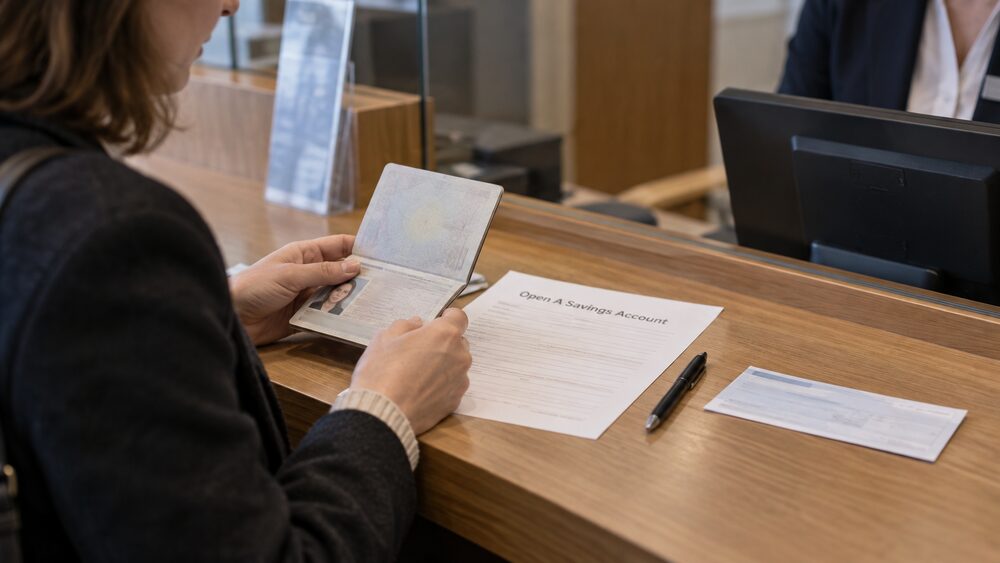
Opening a savings account is usually straightforward: you fill in a short application, prove who you are, and the account is opened within days. NS&I, the government-backed savings provider, aims to open accounts in 7 to 10 working days, and longer only if it needs to ask you for identity documents1. Most high street banks and building societies open simple savings accounts faster than that, often the same day online.
What slows an application down is almost always identity. You will need evidence of who you are, for example a passport or driving licence2, and for some accounts, such as a cash ISA, the provider also needs your national insurance number. Once the account is open, a separate system called Confirmation of Payee checks the name on payments sent to you, processing more than one million requests every day3.
Types of savings account you can open
The first choice is what kind of account you want, because it shapes everything else: how you apply, how quickly you can get your money back, and what the provider has to tell you. The basic idea of a savings account is to keep money you are not spending separate from your day-to-day spending money, so it is not frittered away6. For an emergency fund, debt charities recommend an instant access account, so the money is there the moment you need it7.
The main types you can open are:
- Easy access accounts, where you can withdraw at any time without a penalty
- Notice accounts, where you tell the provider in advance, for example 30, 60 or 120 days
- Fixed-rate bonds, where your money is locked away for a set term in return for a rate that does not change
- Regular savings accounts, for putting aside a set amount each month
- Children's accounts and Junior ISAs, held for a child
- Joint accounts, held with one other person
- Cash ISAs, where interest is free of income tax
Each type is explained in detail in the guide to types of savings account, with separate pages on easy access accounts, notice accounts, fixed-rate bonds and regular savings accounts. If you are saving for a child, see children's savings accounts; if you want to save with someone else, see joint savings accounts.
Where to open one: banks, building societies and credit unions
Savings accounts are offered by high street banks, building societies, credit unions and NS&I, the government's own savings provider. A bank or building society account is also the easiest way to receive payments generally, and most people hold their savings with the same kind of institution8. Budgeting guidance suggests thinking about opening a savings account or joining a credit union as the two main routes for setting money aside9.
Credit unions are member-owned, not-for-profit savings and loans organisations, usually serving a local area, an employer or a community. They tend to accept small regular deposits and are often used by people who want to save a few pounds a week. The credit unions guide explains how they work and how they differ from banks, and how building societies work covers the building society model. If you want to spread money across several providers without opening each account separately, cash savings platforms let you hold accounts with different banks through one service.
Whichever provider you choose, the application process is broadly the same: you fill in an application form, usually in a branch, online, or sometimes over the phone, and provide proof of identity including your full name, date of birth and address10. One point worth knowing before you choose: a cash ISA is an individual account, opened using your national insurance number, and ISAs cannot be held in joint names11. If you want to save jointly, that means an ordinary savings account rather than an ISA.
What you need to apply
The core of any application is proof of identity and proof of address. You will need evidence of who you are, for example a passport or driving licence2, and most providers also ask for something showing your address, such as a recent utility bill or bank statement. Providers run these checks to comply with anti-money-laundering rules, not to credit-check you: opening a savings account does not usually involve a search of your credit file in the way a loan does.
For a cash ISA, the law sets out what the application must contain. The ISA regulations require a declaration giving the applicant's full name, the address of their permanent residence including postcode, their national insurance number or confirmation that they do not have one, and their date of birth12. That is why an ISA application feels longer than an ordinary savings application: the provider is legally obliged to collect those details and to keep a record of them.
Beyond ID, the practical requirements are small. You complete an application form online, in person or by phone13, and for most accounts there is a minimum opening deposit, which varies by provider and account. Before you sign anything, the provider must give you the account's terms, and the summary box on the account page shows the rate, the minimum deposit and the withdrawal rules at a glance.
Opening online, by post or in a branch
How you can apply depends on the provider and the account. Suffolk Building Society, for example, says its savings accounts can be opened in branch, by post, by email or online, depending on the account you choose14. Online-only accounts are usually the quickest to open, because the identity checks run automatically against electronic records; postal applications take longer because documents have to be sent and returned.
Some accounts are restricted to one channel. NS&I's Junior ISA, for example, can only be applied for online, with at least £1 paid by debit card from a UK bank, and NS&I aims to open the account in 7 to 10 working days after identity checks15. Its Direct ISA follows the same 7 to 10 working day timescale16, and NS&I states that the minimum age for opening a cash ISA has increased from 16 to 1816.
If you apply by post, check the account terms for any deadline by which the opening deposit must be paid, because some providers close an application if no money arrives within a set period. If you apply in a branch, take original ID documents rather than copies, and expect the provider to keep a record of what it checked.
How long the account takes to open, and the name check behind it
Opening times vary by provider and by how easily your identity can be verified electronically. NS&I's published timescale across its savings products is 7 to 10 working days, and it states this can take longer if it needs to ask you for identity documents1. If your name or address has changed recently, or you are not on the electoral roll at your current address, expect the checks to take longer.
Once the account is open, a different check comes into play when money moves. Confirmation of Payee, launched in 2020, is the service banks use to check that the name and account type you enter when setting up a new payee matches the details registered with the bank receiving the money, and a warning is shown before you make the payment if the details do not match18. The Payment Systems Regulator reports there are currently more than one million CoP requests every day3.
When someone sets up a payment to your new savings account, their bank will tell them whether the details are a match, a partial match or no match19. A partial match means the account is registered to someone with a similar, but not exactly the same, name, and the payer's bank will show them the actual name to check19. For joint accounts, the payer only needs to use the full name of one of the account holders19.
One detail matters for savings accounts specifically. Accounts associated with a linked or nominated account, which is how many savings accounts are structured, need only to implement the "respond" capability and are not required to send checks themselves20. In practice that means the name on your savings account can be checked when money arrives, but payments out of it to new payees may not always trigger the same check in the other direction.
Paying money in: use your name exactly as it appears on the account
The single most common snag with a new savings account is a payment that will not go through because the name does not match. Confirmation of Payee covers CHAPS, Faster Payments and standing orders19, and it works by checking whether the name of the account the payer is sending money to matches the name they have entered, alerting the payer when there has not been a match21. If you have recently married, use a middle name inconsistently, or hold the account in a shortened form of your name, payments set up with a different version of your name can produce a "no match" warning.
The consequences of getting it wrong are set out plainly by providers: if you make a payment using the wrong details, it might not reach the correct account and you may not be able to recover the money19. So when you tell someone how to pay you, give the name exactly as it appears on the account, plus the sort code and account number.
A few structural points affect how you pay money in:
- Many savings accounts are funded from a nominated current account, and some restrict withdrawals to that same account20
- An ordinary savings account can usually be held in your own name or jointly with one other person1
- A cash ISA cannot be joint: it is opened using your national insurance number and held in one name only11
If a payment goes to the wrong account despite the checks, the guide to getting money back sent to the wrong account and the wider money transfers guide set out what to do.
Rates change and account issues close
When a savings account is opened, the provider has to give more than a welcome letter. For current, basic and instant access savings accounts, the terms and conditions, the interest rates, details of all charges, how information will be given, any spending limits, and what to do if things go wrong are also given22. These documents are the reference for everything that happens later.
Variable rates can change at any time, and providers give notice in the way the terms describe. The page on when a savings provider changes your rate explains how much notice you are entitled to and how to respond, and how interest rates are quoted explains AER, gross and fixed rates. Some accounts carry a bonus rate for an introductory period, covered in bonus rates and promotions.
Accounts with issue numbers are versions of a product, and an issue closes when the provider withdraws it from sale. If you hold a closed issue you keep the account, but new savers cannot open it, and the rate on your issue can still move. Fixed-term accounts end on a set date, and the guide to what happens when a fixed-rate account matures covers your options. One edge case is worth knowing: if the account holder dies, money in a fixed-term account that has not matured can still be closed immediately, with interest paid up to the date of death23.
Cash ISA limits are changing for people aged 18 to 64
Two rule changes affect anyone opening a cash ISA, and both are worth checking before you apply. The first has already happened: from 6 April 2024, the minimum age for opening a cash ISA increased from 16 to 18, except for individuals who were 16 or 17 on 5 April 2024 and had not since turned 18, who can continue to hold, apply for or transfer a single cash ISA5. The transitional arrangements that permitted 16 and 17 year olds to open a new cash ISA ended on 5 April 202624.
The second change is on the way. The government is reducing the annual cash ISA subscription limit to £12,000 for individuals aged under 65, from 6 April 202725. The legislation amends the Individual Savings Account Regulations 1998 and sets the limit at £12,000 per tax year in any year in which a qualifying individual is 64 or under at the end of that year26. The £12,000 cash limit sits within the overall annual ISA limit of £20,000, which is unchanged27. The same legislation also provides that transfers from a stocks and shares ISA or an innovative finance ISA to a cash ISA are prohibited where the account holder is below the age of 6528.
In practice, if you are under 65 and planning to put more than £12,000 into cash ISAs, the 2027 to 2028 tax year is the first one affected. The comparison of cash ISAs against ordinary savings explains when the ISA wrapper matters for your tax position, and how tax on savings interest works covers the allowances outside an ISA.
When an application can be refused
Providers can refuse to open an account, and the reasons are usually about identity or past conduct rather than your savings. If you are bankrupt or have a record of fraud, you will not usually be allowed to open a bank account, and a poor credit rating may lead to refusal for a current account22. For savings accounts the checks are lighter, but a provider that cannot verify your identity will not open the account until you supply documents.
Some accounts have eligibility rules of their own. Help to Save, the government-backed account with a bonus for people on low incomes, has had restrictive rules: earlier regulations did not allow individuals receiving Universal Credit to open an account if their weekly household or individual earnings were less than the equivalent of 16 hours a week at the national living wage rate30. The Help to Save guide sets out the current eligibility conditions.
If a provider refuses you, ask for the reason in writing. If you believe the refusal was wrong, you can complain to the provider and then to the Financial Ombudsman Service, and consumer protection in UK financial services explains that route.
Where the name check does not protect you, and where to get help
Confirmation of Payee is a strong protection, but it has edges. It covers CHAPS, Faster Payments and standing orders19, which are UK payment types. Payments from outside the UK do not pass through the service, so an international transfer into your savings account will not produce a match, partial match or no match response for the sender. Bulk payment file submissions, unattended payments and any payments processed when the customer is not present are also out of scope of the rules20.
You can also switch the check off. Some providers allow you to opt out of Confirmation of Payee for incoming payments by contacting them, but if you do, anyone who tries to pay you will get a message saying your details cannot be checked, which may prevent the payment entirely. New accounts you open afterwards are not automatically opted out, and switching to another provider means contacting the new provider about opting out there19.
The check is one tool against scams, not a guarantee. The regulator describes Confirmation of Payee as one important tool for preventing authorised push payment scams, where a victim is tricked into sending money themselves21. Since 2024, rules from the Payment Systems Regulator require reimbursement of victims of APP scams in many cases, with the details set out in its policy statement32. If you have been scammed, contact your bank immediately and report it; the scams and fraud guide covers the steps, and free, impartial help is available from MoneyHelper.
Child Trust Funds: an account that may already exist
If you were born between 1 September 2002 and the end of the Child Trust Fund scheme, you may already have a savings account you did not know about. A Child Trust Fund is a tax-free savings account created by the government for children born in that period, and if your parent or guardian did not set one up for you, the government automatically opened one33. The accounts mature when the child turns 18, and the money belongs to the young person, not the parent.
The scale of unclaimed money is large. Between September 2020, when the oldest children turned 18, and April 2024, around 2,333,000 accounts matured in total, of which around 1,662,000 were claimed or automatically transferred34. Around a further 415,000 accounts matured during the tax year 2025 to 2026 and were claimed or automatically transferred, bringing the total claimed or automatically transferred to an ISA to around 2,958,000 as of April 202635.
To find one, use the government's free Child Trust Fund finder tool on gov.uk33. If you are, or know someone who is, between the ages of 16 and 18, MoneyHelper has information about tracing and taking control of an account before it matures36. Once found, the money can be withdrawn or transferred into an ISA. The NS&I accounts guide covers the government-backed provider that holds some of these accounts, and tracing lost NS&I savings covers other lost government savings.
Sources36 cited
- NS&I Direct Saver NS&I, 2026-09-04
- Education Maintenance Allowance: how do I claim Turn2us, 2026-09-26
- Extending Confirmation of Payee coverage Payment Systems Regulator, 2026-09-26
- Tax-free Savings Newsletter 19, November 2025 HM Revenue and Customs, 2025-11
- The Individual Savings Account (Amendment) Regulations 2024 legislation.gov.uk, 2024-04-06
- Budgeting and saving money Mencap, 2026
- How to save for an emergency StepChange Debt Charity, 2026-09-25
- What to do now your Post Office card account is closing MoneyHelper, 2026-09-25
- Your business and household budget Business Debtline, 2026-09-26
- Getting a bank account (Scotland) Citizens Advice Scotland, 2026-09-26
- Savings accounts Consumer Council Northern Ireland, 2026
- Individual Savings Account Regulations 1998 legislation.gov.uk, 1998-07-31
- Managing your own money Scope, 2025-08-18
- Open a savings account Suffolk Building Society, 2026-08-25
- NS&I Junior ISA NS&I, 2026-09-24
- NS&I Direct ISA NS&I, 2026-09-04
- Savings accounts Hodge Bank, 2026-08-11
- How do I get money back that I've sent to the wrong account? Which?, 2026-07-30
- Confirmation of Payee Metro Bank, 2026-09-25
- Extending Confirmation of Payee coverage, policy statement PS22/3 Payment Systems Regulator, 2022-10
- Confirmation of Payee: response to the first consultation Payment Systems Regulator, 2026-09-26
- Getting a bank account Citizens Advice, 2026-09-25
- More families risk paying inheritance tax on savings Which?, 2025-08-16
- CTF and JISA FAQs TISA, 2025-10-20
- Cash Individual Savings Account (ISA) limit reduction HM Revenue and Customs, 2026-09-17
- The Individual Savings Account (Amendment) Regulations 2026 legislation.gov.uk, 2026
- Budget 2025: summary of key announcements House of Lords Library, 2025-11-26
- The Individual Savings Account (Amendment) Regulations 2026: draft legislation HM Revenue and Customs, 2026-07-16
- Reduction in the cash ISA limit HM Treasury, 2026-09-17
- Help-to-Save Accounts Regulations: amendment legislation.gov.uk, 2025
- Five ways to save before Christmas Money and Pensions Service, 2026-09-16
- App scams reimbursement: policy statement PS23/4 Payment Systems Regulator, 2023-12
- Child Trust Fund guide NS&I, 2026-09-18
- Annual Savings Statistics 2024 commentary HM Revenue and Customs, 2024-09
- Annual Savings Statistics 2026 commentary HM Revenue and Customs, 2026-04
- Five simple ways to boost your savings Money and Pensions Service, 2025-09-22



 MoneyHelperFree, impartial money and pensions guidance, set up by government
 FSCSProtects your money if a bank, insurer or investment firm fails
 Financial Ombudsman ServiceFree, independent help when a complaint about a firm is not put right
 Citizens AdviceFree advice on money, consumer and legal problems in England and Wales
 GOV.UKOfficial information on tax, benefits and government services