Most people in the UK do not pay any tax on their savings interest. Interest counts as income for Income Tax purposes, but two allowances shield most of it: the personal savings allowance, which lets basic rate taxpayers earn £1,000 of interest a year tax-free and higher rate taxpayers £500, and the starting rate for savings, which is 0%1. On top of that, interest from ISAs and some National Savings products is tax-free altogether and never counts towards your allowances2.
If your interest does exceed your allowances, you pay tax on the excess at your usual rate of Income Tax1. You rarely have to calculate or send this yourself: after the tax year ends, your bank or building society tells HMRC how much interest you earned, and HMRC collects what you owe through your tax code or a Simple Assessment letter1. The only people who must act directly are those with savings interest of more than £10,000, who need to report it on a Self Assessment tax return1.
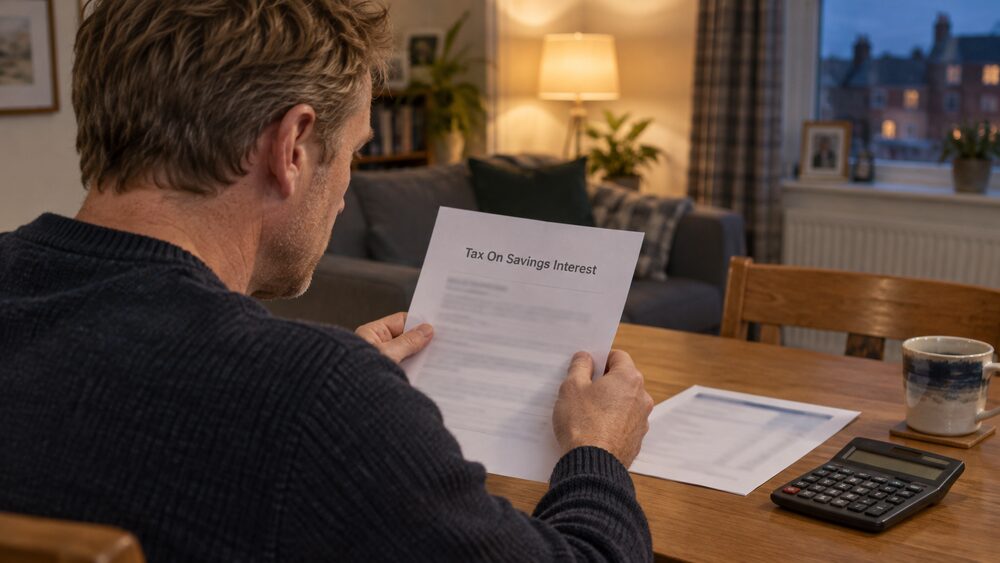
Interest over your allowance is taxed at your usual Income Tax rate
Savings interest is taxable income. HMRC's guidance is straightforward on the point: "You pay tax on any interest over your allowance at your usual rate of Income Tax"1. Interest on savings over your savings allowance is listed among the things you pay Income Tax on, alongside wages, most pensions and rental income2. If your overall taxable income is more than your tax-free allowances, you are taxed at the usual Income Tax rates on the difference2.
What saves most people from a bill is the layering of allowances. The first slice of any income is covered by the Personal Allowance, which is £12,570 for the 2026 to 2027 tax year3. Interest is then covered by the starting rate for savings, charged at 0% under ITA07/S74, and by the personal savings allowance of £1,000 for basic rate taxpayers or £500 for higher rate taxpayers, introduced by HMRC in 20161. Only interest above all of that is taxed.
Not all savings income counts at all. Income from tax-exempt accounts, such as ISAs and National Savings Certificates, is free of Income Tax, as are Premium Bond and National Lottery wins2. NS&I states the position plainly for its Direct ISA: "The interest you earn is tax-free, so it won't count towards your Personal Savings Allowance"8. The same principle applies to any cash ISA: the interest never enters the tax calculation, which is why savers with large balances often compare a cash ISA with an ordinary savings account before choosing where to put money.
The allowances apply per person, not per account. Interest across all your accounts, at all banks and building societies, is added together, so spreading money between providers does not reduce the tax due. Joint account interest is split between the holders for tax purposes, which is covered in more detail in the guide to joint savings accounts.
Income Tax bands and rates that apply to savings interest
The rate you pay on taxable savings interest depends on which band your total income falls into. For the 2026 to 2027 tax year, the main Income Tax bands are: basic rate of 20% on income from £12,571 to £50,270, higher rate of 40% on income from £50,271 to £125,140, and additional rate of 45% above £125,1403. These figures sit on top of the £12,570 Personal Allowance3.
Savings interest has its own set of rates within this structure. Section 11D of the Income Tax Act 2007 charges income tax at the savings basic rate on income that is saving income and would otherwise be charged at the basic rate, at the savings higher rate on saving income that would otherwise be charged at the higher rate, and at the savings additional rate on saving income that would otherwise be charged at the additional rate9. For the 2026 to 2027 tax year, the savings basic rate is 20%5, matching the main basic rate.
| Band | Main Income Tax rate, 2026 to 2027 | What it means for savings interest |
|---|---|---|
| Basic rate, £12,571 to £50,270 | 20%3 | £1,000 of interest tax-free, then 20% on the rest1 |
| Higher rate, £50,271 to £125,140 | 40%3 | £500 of interest tax-free, then 40% on the rest1 |
| Additional rate, above £125,140 | 45%3 | No personal savings allowance, 45% on taxable interest1 |
The starting rate for savings adds a further 0% band for people on low incomes, defined in the legislation at ITA07/S18 and charged at 0%4. The guide to the starting rate for savings explains how it interacts with the personal savings allowance, and the guide to the personal savings allowance covers the £1,000 and £500 limits in full.
Scottish taxpayers need to take care here. Scottish Income Tax bands differ from those in the rest of the UK, and HMRC warns that people who move to or from Scotland and do not tell HMRC "may pay tax at the wrong rate"10. The page on tax on savings interest for Scottish taxpayers covers the differences.
How your bank tells HMRC about the interest you earn
You do not normally report savings interest yourself. HMRC's guidance states: "After the end of the tax year, your bank or building society tells HMRC how much interest you earned"1. This applies where your savings interest is £10,000 or less; above that threshold, the reporting duty falls on you through Self Assessment1.
The timing follows the tax year, which runs from 6 April to 5 April1. Once the year closes, your providers pass the interest figures to HMRC, and HMRC works out whether any tax is due. For interest earned in the 2025 to 2026 tax year, HMRC tells you about the tax due in a tax calculation sent during the 2026 to 2027 tax year, and the tax due is usually collected through your tax code in 2027 to 20281.
If your bank or building society tells HMRC that you have more than £10,000 in savings interest, HMRC will send you a notice to file a tax return1. This is the point at which the automatic system hands over to Self Assessment, covered later on this page.
Your provider also has duties to you directly. Under the FCA's banking conduct rules, a firm should inform a banking customer of the current rate of interest that applies to a savings account on the telephone or in a branch, at the customer's request11. Providers issue certificates of interest or annual statements showing how much you earned, which are worth keeping for your records; the guide to certificates of interest and savings tax statements explains what to look for.
Tax code or Simple Assessment: how HMRC collects what you owe
For people who are employed or get a pension, HMRC will usually collect the tax through your tax code1. This means the amount owed is recovered in instalments through your pay or pension across the following tax year, rather than as a single bill. HMRC also uses the tax code to collect any tax you owe from the previous tax year1.
If you do not have a tax code, or it cannot be changed, HMRC may send a Simple Assessment letter instead1. A Simple Assessment is a tax bill, also known as a PA302, that HMRC sends if you did not pay enough tax and they could not collect it through your tax code12. HMRC checks how much tax you have paid using information from employers, pension providers, banks and building societies12. You may get one if you owe Income Tax that cannot be collected through your tax code, and HMRC has highlighted that a common trigger is "there is tax to pay on interest on savings or dividends"13.
The calculations are not sent all at once. HMRC's tax calculations are usually sent between June and the following March after the tax year ends1. In one worked example on GOV.UK, a taxpayer with a £16,000 State Pension and £1,500 of private pension income received a Simple Assessment after the end of the tax year to collect the remaining £236 of tax due12. HMRC has publicly urged customers not to ignore Simple Assessment letters, since the tax they show is a real liability that does not go away13.
Simple Assessment can also apply where you go over your Personal Allowance and have tax to pay on your State Pension, owe Income Tax that cannot be automatically deducted, or owe £3,000 or more14. If a letter arrives, check the figures in it against your own records before paying, and query anything that looks wrong rather than ignoring it.
Why your tax code changes because of savings
A changed tax code after you earn more interest is usually HMRC doing two things at once. First, it collects any tax you owe from the previous tax year1. Second, it adds an estimated amount for the current tax year, based on the interest information your bank or building society gave HMRC for the previous tax year1. The estimate is a forecast, not a bill, and it can be checked and corrected, which the next section covers.
Because the estimate is based on last year's interest, it can be out of date if your circumstances have changed: a fixed-rate bond that matured, a balance that has been spent, or a move into ISAs will all mean the estimate no longer reflects reality. HMRC's guidance notes that the tax year runs from 6 April to 5 April1, so the estimate in your code for one tax year is built on interest earned in the one before.
The practical effect is that tax on savings interest is usually spread across a year of pay or pension payments. For someone with a modest amount of taxable interest, this can be a few pounds a month rather than a lump sum. The trade-off is that your take-home pay or pension drops until the code is corrected, which is why checking the estimate matters.
Checking HMRC's estimate in your Personal Tax Account
You do not have to wait for a letter to see what HMRC thinks you owe. HMRC's guidance states: "You can see the estimated amount in the Personal Tax Account"1. The Personal Tax Account is HMRC's online service, and it shows the estimated savings interest figure HMRC has built into your tax code for the current tax year, along with how the code is made up.
The estimate is based on the information given to HMRC by your bank or building society for the previous tax year1. If that figure is wrong, because you expect to earn less interest this year or because some of your savings have moved into an ISA, you can ask HMRC to change it. A corrected code means less tax taken through pay or pension each month.
It is worth checking the estimate if any of these apply:
- A fixed-rate bond or account paying high interest has matured or closed1
- You have moved savings into a cash ISA, whose interest is tax-free and does not count towards your allowances8
- Your balance has fallen sharply since the previous tax year1
- You have opened accounts at new providers whose figures HMRC may not yet hold1
The guide to reclaiming tax paid on savings interest covers what to do if too much has already been taken.
Interest over £10,000: when you need a Self Assessment return
The automatic system stops at £10,000. HMRC's guidance is explicit: "If your savings interest is more than £10,000" you need to tell HMRC how much interest you earned on a Self Assessment tax return1. If you do not already complete a Self Assessment tax return, you will need to register1. If you already send one, you report any interest earned on savings there1.
The £10,000 threshold is not only about bank interest. HMRC's helpsheet on gains explains that if you are not within Self Assessment but the gain, together with your other savings and investment income, exceeds £10,000, you need to register15. So interest, dividends and similar income are counted together for this purpose.
Self Assessment is also relevant to people whose overall affairs put them in the system anyway. You have to send a tax return if you have other UK income, for example a pension, savings interest or income from renting out a property7. Once you are registered, all your interest is reported on the return, whatever the amount.
If you are registering for the first time, do it promptly. The deadline for notifying HMRC about new sources of tax, where you do not usually send a return, is 5 October following the tax year1. The return itself then follows the standard Self Assessment timetable, and the deadline is earlier if you are sending your return by post, at 31 October16. The personal tax section explains the wider Self Assessment process.
Changes to savings tax rates and Cash ISA limits from April 2027
Two changes take effect from 6 April 2027, and both affect how much tax savers pay.
The first is a rise in savings tax rates. The government is increasing the rates of Income Tax applicable to savings income by 2 percentage points across all bands from April 20276. HMRC's policy explainer confirms: "Tax on savings income will increase by 2 percentage points across all bands"6. The savings basic rate, which is 20% for the 2026 to 2027 tax year5, rises to 22% for the 2027 to 2028 tax year, with the higher and additional savings rates rising by the same 2 percentage points17. The legislation charging saving income at the savings basic, higher and additional rates remains in place9; only the percentages move.
The second is a cut to the Cash ISA limit. The Individual Savings Account (Amendment) Regulations 2026 set the annual Cash ISA subscription limit for investors below the age of 65 at £12,000 from 6 April 202718. The measure amends the Individual Savings Account Regulations 1998 to reduce the annual cash ISA subscription limit to £12,000 for individuals aged under 657. Savers aged 65 or over keep the existing £20,000 allowance19. NS&I states the change "will only apply to new deposits you make from April 2027 and won't have any impact on savings you've already" made19, so money already inside a cash ISA is unaffected.
Alongside the limit change, new anti-circumvention rules apply from the same date. HMRC's factsheet describes "a charge on any interest paid on cash held in a stocks and shares or Innovative Finance ISA"17, and the draft legislation provides that no relief from tax applies to such interest20. The charge is set at the savings basic rate in force for the year20. Importantly for individuals, ISA managers will pay the charge to HMRC, and individuals are not required to declare to HMRC any interest paid on an ISA20. The practical message is that holding large cash balances inside a stocks and shares or Innovative Finance ISA will no longer keep that interest tax-free.
The overall ISA allowance of £20,000 can still be split across multiple types of ISA21, though the cash element is capped at £12,000 for under-65s from April 20277. The ISAs section covers the full range of ISA types.
What happens if you pay late or get the figures wrong
Tax that is paid late attracts penalties and interest. For Self Assessment, if a final tax bill is paid late there is a penalty of 5% of the tax unpaid at 30 days, 6 months and 12 months, plus interest on the amount owed22. The same principle applies across taxes: HMRC charges late filing penalties and interest where returns are not filed on time, and penalties and interest can apply where tax is not submitted or paid on time22.
Getting the figures wrong carries its own consequences. HMRC's record-keeping guidance warns: "You may have to pay interest and penalties if your figures turn out to be wrong and you have not paid enough tax"23. This is why keeping statements and certificates of interest matters: you need to be able to check HMRC's calculation against what your providers actually paid you. The rules on keeping your pay and tax records explain how long to hold on to documents.
For Simple Assessment, the position is that the letter is a bill: it states the amount due and the deadline for paying. Ignoring it does not stop the debt, and HMRC has urged customers not to ignore these letters precisely because unpaid amounts accrue penalties and interest13. If you believe a calculation is wrong, query it with HMRC before the payment deadline rather than after.
Getting help if you cannot pay or disagree with HMRC
If you cannot pay a tax bill on time, contact HMRC as soon as possible. Official guidance states: "Contact HM Revenue and Customs if you cannot pay your tax bill on time. You could get more time to pay or pay in instalments"24. HMRC provides an online tool to help you find the right guidance and support if you owe money to HMRC for tax or penalties25, covering topics including checking if a letter is genuine, getting extra support due to your health or personal circumstances, making a payment, disagreeing with a tax decision or penalty, and what happens if you do not pay25.
The same advice comes from the Scottish Government's cost of living guidance, which directs people who cannot pay on time to contact HMRC, and from mygov.scot, which advises contacting HMRC as soon as possible if you have missed a tax deadline or know you will not be able to pay a tax bill on time24. These routes are free.
If you disagree with a tax decision or penalty, HMRC's guidance covers how to challenge it25. For people who move to or from Scotland, telling HMRC matters because you may otherwise pay tax at the wrong rate10. And if you need someone to deal with HMRC for you, extra support is available for health or personal circumstances25.
Free, impartial help is available: the personal tax section explains where to get it, and MoneyHelper, HMRC's own guidance and the Scottish and Northern Ireland government sites all provide it at no cost24.
Sources26 cited
- How you pay tax on savings interest HM Revenue and Customs, 2026-09-28
- Income Tax HM Revenue and Customs, 2026-09-26
- Rates and allowances memo HM Revenue and Customs, 2026
- Savings and Investment Manual SAIM1080 HM Revenue and Customs, 2026-09-28
- Finance Act 2026, Section 3 legislation.gov.uk, 2026
- Changes to tax rates for property, savings and dividend income HM Revenue and Customs, 2025-11-26
- Reduction in the Cash Individual Savings Account ISA limit HM Revenue and Customs, 2026-09-17
- Direct ISA NS&I, 2026-09-04
- Income Tax Act 2007, Section 11D legislation.gov.uk, 2026
- Scottish Income Tax if you move to or from Scotland HM Revenue and Customs, 2026-09-28
- FCA Handbook BCOBS 4.1 Financial Conduct Authority, 2026-09-26
- Understand Simple Assessment HM Revenue and Customs, 2026-09-25
- HMRC urges customers not to ignore Simple Assessment letters HM Revenue and Customs, 2026-07-28
- Understanding tax and your pension HM Revenue and Customs, 2025-03-27
- HS321 Gains on foreign life insurance policies HM Revenue and Customs, 2026-07-14
- Tax on UK income if you live abroad HM Revenue and Customs, 2026-09-26
- Tax-free Savings Newsletter 19 HM Revenue and Customs, 2025-11
- The Individual Savings Account (Amendment) Regulations 2026 consultation HM Revenue and Customs, 2026-07-16
- ISA allowances NS&I, 2026-09-01
- ISA reform 2027 anti-circumvention rules factsheet HM Revenue and Customs, 2026-06-23
- Tax-free savings explained NS&I, 2026-09-03
- Timely payments in Income Tax Self Assessment factsheet HM Revenue and Customs, 2026-06-23
- Keeping your pay and tax records HM Revenue and Customs, 2026-09-26
- Debt and money, cost of living support Scottish Government, 2026-09-25
- Find out what to do if you owe money to HMRC HM Revenue and Customs, 2025-08-18
- Tax bill avoidance mygov.scot, 2024-08-02
 MoneyHelperFree, impartial money and pensions guidance, set up by government
 FSCSProtects your money if a bank, insurer or investment firm fails
 Financial Ombudsman ServiceFree, independent help when a complaint about a firm is not put right
 Citizens AdviceFree advice on money, consumer and legal problems in England and Wales
 GOV.UKOfficial information on tax, benefits and government services