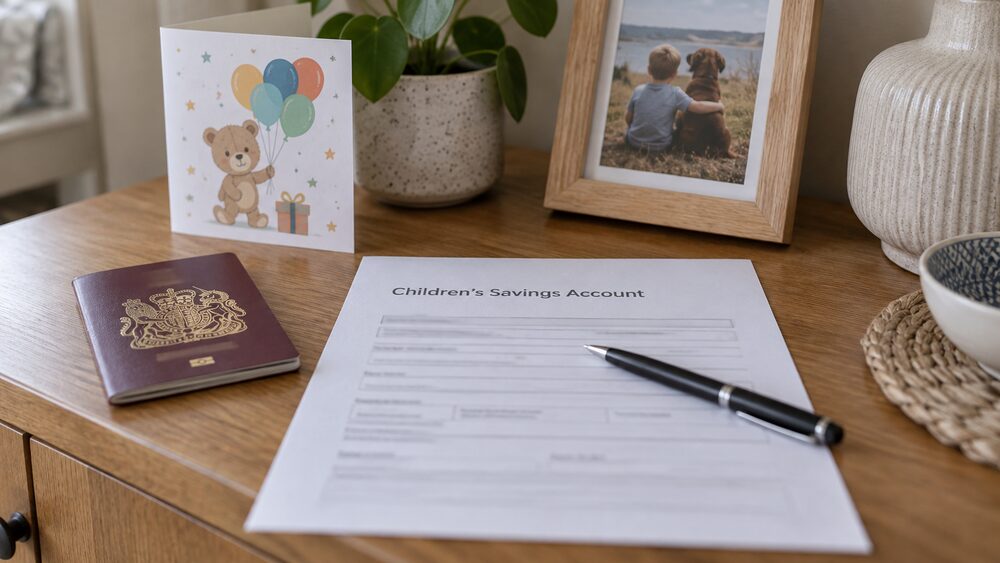
A children's savings account is a savings account held in a child's name, usually opened and managed by a parent or guardian until the child is old enough to take over. Providers offer a wide range of accounts for children, including easy access accounts, regular savers, fixed term options and Junior ISAs1. The money belongs to the child, not the adult who manages it, and the rules on who can withdraw, when control passes and how the money is taxed all depend on the type of account and the provider's own terms.
The two things most families want to know are who controls the money and when the child gets it. For most ordinary children's savings accounts, an adult manages the account until the child becomes a teenager, and the account may convert into an adult account, with the holder gaining control, at 16, 18 or even 21 depending on the provider2. For a Junior ISA, a parent or guardian manages the account while the child is under 16, the child can choose to manage it themselves from 16, and the money cannot be withdrawn until they turn 183.
Types of children's savings account
Children's savings accounts come in the same broad shapes as adult accounts, with the addition of accounts designed specifically for young savers. The main types are easy access accounts, regular savings accounts, fixed term accounts, Junior ISAs and junior accounts run by credit unions.
Easy access children's accounts let money be paid in and taken out at short notice, and suit saving towards short-term goals. Regular savers, sometimes called young saver or junior saver accounts, are designed for putting aside a set amount each month. Fixed term options, including cash savings bonds, tie the money up for a period in return for a known return; MoneyHelper notes that cash savings bonds are one way to save a lump sum for a set term8. Credit unions also offer a range of savings accounts for their members, including instant access accounts and ISAs9, and many run junior accounts for children in their community.
The Junior ISA sits slightly apart. It is a tax-advantaged savings product available to children10, introduced to create tax efficient individual investment plans for them11. A child may hold both a cash Junior ISA and a stocks and shares Junior ISA, but only one of each type during their childhood, though the accounts can be transferred to alternative account managers11. Money can be split between the cash and stocks and shares versions in any proportion12. NS&I, the government's savings provider, is one of the firms offering a Junior ISA, and describes it as a long-term account designed to build up a nest egg5. The wider family of ISAs, including how Junior ISAs fit alongside adult ISAs, is covered in the guide to ISAs.
Building societies and banks also offer their own branded children's accounts, which Yorkshire Building Society's guidance groups together as accounts that can be opened and managed by a parent, guardian or sometimes a grandparent, depending on the provider2. Which type suits a family depends on how long the money can be left alone, whether interest needs regular access, and whether the tax treatment matters. The differences between the main account shapes are explained in types of savings account.
Interest on children's savings is not automatically tax-free
A common assumption is that because the account belongs to a child, the interest must be tax-free. It is not. Yorkshire Building Society's guidance is blunt: interest earned in a children's savings account is not tax-free2. The interest counts as the child's income, and whether any tax is due depends on the child's own allowances and, in some cases, where the money came from. The rules, including the £100 rule that can apply when a parent pays in, are explained in the guide to tax on children's savings.
Tax-free accounts work differently. Interest earned in a Junior ISA is tax-free and does not count towards the child's Personal Savings Allowance5. The same principle applies to ISAs generally: the interest earned on ISAs and other tax-free accounts is not taxable, so it does not use up any of the Personal Savings Allowance13. Age UK makes the same point from the other direction: savings in tax-free accounts like ISAs do not count towards the allowance14.
Child Trust Funds, the predecessor of the Junior ISA, have their own statutory tax exemption. The Child Trust Funds Regulations 2004 provide that no tax is chargeable on the account provider or its nominee, or on the named child or registered contact, in respect of interest, dividends, distributions or gains on the account's investments, provided the regulations are complied with15.
One further point matters for families on low incomes: children's savings do not count in certain means tests, so money held in a child's own name is treated differently from money held by a parent16. How savings affect benefits is covered in how savings affect Universal Credit and other benefits.
Age limits: from birth to 17, depending on the provider
There is no single age at which a child can hold a savings account. Ordinary children's accounts are typically available from birth up to a set maximum age, often 16 or 17, while children's bank accounts can be opened for kids as young as six17. Children can open most ordinary, non-ISA savings accounts themselves from age seven4.
The age rules vary by provider and by account. Yorkshire Building Society notes that other children's savings accounts might mature at age 16, or at 212. Some accounts are restricted to younger children, others run to the child's 18th birthday. The age limits matter for two reasons: they determine when the account ends or converts, and they determine when the child can start managing the money themselves.
For accounts opened by an adult on a child's behalf, the position is set by the account's terms. NS&I's guidance on looking after a child's savings explains that where a grandparent opens an Investment Account for a child, they must nominate someone to look after the account until the child turns 16, and that person must be a parent or guardian18. The same principle, that an adult holds the reins until a set age, runs through nearly all children's accounts.
Because the age limits differ so widely, the account's terms and conditions are the decisive document. Before opening, check the minimum and maximum age, what happens at the upper age limit, and whether the child can take over management before then.
Control passes to the child at 16 or 18
Who controls the money in a children's savings account changes as the child grows up, and the handover happens in stages rather than all at once. For most accounts, an adult manages the account from the moment it is opened. Yorkshire Building Society states that an adult will manage the account until the child is a teenager, and for its own children's accounts that means until the child is 182.
The Junior ISA has a specific two-step handover. A parent or guardian manages a Junior ISA for a child while they are under 16. Once the child reaches 16, they can choose to manage their own account3. The money itself stays locked in until 18: unlike an Adult ISA, the savings in a Junior ISA cannot be withdrawn until the child reaches 1819.
For ordinary accounts, the child's own rights begin earlier. From age seven, children can open most non-ISA savings accounts themselves4, which means a child of that age can hold an account in their own name, even if an adult usually remains involved in practice. Statutory rules for National Savings accounts reflect the same structure: a deposit may be made on behalf of and in the name of a minor under sixteen by that minor's parent, guardian or grandparent20.
The practical point for families is that control and access are two different things. A child may gain the right to manage an account at 16, while still being unable to withdraw the money until 18, as with a Junior ISA. Conversely, an ordinary account may allow withdrawals by the managing adult long before the child has any say. Reading the account terms before opening avoids surprises later.
When the child turns 18
What happens at 18 depends on the type of account. Children's savings accounts may convert into an adult savings account, at which point the account holder gains control and can decide what to do with the money2. Some accounts mature earlier, at 16, or later, at 212, so the age of maturity is set by the provider rather than by law.
For a Junior ISA, the 18th birthday is the moment the money becomes available. The savings in a Junior ISA cannot be withdrawn until the child reaches 1819, and NS&I confirms that no withdrawals can be made from any Junior ISA before then, with exceptions only in cases such as the child's death or terminal illness5. At 18, the young person can choose to withdraw the money or keep it invested, often by transferring it into an adult ISA.
For accounts held in trust for a child, Scope's guidance on managing your own money notes that it is likely you cannot use the money until you are 18, though this depends on the account's rules23. The key step for a young person approaching 18, or a parent managing an account for them, is to check the account terms and the provider's maturity process in advance, so the money does not sit in an account that no longer suits them.
Paying in: parents, grandparents and others
Money can usually be paid into a children's savings account by anyone with the account details, and this is most often the parent, guardian or grandparent2. This makes children's accounts a natural home for birthday money and regular gifts from relatives. Some providers go further: grandparents are able to open and contribute to a child's Investment Account, though they must nominate someone to look after the account until the child turns 16, and that person must be a parent or guardian18.
Who can open the account in the first place is narrower. Children's savings accounts can be opened and managed by a parent, guardian or sometimes a grandparent, depending on the provider, and another relative such as an aunt or uncle may also be able to open one2. The statutory rules for National Savings accounts permit a deposit on behalf of a minor under sixteen by that minor's parent, guardian or grandparent20.
The distinction between paying in and controlling matters. A grandparent who pays in regularly does not gain any say over the account unless the provider allows them to open or manage it. Equally, the money in the account belongs to the child, not to whoever paid it in, and the managing adult is looking after it on the child's behalf. Families making significant gifts should also be aware of the tax rules that can apply to interest on money paid in by a parent, covered in tax on children's savings and the £100 rule.
How interest is paid
Interest on children's savings accounts is typically paid every year, and some accounts pay it every month2. The frequency is set by the provider and stated in the account terms, and it affects how quickly the money grows through compound interest.
Providers differ in the detail. NS&I's Direct Saver, for example, calculates interest daily and adds it to the account once a year, on 1 April24. Monthly interest can suit a family saving towards a short-term goal who want to see the returns, while annual interest paid on a fixed date suits longer-term saving where the money is left alone.
How the interest is described also matters when comparing accounts. Rates are quoted as AER, gross, fixed or variable, and these terms are explained in AER, gross and fixed or variable rates explained. A variable rate can change, and the guide to when a savings provider changes your rate explains the notice providers must give.
Child Trust Funds: checking for an unclaimed account
Before the Junior ISA, the government ran the Child Trust Fund, a tax-free savings account created for children born between 1 September 2002 and 2 January 201125. The government sent vouchers to parents, and if a parent or guardian did not set up an account, the government opened one automatically25. Over six million children had a Child Trust Fund26. The scheme was introduced in 200527, and each account was for a single child, the named child, with no child allowed to hold more than one account28.
The oldest account holders turned 18 from September 2020, and the accounts began maturing. Between then and April 2024, around 2,333,000 accounts matured in total, of which around 1,662,000 were claimed or automatically transferred30. Around a further 345,000 accounts matured during the tax year 2023 to 2024 and were claimed or transferred30, and around 415,000 more matured during the tax year 2025 to 202631. In total, around 2,958,000 accounts had been claimed or automatically transferred to an ISA as of April 202631.
Many accounts have been forgotten, because they were set up automatically. Which? reported that there were 671,000 matured Child Trust Funds that had not been transferred to an adult ISA or paid out to young account holders as of April 20244. The National Audit Office's investigation into Child Trust Funds noted that the remaining 0.2 million accounts were set up after April 2012 for eligible children where there had been a delay opening an account29.
Checking is free. NS&I directs families to the government's free Child Trust Fund finder tool on gov.uk25, and HMRC's guidance confirms who is eligible7. Contact, the charity for families of disabled children, makes the same point: if your child was born between 1 September 2002 and 2 January 2011, the government should have opened a Child Trust Fund for them32. Children can withdraw the money at 18, but because the accounts were set up automatically, many have been forgotten about4.
FSCS protection: up to £120,000 per person
Money in a children's savings account is protected in the same way as any other eligible deposit. The Financial Services Compensation Scheme (FSCS) protects up to £120,000 in total across all accounts a person holds, either in their own name or where they are listed as the beneficial owner6. If the account is an individual account held in the child's name, FSCS protects up to £120,000 in total across all accounts the child holds6. The limit is per person, per authorised firm36.
The protection applies to banks, building societies and credit unions alike. FSCS guidance on deposit protection at banks and building societies sets the £120,000 limit6, and its guidance on credit unions confirms the same protection for money saved with them37. Joint accounts are also eligible, up to the same limit of £120,000 per eligible person38. Since the limit is per authorised firm, money spread across two providers with separate banking licences gets two lots of protection; money across two brands sharing one licence gets only one. The guide to how FSCS protection works for savings explains how to check.
FSCS states that it now protects eligible deposits from the first pound up to £120,000 per person, per authorised firm40. Which? notes that the limit protects up to £120,000 of savings per individual, per financial institution, and that before 1 December it was £85,00041. Compensation is normally automatic: FSCS can compensate depositors up to £120,000 per eligible person, per firm, without the depositor needing to apply36.
Where to get help
Free, impartial help with children's savings is available from several places. The government's free Child Trust Fund finder tool on gov.uk is the starting point for tracing a forgotten account25, and HMRC's guidance sets out what financial help families can check7. MoneyHelper, the government-backed money guidance service, has information on savings products including cash savings bonds8, and the Money and Pensions Service actively encourages 16 to 18 year olds to use MoneyHelper for information about Child Trust Funds33.
In Northern Ireland, the Consumer Council provides guidance on savings accounts and on managing and maximising your money1. Families of disabled children can get help with sorting out family finances, including children's savings, from Contact32, and Scope offers guidance on managing your own money for young people approaching adulthood23. For carers and adoptive parents, the government publishes a Child Trust Fund and Junior ISA factsheet35.
If a provider fails, FSCS protection applies automatically up to £120,000 per eligible person, per firm36, and Which? sets out what to do if your bank goes out of business41. Complaints about a children's savings account go first to the provider, and then to the Financial Ombudsman Service if unresolved. The basics of how savings accounts work, including summary boxes and interest, are covered in how a savings account works and the wider savings guide.
Sources41 cited
- Manage and maximise your money Consumer Council Northern Ireland
- How to save for children and grandchildren Yorkshire Building Society, 2026-09-26
- ISA basics NS&I, 2026-09-01
- Over £1bn unclaimed in Child Trust Funds Which?, 2024-10-02
- NS&I Junior ISA NS&I, 2026-09-24
- Deposit protection: banks FSCS, 2026-09-25
- Check what financial help you can get from HMRC HM Revenue and Customs, 2022-04-05
- Cash savings bonds MoneyHelper
- Savings accounts Consumer Council Northern Ireland
- Junior ISA explanatory memorandum legislation.gov.uk, 2023
- The Individual Savings Account Regulations 2011 legislation.gov.uk, 2011-11-01
- The Individual Savings Account Regulations 1998 legislation.gov.uk, 1998-07-31
- Tax on your savings NS&I, 2022-02-09
- Income tax Age UK, 2026-04-21
- The Child Trust Funds Regulations 2004, Part 3 legislation.gov.uk
- Financial support when someone dies Scope, 2026-04-01
- How to open a bank account online Which?, 2026-04-23
- Looking after a child's savings NS&I, 2023-11-13
- Annual savings statistics 2025: background and methodology HM Revenue and Customs, 2025-09-18
- The National Savings Bank Regulations 2015 legislation.gov.uk, 2015-03-10
- Should you switch your child's Child Trust Fund to a Junior ISA Which?, 2025-05-24
- Open a bank account for a child HSBC UK, 2026
- Managing your own money Scope, 2025-08-18
- NS&I Direct Saver product summary NS&I, 2026-08-18
- Child Trust Fund guide NS&I, 2026-09-18
- Tax information and impact note: New ISA, Junior ISA and CTF HM Revenue and Customs, 2014
- Child Trust Fund explanatory memorandum legislation.gov.uk, 2011
- The Child Trust Funds Regulations 2004 legislation.gov.uk, 2004-05-27
- Investigation into Child Trust Funds National Audit Office, 2023-03-14
- Commentary for annual savings statistics September 2024 HM Revenue and Customs, 2024-09
- Commentary for annual savings statistics September 2026 HM Revenue and Customs, 2026-04
- Sorting out your finances Contact, 2025-10-27
- Five simple ways to boost your savings Money and Pensions Service, 2025-09-22
- Help for young people with experience of care mygov.scot, 2025-10-27
- Child Trust Fund and Junior ISA adoption factsheet HM Revenue and Customs, 2014-02-17
- Check your money is protected FSCS, 2026-09-25
- Deposit protection: credit unions FSCS, 2026-09-25
- What we cover: banks, building societies and credit unions FSCS, 2026-09-25
- What we cover FSCS, 2026-09-25
- Millions receiving large sums now have greater protection FSCS, 2026-03
- What to do if your bank goes out of business Which?, 2025-12-01



 MoneyHelperFree, impartial money and pensions guidance, set up by government
 FSCSProtects your money if a bank, insurer or investment firm fails
 Financial Ombudsman ServiceFree, independent help when a complaint about a firm is not put right
 Citizens AdviceFree advice on money, consumer and legal problems in England and Wales
 GOV.UKOfficial information on tax, benefits and government services