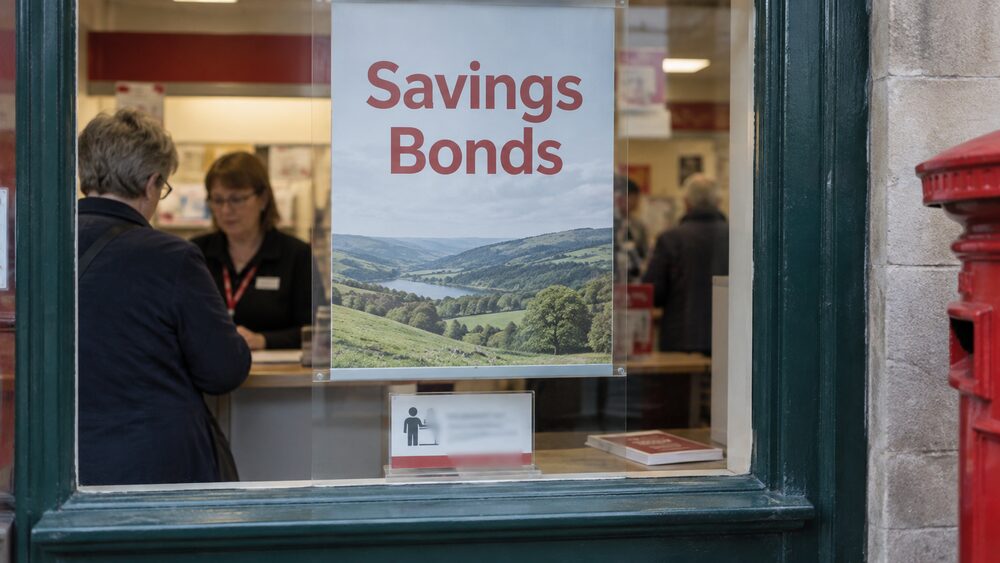
NS&I is the UK government-owned savings bank1, and that single fact shapes everything about it: what it sells, how safe your money is, and what happens if something goes wrong. Its full name is National Savings and Investments, and it is both a government department and an executive agency of the Chancellor of the Exchequer, backed by HM Treasury2. It had 49,865,483 holdings as of 31 March 20263, spread across products most people know by name: Premium Bonds, Direct Saver, the Direct ISA, Junior ISAs, Income Bonds, Guaranteed Growth Bonds, Guaranteed Income Bonds and Green Savings Bonds.
The feature that sets NS&I apart from every bank and building society is its backing. Money saved with NS&I is a claim on the government itself rather than on a commercial firm, so the protection does not come from the Financial Services Compensation Scheme (FSCS), the safety net that covers deposits with banks and building societies. NS&I's own product documents state plainly that it "is backed by HM Treasury, the government's economic and finance ministry"2. What that means in practice, and where it does and does not help, is covered in the section on how NS&I works with HM Treasury.
The range is broader than most people realise. Premium Bonds, with their monthly prize draw, are the famous product, but they sit alongside easy-access savings, cash ISAs for adults and children, fixed-term bonds paying growth or monthly income, and a three-year green bond. Several older products, including Pensioners Guaranteed Income Bonds, Capital Bonds and various Savings Certificates, have matured and closed, and there is a dedicated process for tracing money left in them.
What NS&I offers beyond Premium Bonds
Premium Bonds are the product NS&I is known for, and they work differently from every other savings account: they pay no interest at all. Instead, each £1 saved gets an entry into a monthly prize draw4, with odds of 23,000 to 1 for every £1 Bond, a variable figure NS&I states applies until the June 2026 prize draw4. Bonds must be held for a whole month before they are eligible for a draw4. Prizes can be paid directly to your bank account or an NS&I Direct Saver, or reinvested into more Bonds8. The full mechanics, including how the draw works and how prizes are claimed, are covered in the guide to how Premium Bonds work.
The rest of the range covers the main savings needs:
| Product | What it is | Access to your money |
|---|---|---|
| Direct Saver | Easy-access savings, £1 to £2 million, own name or jointly with one other person5 | No notice and no penalty5 |
| Direct ISA | Cash ISA with a variable interest rate, £1 to £20,000 in the 2026/27 tax year6 | Manageable online and by phone |
| Junior ISA | Cash Junior ISA, allowance of £9,000 in the 2026/27 tax year9 | Transfers to an adult cash ISA at 189 |
| Income Bonds | Monthly income at a variable interest rate set by HM Treasury2 | Manageable online and by phone |
| Guaranteed Growth Bonds | Fixed-term bond; a £1,000 deposit would be worth £1,098.51 at the end of the 2-year term10 | No withdrawals until the end of the term10 |
| Guaranteed Income Bonds | Fixed-term bond paying monthly income | No withdrawals until the end of the term11 |
| Green Savings Bonds | Fixed rate over three years12 | Cannot be cashed in before the end of the term12 |
| Investment Account | Postal account | Pay in and take out by post only13 |
A few details matter when choosing between them. The Direct Saver is the straightforward option: interest is added without deducting tax, but it is taxable and counts towards your Personal Savings Allowance5, and half the balance in a joint account counts towards each holder's personal limit5. The Direct ISA is a cash ISA with a variable interest rate14, so interest is tax-free within the ISA rules, but it is not a flexible ISA: all deposits within the tax year count towards your allowance even if you withdraw them6. NS&I states the Direct ISA may not suit you if you want to invest your full allowance in a stocks and shares ISA or an innovative finance ISA, manage the account by post, transfer in ISA investments from another provider, or have a flexible ISA6.
The Junior ISA is a cash Junior ISA14 with a £9,000 allowance in the 2026/27 tax year9. On the child's 18th birthday the Junior ISA ends and the money is automatically transferred into an adult cash ISA from NS&I, with notice about a month beforehand9.
The fixed-term bonds are the least flexible. Neither Guaranteed Growth Bonds nor Guaranteed Income Bonds allow money to be taken out before the end of the term10, so they suit money you are certain you will not need. NS&I contacts holders at least 30 days before a Guaranteed Income Bond matures to set out the options11. The Investment Account is the opposite of everything else in the range: it is a postal account, so paying in and taking out money means printing and completing a form and sending it to NS&I13. If it is your only NS&I account you cannot manage it online, though you can register for the online and phone service if you hold another NS&I account such as Premium Bonds13.
Older products no longer on sale still generate questions. Pensioners Guaranteed Income Bonds and Capital Bonds have all now matured and been closed completely, with remaining funds transferred to the NS&I Residual Account15. Index-linked Savings Certificates, Fixed Interest Savings Certificates and Children's Bonds are among the older fixed-term investments NS&I still services through its online and phone service16. The page on closed NS&I products covers these in detail.
Most accounts can be managed through NS&I's online and phone service, which supports Premium Bonds, Green Savings Bonds (online only), Income Bonds, Direct Saver, the Junior ISA (online only) and the Direct ISA16. Online you can check investments, pay money in and take it out, change personal details, and choose to have Premium Bonds prizes paid straight to your bank account16. Holders of Premium Bonds, Children's Bonds or an Investment Account can manage them by post instead and do not have to use the online service13. NS&I also operates a switching service for moving some or all of the money in an existing NS&I account to a new account you open17, and you can fill in an online form to switch to or withdraw money from certain accounts, or to manage how you receive Premium Bonds prizes18.
Green Savings Bonds and where the money goes
Green Savings Bonds are lump sum investments that earn a fixed rate of interest over three years19. They are the one NS&I product with a stated purpose beyond saving: the money goes to HM Treasury, which intends to use it to help finance green spending projects chosen by the Government19. HM Treasury plans to allocate an amount equivalent to the funds raised from Green Savings Bonds to its chosen green projects within two years12, and the money is held in a general account at HM Treasury in the meantime20.
What counts as "green" has changed. Under the new Green Financing Framework published in November 2025, the Government now plans to use some of the money raised through Green Savings Bonds to help fund nuclear energy projects12. A saver who bought a Bond expecting only wind and solar projects may find that framing wider than they assumed, though the fixed rate and the term are unaffected.
The product rules are strict:
- You can only invest and manage the Bond online at nsandi.com19.
- The Bond cannot be cashed in before the end of the three-year term19.
- Once you have bought a Bond, you cannot add more money to it12.
- NS&I can change the fixed rate on offer at any time, releasing a new Issue of Bonds for each change, and can withdraw any Issue from sale without notice12.
- Half of an investment held jointly between two people counts towards each investor's personal limit19.
As an illustration of how the fixed rate builds up, NS&I states that a £1,000 deposit would be worth £1,139.53 at the end of the 3-year term12. When the Bond matures you can renew automatically for another 3-year term, switch to another NS&I account, or cash it in, and you will need your NS&I account number and bank account details to hand21. The dedicated page on NS&I Green Savings Bonds goes further into the terms.
NS&I and the cash ISA allowance changes
The ISA landscape is changing, and two of the changes bear directly on NS&I's cash ISAs. The first is the cut in the cash ISA allowance: the annual cash ISA subscription limit falls to £12,000 for individuals aged under 65 from 6 April 20277. NS&I is clear that this change will only apply to new deposits made from April 2027 and will not have any impact on savings already made22. The overall ISA allowance stays at £20,000, so an under-65 saver could still put up to £20,000 a year into ISAs, but no more than £12,000 of that into cash ISAs, including the NS&I Direct ISA.
The second change comes in the Individual Savings Account (Amendment) Regulations 2026, which provide that transfers from a stocks and shares ISA or an innovative finance ISA to a Cash ISA are prohibited where the account holder is below the age of 6524. The same regulations introduce a charge on any interest paid on cash held in a stocks and shares ISA or an innovative finance ISA24. For an NS&I Direct ISA holder this matters at the edges: the Direct ISA does not accept transfers in from other providers anyway6, so the new transfer rules mainly affect anyone thinking of moving money the other way, from investments into NS&I cash, after the rules take effect.
For the current tax year nothing has changed: the Direct ISA accepts from £1 to £20,000 in the 2026/27 tax year6, with a minimum deposit of £16. Because the Direct ISA is not a flexible ISA, withdrawing money does not free up allowance again, so the timing of deposits within the tax year matters more than it would with a flexible ISA6. The wider ISA rules, including the four types of ISA available (cash, stocks and shares, innovative finance and lifetime ISAs), are covered in the guide to ISAs, and the choice between wrapping savings in an ISA or holding them plain is compared in cash ISA vs ordinary savings.
How NS&I works with HM Treasury
NS&I occupies a position no other savings provider holds. It is both a government department and an executive agency of the Chancellor of the Exchequer2, and it acts under the authority of the Director of Savings2. Its general terms and the terms for all its accounts are made under the National Loans Act 1968 or the National Savings Bank Act 19712. In plain terms, when you save with NS&I, the money you invest contributes towards public spending20: you are lending to the government, which is why the security is different in kind from a bank deposit.
That difference is the answer to the most common question about NS&I: is it safe? For banks and building societies, the safety net is FSCS, which covers eligible deposits including current accounts, savings accounts, cash ISAs and savings bonds25, and its coverage includes deposits, current accounts and savings accounts26. NS&I sits outside that scheme. Its key features documents do not mention FSCS at all; they state instead that "NS&I is backed by HM Treasury, the government's economic and finance ministry"27. The practical consequence is that the security of NS&I savings is the security of the UK government itself, with no stated monetary cap of the kind FSCS applies to bank deposits. A saver with £2 million in a Direct Saver5 is relying on the same backing as a saver with £50.
This is a genuine advantage for very large balances, where FSCS protection at a bank would cover only part of the money, but it is not the same as a guarantee in the legal sense that FSCS provides, and it has never been tested in the way FSCS has. It also means NS&I's rates are set with government financing needs in mind: Income Bonds pay a variable interest rate set by HM Treasury2, and NS&I can change the fixed rate on offer on Green Savings Bonds at any time by releasing a new Issue12. The page on when a savings provider changes your rate explains the notice rules that apply to variable rates generally.
NS&I is not entirely outside the consumer protection framework. It is subject to complaint handling standards, publishing data on the complaints it receives3, and disputes that cannot be resolved with NS&I directly can be taken to the Financial Ombudsman Service, which handles complaints about individual savings accounts among other products28. NS&I also publishes an online security promise, under which it monitors accounts 24/7 and uses technology to safeguard savings29, and it checks customers' identity on opening, sometimes requiring documents proving identity and address30.
Old and forgotten NS&I savings
With 49,865,483 holdings as of 31 March 20263, spread over generations of products, it is inevitable that some savings have been forgotten. Examples of NS&I holdings include individual Savings Certificates, Direct ISA accounts, Direct Saver accounts and Premium Bonds3, and older products such as Pensioners Guaranteed Income Bonds and Capital Bonds have matured and closed completely15. When NS&I closes an account and cannot reach the customer, it transfers the money to its Residual Account for safekeeping15, so forgotten money is not lost, it is held.
Unclaimed Premium Bonds prizes are a common example. The prize checker shows any prizes won this month, anything won in the previous six draws, and any older unclaimed prizes8, and it is updated on the day after the first working day of each month8. Prizes do not expire in the way people often fear, and the process for claiming older ones is covered in the guide to unclaimed Premium Bonds prizes.
The scale of forgotten money across the UK is large. HMRC data reported in September 2026 showed over 827,000 matured Child Trust Funds, worth £2,310 on average, still unclaimed, and earlier reporting put the figure at 758,000 young people due an average £2,240 each. Those accounts are not NS&I products, but they illustrate how easily savings opened in childhood are forgotten in adulthood. Advice NI has separately reported generating almost £150 million in unclaimed benefits and entitlements through its work, money people were entitled to but had never claimed.
How to trace lost NS&I savings
NS&I runs a tracing service for exactly this situation. You can trace lost savings and investments using an online form, without having to send any post31. If you prefer paper, you can download and print a form and post it, or write to Tracing Service, NS&I, Sunderland SR43 2SB32. Note the limit of NS&I's own form: it can only be used to request a trace for NS&I accounts or investments32. If you think you may have old accounts with other providers as well as NS&I, the My Lost Account service can trace those too32.
The fastest route depends on what you still have:
- If you know your NS&I number, log in to the online service. You will find your NS&I number on any letter you have had from NS&I since registering for its online banking service18.
- If you have forgotten your NS&I number, you can get a reminder online using your name, date of birth and postcode18.
- If you hold Premium Bonds, you can find your holder's number by logging in and checking your Premium Bonds account page, and you can log in to see and print off a list of all your Bond numbers, or contact NS&I to be posted a Bond record31.
- If you have lost a certificate for a fixed-term investment, write to NS&I with your full name and address and as many details about the investment as you can remember, and it will send a replacement certificate16.
- If you cannot prove ownership online, you can take control of accounts by post, writing to NS&I with which accounts you have, your holder's or account numbers, your name, address and date of birth, your signature, and the signature and details of a witness13.
Logging in is protected by two-factor authentication to ensure it is you18. The full walkthrough, including what information speeds up a trace, is in the guide to tracing lost NS&I savings, and finding your holder's number is covered in finding your NS&I holder's number.
Is the Help to Buy ISA an NS&I product?
The Help to Buy: ISA scheme is a government scheme, but it is not part of the NS&I range: Help to Buy: ISAs were held with banks and building societies, and questions about a specific account go to the provider that holds it. What NS&I's own pages show is the wider ISA picture, including the Direct ISA and the Junior ISA14.
The scheme's dates are what matter to anyone still holding an account. The scheme was closed to new accounts on 30 November 2019, though Help to Buy: ISA account holders can continue saving into their accounts until 30 November 202933. The government published its twentieth official statistics release on the scheme, presenting official statistics on the government's Help to Buy: ISA scheme34. So no new accounts can be opened, and no NS&I product replaces the scheme, but existing holders have until the end of November 2029 to finish saving and claim the government bonus. Savers on low incomes may also want to compare the scheme with Help to Save, the separate government savings scheme that pays a bonus of its own.
NS&I accounts after someone dies
NS&I has specific rules for each product when a holder dies, and they affect how quickly an estate can be settled. For the Direct Saver, if the account holder, or the last surviving holder of a joint account, dies, NS&I will not be able to accept any more deposits into the account; the balance becomes part of the account holder's estate, and the account continues to earn interest35. For a joint account, the surviving account holder gets ownership of the account19. Green Savings Bonds follow the same pattern: if the Bond holder dies, the money becomes part of the holder's estate and the Bond continues to earn interest19.
Two ISA rules are worth knowing. First, you can inherit an additional ISA allowance if your spouse or civil partner dies, up to the value of their ISA at the date of death6. Second, under Regulation 2G of the Individual Savings Account Regulations 1998, a deceased person's ISA (other than a junior ISA) can continue as a "continuing ISA account"36, which is the mechanism that lets the tax-free status survive during estate administration. A Lifetime ISA, which NS&I does not offer, ends on the date of death and there is no charge to withdraw the funds37.
Where the holder dies without a will, the balance forms part of the estate and is distributed under the intestacy rules, but NS&I's product rules still apply on the way there:
- Inherited money held in a Direct Saver or Investment Account can be held in a Direct Saver in your own name even if it takes you over the personal holding limit35.
- NS&I will normally refund unauthorised payments, and missed interest or prizes, unless the customer did not take reasonable care or did not report lost or stolen security details promptly; no refund is made where fraud by the customer is suspected38.
- NS&I may close an Income Bonds account at any time by giving at least two months' written notice, or immediately in specified situations such as false information or breach of the agreement2.
The practical first step is to contact NS&I with the death certificate and details of the accounts; the tracing service in the previous section can identify accounts the family did not know about. The guide to NS&I accounts after death and the section page on money through life's big changes cover the wider estate process.
Where to get help
For anything to do with a specific account, NS&I itself is the first stop: its online and phone service covers most products16, its complaints data is published3, and its help pages cover everything from prize payment options8 to maturing investments21. Identity checks on opening may require documents proving identity and address30, and online logins use two-factor authentication18.
If a complaint cannot be resolved with NS&I, the Financial Ombudsman Service can look at disputes involving individual savings accounts and other NS&I products28. Its service is free. For general questions about savings protection, FSCS provides a tool to check whether money is protected26, though NS&I's own backing comes from HM Treasury rather than FSCS27. For wider, free and impartial guidance on savings decisions, MoneyHelper and the guides on how to open a savings account and switching accounts set out the options without selling anything.
Sources38 cited
- Saving your extra money NS&I, 2026-09-22
- Income Bonds brochure NS&I, 2024-07-01
- Complaints data NS&I, 2026
- Premium Bonds product page NS&I, 2026-09-04
- Direct Saver product page NS&I, 2026-09-04
- Direct ISA product page NS&I, 2026-09-04
- Reduction in the cash ISA limit HM Government, 2027
- Premium Bonds prizes NS&I, 2026-05-13
- Junior ISA product page NS&I, 2026-09-24
- Guaranteed Growth Bonds product page NS&I, 2026-09-15
- Guaranteed Income Bonds product page NS&I, 2026-09-04
- Green Savings Bonds product page NS&I, 2026-09-04
- Take ownership of savings NS&I, 2023-12-05
- ISA basics NS&I, 2026-09-01
- Closed accounts NS&I, 2026-08-27
- Manage your savings online NS&I, 2026-02-26
- Switching NS&I, 2026-06-10
- Accessing your online account NS&I, 2026-05-13
- Green Savings Bonds brochure NS&I, 2025-07
- Green saving NS&I, 2026-06-03
- Green Savings Bonds maturing NS&I, 2025-11-26
- ISA allowances NS&I, 2026-09-01
- Budget 2025: overview of tax legislation and rates GOV.UK, 2025
- The Individual Savings Account (Amendment) Regulations 2026 consultation HM Government, 2026-07-16
- What is the Financial Services Compensation Scheme Bank of England, 2025-12-01
- Check your money is protected FSCS, 2026-09-25
- Guaranteed Growth Bonds key features NS&I, 2025-06-30
- Individual Savings Accounts (ISAs) complaints Financial Ombudsman Service, 2026-09-26
- Our online security promise NS&I, 2024-02-05
- Join NS&I NS&I, 2026-07-21
- Get back to Premium Bonds NS&I, 2026-09-07
- Track lost investments NS&I, 2025-07-14
- Annual savings statistics 2025: background and methodology HM Government, 2025-09-18
- Help to Buy: ISA scheme quarterly statistics HM Government, 2023-11-29
- Direct Saver brochure NS&I, 2024-07-01
- Individual Savings Account Regulations 1998, Regulation 2G legislation.gov.uk, 2026
- Withdrawing money from your Lifetime ISA HM Government, 2026-09-28
- Junior ISA brochure NS&I, 2024-07-01






 MoneyHelperFree, impartial money and pensions guidance, set up by government
 FSCSProtects your money if a bank, insurer or investment firm fails
 Financial Ombudsman ServiceFree, independent help when a complaint about a firm is not put right
 Citizens AdviceFree advice on money, consumer and legal problems in England and Wales
 GOV.UKOfficial information on tax, benefits and government services