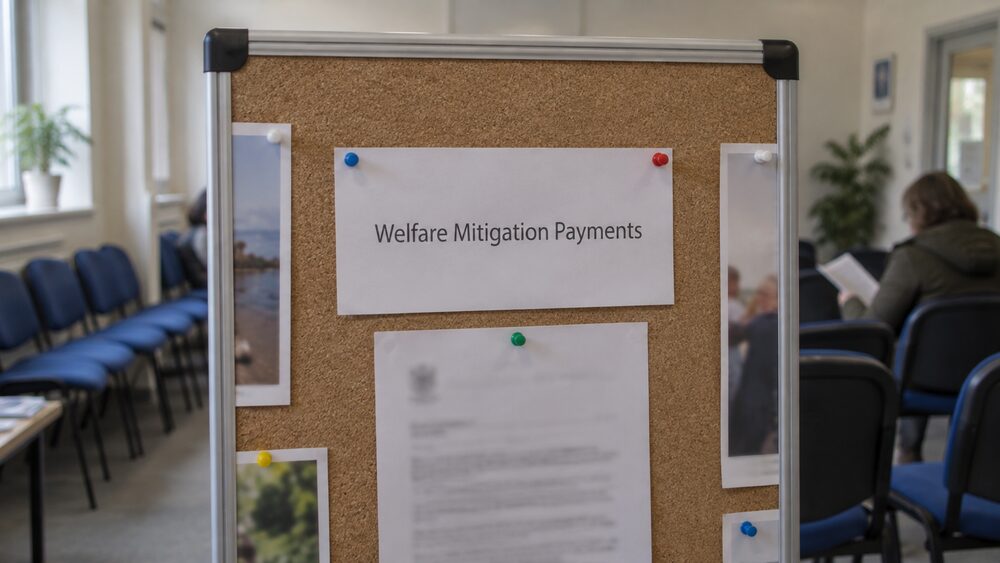
Welfare supplementary payments are extra payments made in Northern Ireland to soften the impact of certain welfare changes1. They exist because Northern Ireland has its own arrangements for two of the most contested changes in the UK benefits system: the social sector size criteria, usually called the bedroom tax, and the Benefit Cap. Where those rules cut a household's housing benefit or Universal Credit, a mitigation payment can make up the difference.
Welfare supplementary payments are extra payments made in Northern Ireland to soften the impact of certain welfare changes1. They exist because Northern Ireland has its own arrangements for two of the most contested changes in the UK benefits system: the social sector size criteria, usually called the bedroom tax, and the Benefit Cap. Where those rules cut a household's housing benefit or Universal Credit, a mitigation payment can make up the difference.
The two schemes work differently. Bedroom tax mitigation is an administrative welfare supplementary payment, normally paid to your landlord rather than to you, unless you pay your own rent2. Benefit Cap mitigation is automatically paid to offset the amount of benefit lost because of the cap, and it is aimed at families3. Neither is a benefit you claim in the ordinary sense, and neither is means-tested on top of the benefit it replaces.
The Benefit Cap itself is a yearly limit on the total certain benefits a household can receive. For 2026/27 it is £22,020 a year for couples and households with children, and £14,753 a year for single adults without children4. In Northern Ireland, 1,140 households were subject to the cap in August 2025, with an average of £45 a week capped4.
What welfare mitigation payments are and who they help
Welfare supplementary payments soften the impact of certain welfare changes in Northern Ireland8. They are not a single benefit but a family of schemes, each attached to a specific change, and each with its own eligibility rules. The two that affect the most households are the social sector size criteria scheme and the Benefit Cap scheme.
The social sector size criteria scheme helps tenants in Housing Executive or housing association property who are treated as having more bedrooms than they need. If you are affected by the SSSC, you are entitled to extra payments known as mitigation payments9. The Benefit Cap scheme helps households whose total benefit is limited by the cap, and it is restricted to people who are responsible for a child or qualifying young person who lives with them1.
There is a third strand, for people who moved from Disability Living Allowance to Personal Independence Payment. You may be eligible if you live in Northern Ireland and were getting DLA as an adult, and were refused PIP and appealed, or were awarded PIP at a lower amount than DLA, or were refused PIP but awarded at least four points on either component and have problems as a result of a violent incident connected with the affairs of Northern Ireland1.
The schemes sit alongside the ordinary benefit system rather than replacing any part of it. They are funded separately, through the Northern Ireland Executive's Departmental Expenditure Limit budget, and the Benefit Cap element is described in official legislation as mitigating the cap for families3.
Bedroom tax mitigation: paid automatically to your landlord
If you rent from the Housing Executive or a housing association and the social sector size criteria reduce your housing support, the money you lose is currently being replaced from a separate fund called a welfare supplementary payment, so you will not lose out financially7. The payment is administrative, which means it is applied without a claim form in the ordinary case2.
The practical point that catches people out is where the money goes. Mitigation payments are normally paid to the landlord unless the tenant pays their own rent9. If your rent is paid direct to your landlord, the mitigation is likely to follow the same route, so you may never see it as a separate credit. If you pay your own rent, the payment comes to you.
For Universal Credit claimants in Northern Ireland, the housing payment is paid directly to your landlord2. Housing Benefit works differently: you can ask the Northern Ireland Housing Executive to pay your landlord directly10. Either way, the mitigation is designed to sit alongside the housing support rather than to be claimed separately.
If you are not sure whether a payment is being made, or you think it has stopped, the Welfare Changes Helpline on 0808 802 0020 deals with bedroom tax queries in Northern Ireland7. The Helpline is the quickest route to a definitive answer about your own case, because the payment is tied to your tenancy and your benefit award rather than to anything you can check on a statement.
Benefit Cap mitigation: £22,020 a year for couples and families
The Benefit Cap limits the total amount of certain benefits a household can receive. For 2026/27 the annual levels are £22,020 for couples and households with children, and £14,753 for single adults without children4. The same £22,020 figure appears in the published benefit and pension rates for couples with or without children, or a single claimant with a child of qualifying age, in the rest of Great Britain5. Independent guidance gives the same £22,020 for a couple or a single person with a child of qualifying age11.
Expressed weekly, the cap is £423.46 a week, which is £1,835 a month or £22,020 a year, for couples and lone parents outside Greater London12. The same £22,020 a year applies to couples with or without children, and to single claimants with a child of qualifying age, in the rest of Great Britain13. Greater London has higher figures, and the amount for a single adult without children there is not settled across the documents, so check your own award.
In Northern Ireland, the cap is mitigated for families. The Department for Communities mitigates the Benefit Cap for families through welfare supplementary payments which are automatically paid to offset the amount of benefit lost3. You may be eligible if you are affected by the benefit cap, live in Northern Ireland, and are responsible for a child or qualifying young person who lives with you1.
The scale is modest but real. In August 2025 there were 1,140 households subject to the Benefit Cap in Northern Ireland and the average amount capped was £45 per week4. Of those, 440 households, about 39%, were families with three or more children, with a total of 560 children in capped households4. Advice NI put the number of households with three or more children who would currently be subject to the cap at 4406.
The Department's own bid for Benefit Cap Mitigations was £12.7million in 2026-27, £13.0million in 2027-28 and £13.4million in 2028-294.
Who is exempt from the Benefit Cap
The cap does not apply to everyone. The Benefit Cap does not apply if a claimant has limited capability for work-related activity, or if they receive Industrial Injuries Disablement Benefit, Attendance Allowance or a War Pension, or if they or a child or qualifying young person get DLA or PIP4. Those exemptions matter because they cover households whose benefit includes a disability element, and they apply regardless of the size of the award.
Age is the other main exemption. Housing Benefit for people above State Pension age is not included in the Benefit Cap10, and the cap does not apply if you and your partner are over State Pension age15. The cap applies to most people aged between 16 and 6416. If you are over State Pension age you can contact the Northern Ireland Pension Centre to check your position, and if you are under it the Check your State Pension forecast service is the route17.
There is also a grace period for people who have recently left work. You can be exempt for a grace period of 39 weeks if you or your partner were in work and earning over a certain amount for at least 50 weeks out of the last 52 weeks before the last day of work, and were not getting Jobseeker's Allowance, Income Support or Employment and Support Allowance18. The exemption is designed to give a household time to adjust rather than losing the cap protection the moment work ends.
Carers have their own route. The Housing Benefit Regulations (Northern Ireland) 2006 provide an exception to the benefit cap where the claimant, the claimant's partner, or a young person for whom the claimant or the claimant's partner is responsible, is entitled to a carer support payment19.
Is the Benefit Cap taken from Universal Credit or Housing Benefit?
Both. Any benefits that you get above the capped amount will be taken from your Housing Benefit or Universal Credit payments15. The cap is not a separate charge or a deduction applied at the end of the year; it reduces the benefit as it is paid.
In Northern Ireland there is a specific protection for Housing Benefit claimants. Special rules in Northern Ireland mean housing benefit claimants get additional welfare supplementary payments making up any shortfall because of the benefit cap20. That is the mechanism that turns the cap into a manageable reduction for families rather than a straight loss of income.
There is a timing point for anyone moving to Universal Credit. If your Housing Benefit includes money for your rates, this will stop when you claim Universal Credit9. Rates support is handled differently under Universal Credit, so a household that moves across should expect the rates element of Housing Benefit to end at that point.
If the cap leaves you short and the mitigation does not cover everything, a Discretionary Housing Payment may be available. You can qualify if you are entitled to Housing Benefit, or the housing cost element of Universal Credit, or you are affected by the benefit cap21. Discretionary Housing Payments are separate from welfare supplementary payments and are awarded by the Housing Executive on a case-by-case basis.
How long mitigation payments last and what could change
The mitigation schemes have been extended more than once, and the current position is that they run until March 2028. The Department confirmed that mitigations are in place until March 2028 and stated that plans are underway to extend the scheme beyond that date6. A written ministerial statement in December 2024 said agreement had been secured to extend those mitigation schemes that were due to end on 31 March 2025 for a further three years22. The Welfare Supplementary Payment (Universal Credit) Regulations (Northern Ireland) 2025 state that those Regulations cease to have effect on 31st March 202824.
The legal history explains why the end date keeps moving. The Welfare Supplementary Payments (Amendment) Bill removed the current end date of 31st March 2020 set out in Article 137A of the Welfare Reform (Northern Ireland) Order 2015, with no new end date for payments25. An earlier version of the Bill would have substituted a new end date of 31st March 2025 to replace the current date of 31st March 202026. The Bill's explanatory notes record that no consultation was carried out in relation to the substitution of a new end date for the mitigation scheme for the Social Sector Size Criteria25, and that no Regulatory Impact Assessment was carried out because the Bill extends a scheme of financial assistance with no cost impact on business, charities or voluntary bodies25. The notes state that the provisions of the Bill are compatible with the Convention on Human Rights25.
The removal of the two-child limit is the change most likely to affect the numbers. The two-child limit was removed in Northern Ireland social security from 6 April 2026, when the Social Security (Removal of Two Child Limit) (Consequential Amendments) Regulations (Northern Ireland) 2026 came into operation on the same day as the Universal Credit (Removal of Two Child Limit) Act 2026, removing the limit from working age Housing Benefit and revoking related provisions for Income Support and Jobseeker's Allowance27. The consequential amendments include Article 10 of the Welfare Reform and Work (Northern Ireland) Order 2016 and regulation 25(1) of the Universal Credit Regulations (Northern Ireland) 201628.
Because fewer families will have their benefit capped, the cost of mitigating the cap is expected to change. Official legislation puts the additional cost to the Welfare Supplementary Payments mitigation scheme, funded through the DEL Budget, at £9.7m in 2027/28 and £10.5m in 2029/303. Advice NI estimated in January 2026 that the additional impact on the Northern Ireland Benefit Cap mitigation scheme could range from £2m to £12.7m4. The two figures measure the change on different bases, so they are not directly comparable.
Where to get help
The Welfare Changes Helpline on 0808 802 0020 handles bedroom tax queries in Northern Ireland and can confirm whether a mitigation payment is being made7. Advice NI provides independent advice on benefit changes in Northern Ireland8, and Housing Rights covers housing costs and Universal Credit claims2. Turn2us sets out the eligibility rules for welfare supplementary payments in Northern Ireland1.
If a mitigation payment stops or is refused and you think that is wrong, the ordinary benefit complaint and appeal routes apply, because the payments are administered by the Department for Communities. For money problems that go beyond the cap, Debt: a complete guide to help, solutions and your rights covers the options in Northern Ireland, and Benefits in the UK: a complete guide explains how the wider system fits together. Devolved benefits: what Scotland, Wales and Northern Ireland pay differently sets out where Northern Ireland's benefit rules diverge from the rest of the UK.
Sources28 cited
- Welfare Supplementary Payment Northern Ireland Turn2us, 2026-09-26
- Claiming Universal Credit Housing Rights, 2026-04-06
- Legislative Consent Memorandum, Universal Credit two-child limit Northern Ireland Assembly, 2026-01-19
- Advice NI response to the Universal Credit Bill LCM Northern Ireland Assembly, 2026-01
- Benefit and pension rates 2026 to 2027 Department for Work and Pensions, 2026
- Report on the Legislative Consent Memorandum for the Universal Credit (Removal of Two Child Limit) Bill Northern Ireland Assembly, 2026-02-05
- Understanding the bedroom tax Carers UK, 2026-09-26
- Benefit changes Advice NI, 2026
- Universal Credit payments and housing nidirect, 2026-09-01
- How much Housing Benefit will I get Turn2us, 2026-03-25
- Changes to the benefit system Age UK, 2026-08-26
- Overall Benefit Cap Trust for London, 2026-08
- How much is the Benefit Cap Turn2us, 2025-10-29
- Work, worklessness and benefits Trust for London, 2026-09-26
- Housing Benefit Age UK, 2026-08-26
- Benefits and support mygov.scot, 2026-08-10
- Guaranteed Minimum Pension nidirect, 2026-06-26
- Benefit Cap Carers UK, 2026-09-26
- The Housing Benefit (Amendment) Regulations (Northern Ireland) 2023 legislation.gov.uk, 2023-11-16
- The Benefit Cap Contact, 2026-05-07
- Rent arrears Housing Rights, 2026
- Written ministerial statement: extension of the welfare supplementary payment schemes Northern Ireland Assembly, 2024-12-05
- Extension of the welfare supplementary payment schemes Northern Ireland Assembly, 2024-12-05
- The Welfare Supplementary Payment (Universal Credit) Regulations (Northern Ireland) 2025 legislation.gov.uk, 2025-03-19
- Welfare Supplementary Payments (Amendment) Bill: explanatory and financial memorandum as amended at Committee Stage Northern Ireland Assembly, 2026-09-26
- Welfare Supplementary Payments (Amendment) Bill: explanatory and financial memorandum as introduced Northern Ireland Assembly, 2026-09-26
- The Social Security (Removal of Two Child Limit) (Consequential Amendments) Regulations (Northern Ireland) 2026 Northern Ireland Assembly, 2026-04-06
- Universal Credit (Removal of Two Child Limit) Act 2026 legislation.gov.uk, 2026-03-18











 Citizens Advice ScotlandFree advice across Scotland
 Citizens AdviceFree advice on money, consumer and legal problems in England and Wales
 MoneyHelperFree, impartial money and pensions guidance, set up by government
 GOV.UKOfficial information on tax, benefits and government services