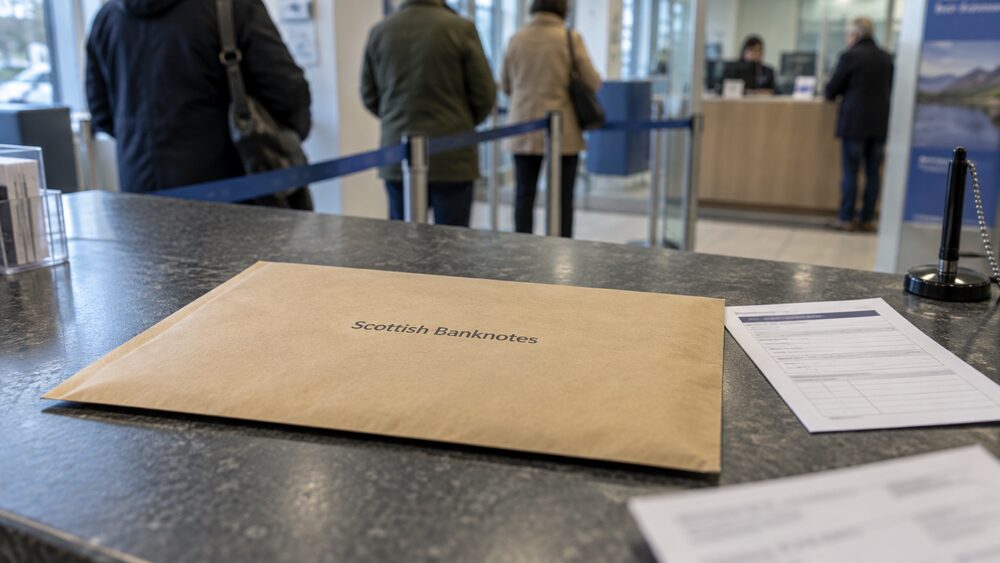
Scotland's banking market looks much like the rest of the UK's on the surface: the same big high street brands, the same apps and cards, and the same protections for your money. Two things make it distinct. First, three Scottish banks issue their own banknotes, around 320 million of them worth £5 billion in total face value in 2025, which raises practical questions about using Scottish money in England1. Second, Scotland has seen the deepest branch closures of any UK nation, with 722 of its 1,041 bank and building society branches closed and another 18 due to close as of November 20252.
This page covers both. It explains how Scottish banknotes work, how common counterfeits are, and what to do if a shop refuses one. It then looks at the main banks and building society serving Scottish customers, including Royal Bank of Scotland's accounts and its branch network, and Scottish Building Society's mortgages. It finishes with the checks you face when opening an account and the protections that apply if things go wrong.
Scottish banknotes: 320 million notes worth £5 billion in circulation
Three banks in Scotland issue their own banknotes: Bank of Scotland, Royal Bank of Scotland and Clydesdale Bank. In 2025 there were 320 million Scottish banknotes in circulation, with a total face value of £5 billion1. These notes are not a separate currency: a £10 Scottish note is worth exactly £10, and they are issued against backing assets held at the Bank of England under arrangements set by UK law.
The scale of the note issue matters to everyday life in Scotland because cash still plays a real role there. Around 500,000 people in Scotland rely on accessing cash, roughly 10% of the population, according to Consumer Scotland3. That is one reason the note issue, and the health of cash access more broadly, is watched closely by policymakers. The same research body notes that approximately 1 in 10 consumers in Scotland, equivalent to around 500,000 people, depend on access to cash3.
Scottish notes are printed to the same security standards as Bank of England notes, and the counterfeit figures bear that out: in 2025 there were approximately 240 counterfeits for every 1 million genuine banknotes across the total circulation of 320 million1. That is a tiny fraction, but it is not zero, and the section on counterfeits below covers what the numbers show.
Using Scottish banknotes in shops and elsewhere in the UK
The question people most often ask is whether Scottish notes are "legal tender". Strictly, Scottish banknotes are not legal tender, even in Scotland. Legal tender has a narrow technical meaning connected with settling court debts, and it does not oblige a shop to accept any particular kind of money. Acceptance of Scottish notes, in Scotland or anywhere else in the UK, is a matter of agreement between you and the business. In practice, Scottish notes circulate freely in Scotland and are accepted by most businesses in England, Wales and Northern Ireland, though a shop in England can decline one if it chooses.
If a shop refuses a Scottish note, there is no official body to compel it to take the note. The practical options are to pay another way, or to exchange the note. Banks in Scotland, and most banks elsewhere in the UK, will exchange Scottish notes for Bank of England notes, and the issuing banks themselves will do so. Bank of Scotland states that meeting UK law on these arrangements is a legal requirement for it6.
Access to cash generally is a live issue in Scotland. As of November 2025, 722 of Scotland's 1,041 bank and building society branches had closed, with another 18 due to close2. Consumer Scotland reported that Scotland was the first part of the UK to see over half of its bank and building society branches close3. Banking hubs, shared counters where several banks operate from one site, are one response: as of January 2024 there were 7 banking hubs in Scotland7. The Financial Conduct Authority oversees how banks maintain access to cash, and its review of branch closures covers firms including NatWest Group UK wide8.
Counterfeit Scottish notes: about 240 fakes per million genuine
Counterfeit levels on Scottish notes are low. In 2025 there were approximately 240 counterfeits for every 1 million genuine banknotes, within a total circulation of 320 million notes1. That means the overwhelming majority of Scottish notes in your wallet are genuine, but the fakes that do exist tend to be passed in ordinary retail transactions, so it is worth knowing what to look for: the issuing bank's name, the security features such as holograms and watermarks, and the feel of the paper.
Counterfeiting extends well beyond notes. UK Finance's fraud report for 2025 recorded 18,477 cases of counterfeit card fraud with losses of £4.7 million, and counterfeit cheque fraud of £0.5 million across 139 cases9. Fraud more broadly is a significant crime in Scotland, though reported levels differ sharply from England and Wales. Crimes of fraud in Scotland have fluctuated within a range of 6,900 to 9,000 per year over the last decade, around 8,000 incidents compared with the 273,000 reported in England and Wales10. Trading Standards Scotland logged 2,411 scams in 2016 and 2017, and Cifas recorded 5,827 identity fraud cases in Scotland in 201610.
If you are worried about scams, help is available. Citizens Advice Scotland bureaux handled 1,203 issues related to scams in a year, according to Scottish Government research11, and the Scottish Government funds organisations to give free debt advice12. Our guide to scams and fraud covers how to spot and report them.
Royal Bank of Scotland: accounts, overdrafts and savings
Royal Bank of Scotland is one of Scotland's two dominant retail banks and a familiar high street name. It offers the full range of personal banking: current accounts, savings, overdrafts, loans, mortgages and cards. It is part of the same banking group as NatWest, and the group also includes Ulster Bank13. The group is among the largest banks required to offer fee-free basic bank accounts, which includes Royal Bank of Scotland13, and it is formally designated under the rules to offer them, covering the RBS and Ulster Bank brands14.
On overdrafts, Royal Bank of Scotland has stated that customers can apply for an increased overdraft limit of £500, and that borrowers can apply to defer loan payments for up to three months via its mobile app15. On savings, it has stated that its fixed savings accounts can be closed early with no charge15, which is worth checking against the terms of any specific account, since many providers apply penalties for early closure.
For service, independent survey data gives a rough sense of scale rather than a verdict: in a Which? survey of mortgage borrowers in August and September 2025, Royal Bank of Scotland had 87 responses and averaged 8.4 appearances per week in borrowers' mortgage tables16. For contact, Royal Bank of Scotland's Premier banking line is 0333 202 3332, with Relay UK users able to dial 18001 before that number, and an international line of +44 131 278 350717. Other numbers are published on its website by product.
Royal Bank of Scotland branch closures in Scotland
Branch closures are the biggest change to banking in Scotland in a generation. As of November 2025, 722 of Scotland's 1,041 bank and building society branches had closed, with another 18 due to close2. Which? reported that Scotland was the first part of the UK to see over half of its branches close, with 751 of its 1,041 branches gone and another eight set to go18. Within that, Bank of Scotland has closed 225 branches in Scotland since 2015, while Royal Bank of Scotland has shut 18318.
The pattern is UK wide but Scotland has felt it earliest. Across the UK there were 410 closures in 2024, of which 31 were from Bank of Scotland and 20 from Royal Bank of Scotland18. NatWest Group, which comprises NatWest, Royal Bank of Scotland and Ulster Bank, has closed 1,565 branches in total18. For Royal Bank of Scotland customers in England and Wales, NatWest Group took the decision to close hundreds of RBS branches there because customers of that brand can now bank in a local NatWest branch19. In Scotland, where the RBS brand remains the group's main presence, the closures reflect the same shift to app and online banking.
If your local branch closes, the alternatives include the bank's app and online banking, post office counters for basic transactions, and the growing network of banking hubs, of which Scotland had 7 as of January 20247. The FCA's rules on access to cash require firms to consider the impact of closures and to put alternatives in place, and its reviews cover NatWest Group UK wide8.
Scottish Building Society: mortgages for properties in Scotland
Scottish Building Society is Scotland's own building society, a mutual owned by its members rather than shareholders, and it lends on properties in Scotland. It appears on the Scottish Government's list of lenders offering the Open Market Shared Equity scheme, alongside Bank of Scotland, Barclays, Halifax, Lloyds Bank, Nationwide, NatWest, TSB, Skipton, Leeds, several credit unions and others20. That scheme helps buyers on low incomes purchase a home with Scottish Government support, and the society's presence on the list shows it participates in shared equity lending as well as standard mortgages.
For borrowers, a building society differs from a bank in ownership and focus rather than in the products themselves: both offer mortgages, and our guide to mortgages covers how the market works. Scottish Building Society's lending is concentrated on Scottish property, which matters for things like the legal process of buying, since Scotland uses a different conveyancing system from England and Wales, and for property purchase taxes, where Land and Buildings Transaction Tax applies instead of Stamp Duty.
Support for homeowners in Scotland also comes through other routes. Under the Housing (Scotland) Act 2006, local authorities in Scotland are allowed to provide grants, loans and subsidised work for housing purposes21. And if you need to check your property's paperwork, you can pay a fee to order a copy of your title deeds from the Registers of Scotland22, which is often simpler than asking a lender to dig out original documents.
Borrowing limits by loan size at Scottish Building Society
Borrowing limits at any lender depend on income, deposit, property value and credit history, and the facts here do not include Scottish Building Society's specific loan size limits. What the facts do show is how the rules around borrowing interact with a borrower's circumstances in Scotland.
If you are bankrupt in Scotland, the law restricts your access to credit: you cannot take out credit of more than £2,000 unless you tell the creditor about your status5. You also cannot take out credit of any amount if, at that time, you have debts of at least £1,00023. These rules sit alongside the normal lending criteria a building society applies, so a borrower's debt history, including any insolvency, feeds directly into what they can borrow.
Enforcement also works differently in Scotland. If a creditor obtains a bank arrestment, freezing money in your account, your bank or building society can release the money earlier if you agree to this24. You can also object to an arrestment on grounds including undue hardship to you and your family, a court having allowed you time to pay, or the creditor not following the correct procedure24. Our guide to debt law in Scotland covers these mechanisms in full.
Why a mortgage application might be declined
Lenders do not always spell out why they decline an application, but the principle that applicants deserve an accurate reason is well established in Scottish public services. The Scottish Welfare Fund's statutory guidance states that applicants must be given an accurate reason for their application being rejected, even if this touches on sensitive issues25. Mortgage lenders operate under different rules, but the same expectation of transparency increasingly applies, and a declined applicant can ask the lender directly for the reason.
The evidence on refusal rates in Scotland is stark. Scottish Government research on the cost of living crisis found that among low income households in Scotland that applied for credit, 27% were refused in 202426. Refusals are not confined to credit: 28% of Scottish Child Payment applications were denied in 2024/2520. These figures describe different products, but together they show how often applications of all kinds fail, and how normal it is to be turned down.
For a mortgage specifically, the common drivers are income and affordability checks, credit history, deposit size and property issues. If you are refused, the practical steps are to ask for the reason, check your credit report for errors, and consider free debt or money advice: the Scottish Government supports organisations to give free debt advice12. If you believe a lender treated you unfairly, you can complain through the lender's process and then to the Financial Ombudsman Service, covered in the final section of this page.
Opening an account: identity and tax residency checks
Opening a bank account in Scotland involves the same identity checks as anywhere in the UK: proof of identity and address, and checks against sanctions and fraud databases. One set of checks that surprises many customers is the tax residency process. Banks in the UK, including Bank of Scotland, operate the Common Reporting Standard, under which they collect and share tax information with other countries.
Bank of Scotland states that it may ask you to complete a form if you have opened a new account, amended your personal details, or a review has shown out of date tax residency information or unknown US citizenship6. For individual customers with accounts in a participating country, the indicators include tax residence in another country, a mailing or residence address abroad, phone numbers, Power of Attorney or signatory authority, or standing transfer instructions in another participating country6.
The information banks report about individuals is extensive: name, address, date of birth, place of birth, country of tax residence, Tax Identification Number, account details, the reporting entity, the total account balance or value at the end of the calendar year, and the gross amount of interest, dividends and other income6. Bank of Scotland states that meeting these requirements is a legal requirement under UK law6. None of this costs you anything or blocks the account; it is a reporting obligation on the bank, not a tax on you.
If you are opening a basic account rather than a standard current account, the largest banks, including Royal Bank of Scotland, are required to offer fee-free basic bank accounts13, and NatWest Group, including the RBS and Ulster Bank brands, is designated for this purpose14. Our guide to current accounts covers the account types and how to switch.
Complaints, fraud and FSCS protection up to £120,000
If something goes wrong with a bank or building society in Scotland, the route is the same as elsewhere in the UK: complain to the firm first, then to the Financial Ombudsman Service. For bankruptcy matters specifically, the Accountant in Bankruptcy handles complaints about the process in Scotland23, and its role covers the administration and supervision of bankruptcy there27.
Fraud and insolvency levels give a sense of the risks. In Scotland there were 2,181 individual insolvencies in Q2 2026, up 13% on the year28. Counterfeit card fraud ran at 18,477 cases and £4.7 million of losses in 20259. If you are struggling, free help exists: the Scottish Government supports organisations to give free debt advice12, and our debt guide sets out the options.
On protection for your money, the Financial Services Compensation Scheme covers deposits with UK banks and building societies. On 1 December 2025 the deposit limit rose to £120,0004. Before that, and still for some categories, the figure people know is £85,000: the FCA's compensation rules set 100% cover up to £85,000 for protected home finance mediation29, and the Bank of England has noted that balances of more than £85,000 can be covered in certain circumstances under temporary high balance rules30. The documents here give both figures, and the difference is the type of claim: deposits are now covered to £120,000 per person per firm, while the £85,000 figure applies to other protected claims. The limit applies per person per licensed firm, so money spread across separate firms is protected separately.
For lost accounts and passbooks, the My Lost Account service traces them free: use the UK Finance form for lost accounts with banks, or with building societies that have become banks; the Building Societies Association form for current building societies; and the NS&I form for NS&I products31. That is the route if you lose a Scottish Building Society passbook and cannot get a replacement directly.
Sources31 cited
- Counterfeit bank notes UK Finance, 2025
- MSP briefing: access to cash and banking facilities Consumer Scotland, November 2025
- Consumer Scotland response to the Access to Banking Services Review call for evidence Consumer Scotland, 2026
- What we cover: banks, building societies and credit unions Financial Services Compensation Scheme, 2025
- Bankruptcy in Scotland National Debtline, 25 September 2026
- Common Reporting Standard FAQs Bank of Scotland, 27 September 2026
- Closure of high street banks: impact on local communities House of Lords Library, January 2024
- Access to cash Financial Conduct Authority, 2024
- UK Finance Fraud Report 2026 UK Finance, June 2026
- EKOS preventative spend research 2018, page 3 Scottish Government, 19 March 2021
- EKOS preventative spend research 2018, page 4 Scottish Government, 19 March 2021
- Debt and money Scottish Government, 25 September 2026
- Safe bank accounts Business Debtline, 26 September 2026
- Basic bank accounts: July 2023 to June 2024 HM Treasury, 5 November 2025
- Coronavirus: what it means for mortgages, savings, borrowing and benefits Which?, 31 October 2020
- Should you choose a bank or building society for your mortgage? Which?, 2025
- Premier Select Account Royal Bank of Scotland, 25 September 2026
- Bank branch closures: is your local bank closing? Which?, 7 July 2026
- Bank branch closures: is your local bank closing? Which?, 7 July 2026
- Open Market Shared Equity scheme: how to apply Scottish Government, 17 March 2026
- Housing grants Disability Rights UK, 14 April 2026
- After you buy Shelter Scotland, 25 July 2024
- Bankruptcy information document Accountant in Bankruptcy, 2026
- A creditor takes money from my bank or building society account Citizens Advice Scotland, 25 September 2026
- Scottish Welfare Fund statutory guidance, April 2025 Scottish Government, April 2025
- Review of emerging evidence on the effects of the cost of living crisis on debt in Scotland, page 5 Scottish Government, 2024
- Bankruptcy Accountant in Bankruptcy, 30 January 2024
- Individual insolvency statistics House of Commons Library, 2026
- Compensation sourcebook Financial Conduct Authority, 2022
- FSCS general insurance limit review Bank of England, 2 November 2023
- How to trace lost money Age UK, 10 February 2025



 Citizens Advice ScotlandFree advice across Scotland
 Citizens AdviceFree advice on money, consumer and legal problems in England and Wales
 MoneyHelperFree, impartial money and pensions guidance, set up by government
 GOV.UKOfficial information on tax, benefits and government services