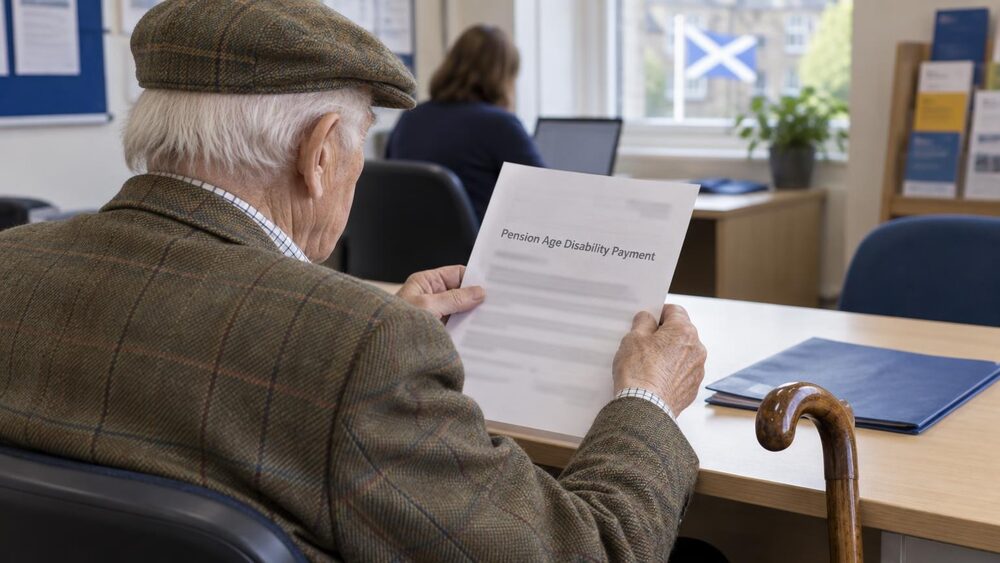
Where you live in the UK changes which body pays your benefits, and in some cases whether you get a payment at all. The Scotland Act 2016 devolved responsibility for certain disability and carer benefits from the UK Government to the Scottish Government, and a new public body, Social Security Scotland, now delivers them1. In Scotland, Adult Disability Payment has replaced Personal Independence Payment and Disability Living Allowance for people aged between 16 and state pension age, and Pension Age Disability Payment has replaced Attendance Allowance2. All of the devolved benefits apart from Industrial Injuries Benefits and Severe Disablement Allowance will, by 6 April 2026, have been replaced by new Scottish Government benefits delivered by Social Security Scotland3.
The sums involved are large. The devolution of disability benefits to Scotland in April 2020, alongside a number of other smaller benefits, accounted for around £3 billion of welfare spending4, and DWP statistics exclude amounts devolved to the Scottish Government, which totalled £5.2 billion in the financial year ending 20255 and is forecast to be £5.8 billion for the financial year ending 20266. Northern Ireland and Wales have taken different routes: Northern Ireland keeps the same benefits as Great Britain but adds mitigation payments that soften the benefit cap and the bedroom tax, while the Welsh Government funds a crisis grant scheme, the Discretionary Assistance Fund.
Which benefits are devolved and which stay UK-wide
The starting point is the Scotland Act 2016, which devolved a significant suite of social security powers to the Scottish Parliament, including powers to provide disability and carer assistance which had previously been reserved to the UK Government2. Not everything moved. DWP continues to administer Severe Disablement Allowance and Industrial Injuries Disablement Benefit in Scotland under Agency Agreements, which is why those two benefits are not replaced by Scottish equivalents by 6 April 20261.
The scale of the transfer has grown quickly. Devolved amounts excluded from DWP benefit statistics totalled £4.4 billion in the financial year ending 202311, £5.2 billion in the financial year ending 20255, and are forecast at £5.8 billion for the financial year ending 20266. Scotland also has some freedom over uprating: devolved Scottish low income benefits were uprated by 6% in April 2022, compared with 3.1% for most reserved benefits12.
The legislation itself shows how finely the split is drawn. The Social Security Benefits Up-rating Regulations 2026 extend to Great Britain, but regulation 2, insofar as it applies to a benefit devolved under Part 3 of the Scotland Act 2016, and regulation 4, extend to England and Wales only13. In other words, the same annual uprating exercise produces two instruments: one for the benefits DWP still pays in Scotland, and one for the benefits Social Security Scotland now pays.
Northern Ireland is a separate case again. Social security there is transferred rather than devolved, and is administered by the Department for Communities rather than DWP, under Northern Ireland's own legislation. The benefit cap in Northern Ireland, for example, has its own legal basis in the Welfare Reform (Northern Ireland) Order 2015, where Article 101 provides for the benefit cap and Article 102 for supplementary and consequential provision14. The amounts and most of the rules mirror Great Britain, but Northern Ireland has chosen to add mitigation payments on top, covered later on this page.
Wales has the least devolution of the three: benefits in Wales are run by DWP on the same terms as England, and the Welsh Government's main role is funding discretionary support such as the Discretionary Assistance Fund. For the money rules that do differ by nation, see the guides to Scottish and Welsh income tax, council tax in Scotland, council tax in Wales and domestic rates in Northern Ireland.
Social Security Scotland and the benefits it pays
Social Security Scotland is the public body that delivers the devolved benefits. The Social Security (Scotland) Act 2018 introduced a range of new benefits devolved to Scotland15, and the body now delivers four different types of disability assistance16, along with low income payments that have no DWP equivalent.
The disability and carer benefits it pays are17:
- Adult Disability Payment
- Child Disability Payment
- Pension Age Disability Payment
- Scottish Adult Disability Living Allowance (Scottish Adult DLA)
Alongside these sit the low income payments. The best known is the Scottish Child Payment, for which there is no limit on the number of children in a family who can get the payment18. It was extended to children aged 6 to 15 by the Social Security (Miscellaneous Amendment) (Scotland) Regulations 202219, and people who have a nil award of a qualifying benefit as a result of sanctions or deductions remain eligible for it19.
When a person becomes entitled to a Social Security Scotland benefit after a DWP benefit ends, the normal rule is that the new payment starts from the day after the DWP benefit stops20. That continuity matters for households budgeting week to week, because it avoids a gap between the two payments.
PIP and Attendance Allowance become Adult Disability Payment and Pension Age Disability Payment
The largest transfer is of disability benefits for adults. Adult Disability Payment replaces PIP and DLA for those aged between 16 and state pension age in Scotland, and Pension Age Disability Payment replaces Attendance Allowance2. People who were getting these benefits have been moved across rather than being asked to reapply: DWP statistics record cases with entitlement devolved to Scotland, including 1,500 PIP cases and 160 DLA cases devolved as at March 20261.
Moving to Scotland from elsewhere in the UK triggers a change of administrator. From 6 November 2025, anyone who moves to Scotland and was getting Personal Independence Payment at the time of their move can apply for Adult Disability Payment20. The same guidance confirms the payment start rule: Social Security Scotland normally pays the new benefit from the day after the DWP benefit stops20. The practical effect is that entitlement continues, but the letter, the phone number and the body making decisions all change.
For people over state pension age, Pension Age Disability Payment is the Scottish replacement for Attendance Allowance, and Scottish Adult DLA continues for those already receiving the older benefit2. The amounts and eligibility rules for these payments are covered in the benefits guide.
Child Disability Payment: how it works and when it stops
Child Disability Payment is the replacement for Disability Living Allowance for children in Scotland16. It is for children in Scotland who would otherwise claim DLA for children, including those waiting for, or challenging the outcome of, a DLA application21. Applications are made to Social Security Scotland through mygov.scot rather than to DWP21, and Social Security Scotland will tell you when your Child Disability Payment will stop21.
The legal foundation is the same as for the adult payments: the Scotland Act 2016 devolved new powers to the Scottish Parliament in relation to social security, including responsibility for disability benefits16.
A child moving from England or Wales to Scotland is the case where the rules bite hardest. DLA for children is not available in Scotland, so a new claim for Child Disability Payment must be made; the child's DLA will continue for up to 13 weeks after the move21. To avoid losing money between the two awards, there are deadlines. A client moving to Scotland who was in receipt of DLA for Children must register their name and date of birth with Social Security Scotland within 26 weeks of the move, and submit the completed part 2 of the application within 32 weeks. Provided both deadlines are met, the Child Disability Payment award is backdated to the day after the DLA for Children award ends16.
The deadlines that keep a child's disability payment continuous across a move to Scotland.
Northern Ireland's welfare mitigation payments
Northern Ireland runs the same core benefits as Great Britain but has added a mitigation scheme that pays back the money some households lose to the benefit cap and the bedroom tax. The Department for Communities mitigates the benefit cap for families through Welfare Supplementary Payments, which are automatically paid to offset the amount of benefit lost due to the cap, funded through the Executive's Departmental Expenditure Limit budget8. Because the payments are automatic, there is no separate application: a household that is capped receives a supplementary payment that makes up the difference.
The benefit cap itself has its own Northern Ireland legal basis in the Welfare Reform (Northern Ireland) Order 201514, and the exemptions mirror Great Britain, with local additions. The Housing Benefit Regulations (Northern Ireland) 2006 were amended so that the benefit cap does not apply where the claimant, the claimant's partner, or a young person for whom the claimant or their partner is responsible, is entitled to a carer support payment22. Carer support payment is the Scottish name for the carer benefit, and the Northern Ireland regulations recognise it so that carers moving between nations keep their exemption.
Scotland takes a different route to the same problem: the Scottish Government mitigates the effects of the benefit cap to an extent through Discretionary Housing Payments23. So a capped household in Scotland applies to its council for a discretionary payment, while a capped family in Northern Ireland receives an automatic supplementary payment. The dedicated guide to welfare mitigation payments in Northern Ireland covers the bedroom tax mitigation and how the scheme works in detail.
The benefit cap: £22,020 a year for families, with exemptions
The benefit cap limits the total amount of benefit certain households can receive. Outside London, the amounts are £22,020 per annum for couples and households with children, and £14,753 per annum for single people without children7.
The cap does not apply to everyone. It does not apply if a claimant has limited capability for work-related activity, or if they receive Industrial Injuries Disablement Benefit, Attendance Allowance or a War Pension. It also does not apply where there is DLA or PIP entitlement for the claimant, a child, or a qualifying young person7. Because Child Disability Payment is the Scottish replacement for DLA for children16, a child receiving it places the household in the same protected position as a child on DLA elsewhere in the UK.
| Household | Cap outside London | Exemptions include |
|---|---|---|
| Couples and households with children | £22,020 a year7 | Limited capability for work-related activity; Industrial Injuries Disablement Benefit; Attendance Allowance; War Pension; DLA or PIP for claimant, child or qualifying young person7 |
| Single people without children | £14,753 a year7 | The same exemptions apply7 |
In Northern Ireland, a capped family does not need to rely on exemptions alone: the Welfare Supplementary Payments scheme automatically offsets the amount lost to the cap8. In Scotland, Discretionary Housing Payments provide partial mitigation through local authorities23. England and Wales have no equivalent national mitigation scheme, so a capped household there depends on the exemptions, or on discretionary help from its council.
The two-child limit is being removed in all four nations
The two-child limit, which restricted child-related support to a household's first two children, is being removed across the UK, but through different legal routes in each nation. The Universal Credit (Removal of Two Child Limit) Act 2026 does this in two sections: section 1 extends to and applies to England, Wales and Scotland, while section 2 extends and applies to Northern Ireland only24. The provision covered by the Act is wholly reserved in England, Scotland and Wales, and wholly transferred in Northern Ireland, which is why two separate sections were needed24.
The mechanism in Great Britain is an amendment to section 10 of the Welfare Reform Act 2012, omitting subsection (1A), which was the two-child limit25. The Social Security (Removal of Two Child Limit) (Consequential Amendments) Regulations 2026 extend to England and Wales and Scotland26. In Northern Ireland, the two-child limit had also been written into income support and jobseeker's allowance by regulations 4 and 5 of the Social (Amendment) Regulations (Northern Ireland) 2017, and those provisions are revoked by the 2026 rule27.
Scotland had already moved ahead of the rest of the UK on child payments. The Scottish Child Payment has no limit on the number of children in a family who can get the payment18, and the Scottish Government's distributional analysis for its 2026 to 2027 budget refers to a payment expected to lift 20,000 children in Scotland out of relative poverty28. The detail of what the Act changes for Universal Credit claims is covered in the benefits guide.
Wales: the Discretionary Assistance Fund for emergencies
Wales has no devolved benefits of its own, but the Welsh Government funds a crisis grant scheme. The Discretionary Assistance Fund (DAF) is a Welsh Government funded crisis fund designed to provide financial assistance to individuals experiencing unexpected financial crisis with no other means of support29. It offers two types of grant: Individual Assistance Payments and Emergency Assistance Payments30. Because these are grants, they do not have to be paid back, unlike a loan or credit30.
The scheme is heavily used. Between September 2025 and March 2026 there were 129,200 payments with a total value of £18,779,0009. The figures are a measure of volumes rather than unique users, because up to three successful applications can be made by an individual in a 12-month period30. Since 2020, people impacted by the pandemic or the loss of the £20 Universal Credit uplift have been able to receive 5 payments in a 12-month period30.
The rules on how often you can apply have been relaxed. The 28-day gap between application dates has been reduced to 7 days for all applicants30. The Welsh Government publishes statistics on the scheme twice a year, in spring and autumn, typically covering the previous six months9.
Scotland's closest equivalents are the Scottish Welfare Fund's Community Care Grants and Crisis Grants, delivered by all 32 local authorities in Scotland31. Like the DAF, these are grants that do not need to be paid back; the Act specifies that the scheme is not for the provision of loans and credit but grants that do not need to be paid back31.
Challenging a decision in Scotland: redetermination first
Challenging a Social Security Scotland decision works differently from challenging DWP. When Social Security Scotland makes a decision, it sends a letter called a notice of determination32. The law says the letter must be clear and accessible and give guidance and explanations about the decision that has been made32. Social Security Scotland aims to make a decision after getting your completed application and any more information they need, and if you have a terminal illness they aim to decide in around 7 working days32.
Before appealing, you must ask for a re-determination: a fresh look at the decision by Social Security Scotland. A request for a re-determination should be made within 42 calendar days of being notified of the determination, and Social Security Scotland then has 56 calendar days to make the re-determination10. Only if you still disagree after the re-determination can you appeal to a tribunal10.
The re-determination process: ask within 42 days for a fresh look at the decision, then appeal if you still disagree with the outcome.
Awards are not set in stone after the decision either. Social Security Scotland will regularly review the information they have and any new information you provide, and will ask you about any changes to your day time care needs and night time care needs32. Reporting a change is therefore part of keeping the award right, not just something done at the point of claim.
Where to get help in each nation
Each nation has its own sources of free help with benefits. In Scotland, Social Security Scotland is the body to contact about the devolved benefits, and mygov.scot sets out the help available on a low income, including the Social Security Scotland benefits17. After a death, Social Security Scotland can be contacted to cancel the person's benefits and entitlements from the Scottish Government, for example the Scottish Child Payment; they can also check whether the person's family is eligible for help with funeral costs34. The Scottish Welfare Fund, delivered by all 32 local authorities, is the route for crisis and community care grants31.
In Northern Ireland, benefits are administered by the Department for Communities. It collects and keeps information about you and any benefits you claim, and it is allowed by law to cross-check this information and share it with certain other organisations35. You have a right, by law, to know what personal information is held about you by organisations, enforced by the Information Commissioner35. Advice NI and similar free advice services respond to consultations on Northern Ireland benefit changes and provide free advice on claims7. For debt problems, Scotland's Debt Arrangement Scheme is administered by the Accountant in Bankruptcy36; the debt law guide covers the differences between the nations.
In Wales, the Discretionary Assistance Fund is the Welsh Government's crisis support29, and DWP handles everything else on the same terms as England. Wherever you live, the benefits guide covers the UK-wide payments, their amounts and their eligibility rules, and the nations hub maps every rule that differs by where you live, from water bills to student funding.
Sources36 cited
- Annual DWP Benefits Statistics Compendium: 2026 GOV.UK, 2026
- Benefit combinations official statistics to March 2026 GOV.UK, 2026-09-15
- The Social Security Benefits Up-rating Regulations 2026 explanatory memorandum legislation.gov.uk, 2026
- Welfare spending: disability benefits Office for Budget Responsibility, 2024-01-19
- Fraud and error in the benefit system, financial year ending 2025 GOV.UK, 2025
- Unfulfilled eligibility in the benefit system, financial year ending 2026 estimates GOV.UK, 2026
- Advice NI response to the Universal Credit (Removal of Two Child Limit) Bill Northern Ireland Assembly, 2026-01-26
- Legislative consent memorandum, Universal Credit (Removal of Two Child Limit) Bill Northern Ireland Assembly, 2026-01-19
- Discretionary Assistance Fund statistics, September 2025 to March 2026 Welsh Government, 2026-05-28
- Pension Age Disability Payment: decisions mygov.scot, 2026-09-26
- Fraud and error in the benefit system, financial year ending 2024 GOV.UK, 2023
- Cost of living crisis in Scotland: analytical report gov.scot, 2022-04
- The Social Security Benefits Up-rating Regulations 2026 explanatory memorandum legislation.gov.uk, 2026
- Welfare Reform (Northern Ireland) Order 2015 legislation.gov.uk, 2015-12-09
- Evaluation of the Five Family Payments gov.scot, 2025-09-04
- Child Disability Payment statistics to 30 June 2026 Social Security Scotland, 2026-08
- Help on a low income mygov.scot, 2023-11-20
- Scottish Child Payment Social Security Scotland, 2026-09-28
- Scottish Child Payment policy gov.scot, 2026-09-26
- Supporting clients moving to Scotland from the rest of the UK Social Security Scotland, 2026-01-27
- Disability Living Allowance for children GOV.UK, 2026-09-25
- The Housing Benefit Regulations (Northern Ireland) 2006, amendment legislation.gov.uk, 2023-11-16
- Universal Credit Scotland dashboard, November 2021 gov.scot, 2021-11
- Universal Credit (Removal of Two Child Limit) Act 2026, explanatory notes legislation.gov.uk, 2026-03-18
- Universal Credit (Removal of Two Child Limit) Act 2026 legislation.gov.uk, 2026-03-18
- The Social Security (Removal of Two Child Limit) (Consequential Amendments) Regulations 2026 legislation.gov.uk, 2026-03-19
- Draft explanatory memorandum, two child limit regulations Northern Ireland Assembly, 2026
- Scottish Budget 2026-2027 distributional analysis gov.scot, 2026-01-13
- Discretionary Assistance Fund analysis report 2025 summary Welsh Government, 2026-01-29
- Discretionary Assistance Fund dataset StatsWales, 2025-10
- Scottish Welfare Fund statutory guidance gov.scot, 2026-03
- Pension Age Disability Payment reviews: what you need to know mygov.scot, 2026-09-26
- Pension Age Disability Payment and Scottish Adult DLA statistics to 31 July 2026 Social Security Scotland, 2026-09
- Reporting a death without Tell Us Once GOV.UK, 2026-09-28
- Benefit fraud (Northern Ireland) nidirect, 2026-08-20
- Debt Arrangement Scheme information for money advisers Accountant in Bankruptcy, 2024-01-31



 Citizens Advice ScotlandFree advice across Scotland
 Citizens AdviceFree advice on money, consumer and legal problems in England and Wales
 MoneyHelperFree, impartial money and pensions guidance, set up by government
 GOV.UKOfficial information on tax, benefits and government services