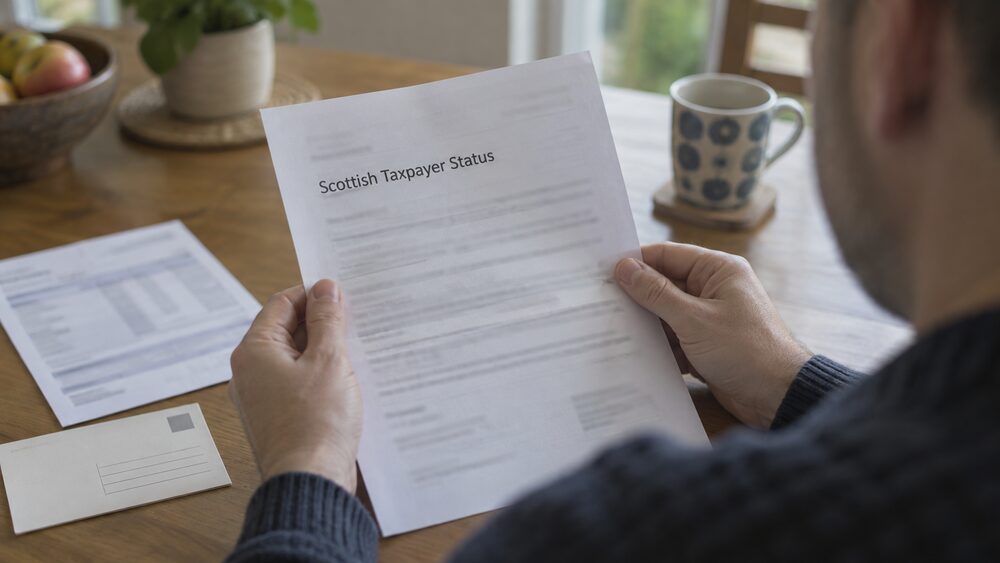
Whether you are a Scottish taxpayer comes down to where you live, not where you work. The definition is based on where an individual resides in the course of a tax year, and the location of a person's employer is not relevant1. So someone who works in Scotland but has their home elsewhere in the UK is not a Scottish taxpayer on that ground, and someone who works for an English company from a home in Scotland can be.
Whether you are a Scottish taxpayer comes down to where you live, not where you work. The definition is based on where an individual resides in the course of a tax year, and the location of a person's employer is not relevant1. So someone who works in Scotland but has their home elsewhere in the UK is not a Scottish taxpayer on that ground, and someone who works for an English company from a home in Scotland can be.
If you move to Scotland and live there longer than anywhere else in the UK during a tax year, you pay Scottish Income Tax2. The same test catches people with two homes: if you live in a home in Scotland and one somewhere else in the UK, for example for work, you can still be a Scottish taxpayer2. It also catches people who do not have a home and stay in Scotland regularly, for example offshore or in hotels instead2.
Once it applies, it applies for the whole tax year, which runs from 6 April to 5 April the following year3. Scottish taxpayer status applies for the entire tax year4. Scottish Income Tax applies to all non-savings, non-dividend income of Scottish taxpayers, and took effect from 6 April 20175. It is a partially devolved tax, and HMRC is responsible for its collection and management6.
Scottish taxpayer status depends on where you live, not where you work
The residence test is the whole of it. HMRC's own statistics describe the definition as based on where an individual resides in the course of a tax year, and state plainly that the location of a person's employer is not relevant1. That single sentence settles the question most people arrive with: a job in England, a payroll department in Manchester or a contract that names a London office changes nothing.
What does change things is the pattern of your living arrangements across the year. Mygov.scot sets out three situations that bring someone in: moving to Scotland and living there longer than anywhere else in the UK during the tax year; living in a home in Scotland and one somewhere else in the UK, for example for work; and not having a home at all but staying in Scotland regularly, for example offshore or in hotels instead2.
That third route matters for people who might assume they are outside the system. Offshore workers on the UK continental shelf are treated as having performed their duties in the UK, and their employment income is liable to UK tax where the work is on the UK continental shelf but outside the UK's territorial sea7. Someone in that position who is not UK resident can still find their earnings pulled into UK tax.
The practical consequence is that two people doing identical work for the same employer can be on different income tax systems, because one goes home to Scotland and the other does not. If you live in Scotland, the figures used to work out your income tax will be different from those in the rest of the UK3.
Status applies for a whole tax year
There is no part-year version. Scottish taxpayer status applies for the entire tax year4, and the tax year runs from 6 April to 5 April the following year3. Move to Scotland in February and, if Scotland is where you live for longer than anywhere else in the UK across that tax year, the Scottish rates apply to the whole of it, not just from the date the keys changed hands.
The same whole-year rule is written into the Welsh system, where Welsh taxpayer status applies for a whole tax year and it is not possible to be a Welsh taxpayer for part of a tax year8. The two devolved systems are separate, but they share this structure.
What the status covers is narrower than "all your income". Scottish Income Tax applies to all non-savings, non-dividend income of Scottish taxpayers, and took effect from 6 April 20175. Savings interest and dividends sit outside the Scottish rates. Scottish Income Tax is a partially devolved tax6, which is the technical way of saying that only part of what you earn is taxed under Scottish rules.
The Scottish Government's own technical factsheet puts a figure on the effect: once deductions such as pension contributions are taken into account, the proportion of Scottish taxpayers who are set to pay less than in the rest of the UK is expected to be around 57% for 2026 to 20276. That is an official projection for the population as a whole, not a statement about any individual's bill, which depends on how much you earn and how it is taxed.
Moving to or from Scotland: telling HMRC your new address
You must tell HMRC of your new address if you move to or from Scotland3. The consequence of not doing so is stated just as directly: you may pay tax at the wrong rate if you do not3. This is not a formality. HMRC works out which rates to apply from the address it holds, so an out-of-date record is how people end up on the wrong system for months.
The duty is not limited to crossing the border. To make sure you pay the right amount of tax, you must tell HMRC if you change address in Scotland2. A move between two Scottish addresses does not change your status, but HMRC still wants the new address on file.
Council Tax runs on a separate track with its own notifications. When you move in, you need to register for Council Tax, and you need to tell your local council if you move into or out of a property9. You must also tell your local council if another adult moves into or out of your home9. Those notifications go to the council, not to HMRC, and doing one does not do the other.
If you moved to Scotland while receiving Carer's Allowance or a disability benefit, or while caring for someone who receives a disability benefit, there are further steps. Tell the benefit provider your change of address, and make a new application to Social Security Scotland for the replacement Scottish disability and carer benefits10. Disability and carer benefits are devolved, so the award does not simply follow you across the border.
If HMRC has your status wrong: checks, corrections and errors
HMRC does not sign off a tax return and close the file. When HMRC deal with tax returns, they use a process now, check later approach11. A return can be processed, a code issued and tax collected, and the position examined afterwards.
There are two correction windows, and they belong to different people. If HMRC find an obvious error on a tax return, they can correct it within nine months of the date it was filed12. Separately, you usually have 12 months from the tax return deadline to correct the mistake yourself14. If a figure on your return is wrong, the sooner it is raised the more room there is to fix it inside the relevant window.
If you disagree with something HMRC has decided, there is a route for that. HMRC's own guidance covers disagreeing with a tax decision or penalty, alongside checking if a letter you have received from HMRC is genuine, getting extra support due to your health or personal circumstances, making a payment, getting help with signing in to HMRC online services, what help is available if you cannot pay your tax on time, and what will happen if you do not pay your tax bill15.
Errors carry consequences beyond the tax itself in some settings. Revenue Scotland states that any omission, error or inaccuracy in a claim may render you liable to financial penalties and, or, prosecution16. That wording sits on the land and buildings transaction tax side rather than income tax, but it shows the standard applied to claims made to a Scottish tax authority.
Getting help from HMRC
For queries about the rate of tax you pay, you can call HMRC on 0300 200 3300, with lines open Monday to Friday from 8:00 to 18:006. The same number is given for tax queries from NHS Scotland pensioners18. In Scotland you can also contact Advice Direct Scotland on 0808 164 600019.
If the problem is paying rather than calculating, the first step is to make contact rather than wait. Contact HM Revenue and Customs if you cannot pay your tax bill on time, as you could get more time to pay or pay in instalments20. HMRC also publishes an online tool to help you find the right guidance and support if you owe money to HMRC for tax or penalties15.
HMRC have a duty to support people who need extra help, including those with physical or mental health conditions21. That duty sits alongside the general guidance topics above, and it is worth naming explicitly because people with a health condition or a caring role often assume the system has no flexibility. If you need someone to deal with HMRC on your behalf, there is guidance on having someone help you21.
Free, independent help exists outside HMRC. TaxAid publishes guidance on tax enquiries and on problems with returns you have already submitted12, and on claiming a refund on pension tax7. If you are on a low income, the Scottish Welfare Fund guidance requires a check on whether the applicant is on a low income or does not have access to their money23, and the Scottish Government's cost of living pages set out debt and money support20.
Where the Scottish rules reach, and where they stop
Scottish Income Tax is a partially devolved tax6, and the boundary of what it covers is worth knowing because it explains why some of your income is taxed under Scottish rates and some is not. Non-savings, non-dividend income falls inside it5. Savings interest and dividends do not.
Pension tax relief interacts with the Scottish rates. Scottish taxpayers can get 22% relief up to the amount of any income they have paid 42% tax on24. That is a rule about how relief is given at source and then adjusted, and it is one of the places where being a Scottish taxpayer produces a different outcome from being a taxpayer elsewhere in the UK.
Some Scottish benefits are taxable and some are not, which affects the picture at the end of the year. Scottish Carer Supplement is taxable, and you will need to notify HMRC if you receive it25. Carers UK states that in Scotland, Scottish Carer Supplement is also taxable and will be taken into account when looking at whether a person is liable for any Income Tax26. If you receive it and do not normally file a return, that is a reason to check whether you need to.
Other devolved payments sit outside the tax system entirely. The Funeral Support Payment requires the client to be ordinarily resident in Scotland27, and Scottish postgraduate loans require the applicant to have a legal status in the UK28. These are residence conditions for Scottish support, not tax status tests, and they are decided separately from whether you are a Scottish taxpayer.
If you are leaving the UK rather than moving within it, different rules apply again. Non-UK residents who sell a UK home must tell HMRC within 60 days of transferring ownership through conveyancing, even if there is no tax to pay29. And where you live changes which advice you need: you will need different advice if you live in Scotland30.
Sources30 cited
- Scottish Income Tax outturn statistics 2024 to 2025 GOV.UK, 2026-07-09
- Scottish Income Tax: who pays mygov.scot, 2026-04-06
- Scottish Income Tax: if you move to or from Scotland GOV.UK, 2026-09-28
- Scottish tax and pension tax relief Hargreaves Lansdown, 2026-09-26
- Income Tax Scottish Government, 2026-09-28
- Scottish Income Tax technical factsheet Scottish Government, 2026
- How to claim a refund on pension tax TaxAid, 2025-09-24
- Welsh Income Tax outturn statistics 2024 to 2025 GOV.UK, 2026-07-09
- Council Tax: register mygov.scot, 2026-04-01
- Benefits if you are disabled, ill or injured Carers UK, 2026-09-26
- Income tax debt Business Debtline, 2026-09-26
- Tax enquiries TaxAid, 2025-09-26
- Self Assessment: enquiries TaxAid, 2025-09-26
- Enquiries and other problems with returns you have submitted TaxAid, 2026-09-26
- Find out what to do if you owe money to HMRC GOV.UK, 2025-08-18
- How to claim a repayment of the Additional Dwelling Supplement Revenue Scotland, 2025-10-02
- Tax overpayments and underpayments GOV.UK, 2026-09-25
- Annual pension increase Scottish Public Pensions Agency, 2026
- Problems with services: consumer advice Isle of Anglesey County Council, 2025-09
- Debt and money Scottish Government, 2026-09-25
- Having someone help you TaxAid, 2026-06-19
- Problems paying tax debt: health TaxAid, 2026-06-19
- Scottish Welfare Fund statutory guidance Scottish Government, 2025-04
- Scottish Income Tax: allowances and reliefs mygov.scot, 2026-04-06
- Carer's Allowance and the earnings limit Carers UK, 2026-09-26
- Carer's Allowance Supplement in Scotland Carers UK, 2026-09-26
- Eligibility for Funeral Support Payment Social Security Scotland, 2026-09-26
- Postgraduate loans in Scotland Prospects, 2026-09-26
- Tax when you sell your UK home if you live abroad GOV.UK, 2026-09-27
- Income tax debt in England and Wales Business Debtline, 2026-09-26










 Citizens Advice ScotlandFree advice across Scotland
 Citizens AdviceFree advice on money, consumer and legal problems in England and Wales
 MoneyHelperFree, impartial money and pensions guidance, set up by government
 GOV.UKOfficial information on tax, benefits and government services