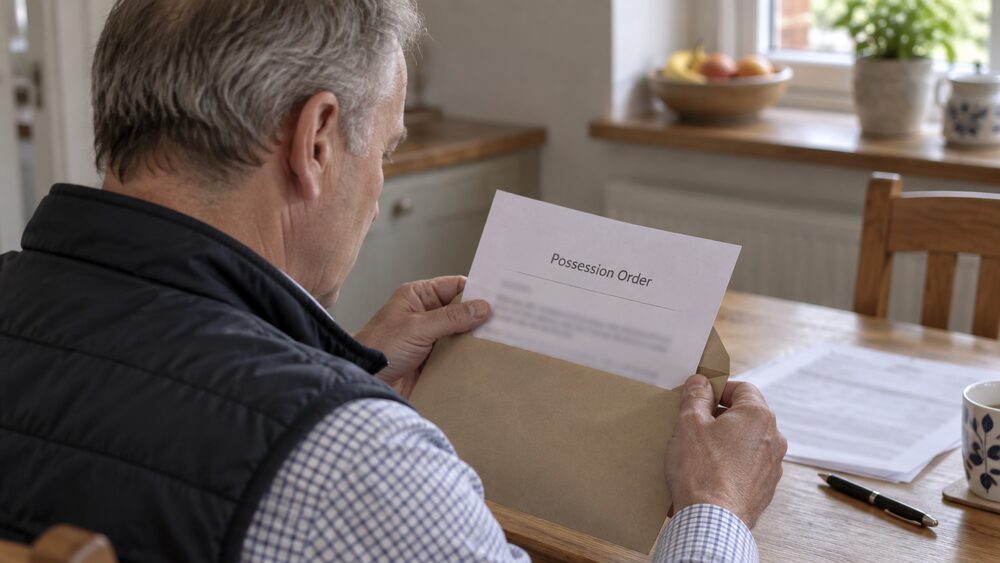
If a court has decided your lender can take your home, the type of order it makes decides what happens next. There are two types of possession order: an outright possession order and a suspended possession order1. An outright order sets a date by which you must leave, and after that date you no longer have the right to live in your home2. A suspended order lets you stay as long as you keep to the payments the court sets3.
If a court has decided your lender can take your home, the type of order it makes decides what happens next. There are two types of possession order: an outright possession order and a suspended possession order1. An outright order sets a date by which you must leave, and after that date you no longer have the right to live in your home2. A suspended order lets you stay as long as you keep to the payments the court sets3.
The date for possession on an outright order is usually 28 days after the court hearing, though it can be as soon as 4 weeks after the hearing2. It is not the same as an eviction date: if you are still in the property after the date for possession, the lender can apply for bailiffs, who then give you a separate eviction date and time5.
Official statistics for April to June 2026 show the median time from claim to repossession was 45 weeks for outright orders, an increase of 5.3 weeks, and 120.7 weeks for suspended orders, a decrease of 22.4 weeks6. That gap matters: a suspended order usually means a much longer process, because you are still in your home while you pay.
An outright possession order sets a date you must leave
An outright possession order is the court's decision that you must leave your home by a set date. The order sets a "date for possession"5. After that date, you will not have the right to live in your home2. The court sets a date that you must leave, and it could be very soon after your court hearing1.
The practical effect is that the clock is running. You must leave your home by the date on the order, and if you do not move out on time, your lender can apply to evict you9. The same rule applies whether the claim came from a mortgage lender or a freeholder: if the court orders a repossession, it will set a date by which you have to move out, and if you do not leave by that date, your lender or freeholder can ask the bailiffs to evict you10.
An outright order is different from a suspended order in one crucial way. With a suspended order, you keep your home as long as each month you pay your mortgage and a set amount towards the arrears11. With an outright order, there is no payment plan keeping you in the property: the order is that you leave.
If you are a tenant rather than an owner, the same framework applies when your landlord's lender repossesses. A landlord cannot take back possession without a court order7. If your landlord bought the property through a Buy-to-Let mortgage, you probably have no right to stay in the property after it is repossessed by the lender12. There is more on this in renting a home your landlord's lender is repossessing.
The date for possession: usually 28 days, up to 6 weeks
The date for possession is usually 28 days after the court hearing2. It can be as soon as 4 weeks after the hearing4. In Scotland, a sheriff court possession order normally allows you at least 28 days before your landlord could take further action6.
The court has some discretion to give longer. If the possession claim was made because of serious rent arrears, the maximum time the court can give you is six weeks13. In some cases you can ask for the possession order to be postponed for a longer period, for example three months, to allow a sale14.
The date for possession is not the same as an eviction date5. This is the single most important distinction on this page. The date for possession is the deadline in the order. The eviction date is a later step: if you have not left by the date in the order, the lender applies for a bailiff's warrant, and the bailiffs then write to you with a date and time2.
When a judge makes an outright order
A judge makes an outright order when the case for possession is made out and there is no basis for letting you stay on terms. In some situations the judge has no choice. In housing association cases where the landlord used ground 8, the judge must make an outright possession order if you still owe more than 8 weeks' rent15. Where an outright order is made on that basis, the court cannot stop the bailiffs5.
The same mandatory outcome applies in shared ownership. If ground 8 is proven, the court is required by law to order possession of the property16. For sub-occupation contracts, the court will only grant an extended possession order if it grants a possession order against the contract holder17.
An outright order also has knock-on effects beyond your home. You cannot buy your home under the Right to Buy if a court has made a possession order which says that you must leave your home18.
If you are facing a hearing, the court process and what you can say are covered in what happens at a mortgage repossession hearing and returning the court defence form. Free, independent advice is available before the hearing from Shelter, National Debtline and court duty help desks.
Asking the court to suspend an outright possession order
You can ask the court to suspend an outright possession order2. This is not automatic, and it depends on what you can offer and why you need more time.
The court can make a suspended possession order if you can keep to a repayment plan, for example by paying £50 a month on top of the normal mortgage payment3. A suspended order means you are ordered to leave, but the actual eviction is delayed; if the arrears are cleared, the suspended order is no longer valid19.
If a warrant for possession has already been issued, you can ask the court to suspend it. The reasons to ask include: to give you more time to sell, to give you more time to find somewhere else to live, or to make a new offer of payment on your arrears20. If you are a tenant and the lender will not delay the eviction, you can ask the court to suspend the warrant of possession for 2 months21.
The application is made on court form N244, and the fee is £157. On the form, question 3 asks what you want the court to do. A suggested wording is:
There is more detail on the form and the process in using form N244 to stop mortgage repossession.
Can I get more time if leaving would cause me extreme hardship?
Yes, in limited circumstances. If you can prove that you would be in extreme hardship, the judge may agree to delay possession for up to 6 weeks7. This is a specific test, and you need evidence of the hardship, not just a preference to stay.
The court can also make a possession order with a stay, which means you must leave your home after a certain amount of time. The judge may use this order if you cannot leave right away, for example if you are sick or pregnant, or to give you time to pay off a debt9. In some cases the court can postpone the possession order for a longer period, for example three months, to allow a sale14. For more time to find somewhere else to live, an example period is two months22.
If you are in Scotland, the options differ. The Home Owners' Support Fund and the Mortgage to Shared Equity scheme are designed for homeowners in difficulty, and the sheriff court process is set out in repossession in Scotland. In Northern Ireland, the process and help available are covered in repossession in Northern Ireland.
After the date for possession: bailiffs and eviction
If you have not left your home by the date set in your outright possession order, or you broke the terms set out in your suspended possession order, your lender can send bailiffs to evict you1. The lender applies to the court for a bailiff's warrant, and you will receive a letter from the court bailiffs giving you an eviction date and time2.
The notice period can be short. If you have a suspended possession order and you miss even one payment, or pay less than the sums ordered, your lender can apply to the court for a bailiff's warrant straight away. There is not normally another hearing, and you may only get a few days' warning before the bailiffs arrive to evict you23.
In England and Wales, the law sets a notice requirement before a possession order can be executed. The order may be executed only if the mortgagee gives notice at the property of any prescribed step taken for the purpose of executing the order, and only after the end of a prescribed period beginning with the day on which such notice is given24.
After the eviction, arrangements for removing furniture and possessions should usually be made within two weeks of the eviction20. If bailiffs take items, proof of ownership such as a credit agreement or a receipt must be shown to the bailiff25. In Scotland, an exceptional attachment order is where a sheriff officer seizes property inside your home, as a last resort, with prior application to the sheriff court26.
What repossession costs you: sale, shortfall and credit record
Repossession does not usually end the debt. If selling your home does not raise enough money to repay the first mortgage, and any other mortgages, plus all the costs, you may still owe some money to the lender20. If the money from the sale of your home is not enough to cover your mortgage debts, you will still owe the outstanding amount to your lender27. Even if you sell voluntarily, you will still have to repay the full amount outstanding on your mortgage, and your lender can take legal action against you to get back any unpaid debts even after the property is sold28.
There is more on this in do I still owe a mortgage shortfall after repossession.
The credit record effect is long. When your home is repossessed it stays on your credit record for up to 6 years8. Your house being repossessed will affect your credit rating29. Repossession can also affect your housing options: it might be harder to buy another home or rent privately30. There is more on borrowing again in borrowing again after a repossession.
If you are struggling with mortgage arrears, free and impartial help is available. Mortgage arrears: what to do if you cannot pay sets out the options, and what a lender must do before going to court explains the rules lenders must follow. Shelter, National Debtline and MoneyHelper all give free advice, and your local council can help with housing options after a repossession8.
Sources30 cited
- House repossession StepChange, 2026-09-25
- What can the court do? Shelter Cymru, 2026-07-30
- Mortgage arrears National Debtline, 2026-09-25
- Rent arrears in social housing National Debtline, 2026-09-25
- Possession orders Shelter England, 2024-08-26
- Mortgage and landlord possession statistics: April to June 2026 Ministry of Justice, 2026-04
- Mortgage arrears Business Debtline, 2026-09-26
- Car repossession National Debtline, 2026-09-25
- Eviction for rent arrears Housing Rights, 2026
- Home repossession process Shelter England, 2026-08-24
- Taken to court by your mortgage lender Housing Rights, 2026
- Rent arrears National Debtline, 2026-09-25
- Possession hearing Shelter England, 2024-08-26
- Ask the lender to delay eviction Shelter England, 2026-05-01
- Your right to buy your home: a guide GOV.UK, 2026-04-08
- Sub-occupation contracts Shelter Cymru, 2026-07-27
- What happens when a lender sells your home Shelter England, 2026-01-27
- Diligence National Debtline, 2026-09-25
- Rent arrears in social housing Business Debtline, 2026-09-26
- Notices of possession served from 1 May 2026 GOV.UK, 2026-04-07
- How to stop an eviction after a repossession hearing Shelter England, 2026-07-14
- High Court enforcement National Debtline, 2026-09-25
- Mortgage Repossession (Protection of Tenants etc) Act 2010 legislation.gov.uk, 2010-04-08
- What can a bailiff take? Debt Advice Foundation, 2020-06-04
- Car finance Advice NI, 2026-09-26
- Can shared owners lose all of their investment? National Housing Federation, 2026-09-26
- Find a home after repossession Shelter England, 2026-06-30
- Paying off mortgage debt Shelter Cymru, 2026-08-28
- Logbook loan debt StepChange, 2026-09-25
- What is secured debt? National Debtline, 2026-09-25







 MoneyHelperFree, impartial money and pensions guidance, set up by government
 StepChangeFree debt advice and solutions from a charity
 Financial Ombudsman ServiceFree, independent help when a complaint about a firm is not put right
 Citizens AdviceFree advice on money, consumer and legal problems in England and Wales
 ShelterFree housing advice from a charity