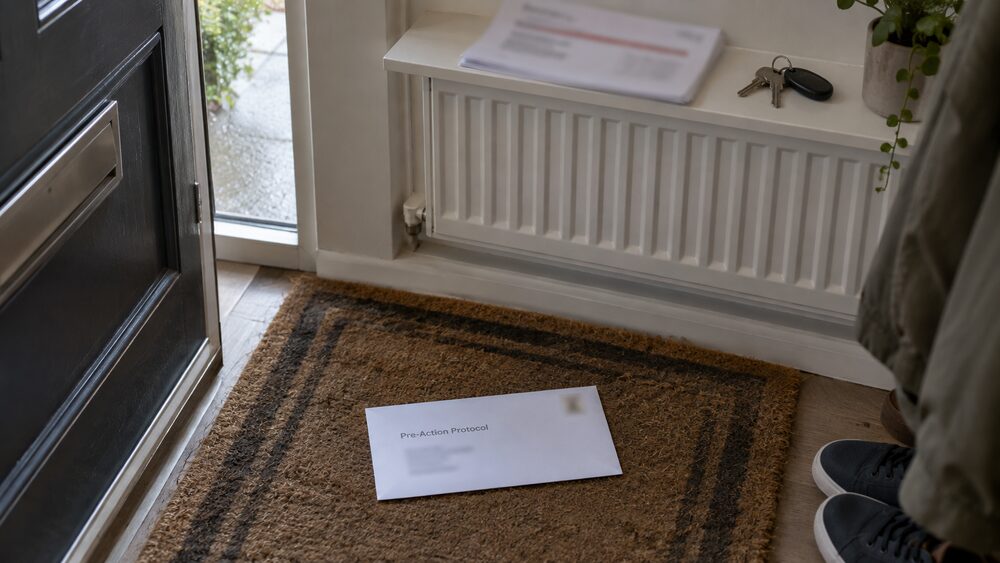
If you fall behind on your mortgage, the law does not let your lender simply change the locks. For a mortgage or secured loan on the home you live in, the lender will normally need a court order before it can take possession1. Before it can even start a court claim, it is expected to follow a set of rules called the pre-action protocol: a framework designed to make both sides talk and try to reach an agreement first2.
If you fall behind on your mortgage, the law does not let your lender simply change the locks. For a mortgage or secured loan on the home you live in, the lender will normally need a court order before it can take possession1. Before it can even start a court claim, it is expected to follow a set of rules called the pre-action protocol: a framework designed to make both sides talk and try to reach an agreement first2.
The protocol applies to most residential mortgages, including first and second mortgages3. It does not apply to buy-to-let mortgages2. Most lenders do not start repossession action until at least three payments have been missed, and lenders could previously start after three months of arrears4. Repossession is always a last resort, and there are several steps you can take before it gets that far5.
This page explains what the protocol asks of your lender, when court action usually begins, how selling your home yourself can work, where the rules apply, and what happens to the shortfall and your credit record if repossession goes ahead.
The pre-action protocol: talking before any court claim
The pre-action protocol is a set of court rules describing how a lender is expected to pursue legal action8. Its purpose is to ensure that you and your mortgage provider try to reach an agreement before having to go to court9. Before the repossession process, your lender must contact you and try to work things out, and show the court what was offered10.
The protocol sits alongside the FCA's mortgage conduct rules, known as MCOB. Most first mortgages taken out on or after 31 October 2004 will be regulated by the FCA's MCOB rules11. Those rules require lenders to treat customers fairly when they fall into arrears, and the protocol adds a court-facing layer on top.
If your lender takes you to court, it must complete a checklist to confirm that it has followed the protocol12. The court will look at that checklist when deciding what order to make. If the lender has not followed the protocol, the court can take that into account, though the protocol is not a law that automatically blocks a claim.
The protocol also allows a lender to postpone repossession action when the Financial Ombudsman Service is dealing with a complaint3. If you have made a complaint to the ombudsman about how your lender has handled your arrears, that can pause the process while it is investigated.
"This Protocol describes the behaviour the court will normally expect of the parties prior to the start of a possession claim"
What the protocol asks your lender to do
The protocol sets out a series of steps the lender should take before starting a court claim. These are not optional extras: they are what the court expects to see.
The lender must contact you and try to work things out10. It must consider any reasonable request from you to change how you pay your mortgage, such as switching to a different payment arrangement3. It must respond to any offer of payment you make3. If it turns down your offer, it must give you its reasons within ten working days3.
The protocol also expects the lender to give you information about your arrears. Before going to court, it must give you a list of all missed payments, details of the total amount of your arrears, and information about how much you still owe on your mortgage13. That gives you the figures you need to make a realistic proposal.
Any proposal made under the protocol is expected to be a realistic one, and the rules state that unrealistic arrangements for payment should not be put forward14. A lender is more likely to accept an offer that reflects what the borrower can genuinely afford than one that is too low to be credible.
In Scotland, the rules are different. Before making an application to court, the creditor must comply with pre-action requirements, and must make reasonable efforts to agree with the debtor proposals in respect of future payments and fulfilment of other obligations15. The creditor must not make an application if the debtor is taking steps likely to result in payment of arrears or the whole amount within a reasonable time15.
When lenders usually start taking action
There is no single number of missed payments that triggers court action. Most lenders do not start repossession action until you have missed at least 3 payments4. Lenders could previously start repossession orders after three months of arrears18. The protocol's emphasis on negotiation means the timing depends heavily on whether you are engaging with the lender and what you are offering.
If you miss your mortgage repayments and cannot agree a repayment plan, your mortgage lender might start court action to repossess your home19. The key phrase is "cannot agree": if you are talking to the lender and making realistic proposals, the process should slow down.
There are other circumstances that can change the picture. If you are made bankrupt, the trustee tells your mortgage lender you are bankrupt, and they may consider repossession even if you are up to date with your payments, and it is more likely if you are behind on payments20. If you have an interest-only mortgage and the loan has not been repaid by the end of the term, lenders will have the legal right to repossess your home21.
Official statistics give a sense of how long cases take once they reach court. In April to June 2026, the median time from claim to repossession for suspended orders was 120.7 weeks, a decrease of 22.4 weeks22. That figure covers cases where the court suspended the possession order, not every case.
Selling your home yourself before repossession
One of the most important options the protocol preserves is the chance to sell your home yourself. The lender should give you the chance to sell your home to pay off the debt, and you must show you are taking active steps to sell23. Selling voluntarily usually achieves a better price than a forced sale after repossession.
If you can show that you have received a better offer from a serious buyer, the courts may be willing to make an order for sale allowing the borrower to sell the property, preventing the lender from selling for a limited amount of time24. That gives you a window to complete a sale on your own terms.
A mortgage repossession hearing gives the borrower a chance to explain to a judge why they should keep their home or sell it themselves25. The hearing is not just a formality: it is where the case can be presented, including any offer received.
The FCA's rules add a further step. That is a recognition that repossession can lead to homelessness, and that council housing may be an option.
If you are dealing with a serious illness or disability, organisations such as Macmillan can provide financial support and advice on mortgage worries26. Free, impartial help is available from Shelter, National Debtline and MoneyHelper.
Where the protocol applies and where it does not
The protocol applies to most residential mortgages3. It applies to residential first and second mortgages27. That means a second charge secured loan on your home is generally covered, as well as your main mortgage.
The protocol does not apply to buy-to-let properties9. Buy To Let mortgages are excluded from the protocol2. For most business mortgages, such as buy-to-let or commercial mortgages, the Law of Property Act 1925 gives the lender the right to repossess the property or land without a court order by appointing LPA receivers28. If you have a buy-to-let mortgage, the protections described on this page largely do not apply.
There are also limits on what counts as a guarantee under the FCA's consumer credit rules. A guarantee does not include a legal or equitable mortgage or a pledge29. That distinction matters if you have guaranteed someone else's loan: the rules that apply to guarantees are not the same as those that apply to mortgages.
In Scotland, the pre-action requirements are set out in legislation rather than a court protocol. The creditor must make reasonable efforts to agree with the debtor proposals in respect of future payments and fulfilment of other obligations15. The creditor must not make an application if the debtor is taking steps likely to result in payment of arrears or the whole amount within a reasonable time15.
In Northern Ireland, the guidance is different again. The pre-action protocol applies to most residential mortgages3. If you are a homeowner in Northern Ireland, the advice is tailored to the Northern Ireland court process10.
If repossession goes ahead: sale, shortfall and your credit record
If the court makes a possession order and your home is repossessed, the lender will sell it. Your home will then usually be sold as quickly as possible, often for less than the market value, meaning you would owe the bank even more than you would have if you had sold the property yourself30. That is why selling voluntarily, if you can, usually leaves you in a better position.
The lender must follow Financial Conduct Authority rules and sell your home for the best price that might reasonably be paid, taking into account things like house market conditions31. It cannot simply accept the first low offer. Your lender and any other secured debts will use the money to clear your debt with them; you will get any money left over; if the sale does not cover your debt, you may be asked to pay this back32.
If the sale does not cover what you owe, the remaining debt is called the mortgage shortfall. If it sells for less than you owe them, they may want you to pay back the rest of the debt, the mortgage shortfall7. The lender can pursue you for that shortfall, though it may take time and there are rules on how long it can chase you.
A repossession stays on your credit record for up to 6 years6. During that time it can affect your ability to get credit, and it may make it harder to buy another home or rent privately33. After six years it should drop off your credit file, though lenders may still ask about your history.
Sources33 cited
- The Regulated Activities (Amendment) Order 2025 legislation.gov.uk, 2025
- Pre-Action Protocol for Possession Claims based on Mortgage or Home Purchase Plan Arrears in Respect of Residential Property Ministry of Justice, 2017
- Advice to avoid losing your home nidirect, 2025
- Taken to court by your mortgage lender Housing Rights, 2026
- Housing related debts Advice NI, 2026
- Pre-action protocol in the county court Business Debtline, 2026
- Repossession GOV.UK, 2026
- Home repossession process Shelter England, 2026
- How to deal with missed mortgage payments Shelter England, 2026
- What to do if you can't pay your mortgage Which?, 2025
- Mortgage shortfalls National Debtline, 2026
- House repossession StepChange, 2026
- Mortgage arrears National Debtline, 2026
- Mortgage repossession hearings Shelter England, 2026
- Sale by mortgage lender Shelter Cymru, 2026
- Negative equity Which?, 2025
- Mortgage arrears or payment difficulties nidirect, 2025
- Find a home after repossession Shelter England, 2026
- After repossession Shelter Scotland, 2025
- Mortgage arrears StepChange, 2026
- Bankruptcy and my home StepChange, 2026
- Section 4: proceedings relating to residential property: pre-action requirements legislation.gov.uk, 2026
- Section 3: creditor making an application under section 5(1) legislation.gov.uk, 2026
- Mortgage and landlord possession statistics: April to June 2026 Ministry of Justice, 2026
- Sorting out mortgage problems Housing Rights, 2026
- Mortgage worries Macmillan Cancer Support, 2026
- How to tackle your interest-only mortgage Which?, 2026
- What is secured debt? National Debtline, 2026
- Your priority debts Business Debtline, 2026
- Mortgage arrears Business Debtline, 2026
- Mortgage shortfalls Business Debtline, 2026
- Mortgage arrears debt help and advice Creditfix, 2026
- Personal auction finance Together Money, 2026












 MoneyHelperFree, impartial money and pensions guidance, set up by government
 StepChangeFree debt advice and solutions from a charity
 Financial Ombudsman ServiceFree, independent help when a complaint about a firm is not put right
 Citizens AdviceFree advice on money, consumer and legal problems in England and Wales
 ShelterFree housing advice from a charity