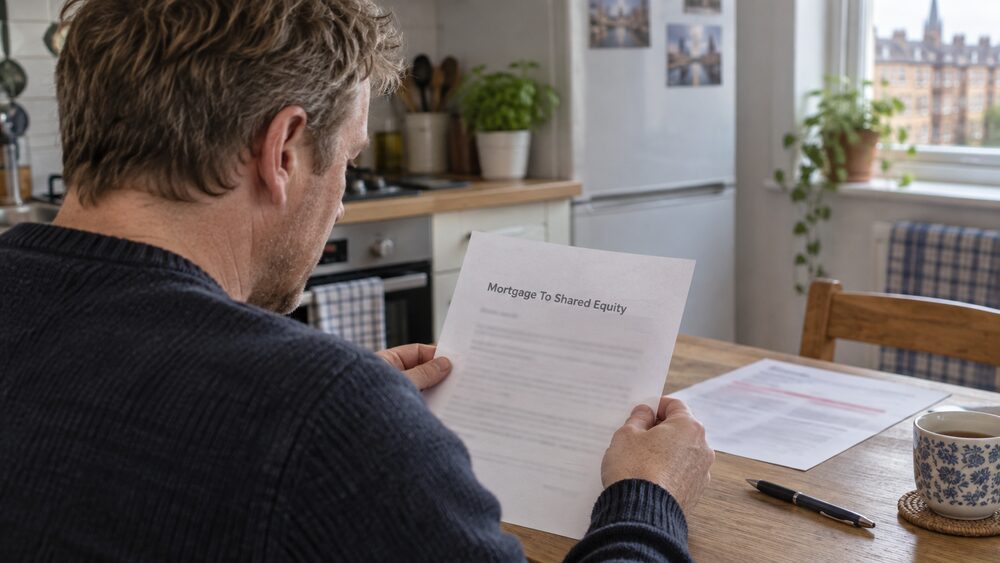
If you are behind on your mortgage in Scotland and your home is at risk, the Mortgage to Shared Equity scheme lets the Scottish Government buy a stake of up to 30% in your property so you can pay down your loan to a manageable level. You stay the owner and you do not pay rent on the government's share1.
It is one of two schemes that make up the Home Owners' Support Fund, which is run by the Scottish Government to help people stay in their homes. The other is Mortgage to Rent, where a social landlord buys your home and you stay there as a tenant1.
The scheme is not open to everyone. You must hold at least 25% equity in your home, and you cannot use it if you bought through a shared ownership or shared equity scheme4. Applications are handled in the order they arrive, and if funding runs short the Scottish Government has said it will publish a prioritisation process2.
How Mortgage to Shared Equity works: the government takes a stake, you stay the owner
The scheme involves the Scottish Government taking a financial stake in your home while you remain the owner7. That is the central point: you are not selling up and you are not becoming a tenant. You keep the title to the property and you carry on living there.
What the stake does is reduce your mortgage debt. The government buys a share of your home, and the money goes towards paying down your loan so that the repayments become affordable again. The size of the stake is not fixed at a headline figure. The government works out the minimum level of equity needed to bring your debt down to a manageable level, based on a detailed assessment of your income and expenditure commitments5.
That assessment is why two households in similar-looking trouble can end up with different outcomes. The scheme is designed around what you can realistically repay, not around a flat percentage. The maximum the government will take is 30% of your property1.
You do not pay rent on the government's share. The Scottish Government takes an equity stake in the property but does not charge you rent2. That distinguishes it sharply from Mortgage to Rent, where you become a tenant and pay rent to a social landlord.
The scheme sits alongside the wider Home Owners' Support Fund in Scotland, which is the umbrella for both routes. If you are weighing up whether to stay in your home or sell, the mortgage arrears guide sets out the steps a lender must take before it can go to court.
Government share: up to 30% of your property
The ceiling on the government's stake is 30% of your property1. Within that ceiling, the actual figure is set by the affordability assessment described above, and the aim is the smallest stake that makes your remaining mortgage manageable5.
To qualify at all, you must hold 25% or more equity in your home5. Equity here means the difference between what your home is worth and what is still owed on it. If your loan is large relative to the value of the property, you may not have enough equity to qualify.
It is worth being clear about what the 30% figure is and is not. It is the maximum share the Scottish Government will take in your home under this scheme. It is not a cash payment to you, and it is not a grant. The money is used to reduce your mortgage debt.
Applying through the Home Owners' Support Fund
The Home Owners' Support Fund is a Scottish Government scheme that borrowers in arrears can apply for3. It is made up of two schemes: Mortgage to Rent and Mortgage to Shared Equity1. It operates in Scotland only8.
To find out whether you are eligible and to apply, you must visit an approved money adviser6. This is not a scheme you apply for directly by filling in a form on a website. The adviser route exists so that someone independent looks at your whole financial position before the application goes forward.
If you are dealing with a lender, a debt adviser or a court process at the same time, the repossession in Scotland guide explains the sheriff court steps and your rights. Free, impartial help is available from MoneyHelper and from debt advice charities, and a money adviser is the route into this scheme.
The standard security over your home
Taking a government stake does not leave the government's money unprotected. The shared equity arrangements include the granting of a mortgage, known in Scotland as a standard security, to secure the rights of the Scottish Government7. The same applies across the shared equity schemes: although you own the property outright, the interests of the Scottish Government are secured by a standard security on it9.
In plain terms, a standard security is the Scottish equivalent of a mortgage. It gives the government a legal claim over the property if the terms of the arrangement are not met. So while you remain the owner, the government's share is not a handshake: it is registered against your home.
There is also a condition on the property itself. Your home must be above the tolerable standard4. The tolerable standard is the basic fitness benchmark for housing in Scotland, covering things like structural stability, damp, drainage and water supply.
"Although you will own the property outright, the interests of the Scottish Government will be secured by a standard security on your property."
Selling your home: how the sale price is split
When you sell, the sale price is split between the Scottish Government and you based on the level of equity each holds2. If the government holds 30% and you hold 70%, the government receives 30% of the selling price and you receive 70%.
The split follows the equity percentages, not the cash amounts. The government's share is calculated on the sale price of the property, regardless of whether the property has increased or decreased in value, and regardless of whether the sale price is above or below the valuation figure9. The percentage you get is not affected by changes in the value of your property over time10.
That matters in both directions. If your home has risen in value since the government bought in, the government's share of the proceeds rises with it, in cash terms, because the percentage is fixed. If your home has fallen in value, the government's cash share falls too. The percentage stays the same either way.
The same principle runs through the other Scottish shared equity schemes. Under the New Supply Shared Equity scheme, if you have a 70% share of your home and you decide to sell it, you will get 70% of the selling price and the Scottish Government will get 30%11. Under the Open Market Shared Equity scheme, an owner with an 80 per cent stake gets 80 per cent of the selling price and the Scottish Government receives the remaining 20 per cent10.
Buying back the government's stake
After two years you can start to reduce the Scottish Government's stake in your home4. You can buy as much additional equity as you can afford, as often as you like, and if your financial position improves you are normally expected to re-purchase the Scottish Government's stake within 10 years2.
This is sometimes called staircasing: buying back a slice of the equity the government holds, in stages, until you own the whole property again. The two-year wait is a fixed feature of the scheme, not a matter of negotiation.
The 10-year expectation is a softer point than the two-year rule. The government's own wording is that you are normally expected to re-purchase the stake within 10 years if your financial position improves2. It is a target tied to your circumstances rather than a hard deadline that triggers a penalty on a set date.
What happens if the scheme runs out of funding
Applications for the Mortgage to Rent and Mortgage to Shared Equity schemes are considered in the order they are received2. If funding is not available to meet demand, the Scottish Government has said it will agree and publish a prioritisation process2.
That is the honest position: the scheme is not an unlimited pot. Being earlier in the queue helps, and the published prioritisation process is the mechanism that decides who is helped when the money runs short. The scheme's own guidance has acknowledged that funding may not be available to meet demand2.
The practical consequence is that delay has a cost. An application that sits unmade while you wait to see whether things improve is an application that is not in the queue. The route in is through an approved money adviser, and that is also the person who can tell you where you stand6.
Mortgage to Rent or Mortgage to Shared Equity: how the two compare
The two schemes under the Home Owners' Support Fund solve the same problem in different ways, and the choice between them is largely set by your circumstances rather than your preference.
| Mortgage to Shared Equity | Mortgage to Rent | |
|---|---|---|
| What happens | The Scottish Government buys up to 30% of your home1 | A social landlord buys your home and you stay as a tenant1 |
| Who owns the home | You remain the owner7 | The social landlord owns it |
| What you pay | No rent on the government's share2 | Rent to your landlord |
| Tenancy | Not applicable, you are the owner | Normally a Scottish Secure Tenancy5 |
| Shared equity or shared ownership buyers | Not eligible4 | Can be considered4 |
The tenancy point is worth spelling out. Under Mortgage to Rent, your new landlord will normally provide you with a Scottish Secure Tenancy, with a tenancy agreement entered into on the day the property is sold5. That gives you the security of a social tenancy, but you are no longer the owner.
Under Mortgage to Shared Equity you keep ownership, but you give up a slice of the equity in your home and you take on the standard security that protects the government's stake7. Neither route is free of consequences. The Mortgage to Rent scheme guide covers the tenant route in more detail.
Where the scheme sits among Scotland's shared equity products
Scotland has several shared equity schemes, and they are easy to confuse because they share a name pattern. They are not the same thing, and the differences decide who can use which.
| Scheme | What it is for | Typical split |
|---|---|---|
| Mortgage to Shared Equity | Helping owners in arrears stay in their home | Government takes up to 30%1 |
| Open Market Shared Equity | Buying an existing home that is on sale | Buyer pays 60% to 90% of the cost12 |
| New Supply Shared Equity | Buying a brand new house that is being built | Buyer pays 60% to 80% of the cost12 |
| Shared Ownership | Buying a share of a home on a low income | 25%, 50% or 75% shares12 |
The crucial distinction for anyone in arrears is that the buying schemes are for people getting onto or moving up the property ladder, while Mortgage to Shared Equity is a rescue scheme for people already on it. The eligibility rules reflect that: shared ownership and shared equity buyers are excluded from Mortgage to Shared Equity but can be considered for Mortgage to Rent4.
If you are trying to work out which Scottish scheme applies to you, the Mortgages in Scotland guide sets out how the Scottish market and its rules differ from the rest of the UK.
Getting help before you apply
The Home Owners' Support Fund is a Scottish Government scheme for homeowners struggling with mortgage payments, and it operates in Scotland only8. It is not available in England, Wales or Northern Ireland, where different arrangements apply.
Before any application, it is worth understanding what a lender can and cannot do. The pre-action rules guide explains what a lender must do before going to court, and the possession orders guide covers outright and suspended orders. If your home is already in negative equity, the negative equity guide explains what that means for selling.
Free, impartial help is available. MoneyHelper offers guidance on mortgage problems, and debt advice charities can look at your whole financial position. An approved money adviser is the required route into the Home Owners' Support Fund, so that conversation is the practical first step rather than a last resort6.
Sources12 cited
- Home Owners' Support Fund: if you're separated from your partner mygov.scot
- Home Owners' Support Fund information booklet Scottish Government, April 2015
- Mortgage repossession and arrears Shelter Scotland
- Help with your mortgage payments National Debtline
- The danger of losing your home: help with your mortgage Scottish Government
- Help if your partner dies mygov.scot
- The danger of losing your home: help with your mortgage Scottish Government
- At risk of losing your home Independent Age
- Open Market Shared Equity scheme buyer information Scottish Government, April 2025
- Open Market Shared Equity scheme buyer information leaflet Scottish Government
- New Supply Shared Equity scheme: after buying mygov.scot
- Help to buy a home mygov.scot





 MoneyHelperFree, impartial money and pensions guidance, set up by government
 StepChangeFree debt advice and solutions from a charity
 Financial Ombudsman ServiceFree, independent help when a complaint about a firm is not put right
 Citizens AdviceFree advice on money, consumer and legal problems in England and Wales
 ShelterFree housing advice from a charity