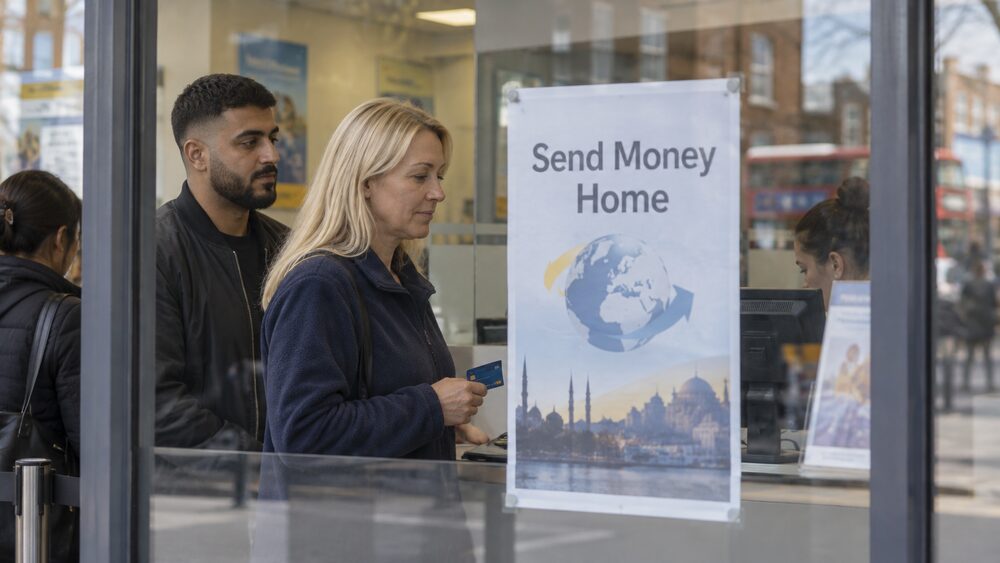
Sending money to family in another country is one of the most common international payments people make from the UK. The Financial Ombudsman describes an international money transfer simply: it "allows people to send funds from a UK account to another account in different country"1. When that payment is regular support for relatives, it is usually called a remittance, and the same practical questions come up every time: what it will cost, how long it will take, and what to do if the money does not arrive.
The cost is rarely just one number. Providers charge a fee, apply their own exchange rate, and may add charges at the receiving end. One bank quotes its charge for an electronic sterling remittance as either £10.00 or £25.00 depending on the service, and its own documents give both figures2. Timing also varies with how you pay: the same bank states that a remittance to another bank in India normally takes 2 to 3 business days after the funds have cleared, and that a cheque takes 6 working days to clear in the first place2.
What a remittance is and how the money reaches your family
In everyday use, a remittance is money a person working or living in one country sends to family in another. In the UK the word has a second, unrelated meaning in tax: the "remittance basis" is a way some people who are UK resident but not domiciled here can be taxed, under which, as Which? puts it, "you're taxed only on the income received in the UK in the year"5. HMRC's guidance explains that if you are UK resident but not domiciled in the UK, special rules may apply to your foreign income and gains, with a choice between the arising basis and the remittance basis6, and its Self Assessment helpsheet describes the remittance basis as available to "individuals who are resident but do not live permanently in the UK and have foreign income and gains"7. This page is about the everyday meaning, sending money home, not the tax treatment, though the two can overlap for people supporting family from foreign earnings.
Mechanically, a remittance is a payment like any other, but with extra steps. You hand money to a provider, by bank transfer, debit card or cash. The provider waits until it treats the funds as received and cleared. It converts the currency at its own rate, then passes the payment on through partner banks or local payout networks abroad, until it reaches your family as a bank deposit, wallet credit, card load or cash. Each step can add time and cost, and each is a place a payment can get stuck.
The underlying payment systems matter less than you might think, but they explain some of the timing. The Payment Systems Regulator notes that the bulk of UK card payments "still go through the existing card systems (usually Visa or Mastercard)"8, so a remittance paid by debit card starts life on the same rails as any card purchase. For a fuller picture of the plumbing, see how international payments work, and for the different types of firm that can send money abroad, ways to send abroad.
Bank account, cash pickup, card or digital wallet: how the money arrives
How the money arrives at the other end is usually the first practical choice, because it determines what your family has to do, how fast the money lands and what details you need to get right.
- Direct to a bank account. The money is credited to your family's account. One bank states that for remittances to other banks in India, the payment normally takes 2 to 3 business days after the funds have cleared2. This is usually the cheapest option for regular support, but it needs accurate recipient details, and a wrong account number is a common cause of delays.
- Cash pickup. Your family collects cash from an agent location. This suits recipients without a bank account, but collection points have opening hours and limits, and cash collection is a target for fraudsters. See cash pickup services for how it works.
- To a card or digital wallet. The money lands in a mobile wallet or on a card your family already uses. Some providers report very fast delivery on popular corridors, with one firm stating that 95% of its transfers to Turkey are received in under 3 minutes based on internal data. See sending to a mobile wallet abroad.
- Paid by cheque. Slow but still offered by some banks. One bank states it takes 6 working days, excluding holidays, Saturdays and Sundays, to clear a cheque2.
How you pay at your end also shapes the deal. One bank states that for cash and UK debit card payments, "the remittance will be processed at the rate available at the time of the request", while for existing customers paying by other means it applies "the remittance rate available only after the funds have cleared"2. That difference matters when rates move: with a card you lock the rate when you pay, with a bank transfer the rate may not be fixed until the money has arrived at the provider. The same bank also allows existing customers to use a non-SBI UK debit card, with the funds first transferred to their SBI UK account and the remittance sent from there2.
For a side-by-side comparison of the two most common destinations, see cash pickup vs bank deposit, and for the details each option requires, details needed to pay someone abroad.
Remittance costs: the fee is only part of the price
The headline fee is the visible part of the cost. The exchange rate is often the bigger part, because the provider applies its own rate rather than the mid-market rate, and the gap between the two is a margin you pay without ever seeing a line for it. To compare providers honestly, the only number that matters is how much arrives in your family's currency, not the fee on its own. The mechanics of rates and margins are covered in exchange rates on international payments.
Fees themselves vary by provider and by service. One bank's charges for electronic sterling remittances are quoted in its own documents at both £10.00 and £25.00 per transfer, depending on the service used2. When a provider's own pages show different figures for what looks like the same thing, ask which service the quote covers before you commit.
Timing of the rate adds a second layer of cost. As noted above, one bank fixes the rate at the moment of the request for cash and debit card payments, but only after funds have cleared for other payments2. If the currency moves between your payment clearing and the conversion, the amount your family receives changes even though the fee did not.
A few further points are worth checking:
- Who pays the receiving charges. Correspondent or receiving banks abroad can take their own cut. Ask the provider whether the quoted amount is what lands, or what leaves.
- Currency of payment. Official guidance on overseas payments to a UK government body states that all overseas payments are to be made in sterling, and that a bank may charge if any other currency is used9. The same logic applies in reverse: sending an unusual currency pairing can add cost.
- Cancellation charges. One bank states that "any subsequent cancellation or amendment to the request will be processed as a separate transaction and charges will be applied accordingly"2. Changing your mind is not free.
For regular monthly support, the structure of the payment matters as much as the price of one transfer. See regular payments abroad for how standing arrangements work, and banks vs specialist providers for how the two types of firm charge differently.
How long an international money transfer takes
There is no single answer, because the clock has several stages and each provider quotes its own. The clearest way to think about it is: time for your money to clear, plus time for the provider to convert and send, plus time for the receiving bank abroad to credit the account.
One bank's stated timings give a concrete example. A cheque takes 6 working days to clear, excluding holidays, Saturdays and Sundays. Once funds have cleared, a remittance to another bank in India normally takes a further 2 to 3 business days2. Paying by debit card or bank transfer removes the cheque stage, but the clearing and delivery stages remain.
Two rules of thumb hold across providers. First, business days are not calendar days: weekends and holidays in either country pause the clock. Second, the receiving side can be as slow as the sending side. The International Pension Centre, for example, warns people living abroad that a payment due in the same week as a US federal holiday "could arrive one day late" because a US company processes those payments10. The same asymmetry applies to remittances: a Philippine, Indian or Nigerian holiday delays a payment just as effectively as a UK one.
For a fuller treatment of cut-off times, holidays and corridor-specific timings, see how long an international payment takes.
What can delay a transfer
Most delays fall into a small number of causes, and knowing them helps you judge whether a wait is normal.
- Clearing times at your end. The provider cannot send what it has not received. Payments from outside the UK may take longer to arrive, as HMRC notes of National Insurance payments11.
- Holidays and weekends in either country. As above, these pause processing on either leg of the journey2.
- Checks on the payment. Identity, source-of-funds and sanctions checks can hold a transfer, especially for larger sums. See identity and security checks and sending a large sum overseas.
- Wrong or incomplete recipient details. A payment with a mismatched name or account number can be returned or held by the receiving bank.
- Provider backlogs and failures. These are rarer but real. Which? has reported investment transfer delays "as extreme as 450 days"12, and an ombudsman case study records a transfer of accounts to a new platform with "a delay of over five months"13. Remittances are simpler than investment transfers, but the lesson is general: firms differ widely in how quickly they act, and long delays do happen.
The regulations recognise that moving money takes time by setting outer limits in some situations. For a consumer switching to a payment provider in the EU, the rules require the UK provider to complete the switch, including transferring any positive balance, by a date "at least six business days after the UK payment service provider receives the consumer's request", unless otherwise agreed14. That is a switching deadline rather than a remittance one, but it shows the order of magnitude the law considers reasonable for cross-border money movement.
If a payment is stuck, the practical steps are in tracing, cancelling or recalling a payment sent abroad.
Tracking a transfer: what each status means
Most providers now show a status for each transfer in their app or online account, and many send a text or email at each stage. The principle is the same everywhere: check the status where you made the payment, because that is where the information is. Student Finance England tells its customers to "check on the status of your payment at any time via your online account" and to "look out for the text message we send to let you know your payment is on its way"15, and the same two channels, an online status and a message, are what a good remittance provider offers.
Statuses differ in wording but usually map to the stages in the flow above: payment requested, funds received, funds cleared, currency converted, sent or paid out, delivered. Two statuses deserve particular attention:
- "Failed" or "returned". This means the payment did not complete. One service explains the status plainly: "Your payment has been returned to us. Go to 'Your personal details' to check your bank details"16. For a remittance, the equivalent check is the recipient's details you entered: account number, name and any routing code.
- No movement at all. A status stuck at an early stage for longer than the provider's quoted time is the point to contact them, not to wait.
Be careful with messages that arrive out of the blue. HMRC warns that it may send a text if it has not received a payment, asking you to check your online account17, and it publishes guidance on checking whether a text message supposedly from HMRC is genuine17. The same caution applies to remittances: a text about a "problem" with your transfer, with a link to click or a number to call, is a standard scam pattern. Check statuses only in the provider's own app or by contacting it through details you already have. See scams involving payments abroad.
When a transfer fails: refunds and where the protection stops
If a payment fails or is returned, the money normally comes back to you, but the amount can differ from what you sent. One bank states that "the refund will be made in GBP and the exchange rate applied will be either" a rate it specifies, meaning that if the currency was already converted, the refund reflects a conversion back2. On a volatile currency, that can mean getting back less than you paid. Cancelling or amending a request that has been accepted but not yet processed is treated as a separate transaction with its own charges2.
Providers also set reporting windows. One bank states that "any non-receipt of payment should be advised to us within 7 working days"2. Reporting a missing payment promptly is in your interest: it starts the trace sooner and, where fraud is involved, protects your refund position.
For unauthorised transactions, the law is clear. The Payment Services Regulations require the provider to "refund the amount of the unauthorised payment transaction to the payer" and, where applicable, restore the debited account to the state it would have been in18. MoneyHelper's guidance for current account customers is that if you "check transactions and report any you don't recognise quickly, you'll usually get a refund if it's fraud"19.
Scam payments, where you were tricked into authorising the payment yourself, are treated differently, and here the limits matter:
- The reimbursement rules that took effect on 7 October 2024 cover payments "made a bank transfer to someone else's account in the UK on or after 7 October 2024" under the Payment Systems Regulator's scheme4, and the ombudsman's guidance describes the same rules covering "most transfers between UK bank and other accounts"20. A remittance sent abroad is generally outside this scheme.
- Where the rules do apply, you must have "made a transfer as part of a scam on or after 7 October 2024", have sent it "to another UK account", and told your bank "no more than 13 months after the last payment"20.
- Even then, "your bank can deduct £100 from the refund they give you unless you are considered as vulnerable under the rules", though some banks choose not to apply the excess3.
- A bank can refuse a refund if it can prove you authorised the payment, can prove you acted fraudulently or negligently, or you reported the fraud 13 months or more after the payment was taken3.
If things go wrong and the provider will not put them right, the Financial Ombudsman Service can consider complaints about sending money abroad1. Its case records show it takes delay seriously: in one case it ruled against a firm over "50 calendar days of delays" in a transfer, more than a year after the original request13. Complaints should normally go to the provider first, which then has a set period to respond before the ombudsman can look at it.
One last resort exists for people abroad with no other option, though it is not a remittance route: the FCDO's money deposit service at a British embassy, high commission or consulate is "only considered in exceptional circumstances if no other transfer service is available", usually takes longer than other options and charges a fee21.
For what happens if the firm holding your money fails, see safeguarding and the FSCS and when a payment firm fails, and for your general rights, your rights under the Payment Services Regulations.
Sources21 cited
- Sending money abroad: complaints the Financial Ombudsman can help with Financial Ombudsman Service
- Paying by UK debit card: remittance terms SBI UK, 2026-09-25
- Dealing with fraud National Debtline, 2026-09-25
- Fraudulent payments Financial Conduct Authority
- Tax on overseas property and rental income Which?, 2026-04-06
- Residence, domicile and the remittance basis: RDR1 guidance note HM Government, 2025-05-16
- Remittance basis helpsheet HS264 HMRC, 2014-07-04
- Account-to-account payments Payment Systems Regulator, 2026-09-26
- Repay Child Benefit overpayments HM Government, 2026-09-26
- International Pension Centre Department for Work and Pensions, 2026-09-26
- Pay voluntary Class 3 National Insurance HM Government, 2026-09-26
- What happens when a stocks and shares Isa transfer goes wrong Which?, 2024-08-31
- Customer claims account transfer delays cause £30,000 loss Financial Ombudsman Service, 2026-09-27
- The Cross-Border Payments Regulations 2015 legislation.gov.uk, 2015-12-15
- Preparing for payment Student Finance England, 2026-09-02
- Getting your first student finance payment Student Finance England, 2021-08-23
- Check if a text message you've received from HMRC is genuine HMRC, 2026-09-18
- The Payment Services Regulations 2017, Part 7 legislation.gov.uk
- How to open, switch or close your bank account MoneyHelper, 2026-09-25
- Scams: you've been tricked into making a payment Financial Ombudsman Service, 2026-09-27
- Your finances when travelling abroad Foreign, Commonwealth and Development Office, 2022-08-31



 MoneyHelperFree, impartial money and pensions guidance, set up by government
 Financial Ombudsman ServiceFree, independent help when a complaint about a firm is not put right
 FCA Warning ListCheck whether a firm is authorised before you deal with it
 Citizens AdviceFree advice on money, consumer and legal problems in England and Wales