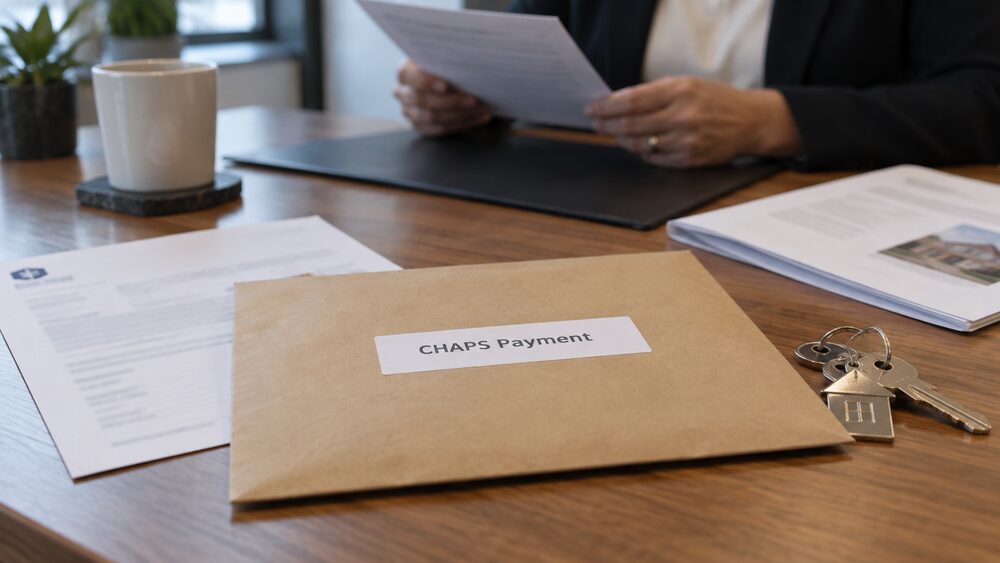
When you are moving a large sum, whether a house deposit to a solicitor, money to buy a property abroad, or savings for a move overseas, the ordinary ways of sending money are not always the right ones. CHAPS is the UK's same-day payment system for high-value transfers, such as paying a deposit for a property, and it usually involves a fee1. High-value transactions are processed through the Bank of England's settlement service via CHAPS, which the Bank describes as a risk-free, instant way of settling big payments such as when you buy a home2. It exists for exactly this kind of payment: CHAPS is for high-value transactions such as buying a house3.
If the money needs to arrive in another currency, in an overseas account, a different route is needed. An international money transfer allows people to send funds from a UK account to an account in a different country4, and this is where exchange rate margins and fees matter most: a cross-border transfer can take three to five days, with up to 6% chewed up in fees5. This page explains both routes, what they cost, what your bank may ask you to prove about where the money came from, and what protection exists if something goes wrong.
Two ways to move a large sum: CHAPS and spot transfers
The first question is what the money needs to do. If it is staying in sterling and moving between UK accounts, CHAPS is the system built for the job. It is a same-day payment system used for high-value transfers, such as paying a deposit for a property, and it often involves a fee1. The Bank of England explains that high-value transactions are processed in its real-time gross settlement service via CHAPS, settling instantly and finally between banks2.
If the money is going abroad, or needs to arrive in a foreign currency, you are making an international money transfer: sending funds from a UK account to an account in a different country4. A spot transfer is the simplest form of this, converting and sending at the exchange rate available on the day. The costs sit in two places: the provider's stated fee, and the margin it adds to the exchange rate. A parliamentary report on cross-border payments noted that such a transfer takes three to five days, with up to 6% chewed up in fees5. On a large sum, even a small percentage margin adds up to a serious amount of money, so the rate matters more than the headline fee.
For most people the two routes work together: a CHAPS payment to a solicitor for a UK completion, or a spot transfer, often arranged through a specialist provider or broker, for a purchase abroad. The pages on how international payments work, the ways to send money abroad and exchange rates and margins cover each route in more detail.
No upper limit on a CHAPS payment
CHAPS has no upper limit on the amount you can send. That is its purpose: it exists for sums too large for the everyday payment systems. By comparison, each bank and building society sets its own limit on the amount that can be sent using Faster Payments10, so a very large ordinary transfer may simply not be possible that way. Most banks advise using CHAPS for payments of more than £25,0006.
The sums that flow through the system show the scale it is built for. The average value of a retail and commercial CHAPS transaction amounted to £627,298 in 202311. In 2025 there were 53.3 million CHAPS payments processed, worth a total of £93.9 trillion, yet CHAPS accounted for just 0.1% of the total volume of payments in the UK12. In other words, it is a small number of very large payments.
Private individuals seldom make CHAPS payments themselves7: it is typically a solicitor or licensed conveyancer who sends the completion money. But individuals do initiate them, and one ombudsman case involved a customer asking their bank to send £135,000 to the seller's solicitors' client account13. If you are asked to arrange a CHAPS payment yourself, for example for an auction purchase or a private sale, your bank will take the instruction and start the payment on your behalf.
CHAPS fees: usually charged to send, sometimes to receive
CHAPS is not free. You can pay with a CHAPS payment but there will be a charge, so check with your bank8. Each bank sets its own fee, and it can differ by how you ask for the payment: in a branch, by phone or online. Because the fee is fixed rather than a percentage, it is a small proportion of a very large payment, but it is worth confirming the exact amount before you instruct.
Receiving banks sometimes charge too, particularly for payments arriving from abroad, and the sender can sometimes choose who pays the intermediary charges. The overall cost of moving money across borders is worth measuring in total: up to 6% of a cross-border transfer can be chewed up in fees5. For context on how foreign exchange fees work elsewhere, using a debit card abroad typically attracts a foreign exchange fee of often around 3% of the transaction amount14, and credit cards typically charge up to 2.99% each time you use one abroad15. A specialist provider or broker quoting a rate for a large transfer should be able to tell you the total cost in the receiving currency, which is the only figure that lets you compare offers properly. The page on payment limits covers caps on other systems, and banks vs specialist providers compares the two approaches.
How long a CHAPS payment takes: same day, before the cut-off
A CHAPS payment made before the cut-off arrives the same working day. HM Revenue and Customs notes that if you pay by CHAPS or Faster Payments, you can submit your payment on the same or next day16, and for CHAPS the point is that the money settles the same day it is started. The system opens for business at 6.00am each day and payments usually have to be started by 4.00pm7.
The cut-off is not a single national time: it depends on your bank and on how you make the request. The published opening and start times come from the ombudsman's own guidance, which describes CHAPS opening at 6.00am with payments usually started by 4.00pm7. If you are cutting it fine on a completion day, ask your bank for its cut-off for the channel you will use, and have the recipient's details checked in advance. The page on how long payments take covers cut-off times and delays more generally.
CHAPS is sterling only: sending in another currency
CHAPS payments are in pounds sterling. It is a sterling settlement system, used for high-value transactions such as buying a house3. If you need to send money in another currency, or to an account outside the UK, you need an international payment instead: the FCA's rules for banks describe the service of initiating a payment in a currency other than a currency of the United Kingdom to a payee outside the United Kingdom20.
This is where the exchange rate becomes the biggest cost on a large sum. The margin a provider adds to the mid-market rate is a percentage, so it scales with the amount: the same margin that costs a few pounds on a holiday transfer costs thousands on a property purchase. Typical foreign exchange fees elsewhere in banking give a sense of the scale: around 3% on debit card spending abroad14 and up to 2.99% per credit card transaction15. The pages on exchange rates, Swift payments and fixing a rate with a forward contract explain how quotes and rate guarantees work.
One cost is specific to pension money. If you are moving a UK pension overseas rather than a bank balance, transferring to a qualifying recognised overseas pension scheme outside the EEA will trigger a 25% UK overseas transfer charge21. The legislation sets the charge at 25% of the transferred value where the overseas transfer charge arises22. Anyone considering this route needs specialist pension advice, because the charge can take a quarter of the sum.
Where your bank may restrict CHAPS payments
Not every institution offers CHAPS on the same terms. The main banks and larger building societies are direct members of CHAPS, and there are also over 400 indirect members, typically smaller banks and building societies, who have access to the system through a direct member13. So a small building society can usually send a CHAPS payment, but it does so through another institution, which can mean an earlier cut-off or a different process.
How you can instruct the payment also varies: some banks only allow CHAPS payments to be made in branch or via post6. If your only route is a branch visit, the practical deadline is the branch's own cut-off, not the system's. It is worth checking this well before the day you need the money to move.
For large payments, banks also apply security and source of funds checks. A request to move a very large sum, especially to a new payee or abroad, can trigger identity verification and questions about where the money came from. The page on identity and security checks when sending covers what to expect and why payments are sometimes held. Separately, the name-checking service Confirmation of Payee was introduced when the regulator directed the UK's six largest banking groups to introduce it over Faster Payments and CHAPS transactions in 202023, which helps catch mistyped or manipulated account details before the money leaves.
A CHAPS payment cannot be reversed
The defining feature of CHAPS is that settlement is final. The Bank of England describes it as a risk-free, instant way of settling big payments such as when you buy a home2: once the payment has settled, the money has moved and the sending bank cannot claw it back. This is precisely what makes it suitable for property completion, where the recipient needs certainty, and precisely why it is a target for fraudsters. £22.5m of bank transfer scam losses in 2021 related to payments made by CHAPS6.
Because there is no undo, the checks happen before the payment, not after. That means verifying the recipient's account details directly with them, using a number you have looked up independently, and being suspicious of any last-minute change of bank details, a classic feature of conveyancing fraud. If a payment has gone wrong, the page on tracing, cancelling or recalling a payment explains what may still be possible, and scams involving payments abroad covers the warning signs.
Scams on large payments and the £85,000 refund cap
Since 7 October 2024, banks and other payment providers have had to refund victims of authorised push payment (APP) fraud, where a person is tricked into sending money themselves1. The rules require banks and other payment service providers to reimburse you up to a maximum of £85,000 if you are the victim of a scam, and if they do decide to reimburse you they may deduct an excess of up to £100 for each scam claim9. The Bank of England, as the operator of CHAPS, has also set the maximum level for CHAPS APP scams at £85,000 per claim24, and the regulator's consolidated policy statement confirms the CHAPS reimbursement requirement25.
The cap has a history worth knowing. When the mandatory reimbursement level was first set, in December 2023, it was £415,000 per claim26, a figure aligned with the Financial Ombudsman's maximum reimbursement at the time27. It was then reduced from £415,000 to £85,00028, and the regulator confirmed the reduction of the maximum level for Faster Payments APP scams to £85,000 per claim24. The change was contested: the PSR's analysis shows that an £85,000 cap will see around 90% of total APP scams by value reimbursed, whereas 98% of the value of APP scams would have been protected under a £415,000 cap11. The average value of all APP scams over £85,000 was £175,000 in 202311, which means the largest property-deposit scams fall well above the cap. Someone tricked into sending £200,000 by CHAPS could recover £85,000 at most, and the excess of up to £100 may also be deducted9.
The scope limits matter just as much as the cap. The rules cover most transfers between UK bank and other accounts9: to be eligible you must have made a transfer as part of a scam on or after 7 October 2024, made the transfer to another UK account, and told the bank or payment service provider no more than 13 months after the last payment9. Only UK bank transfers are covered, not payments to foreign accounts or other payment methods such as card payments29. When the rules were first announced, international payments and CHAPS transactions were out of scope of the mandatory requirement30, and the Bank of England subsequently brought CHAPS within an equivalent requirement of its own24. The regulator's work on APP scams centres on the two payment systems consumers use when making push payments, CHAPS and Faster Payments31. The FCA confirms that if you are eligible, your payment service provider must refund you up to £85,00032, and the same cap applies to newer routes such as Pay by Bank33.
Several details of the scheme were consulted on before landing where they have. The original consultation proposed reimbursement on all payments over £100, subject to an excess of no more than £3534; the excess was subsequently set at up to £100 for each scam claim9, and the regulator's reimbursement dashboard records claims by reference to the £100 excess and the £85,000 maximum cap35. Independent guidance confirms the maximum amount you can claim back is £85,00036, and the same figure appears in debt charity guidance on dealing with fraud37. The consultations on the excess and maximum reimbursement level for Faster Payments, and on a maximum level for CHAPS on behalf of the Bank of England, set the current position38, alongside the consultation on the consumer standard of caution, which governs when a victim's own behaviour, such as ignoring warnings, can affect a claim39.
When a payment firm fails
If you are using a specialist provider or broker rather than a bank, a different protection applies to the money in transit. Payment firms that are not banks must safeguard customers' funds, keeping them separate from their own money. Should a money transfer company go out of business, there is no limit to the amount you can get back from safeguarded funds, unlike with banks, which are under the FSCS limit40. The trade-off is that recovering safeguarded money can take time and depends on the firm's records being in order, whereas FSCS protection for bank deposits pays out quickly up to its limit. The pages on safeguarding and the FSCS and what happens when a payment firm fails explain both regimes.
Where to get help
If a large payment has gone wrong, the first step is to complain to the bank or provider that made the payment, in writing, and keep a record. If it does not refund you or rejects your claim, you can take the complaint to the Financial Ombudsman Service, which deals with complaints about scams and payments, including CHAPS and Faster Payments reimbursement decisions9. The ombudsman can look at cases the mandatory rules do not cover, and its decisions bind the firm if you accept them.
The Financial Conduct Authority publishes guidance on fraudulent payments and when a provider must refund up to £85,00032, and the Payment Systems Regulator publishes a reimbursement dashboard showing how firms are handling APP scam claims35. For the mechanics of making a complaint, the page on your rights under the Payment Services Regulations sets out the process, and the scams and fraud guide covers the wider warning signs. If the money was part of a pension transfer abroad, the 25% overseas transfer charge and the transfer itself need regulated pension advice before anything is sent21.
Sources40 cited
- Fraud victims who pay the wrong way could be left with nothing Which?, 2024-10-16
- What's the Bank of England's role in the housing market? Bank of England, 2019-01-10
- When you make a payment Payment Systems Regulator, 2026-09-26
- Sending money abroad Financial Ombudsman Service, 2026-09-26
- Cross-border payments report House of Commons Treasury Committee, 2023-05-17
- Friday afternoon fraud: the scam that wipes out your house deposit in seconds Which?, 2023-03-27
- Ombudsman News issue 42: CHAPS Financial Ombudsman Service, 2004-12
- Buying a used car Citizens Advice, 2026-09-25
- Scams: you've been tricked into making a payment Financial Ombudsman Service, 2026-09-27
- Payment methods factsheet Building Societies Association, 2023-01-10
- Which? response to the PSR's consultation on Faster Payments APP scams: changing the maximum level of reimbursement Which?, 2024-09-18
- Payment Markets Report 2026 Summary UK Finance, 2026-08
- Ombudsman News issue 42, case 42/1 Financial Ombudsman Service, 2004-12
- How to open, switch or close your bank account MoneyHelper, 2026-09-25
- Spending abroad: the 4 dos and 5 don'ts Which?, 2024-07-26
- Pay Stamp Duty HM Revenue and Customs, 2014-10-30
- CHAPS payments Santander, 2026
- Pay by CHAPS Bank of Scotland, 2026-09-27
- Making and receiving payments AIB (NI), 2026
- BCOBS 7.5.4R: payment services Financial Conduct Authority, 2018-08-15
- Living abroad after Brexit: is your UK pension secure? Which?, 2020-11-28
- Finance Act 2017, Schedule 4, Part 2: overseas transfer charge legislation.gov.uk, 2024-04-06
- CP21/11: Confirmation of Payee, ending dual running Payment Systems Regulator, 2020
- PS24/7: Faster Payments APP scams reimbursement requirement, confirming the maximum level of reimbursement Payment Systems Regulator, 2024-10-07
- PS24/5: CHAPS APP scams reimbursement requirement Payment Systems Regulator, 2026-09-26
- PS23/4: APP scams policy statement Payment Systems Regulator, 2023-12
- CP24/11: Faster Payments APP scams, changing the maximum level of reimbursement Payment Systems Regulator, 2024-09
- The investment fraud refund lottery: will your bank help you? Which?, 2024-09-29
- Santander's new app blur feature Which?, 2025-08-28
- New rules for bank transfer fraud reimbursement from 2024 Which?, 2023-06-07
- APP scams: the role of payment system operators, final terms of reference Payment Systems Regulator, 2026-09-26
- Fraudulent payments Financial Conduct Authority, 2016-04-16
- Pay by Bank: can you trust this new way to pay? Which?, 2025-06-12
- CP22/4: APP scams, requiring reimbursement Payment Systems Regulator, 2026-09-26
- APP scams reimbursement dashboard Payment Systems Regulator, 2026-07-30
- What to do if you're the victim of a bank transfer APP scam Which?, 2026-05-12
- Dealing with fraud National Debtline, 2026-09-25
- CP23/6: APP fraud, excess and maximum reimbursement level for FPS and CHAPS Payment Systems Regulator, 2026-09-26
- CP23/7: APP fraud, the consumer standard of caution Payment Systems Regulator, 2026-09-26
- What happens if my international money transfer provider goes bust? Which?, 2025-12-08



 MoneyHelperFree, impartial money and pensions guidance, set up by government
 Financial Ombudsman ServiceFree, independent help when a complaint about a firm is not put right
 FCA Warning ListCheck whether a firm is authorised before you deal with it
 Citizens AdviceFree advice on money, consumer and legal problems in England and Wales