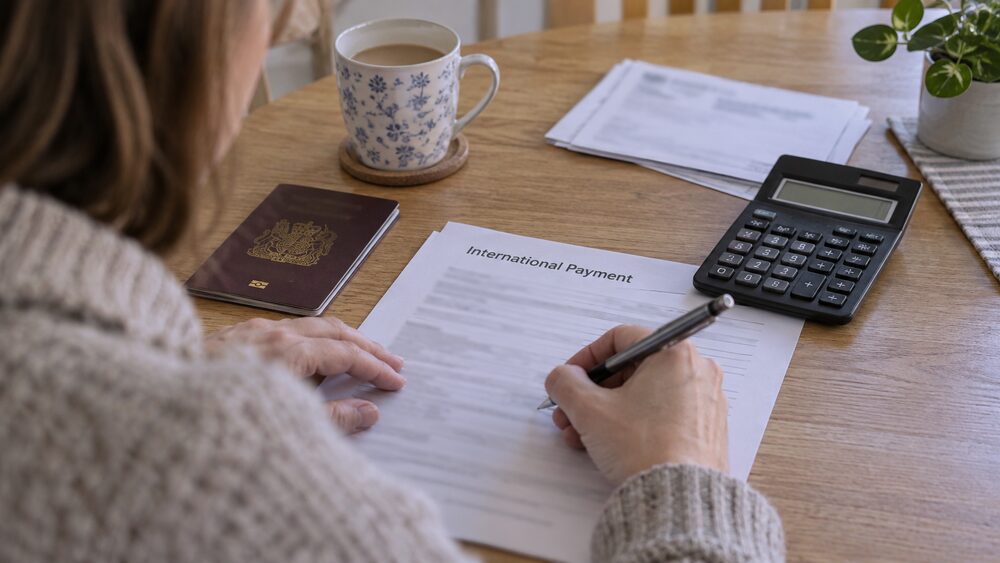
An international money transfer allows people to send funds from a UK account to another account in a different country1. Behind that simple description sits a chain of banks, messages and charges that most people never see, and it is that chain which decides how much arrives, how quickly, and what happens when something goes wrong.
The core idea is this: your bank does not physically ship your money abroad. It sends a series of instructions, usually over a messaging network called Swift, and the funds move between banks that hold accounts with each other until they reach the recipient's bank. Where two banks have no direct relationship, a correspondent or intermediary bank sits in the middle, and each bank in the chain can take a fee. A 2023 Treasury Committee report put the problem bluntly: a cross-border transfer "takes three to five days" and "up to 6% is chewed up in fees"2.
Specialist providers work differently. Rather than routing every payment through the bank chain, many hold local accounts in the destination country and pay the recipient from a domestic account, which can be faster and cheaper. The route your money takes matters, so this page explains each step of it.
How an international payment moves from your bank to someone abroad
An international payment is defined by banks as transferring funds, in any currency, from or to an account outside the UK, or moving funds between UK accounts in a currency other than sterling3. That second half matters: a payment in euros between two UK accounts still counts as an international payment, because it leaves the domestic sterling system.
When you instruct your bank, it does not open a pipe to the other country. It checks the instruction, may convert your sterling into the destination currency at its own exchange rate, and charges a fee for doing so. It then sends the payment instructions onward. If your bank and the recipient's bank deal with each other directly, the payment can move between them in one hop. Very often they do not, and this is where correspondent banking comes in.
A correspondent bank is a bank that holds an account on behalf of another bank. If your bank has no direct link to a bank in, say, Bangladesh, it sends the payment to a correspondent that does, and that correspondent passes it on, possibly through further intermediaries. Each bank in the chain handles the payment in turn, and each can deduct its own charge, which is one reason the recipient can receive less than you sent. The Financial Ombudsman Service, when it investigates a complaint about a transfer, asks for "any messages used for the international money transfer, such as a SWIFT or an MT103"1, which shows how central these messages are to tracing where money actually went.
The practical consequence of this chain is that no single bank controls the whole journey. Your bank is responsible for sending the instruction correctly, but once the payment is with a correspondent abroad, delays and deductions can happen outside its reach. That is why tracing a missing international payment can take days, and why the tracing and recalling process exists. The full range of ways to send money abroad, including specialist providers that bypass this chain, is covered in ways to send abroad.
Swift: the messaging network banks use for payments abroad
Swift stands for the Society for Worldwide Interbank Financial Telecommunication. Swift payments let you send and receive payments to other countries4, but Swift itself is not a bank and does not hold your money. It is a messaging network: a secure postal service for payment instructions, used by banks in more than 200 countries. When you ask your bank to send money abroad, it composes a message, in standard formats such as the MT103 the ombudsman refers to1, and that message tells the other banks in the chain what to do, how much to move, and to whose account.
Because the format is standardised, a bank anywhere in the network can read an instruction from a bank anywhere else. That is what makes the correspondent chain workable: your bank does not need a relationship with every bank in the world, only with correspondents that connect onward. The trade-off is that each message is processed by each bank in turn, on working days only, which is a large part of why international payments are slower than domestic ones.
Two things follow for a consumer. First, a "Swift payment" and a "wire transfer" are, in everyday terms, the same thing: the wire transfer is the payment, Swift is how the instructions travel. Second, the details in the message matter enormously. A wrong account number or bank code in a Swift message can send money to the wrong place, and correcting it means asking each bank in the chain to act. The dedicated page on Swift payments and wire transfers covers the formats in more detail, and SEPA vs SWIFT explains the faster, cheaper route that exists for euro payments.
Fees and exchange rates: where the cost of sending money abroad comes from
There is a cost for making an international payment10, and it comes from three places: the sending fee, the exchange rate, and charges taken along the route.
The sending fee is the charge your own bank applies. Santander International, for example, states plainly that "there will be a charge applied for international payments and receipts"11, and its expat account charges a fee in currency equivalent for a Swift payment out in euros or US dollars12. Fees vary by bank, by account and by channel, so the only reliable way to know your charge is to check before you send.
The exchange rate is often the bigger cost, and the harder one to see. Your bank converts sterling into the destination currency at a rate it sets, which includes a margin over the mid-market rate. That margin is a real charge even when the transfer is advertised as fee-free. The scale of the problem is set out in the Treasury Committee's report: up to 6% of a cross-border payment can be chewed up in fees2. For context on how widely these costs vary even within financial services, MoneyHelper notes that using a debit card abroad commonly carries a foreign exchange fee of around 3% of the transaction amount13, and an independent survey of investment platforms found foreign exchange fees ranging from 0.45% to 1.5% on amounts up to £5,00014. The same principle applies to transfers: the percentage is the cost, and it is worth knowing what yours is before you commit.
The third cost is taken en route. Correspondent and receiving banks can deduct their own fees, which is a common reason the recipient receives less than you sent. There is usually a fee for cross-border payments even when the payment is being made to settle a debt abroad15, and receiving banks abroad may charge for crediting the money.
| Where the cost sits | Who charges it | How you see it |
|---|---|---|
| Sending fee | Your bank | Shown as a fee when you set up the payment11 |
| Exchange rate margin | Your bank or provider | Built into the rate you are quoted2 |
| Intermediary charges | Correspondent banks in the chain | Deducted before arrival, often invisible to you |
| Receiving charge | The recipient's bank | Shown to the recipient, not to you |
Some accounts do offer genuinely fee-free spending abroad: one digital bank was noted in 2024 as having no fees on spending abroad, including cash withdrawals16. But "no fee" on a transfer is not the same as "no cost", because the exchange rate margin usually remains. The page on exchange rates explains how to read a quote and compare the total amount that will arrive rather than the headline fee.
How long an international payment takes
How long a payment takes depends on the route, the currency and the destination, and banks quote strikingly different timescales.
| Provider | Stated timescale | Applies to |
|---|---|---|
| Barclays | Most payments arrive within one to two working days5 | International payments generally |
| Barclays | Within one working day; US payments same day or next working day6 | Payments to Europe and the US |
| Starling | Generally one to three working days17 | All other international payments |
| Coutts | One to three days, some up to five18 | International payments |
| HSBC | Up to 4 working days or longer19 | Payments outside the EEA |
| Metro Bank | 2 to 5 working days20 | Payments outside Europe |
| Lloyds | No longer than five working days21 | Any currency to any other country |
| Ulster Bank | Up to 10 working days22 | International payments pending |
| Al Rayan Bank | Typically 7 to 10 working days23 | International payments |
The spread in that table is real, and it reflects the same underlying mechanics. Payments within Europe usually arrive the same working day but can take up to five days20, because European payments can travel on a shared system with fewer intermediaries. Payments outside Europe pass through more banks, each processing on its own schedule. The Treasury Committee's figure of three to five days for a cross-border transfer2 sits in the middle of the range.
Cut-off times add another layer. A cut-off is the latest time a bank accepts a payment and still starts processing it that day; one private bank sets its cut-off for international payments at 14:3018. Send after the cut-off and the clock starts the next working day. Weekends and bank holidays in either country add delay, and the government notes that a payment due in the same week as a US federal holiday can arrive a day late because a US company processes it24. For faster options, Santander states that payments in euros and US dollars can arrive the same day if sent before its cut-off time25.
The page on how long an international payment takes covers delays in more detail, and sending euros explains the faster SEPA route.
The details you need to send or receive money from abroad
Getting the details right is the part you control, and it is where most failed payments start. Banks ask for broadly the same set of information, whichever one you use.
To send money, Barclays requires the recipient's full name as shown on their account, their address, their bank's address, their account number or IBAN, their SWIFTBIC or national clearing code, and a detailed reason for the payment, called the "purpose of payment"6. Halifax asks for the recipient's IBAN, the name and address of their bank, a clearing code and the reason for the payment when sending to the rest of the world26, and Lloyds asks for the same21. HSBC adds the country or region of the recipient's bank and the amount of the payment19.
The IBAN is the key identifier. Your IBAN helps banks identify accounts held anywhere in the world so they can process international payments automatically27. Alongside it sits the BIC, previously the Bank Identifier Code, which identifies the bank itself24. If you are receiving money from abroad, you give the sender your IBAN, your BIC, or a bank or brand code and account number24.
- Recipient's name: exactly as it appears on their account6
- Recipient's IBAN or account number: the account identifier in the destination country6
- Recipient's bank BIC or clearing code: identifies the bank6
- Bank name, address and country: so the payment is routed correctly19
- Reason for the payment: many banks require a purpose, and some destinations require a detailed one6
The reason for the payment is not a formality. Some countries restrict what money can be sent for, and a vague purpose can hold a payment up while checks are made. The page on details needed to pay someone abroad covers each field, and restricted currencies explains country-specific rules. If you are on the receiving end, receiving a payment from abroad sets out what to give the sender.
Ways to send: app, online banking or branch
How you actually make the payment depends on your bank, and the differences are practical rather than cosmetic. Some banks allow international payments only through online banking: Santander UK tells customers they can make and receive international payments in online banking, "though you won't be able to use our Mobile Banking app"25. Others, including Barclays, let you send and receive money online to more than 130 countries5.
The channel can affect both cost and speed. Payments set up digitally are usually cheaper than those made in a branch, where a bank may charge more for staff-assisted payments, and digital payments can be submitted right up to the cut-off time. For payments in euros and US dollars, funds can arrive the same day if sent before the cut-off25. Branch and telephone payments typically need to be set up earlier in the day.
If your bank's own international payment service is expensive or limited, you are not tied to it. Specialist providers, brokers and cash collection services each work differently, and banks vs specialist providers compares the approaches. For large sums, sending a large sum overseas covers the checks a provider will make on where the money came from, and identity and security checks explains why a payment can be held while a provider verifies you.
Consumer protection and where it stops
Protection for international payments is thinner than most people assume, and it is worth knowing the limits before you send rather than after.
The starting point is that a bank transfer abroad is not like a card payment. MoneyHelper warns that with a bank transfer "it's harder to get your money back, and you have much less protection if something goes wrong"28. That is why official anti-scam guidance tells people to pay by credit card for purchases over £100, by debit card or by PayPal rather than by bank transfer, because those routes carry more protection29. Section 75 of the Consumer Credit Act applies to credit card purchases, including purchases from overseas websites30, and paying by card is the standard advice for extra protection if things go wrong31.
For scams specifically, the main UK reimbursement rules do not stretch to international payments. The Contingent Reimbursement Model (CRM) Code covered authorised push payment scams between UK accounts, but the ombudsman's own case study on a holiday apartment rental scam states that "international payments aren't covered by the CRM Code and the relevant regulations say Paul is responsible for any payments he's made"7. In that case, Paul lost money he could not recover, because the payment left the UK banking system's protections behind.
There are still places to turn. The Financial Ombudsman Service can consider complaints about international money transfers, and asks for evidence including the Swift messages used1. The Payment Systems Regulator has also consulted on whether there is adequate consumer protection for interbank payments, asking "whether there is adequate consumer protection, or if more needs to be done"32. If something goes wrong, complain to your provider first, then take the complaint to the ombudsman if it is not resolved. Free, impartial help is available from MoneyHelper, and the pages on scams involving payments abroad, your rights under the Payment Services Regulations and safeguarding set out where protection starts and stops.
Sources32 cited
- Sending money abroad: how the Financial Ombudsman can help Financial Ombudsman Service, 2026-09-26
- Treasury Committee report on cross-border payments UK Parliament, 2023-05-17
- International payments: definition and service terms AIB Northern Ireland, 2026
- Swift payments explained Handelsbanken, 2026
- Send and receive money online to 130 plus countries Barclays, 2026
- How to make an international payment Barclays, 2026
- Consumer complains about holiday apartment rental scam Financial Ombudsman Service, 2026-09-26
- Bank accounts for young people Santander International, 2026-09-25
- What is SEPA? HSBC, 2026
- Making and receiving payments AIB Northern Ireland, 2026
- Foreign exchange service charges Santander International, 2026-09-25
- Current account for expats: Swift payment fees Santander International, 2026-09-25
- How to open, switch or close your bank account MoneyHelper, 2026-09-25
- How investment platforms work Which?, 2026-03-16
- Dealing with UK debts abroad StepChange Debt Charity, 2026-09-25
- Spending abroad: the 4 dos and 5 don'ts Which?, 2024-07-26
- Starling personal account general terms Starling Bank, 2026-05-31
- International payments: timescales and cut-off Coutts, 2026-09-26
- Sending money to the UK HSBC, 2026
- International payments for personal accounts Metro Bank, 2026-09-25
- Send an international payment Lloyds Bank, 2026-09-27
- Debit card payments guide Ulster Bank, 2026-09-25
- Payments, direct debits and account details Al Rayan Bank, 2026
- State pension if you retire abroad GOV.UK, 2026-09-26
- Making international payments Santander UK, 2026
- International payments: send money guide Halifax, 2026-09-27
- What is an IBAN, a BIC and a SWIFT code? HSBC, 2026
- Shop safely online MoneyHelper, 2026-09-25
- Types of scam MoneyHelper, 2026-09-25
- Online shopping: VAT, import and handling costs Which?, 2025-07-30
- Check if something might be a scam Citizens Advice, 2019-05-30
- CP21/4: consumer protection in interbank payments Payment Systems Regulator, 2026-09-26


 MoneyHelperFree, impartial money and pensions guidance, set up by government
 Financial Ombudsman ServiceFree, independent help when a complaint about a firm is not put right
 FCA Warning ListCheck whether a firm is authorised before you deal with it
 Citizens AdviceFree advice on money, consumer and legal problems in England and Wales