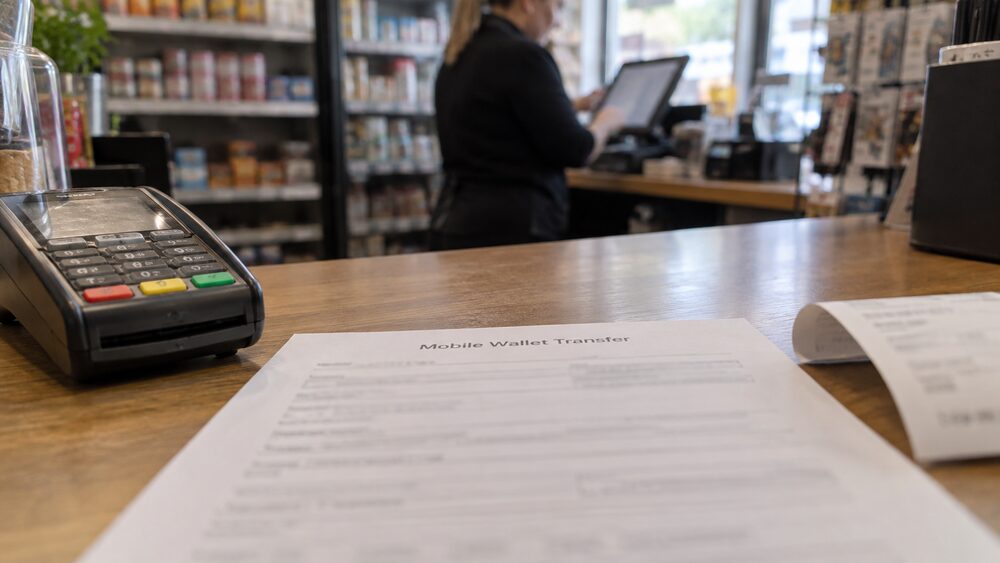
A mobile wallet transfer sends money from your UK account to a wallet held on someone else's phone, usually in another country. The wallet is identified by a phone number rather than a sort code and account number, and the person receiving it does not need a traditional bank account to hold or spend the money. That is why wallets are widely used for remittances, particularly where banking access is patchy.
A mobile wallet transfer sends money from your UK account to a wallet held on someone else's phone, usually in another country. The wallet is identified by a phone number rather than a sort code and account number, and the person receiving it does not need a traditional bank account to hold or spend the money. That is why wallets are widely used for remittances, particularly where banking access is patchy.
The mechanics are the same as any other international payment: an international money transfer allows people to send funds from a UK account to another account in a different country1. What changes is the last step, where the money lands in a wallet rather than a bank account.
Not every UK bank can pay a wallet directly. Santander, for example, lets customers make and receive international payments in Online Banking, though not through its Mobile Banking app2, while Metro Bank lets customers send money outside the UK in pounds sterling, euros or US Dollars to 35 countries through its mobile app3. Where a bank cannot reach a wallet, a specialist transfer service usually can.
What a mobile wallet transfer is and where it is used
A mobile wallet is a payments system held on a phone. Apple Pay is well known in the UK, and Google Wallet is a similar mobile payments system that works on Android devices and some Android-based smartwatches8. Abroad, the same idea is used less for tapping a card in a shop and more for holding and receiving money, which is what makes it useful for remittances.
The names people meet most often in this market are PayPal and MoneyGram. PayPal offers an online or e-money transfer service, and with MoneyGram you can transfer money through the Post Office, or you can do it online9. Both are routes a sender in the UK can use to reach a recipient who does not hold a bank account in the usual sense.
It helps to separate this from a different product with a confusingly similar name. A money transfer on a credit card means moving funds from a credit card to your UK bank account, and a transfer fee might apply in addition to interest10. That is a way of borrowing, not a way of sending money overseas, and it does not reach a wallet abroad.
The reason wallets matter for remittances is access. A current account usually lets you receive benefits and wages, spend in shops, withdraw cash, manage online or by mobile app, and set up Direct Debits and standing orders11. A wallet does far less than that, but it does the one thing a recipient without a bank account needs: it receives money and lets them spend or withdraw it.
How sending to a mobile wallet works from the UK
The transfer runs in two legs. The first is domestic: the account provider transfers money, on the instruction of the customer, from the customer's account to another account in the UK12. The second is the international leg, where the money leaves the UK and is paid out to the wallet in the destination country. Account-to-account payments move money directly from a payer's bank account to a payee's bank account without the need for intermediaries such as credit or debit cards13, which is why they are cheaper to run than card payments and why transfer firms build on them.
In practice you start in your bank's app or online banking, or in a specialist provider's app. Some banks restrict which channel you can use: Santander customers can make international payments in Online Banking but not in the Mobile Banking app2. Others allow it in the app but only to a set list of countries, as Metro Bank does with 35 countries3.
The wallet itself is activated by phone. Barclays sends an SMS confirming Travel Wallet activation to all accountholders on set up of each Travel Currency Travel Wallet14, which shows the pattern: the phone number is the account identifier, and the confirmation goes to the phone.
Fees, exchange rates and what the recipient receives
Two costs sit on top of the amount you send: the fee and the exchange rate margin. On the fee side, there may be a cost for sending or receiving the money, depending on your bank and the bank you are transferring the money to14. As an example of a bank charge, one UK bank's standard electronic international payment carries a £25 fee2.
The exchange rate is where transfers differ most. The exchange rate will change depending on the day and time your payment is made and the bank or company you use, and your bank should tell you the rate used before completing the transfer14. Some providers build their charge into the rate rather than showing it separately: HSBC international money transfers are made using the HSBC Exchange Rate, which includes a currency conversion charge15.
For comparison, the cost of moving money between accounts in the UK is often expressed as a percentage. A money transfer credit card, which shifts money from your card to your current account, usually charges around 4%16. A balance transfer fee of 3% on a £2,000 balance comes to a £60 fee17. Those are domestic products, not remittance services, but they show the shape of the charges: a percentage of the amount moved, taken up front.
What the recipient actually receives is the amount after the fee and after conversion at the provider's rate. Because the rate moves with the day and time14, the same transfer can produce a different amount on a different morning. The rate you are quoted at the point of confirmation is the one that matters.
Details you need before you send
For a wallet transfer the key detail is the recipient's phone number, registered to their wallet, plus their name as it appears on the wallet account. For the bank leg, the requirements are the same as any other payment.
For a one-off bank transfer you need the amount you want to send, the full name of the person you're sending money to, their 6-digit sort code, their 8-digit account number, a payment reference, and whether you want the money sent straight away or at a later date and time4. For a standing order you need the amount of money you want to send, a payment reference, when you want the money to leave your account, and how long you'd like the regular payments to continue4.
Once you've sent money to someone once, their details will be stored and you won't need to enter them next time4. That convenience is also a risk: a stored payee is easy to pay again without rechecking.
Some banks now have a warning when you transfer money to someone, prompting you to double check the details are correct and think twice that the person you're sending money to is genuine4. Where a bank asks for more, a CHAPS payment requires the full account name of the person you want to pay as it appears on their account, their sort code, their account number, a reference or other payment details, the amount, and your card and PIN plus a form of ID if you visit a branch18.
How long it takes, and what sets the limit
Speed depends on the rail used. Money sent using Faster Payments through online banking on a smartphone app will reach the recipient's account within 2 hours, and sometimes it's received immediately4. Transfers through banking apps are usually done via Faster Payments, which are secure payments that usually arrive within seconds19. A bank paying into a savings account gives a similar picture: in most cases the money will leave your bank account straight away, and it can take up to two hours to reach the account20.
The international leg and the wallet payout sit on top of that. A wallet credit is not instant in every country, and the receiving service may hold the money while it checks the recipient.
Limits come from both ends of the transfer. Your bank or provider sets a cap on what you can send, and the wallet sets a cap on what it will hold or what can be spent. As examples, one UK bank allows up to £20,000 per transaction through its send money feature5, and one bank caps mobile wallet spending at £500 per transaction6. A wallet's incoming limit is often lower than a bank's outgoing limit, so a large transfer may need to be split or sent to a bank account instead.
When a transfer goes wrong: mistakes, delays and scams
The most common mistake is a wrong phone number. If the number does not belong to a wallet, the payment should fail and the money should automatically bounce back to you21. If it belongs to someone else, the money has reached a real person, and recovery depends on the provider tracing it and the recipient agreeing to return it.
Delays usually come from checks rather than from the payment rail. A provider may hold a transfer while it verifies identity or the source of funds, and the recipient's wallet may hold it while it verifies them.
Scams are the bigger risk. Scams involving authorised push payments occur when consumers are tricked into authorising a transfer of money to an account that they believe belongs to a legitimate payee22, and they are the second biggest type of payment fraud21. A bank transfer request is itself a warning sign: if someone is asking you to pay by bank transfer, it could be a sign that it's a scam23.
Digital wallet fraud is a related problem: it happens when a criminal steals your card details, tricks you into sharing a one-time passcode and adds your card to a digital wallet on their own phone25. The warning sign is transactions that you didn't make25.
If you are contacted after a loss, be careful. Be alert to follow-up scams: criminals may contact you again pretending they can recover your money for a fee26. With cryptocurrency fraud specifically, if you are scammed it is unlikely you will recover any of your money27.
Where to get help and how to complain
Start with your bank or transfer provider. Contact your financial provider by phone, and you can also contact the Financial Ombudsman Service if you are still unhappy28. If you contact your bank, you may be able to recover money you've lost in unauthorised or unexpected payments29.
The ombudsman service takes complaints through its website, using an online form that guides consumers through the information needed30. It is free to use and covers banking and payments, including sending money abroad1.
On the reimbursement picture, 88% (£316m) of the money lost to APP scams has been reimbursed to victims, covering 7 October 2024 to 31 March 202631. That figure relates to the UK scheme, so it does not tell you what happens to a transfer sent to a wallet overseas.
If a provider will not refund you after a scam, there is a route beyond the bank: the ombudsman can look at the complaint, and the Financial Ombudsman Service is the body to escalate to32. For help that is free and independent, MoneyHelper covers banking choices and safe online shopping33, and Age UK sets out support for scam victims29.
Is money sent to a mobile wallet protected by the FSCS?
Usually not. The Financial Services Compensation Scheme covers deposits with banks and building societies, but FSCS can't protect e-money or payment services firms7. A wallet is normally an e-money product, so the protection you get is safeguarding rather than insurance.
Safeguarding means your money is held separately. A virtual current account is covered by e-money rules, which means your money is kept safe at a different bank, but you'd need to make a claim to the administrator if your provider failed33. That is a real protection, but it is slower and less certain than a compensation payout.
There are narrow cases where the scheme does step in. In most cases FSCS would cover the costs deducted by the joint special administrators for distributing client money from the client money pool34. That is about the cost of returning money, not about replacing a lost balance.
The practical point for a sender is that the money is protected by the rules of the country where the wallet sits, not by UK deposit protection. If the wallet provider fails, the route is the administrator, and the timescale is set by that process rather than by the FSCS.
Sources34 cited
- Sending money abroad Financial Ombudsman Service
- Making international payments Santander UK
- How do I send money outside the UK? Metro Bank
- Online money transfers Age UK, 2026-03-23
- Make payments Royal Bank of Scotland, 2026-09-25
- Virtual cards Starling Bank
- How to choose the right bank account MoneyHelper, 2026-09-25
- What is Apple Pay? Which?, 2026-03-05
- Private child maintenance arrangements nidirect, 2026-08-19
- What are interest rates? Halifax, 2026-09-27
- Choosing a bank account for your Universal Credit payment MoneyHelper, 2026-09-25
- Glossary of the terms Kroo, 2026-09-25
- Account-to-account payments Payment Systems Regulator, 2026-09-26
- Travel Wallet terms and conditions Barclays
- Setting up your finances abroad HSBC UK
- Should I get a credit card? Which?, 2026-09-18
- Credit card debt StepChange, 2026-09-25
- CHAPS payments Santander UK
- Parents' guide to student banking Nationwide
- Pay by bank account NS&I, 2025-12-01
- Outcome of consultation on the development of a contingent reimbursement model Payment Systems Regulator, 2026-09-26
- Which authorised push payment super-complaint: our response Payment Systems Regulator, 2026-09-26
- Shop safely online MoneyHelper, 2026-09-25
- Support for scam victims Age UK, 2026-04-13
- Digital wallet fraud Take Five, 2026-09-26
- Crypto fraud Take Five, 2026-09-26
- Check your money is protected FSCS, 2026-09-25
- How to complain Financial Ombudsman Service, 2026-09-26
- APP scams reimbursement dashboard Payment Systems Regulator, 2026
- Courier fraud Take Five, 2026-09-26
- How to spot a fake, fraudulent or scam website Which?, 2026-08-07
- Investment fraud Take Five, 2026-09-26
- Dolfin FSCS coverage position FSCS, 2026-09-25
- When you make a payment Payment Systems Regulator, 2026-09-26

 MoneyHelperFree, impartial money and pensions guidance, set up by government
 Financial Ombudsman ServiceFree, independent help when a complaint about a firm is not put right
 FCA Warning ListCheck whether a firm is authorised before you deal with it
 Citizens AdviceFree advice on money, consumer and legal problems in England and Wales