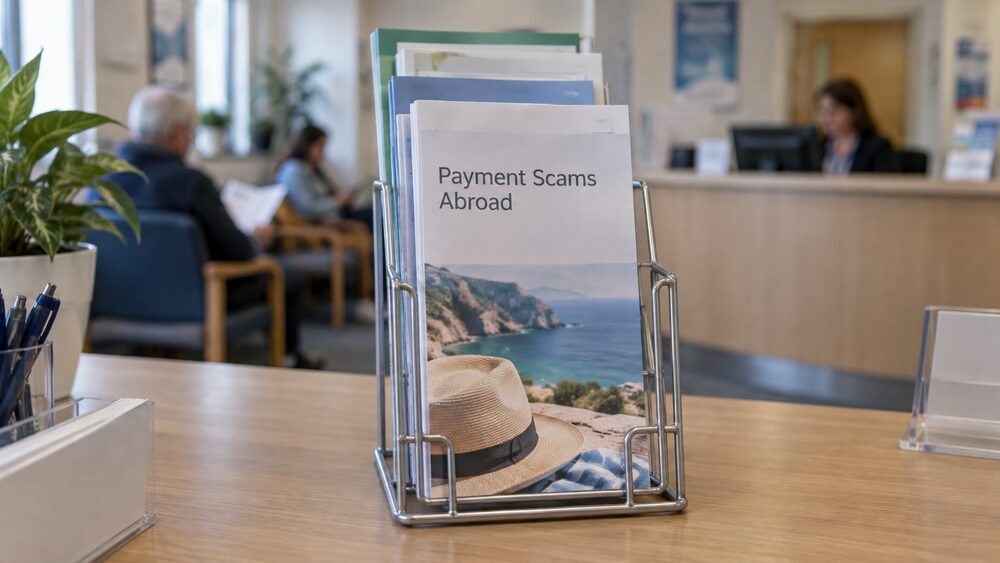
Sending money abroad is a common enough task that scammers have built whole playbooks around it. The scams described on this page share one feature: at some point you are asked to make a payment, often overseas, to someone who is not who they claim to be. Sometimes the payment is the "fee" that releases a prize or inheritance that never existed. Sometimes it is a genuine transfer to a real account, but the person who persuaded you to send it was lying about who they were. And sometimes the "transfer company" itself is fake, a website or email address set up to look like a firm you might trust.
The reason these scams work so well is that a bank transfer is fast and hard to reverse. MoneyHelper warns that paying by bank transfer gives you much less protection if something goes wrong, and that being asked to pay this way can itself be a sign of a scam1. Authorised push payment (APP) scams, where the victim is tricked into making the payment themselves, are the second biggest type of payment fraud in the UK2. The refund rules that now exist are a real improvement, but they have limits, and the biggest limit for this page is that international payments sit outside them.
How money transfer scams work: fee demands and fake providers
Two patterns dominate scams that involve sending money abroad. The first is the advance fee scam: you are told you have won a prize, are owed a refund, or have inherited money, but first you must pay a fee, often described as a transfer fee, tax, legal fee or release fee, to get it. The fee is the point of the exercise. Once you pay, the "prize" never arrives, and you are often asked for further fees, each one supposedly the last. MoneyHelper's scam guidance lists exactly this pattern among the common types, including scams that say you have unclaimed credits or that you have to pay to apply for a relief7. The fee is frequently demanded by international transfer, because it is fast, hard to trace and hard to reverse.
The second pattern is the fake provider. Here the scammer impersonates a money transfer company, or invents one. You receive an email that looks like it comes from a genuine firm, complete with a logo and professional wording, giving you account details to pay your transfer into. The account belongs to the scammer. The FSCS lists the red flags it uses to spot scam messages aimed at its own name, and the same list applies to any firm: being asked for money or payment details, a message arriving through an unusual channel such as WhatsApp, a phone number that is not on the firm's website, an email address that does not end in the firm's own domain, and American spellings or spelling errors8. A real transfer company will never email you new account details out of the blue and ask you to pay into them.
A third pattern sits between the two: the payment is real and the recipient account is real, but the story behind it is false. Romance scams, fake holiday rentals, bogus investment opportunities and fraudsters posing as family members in trouble all end the same way, with a bank transfer, often abroad, that the victim authorised themselves. That is what makes it an APP scam rather than a hack: you instructed the payment. MoneyHelper's guidance on shopping safely online is blunt that bank transfer is the payment method that leaves you least protected1. The rest of this page is about how to spot these approaches before you pay, and what your options are if you already have.
Warning signs of a scam contact
Scam messages follow patterns, and the patterns are recognisable. The FSCS lists common warning signs: inaccurate spelling and wording, a sense of urgency pushing you to act quickly, requests for bank details or passwords combined with being told not to tell anyone, and an unfamiliar email address9. Government guidance adds a checklist that covers most of what scammers do: pressure to decide, a short deadline, threats, the contact being unexpected, requests for personal information such as bank details, instructions to transfer money, claims you must pay to apply for or get a relief, claims of unclaimed credits, and offers of a discount, refund, rebate or grant10.
The urgency is the most reliable signal. Scammers want you to act before you have time to check anything. The Student Loans Company warned students about convincing text messages, emails and phone calls claiming a payment is at risk, has been blocked, that bank details need updating, or that an account will be closed unless the recipient acts immediately11. The messages are designed to look like they come from a trusted organisation. The same technique is used with delivery firms, banks, tax authorities and broadband providers.
| Warning sign | What it looks like |
|---|---|
| Urgency and pressure | "Act now", a short deadline, threats that an account will be closed9 |
| Unexpected contact | You did not expect the message, and it arrives out of the blue10 |
| Payment demands | A fee to release a prize, refund or relief; instructions to transfer money7 |
| Secrecy | Being told not to tell anyone, including your bank9 |
| Wrong details | Spelling errors, American spellings, an unfamiliar email address8 |
| Unusual channel | WhatsApp, social media or a phone number not on the firm's website8 |
Two rules cover most cases. First, if someone is asking you to pay by bank transfer, treat that as a warning sign in itself, because it is the payment method that gives you least protection1. Second, never let anyone rush you. A genuine organisation will wait while you hang up and call it back on a number you look up yourself. Take Five's guidance on banking fraud notes that fraudsters impersonate trusted organisations, such as banks, HMRC and broadband providers, to get your information12, and the defence is always the same: stop, and verify independently.
Scammers posing as regulators and official bodies
Impersonating an official body is a scam technique in its own right, and it works precisely because a regulator's name carries authority. The Payment Systems Regulator (PSR), which oversees UK payment systems, has issued a public warning about fraudsters sending members of the public emails posing as PSR staff and asking for money13. The scammers may make contact by email, post or phone, and may use the name of a real employee to sound convincing13.
The PSR's own advice is unambiguous: it never contacts members of the public asking for money or bank account details13. If someone claiming to be from your bank, the PSR or another financial regulator such as the FCA contacts you out of the blue, the recommended action is to hang up, contact the organisation directly using publicly listed contact details, and not be pressured into sending money13.
The same warning applies to other official bodies. Courts and tribunals services have issued guidance on suspicious phone calls, emails and text messages claiming to come from HM Courts and Tribunals Service, and the advice is the same: report it to Report Fraud online or by calling 0300 123 204014. The pattern to hold on to is simple. Real regulators and government bodies do not cold-call you demanding money, they do not ask for your passwords or full bank details, and they do not tell you to keep the conversation secret from your bank. Any of those three means the contact is fraudulent, no matter how convincing the caller sounds or how correct the details they already have about you.
Confirmation of Payee: a name check before you pay
Confirmation of Payee (CoP) is the main technical defence against sending money to the wrong account. It is a name checking service designed to help prevent APP scams and misdirected payments15. It works by checking whether the name of the account you are sending money to matches the name you entered, and it alerts you when there has not been a match16.
When you set up a new payee and make a payment, your bank checks the name you typed, and the account type, against the details registered with the receiving bank. The result comes back as one of three outcomes: a match, a close match, or no match, so corrections can be made before the money leaves your account6. A "no match" result is a strong warning that the account does not belong to the person you think it does. A "close match" means the name is similar but not identical, and the payment is not confirmed until the details are checked against the name of the person or company you have been dealing with.
The check is not a formality. FCA research found that among adults who set up a new payee when making a direct bank transfer in the 12 months to May 2024, 29% recalled an occasion where the payee details did not match first time17. Some of those will have been typos or a married name; some will have been scam accounts. The check gives you a moment to stop, which is exactly what a scammer has been working to deny you.
You are automatically opted in to Confirmation of Payee to protect you from fraud and to prevent payments going to the wrong account18. You can ask your bank to opt you out of your details being checked when other people pay you, but you cannot opt out when you are making a payment to someone else18. If you see a different message when paying, it may mean there is a system problem or that the receiving bank does not use Confirmation of Payee18.
Where Confirmation of Payee does not apply
The name check has gaps, and scammers know where they are. The most important gap for this page is that Confirmation of Payee applies to UK account-to-account payments through the systems it covers. When you send money abroad, the payment typically travels through correspondent banks and foreign systems where the UK name check does not run. The PSR noted in 2022 that payment service providers that do not provide CoP checks accounted for less than 5% of Faster Payments transactions but for 15 to 20% of the value of relevant APP scams19, which shows how fraud concentrates where the check is absent.
The scope of the check has been extended over time, and the PSR has consulted on removing the expiry date from the direction that requires firms to provide it and on expanding the range of directed firms20. Confirmation of Payee helps reduce misdirected payments and certain types of APP fraud by checking whether a payee's account details match those held by their payment service provider20, but it only works where both ends of the payment are within its reach.
For a payment sent abroad, the practical consequences are worth stating plainly. The name check that would warn you about a mismatched UK account generally will not fire. The receiving account may be in a country with no equivalent check. And the speed that makes UK transfers convenient works against you: once an international payment has been routed through several banks, recalling it depends on the cooperation of every bank in the chain. If you are sending money abroad, the checks in how international payments work and the details in what you need to pay someone abroad are your defence, because the automated name check largely is not.
APP scam refunds: who must reimburse you
Since 7 October 2024, there has been a mandatory reimbursement scheme for victims of APP scams. The PSR's policy requires payment firms to reimburse all in-scope customers who fall victim to APP fraud in most cases21. The requirement applies to APP scam payments made by individuals, microenterprises and charities5. Reimbursement is required in all but exceptional cases, so more victims get their money back15, and the design reflects the principle that responsibility for allowing fraudulent payments sits with both the sending and the receiving bank or building society15.
The cost is shared between the two ends of the payment. Once a sending firm has reimbursed the consumer, it can claim 50% of the reimbursement amount from the receiving firm5, and a receiving firm must send 50% of the cost of a reimbursement claim to the sending firm within a deadline set by Pay.UK22. Half of any stolen funds that are recovered must also be returned to the sending firm22. The aim is that the firm that let the fraudster receive the money pays its share of the loss, not just the victim's bank.
The rules also contain a protection for people who were targeted because of their circumstances. If the rules apply and you were particularly vulnerable to the specific type of APP scam, your bank or payment service provider must reimburse you3. Before the mandatory scheme, reimbursement operated under the voluntary Contingent Reimbursement Model code, which the PSR monitored while the Lending Standards Board oversaw its members23.
The scheme is working as intended for the payments it covers. PSR statistics show that between 7 October 2024 and 31 March 2026, 88% (£316m) of the money lost to APP scams was reimbursed to victims4. The PSR publishes performance data covering reimbursement to victims, money sent from victims' accounts and money received into fraudsters' accounts, drawn from the largest 14 banking groups in Great Britain and Northern Ireland, along with eleven other smaller firms that were in the top 20 highest receivers of fraud24, so you can see how well your own bank is doing.
Refund limits for payments sent abroad
This is where the rules stop, and it matters more than anywhere else on this page. The mandatory reimbursement requirement does not apply to international payments. The PSR's consolidated policy statement lists the exclusions plainly: payments which take place across other payment systems, payments made before 7 October 2024, international payments, payments made for unlawful purposes, and civil disputes5. Card payments and crypto payments are also outside the scheme, because it covers payments made through UK Faster Payments and CHAPS, the system over which the majority of these scams happen25.
For the payments that are covered, the limits are these: banks and other payment service providers must reimburse you up to a maximum of £85,000 if you are the victim of an APP scam3, and a £100 excess can be deducted from your refund, though not if you were particularly vulnerable4. The Financial Ombudsman Service, which enforces these rules when a bank refuses, states them in the same terms: reimbursement up to a maximum of £85,0003.
For a payment sent abroad, none of that machinery applies. There is no legal requirement on your bank to reimburse you, no cap, no cost sharing between sending and receiving firms, and no ombudsman rule forcing a refund. That does not mean the money is necessarily gone. Your bank can still attempt to trace and recall the payment through the correspondent banking chain, and the receiving bank abroad may freeze or return funds if it is alerted quickly. The PSR's advice for victims is to contact your bank as soon as you realise, because speed is the main factor in whether anything can be recovered28. But recovery is a best effort, not an entitlement, and the further the payment has travelled, the harder it is.
What to do straight away if you have been scammed
Speed matters more than anything else in the first hour. The Financial Ombudsman Service sets out the immediate steps: contact your bank or payment services provider immediately, contact the police on 101, report the scam to Report Fraud, and keep records of all contact and correspondence between you and the scammer29. The PSR gives the same first instruction: as soon as you realise you have fallen victim to a scam, immediately contact your bank to report it28.
A numbered version of the process:
- Stop all payments. Do not send further money, including "fees" the scammer says will release your earlier payment. A request for more money is part of the scam, not the way out of it7.
- Call your bank immediately on the number on your card or its official app, and ask it to attempt to recall or freeze the payment. The sooner it acts, the better the chance of stopping the funds28.
- Report to the police through Report Fraud, the national fraud reporting service, online or by calling 0300 123 204014. The Information Commissioner's Office also directs complaints about fraud and scams to Report Fraud33.
- Keep everything: messages, emails, phone numbers, account details you were given, and records of what you paid and when. Your bank and the police will need these29.
- Change passwords and contact your bank again if you shared any security details, because the scammer may attempt to access your account directly.
If the scammer contacts you again, end the conversation. Do not be pressured into sending money, and contact the organisation they claim to represent using publicly listed details13. If you need help working out what happened, MoneyHelper offers free, impartial guidance on scams and what to do next7.
Complaints: from your bank to the Financial Ombudsman
If your bank does not resolve the matter, or refuses a refund you believe you are owed, the next step is its formal complaints process and then the Financial Ombudsman Service. The ombudsman may be able to help if you have lost money to a scam and you are unhappy with how your bank or payment services provider handled things3. It covers complaints about the way a financial business has dealt with a scam involving unauthorised payments, stolen details or identity theft29, and more broadly issues such as account closures, disputed transactions, IT failures and problems with switching services34.
An important point for scams involving a transfer: the ombudsman can also look into complaints about the bank or payment service provider that received your money, considering the steps it took to recover the funds and whether it should have had concerns about its customer's account3. That means a complaint is not limited to the bank that sent the payment.
The ombudsman's service is free. Its decisions are not binding on you, so you can accept an award or reject it and pursue the matter elsewhere, but they are binding on the firm if you accept. For problems with a card retained by an ATM, the PSR's own guidance follows the same route: contact your card issuer first, and if it does not resolve the matter, complain to the Financial Ombudsman Service35.
One body that cannot help is the PSR itself. It regulates the payment systems, not individual payments: it does not deal with consumer related issues, does not handle complaints from consumers about individual payments, and does not get involved with financial issues beyond the payments industry36. Its own consumer guidance is that the best thing to do first is contact your account provider, for example your bank37. The PSR's role in scams is at the system level: it sets the reimbursement rules, publishes the performance data that shows how well each banking group protects and reimburses its customers24, and has implemented rules that let people see how well their bank is protecting them against APP scams37. It cannot order your money back, but the ombudsman can, for the payments the rules cover.
For payments sent abroad, where the mandatory rules do not apply, the ombudsman can still consider whether your bank handled the payment and the aftermath reasonably, but it cannot force a refund that no rule requires. That asymmetry is the practical reason the earlier sections of this page matter: the checks you make before sending money abroad are, for now, the strongest protection you have. The wider guide to scams and fraud covers the other main types, and tracing, cancelling or recalling a payment sent abroad covers the recovery process in detail.
Sources37 cited
- Shop safely online MoneyHelper
- Outcome of consultation on the contingent reimbursement model Payment Systems Regulator
- Scams: you've been tricked into making a payment Financial Ombudsman Service
- APP scams reimbursement dashboard Payment Systems Regulator, 2026-07-30
- PS25/5: APP scams reimbursement consolidated policy statement Payment Systems Regulator, 2025-05
- Confirmation of Payee Payment Systems Regulator
- Types of scam MoneyHelper
- FSCS podcast episode 46 transcript: scams and what to look for Financial Services Compensation Scheme, 2025
- Scams: what to look for Financial Services Compensation Scheme
- Staying safe from scammers GOV.UK, 2024-06-17
- Students urged to stop and think before you click GOV.UK, 2026-09-01
- Banking fraud: protect yourself Take Five to Stop Fraud
- Warning: fraudsters posing as PSR employees Payment Systems Regulator
- Guidance on HMCTS related suspicious phone calls, emails and text messages GOV.UK, 2026-09-17
- CP22/4: APP scams, requiring reimbursement Payment Systems Regulator
- CP19/4: Confirmation of Payee response to the first consultation Payment Systems Regulator
- Financial Lives 2024: payments Financial Conduct Authority, 2024-05
- Confirmation of Payee: banking safely Hampden Bank, 2026
- PS22/3: Extending CoP coverage Payment Systems Regulator, 2022-10
- CP26/2: Specific Direction 17, Confirmation of Payee Payment Systems Regulator
- PS23/3: Fighting APP fraud, a new reimbursement requirement Payment Systems Regulator
- PS23/4: APP scams policy statement Payment Systems Regulator, 2023-12
- The Contingent Reimbursement Model code Payment Systems Regulator
- APP fraud performance data Payment Systems Regulator
- CP24/8: CHAPS APP scam reimbursement requirement Payment Systems Regulator
- Dealing with fraud National Debtline, 2026-09-25
- What to do if you're the victim of a bank transfer scam Which?, 2026-05-12
- If you've fallen victim to a scam Payment Systems Regulator
- Scams involving unauthorised payments and identity theft Financial Ombudsman Service
- Investment fraud Take Five, 2026-09-26
- Protect yourself Take Five, 2026-09-26
- How to spot and avoid AI scams Which?, 2026-08-07
- Nuisance calls Information Commissioner's Office
- Banking and payments complaints Financial Ombudsman Service
- Access to cash: frequently asked questions Payment Systems Regulator
- When you make a payment Payment Systems Regulator
- How we help you Payment Systems Regulator



 MoneyHelperFree, impartial money and pensions guidance, set up by government
 Financial Ombudsman ServiceFree, independent help when a complaint about a firm is not put right
 FCA Warning ListCheck whether a firm is authorised before you deal with it
 Citizens AdviceFree advice on money, consumer and legal problems in England and Wales