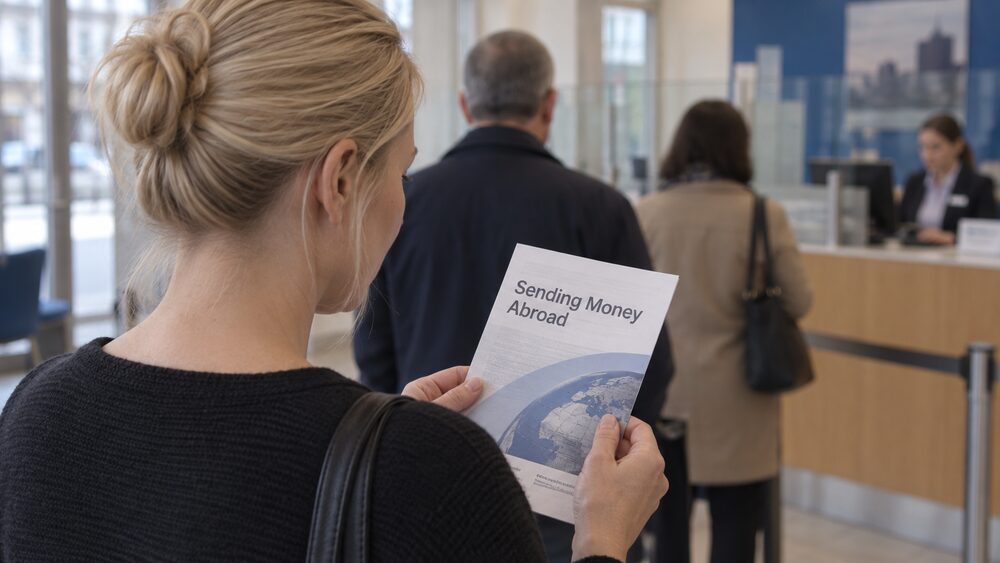
Sending money abroad means asking a firm to move funds from your UK account to a person or business in another country. The Financial Ombudsman Service describes an international money transfer as one that "allows people to send funds from a UK account to another account in different country"1. In regulatory terms, the action is initiating "a payment in a currency other than a currency of the United Kingdom to a payee outside the United Kingdom"2. The same basic choice faces everyone: whether to use your own bank, a specialist transfer provider, a currency broker for larger sums, or a service that hands over cash at the far end.
The differences between these routes matter most in three places: cost, speed and what happens when something goes wrong. A report by the Treasury Committee on cross-border transfers found that a typical transfer "takes three to five days" and that "up to 6% is chewed up in fees"3. Six pounds in every hundred is a large share of a payment, and the different routes exist largely because they attack that cost in different ways.
The main ways to send money abroad
There are four broad routes, and the ombudsman's list of the businesses it covers maps onto them almost exactly: a "high street bank", a "specialist money transfer and remittance business", an "online payment service", or a "foreign exchange specialist"1.
Your own bank. Every major UK bank can send an international payment from a current account. It is the route most people already have set up, and it suits occasional payments where convenience matters more than squeezing out the last fraction of a per cent. Banks typically charge a fixed fee per payment and build their own exchange rate margin into the conversion, which is where much of that 6% figure comes from3.
Specialist transfer apps. These are the firms people know from adverts and app stores. They take payment by card or bank transfer and pay out abroad, often into the recipient's bank account, a mobile wallet, or as cash for collection. They exist in large part because they undercut bank pricing on the same corridors.
Currency brokers. A foreign exchange specialist is geared to larger sums, such as a house purchase or a pension transfer, and to people who want to fix an exchange rate in advance rather than accept whatever the rate is on the day. The dedicated guides to sending large sums overseas and fixing an exchange rate cover how those arrangements work.
Cash collection and remittance services. These deliver physical cash that the recipient picks up at an agent, or pay into a mobile wallet. They suit recipients without a bank account, and they are the dominant form of family remittance in many corridors. The comparison of cash pickup versus bank deposit sets out the trade-offs.
Which route suits a particular person depends on the amount, how often they send, whether the recipient has a bank account, and how quickly the money is needed. Someone paying a one-off bill may value the familiarity of their bank; someone supporting family monthly may find a specialist app or remittance service cheaper; someone moving the proceeds of a house sale will usually be talking to a broker.
Sending through your bank: what you need and how it works
A bank transfer needs a short list of details: "the amount you want to send", "the full name of the person you're sending money to", their account details, "a payment reference", and a choice about whether the money is sent straight away or later4. For an international payment the account details are the receiving country's format, such as an IBAN and BIC, which the guide to recipient details explains. Once you have paid someone, "their details will be stored and you won't need to enter them next time"4.
Two practical points about bank payments are worth knowing before you start. First, some banks do not allow new payees to be set up in the mobile app: "Some banks don't let you set up a new payee on their mobile app, so you'll need to log in to online banking on a computer", and some require a card reader to verify the setup4. Second, if you are paying a UK organisation that then sends money overseas, the currency you use can carry a charge: HMRC, for example, tells people to "make all overseas payments in sterling" because "your bank may charge you if you use any other currency"8.
Where a card rather than a transfer is used, European rules on cross-border payments give you a right to information. When you make a card payment or cash withdrawal in a currency different from your account's currency, your provider must "send to the payer an electronic message with the information referred to in paragraph 1, without undue delay", and at least monthly while such payments continue9. That message shows the charges and the exchange rate applied, which is the figure to check against the mid-market rate described in the guide to exchange rates.
Domestic payments in sterling are fast: money sent using Faster Payments through a banking app "will reach the recipient's account within 2 hours, and sometimes it's received immediately"4. International payments are slower, as the next sections explain. If you are moving your whole banking relationship abroad rather than making a single payment, UK rules require your UK provider, where you open an account with an EU payment service provider, to hand over, free of charge, your lists of standing orders and direct debits, information on recurring incoming credits for the previous 13 months, to transfer any positive balance and to close the UK account10.
Confirmation of Payee, the name-checking service, applies to accounts that allow customers to transfer funds in and out, and those accounts "will still be required to implement" the ability to send and respond to Confirmation of Payee requests11. It is a UK account-name checking service, so it will not usually verify a foreign account, which is one reason payments abroad carry more risk of error than payments at home.
Specialist transfer apps: card, bank account, wallet or cash pickup
Specialist providers are the businesses the ombudsman calls "specialist money transfer and remittance business" and "online payment service"1. They typically offer several delivery options for the same transfer: payment into the recipient's bank account, credit to a mobile wallet, or cash available for collection. The guide to sending to a mobile wallet abroad covers that route, and the comparison of banks versus specialist providers sets out how their pricing differs.
What these firms have in common is that most are authorised as payment services or e-money firms rather than as banks, and that has a consequence for protection. Revolut, one of the best known, is a case in point: "Revolut customers don't benefit from the Financial Services Compensation Scheme"12. The same is true of prepaid card operators: "Prepaid cards are run by what are known as 'e-money' companies. The FSCS does not apply to them."13
That does not mean money held with these firms is unprotected, but the protection works differently. Authorised payment and e-money firms must safeguard customers' money, holding it separately from their own funds, so that it can be returned if the firm fails. The FSCS's deposit protection, by contrast, "can only protect money held by UK branches of authorised banks and building societies"14. The section on protection below, and the guides to safeguarding and the FSCS and when a payment firm fails, explain what this means in practice.
Before using any transfer firm, check that it is authorised. The FCA lets you do this through its Register, and warns that with an unauthorised firm "you will not be protected by the FSCS if the firm goes out of business, so it is unlikely you would get your money back"15. The guide to identity and security checks explains the verification these firms will run on you as a customer, which is a legal requirement rather than an optional hurdle.
Cash collection: how the recipient picks up money
Cash collection services pay out physical money at an agent, such as a branch, a kiosk or a shop displaying the provider's symbol. The recipient does not need a bank account, which is why this route dominates remittances to countries where bank coverage is thin. The mechanics are simple: the sender pays the provider, the recipient gets a reference number, and the recipient takes that number and ID to a collection point.
The UK has home-grown versions of the same idea, which show how the model works. Under the Payment Exception Service, used for certain benefit and pension payments, "you may be sent a: payment card, voucher by email, text message with a unique reference number", which is shown at anywhere displaying the PayPoint symbol, with proof of identity16. Banks have run similar schemes: "Payout Now" "sends a unique reference code by text, email or post to a customer who can take it to a Post Office branch to withdraw cash without the need to hand over bank details", and "Fast Pace" allows a customer to arrange for a trusted person, such as a carer or family member, to collect a pre-authorised cheque at their bank and cash it at a Post Office branch17.
ID is the gatekeeper at the counter. If someone else collects on the recipient's behalf, "they will need your payment card or voucher, your ID, their own ID"18. A collection can be refused if the ID does not match, so it is worth confirming the recipient has acceptable identification before sending.
Cash collection has clear limits. It is usually more expensive per pound than an account-to-account transfer, the amount that can be collected in one go may be capped, and carrying cash has its own risks. There is also a last-resort government option for British nationals abroad: the FCDO's money deposit service "will only consider this if no other transfer service is available", usually takes longer than other options, requires visiting the nearest British embassy, high commission or consulate in person, and charges a fee19. The guide to cash pickup services covers the mainstream commercial version in detail.
How long an international transfer takes
Speed depends on the route. A domestic Faster Payments transfer arrives "within 2 hours, and sometimes it's received immediately"4. A cross-border transfer through the traditional banking system is a different animal: the Treasury Committee's figure is that "it takes three to five days"3. The delay comes from the chain the money passes through, including cut-off times, weekends and holidays in both countries, and intermediary banks between the sending and receiving institutions. The guide to how long an international payment takes breaks down each stage.
Specialist apps and remittance services often quote faster times than that, particularly for wallet or cash payouts, because they settle through their own networks rather than the full banking chain. But the three-to-five-day figure remains the honest expectation for a standard bank-to-bank international payment, and it is wise to assume the slower end when the money is needed for a deadline such as a property completion.
Tracking a transfer and what each status means
Most banks and transfer firms give a status for each payment, usually visible in the app or on a transaction list. The common statuses follow the journey in the diagram above: authorised or pending when you have approved it, processed or sent once the provider has passed it on, and completed or credited once the money has arrived. Some providers send notifications at each stage: Student Finance England, for example, tells customers to "look out for the text message we send to let you know your payment is on the way"20.
For card payments and cash withdrawals abroad, the law gives you a periodic paper trail. Your provider must send you an electronic message with the charge and exchange rate information after a cross-border card payment or withdrawal, "and once every month in which such payment orders in the same currency are received"9. That is the figure to check if you think a card rate looks poor.
A status that sits at "sent" or "processing" for days is not necessarily a fault: it can mean the payment is moving between intermediary banks, or that a compliance or security check has paused it. The guide to tracing, cancelling or recalling a payment explains what can be done at each stage, and when a trace is worth requesting.
When a transfer is delayed or fails
Delays usually have mundane causes: a cut-off time missed, a public holiday in the receiving country, a wrong character in an account number, or a security check. Failures are more serious, and the two questions that matter are whether the money can be recovered and whether anyone is obliged to refund you.
For scam payments, the rules changed on 7 October 2024. From that date, for payments within the mandatory authorised push payment scheme, "your bank will usually have to give you a refund if you made this type of payment on or after 7 October 2024"21. Citizens Advice's summary of the position before the mandatory scheme was that "most banks should reimburse you if you've transferred money to someone because of a scam"22.
There are two important boundaries. First, the mandatory scheme is domestic: "Only UK bank transfers are covered, not payments to foreign accounts or other payment methods such as card payments"5. A transfer sent abroad that turns out to be a scam falls outside the mandatory refund, so the protection is weaker precisely where recovery is harder. Second, there are time limits and conditions: a bank can usually refuse a refund if "you told them about the fraud 13 months or more after the payment was taken"21.
For payments that simply go astray rather than to a scammer, the starting point is that a bank transfer is your instruction. MoneyHelper's guidance on paying safely online is blunt: "it's harder to get your money back, and you have much less protection if something goes wrong"23. The practical steps are to contact the provider immediately, ask for a trace or recall, and complain if the provider's handling was at fault. The guide to scams involving payments abroad covers the specific fraud patterns, including fake providers and upfront fee demands.
Protection: why transfer firms are not covered by the FSCS
The Financial Services Compensation Scheme protects deposits, insurance and investments, but not money held with transfer firms. The FSCS states plainly: "FSCS can't protect e-money or payment services firms."6 Its eligibility guidance repeats the point: "For example, we can't protect you if an e-money firm or payment services firm fails."14 When a payment firm has failed, the answer is the same: "The FSCS only applies to certain types of activity and does not cover payment services."24
So the protection for money in transit with a transfer firm is not FSCS deposit protection but safeguarding: authorised firms must hold customers' money separately from their own, so that if the firm fails the money can be identified and returned. That process is administered in the insolvency, and it can take time; the guide to when a payment firm fails explains what customers of a failed firm should do.
There is one narrow case where the FSCS can reach money sent through a payments firm. Under the FCA's rules, the FSCS "may 'look-through' the payments firm to compensate its customers if the firm's UK safeguarding bank fails", but "FSCS does not cover cases where the payments firm itself fails"25. In other words, if the bank where your transfer firm keeps its safeguarded funds collapses, FSCS protection may apply to the underlying deposits; if the transfer firm itself goes under, you rely on safeguarding and the insolvency process.
The check to make before using any provider is authorisation. The FCA warns that with unauthorised firms "you will not be protected by the FSCS if the firm goes out of business, so it is unlikely you would get your money back"15, and safeguarding rules apply only to authorised firms in the first place. You can check a firm on the FCA Register using its name or reference number. The guide to safeguarding and the FSCS sets out the full picture, and the section on consumer protection explains how FSCS cover works across financial services.
Complaints: the provider first, then the Financial Ombudsman
The ombudsman can look at complaints about any of the businesses described on this page, "a high street bank, specialist money transfer and remittance business, online payment service, or foreign exchange specialist"1.
The process is the same whichever kind of firm is involved:
- Make a formal complaint to the firm, in writing if possible, setting out what went wrong and what you want it to do.
- Give the firm time to respond. "If they don't send you a final response letter within eight weeks, or you're unhappy with their response, you can bring your complaint to the ombudsman" using its complaint form26.
- Complete the ombudsman's complaint form. A case handler is assigned and "may ask for more information"26.
- The ombudsman looks at both sides and issues a decision, which the firm must accept if you accept it.
The ombudsman's service is free to the consumer. It can look at whether the transfer was carried out properly, whether the fees and exchange rate were as disclosed, whether the firm's checks delayed or lost the payment, and how the firm handled the complaint itself. It cannot overturn a correct payment that simply went to the account you told it to, but it can award compensation for inconvenience, financial loss and poor handling.
Sources28 cited
- Sending money abroad: complaints the Financial Ombudsman Service can help with Financial Ombudsman Service, 2026-09-26
- BCOBS 7.5.4R: payment services rules Financial Conduct Authority, 2018
- Treasury Committee report on cross-border payments House of Commons Treasury Committee, 2023-05-17
- Online money transfers: how to make a bank transfer Age UK, 2026-03-23
- Santander's new app blur feature and APP scam protection Which?, 2025-08-28
- Check your money is protected Financial Services Compensation Scheme, 2026-09-25
- Complaints that involve gambling related harm: the complaint process Financial Ombudsman Service, 2026-09-26
- Repay Child Benefit overpayments: overseas payments HMRC and GOV.UK, 2026-09-26
- Regulation (EC) No 924/2009 on cross-border payments, Article 3a(5) legislation.gov.uk, 2019-03-19
- The Payment Accounts Regulations 2015 legislation.gov.uk, 2015-12-15
- Extending Confirmation of Payee coverage, PS22/3 Payment Systems Regulator, 2022-10
- Is your money safe with Revolut? Which?, 2024-06-13
- Wirecard goes bust: what it means for prepaid card and Curve customers Which?, 2020-06-30
- Can't find the firm you're looking for: FSCS eligibility Financial Services Compensation Scheme, 2026-09-25
- How to check a firm or individual is authorised Financial Conduct Authority, 2023-03-20
- Bank and building society accounts: getting your money Macmillan Cancer Support, 2022-11-01
- Banking post lockdown: visiting branches, getting cash, contacting your bank Which?, 2020-08-07
- Payment Exception Service: collecting money Turn2us, 2026-05-26
- Your finances when travelling abroad: FCDO money deposit service GOV.UK, 2022-08-31
- Preparing for payment: Student Finance England GOV.UK, 2026-09-02
- Dealing with fraud and scams: APP refund rules Business Debtline, 2026-09-26
- Check if you can get your money back after a scam Citizens Advice, 2019-05-30
- Shop safely online: bank transfer risks MoneyHelper, 2026-09-25
- Premier Payment Solutions Ltd enters liquidation: FSCS position Financial Conduct Authority, 2026-09-14
- PS25/12: FSCS look-through for payments firms Financial Conduct Authority, 2025-08
- Savings and endowments: how to complain to the ombudsman Financial Ombudsman Service, 2026-09-27
- Debt collecting complaints Financial Ombudsman Service
- Unregulated collective investment schemes complaints Financial Ombudsman Service



 MoneyHelperFree, impartial money and pensions guidance, set up by government
 Financial Ombudsman ServiceFree, independent help when a complaint about a firm is not put right
 FCA Warning ListCheck whether a firm is authorised before you deal with it
 Citizens AdviceFree advice on money, consumer and legal problems in England and Wales