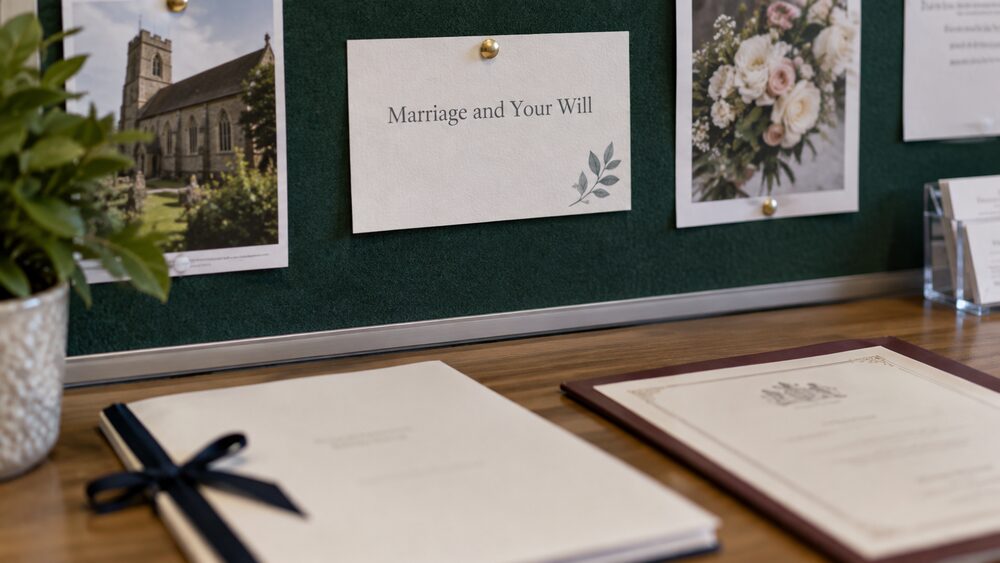
In England, Wales and Northern Ireland, getting married or entering a civil partnership automatically revokes a will you made before the ceremony1. The will is not amended or partly overridden: it stops applying, and unless you make a new one your estate is distributed under the intestacy rules instead. In Scotland the opposite is true, and marriage does not revoke a will at all1.
In England, Wales and Northern Ireland, getting married or entering a civil partnership automatically revokes a will you made before the ceremony1. The will is not amended or partly overridden: it stops applying, and unless you make a new one your estate is distributed under the intestacy rules instead. In Scotland the opposite is true, and marriage does not revoke a will at all1.
Divorce behaves differently again. It does not cancel a will, but it changes what the will does: your former spouse is treated as though they had died, so any gift to them fails and any appointment of them as executor fails with it1. The rest of the will stands.
The practical effect is that two of life's biggest events pull in opposite directions. Marriage wipes the slate clean and leaves you without a will unless you write a new one. Divorce leaves the document in place but quietly removes your ex from it, which is not the same as putting your estate where you now want it to go.
Marriage or civil partnership cancels an existing will
The rule in England, Wales and Northern Ireland is blunt. Getting married or entering a civil partnership automatically revokes a will, and the same applies to a will made before a remarriage1. Age UK puts it in the same terms for anyone remarrying or entering a new civil partnership: it "automatically revokes (cancels) any existing will you have, so you'll need to make a new will"5.
That means a will written years earlier, naming children from a previous relationship or leaving specific items to friends, simply stops operating on the day of the ceremony. Nothing needs to be torn up or formally withdrawn. The revocation happens by operation of law.
There is a narrow exception in practice, and it is worth knowing about because it is the one thing that survives. A will made in anticipation of a marriage can be written so that it is not revoked by that marriage, but this has to be built into the will itself before the wedding, not added afterwards. The wording and conditions are not set out here, so anyone wanting this needs it drafted by a solicitor.
For most people the answer is simpler: after a marriage or civil partnership, a new will is needed. The government recommends reviewing a will every five years and after major life events such as marriage or civil partnership, or the birth or adoption of a child4. Which? suggests a shorter cycle, reviewing every three years1. Either way, a wedding is a trigger, not a routine date.
Divorce does not cancel a will, but it changes it
Divorce ends the marriage but not the financial connection between ex-partners6. It also leaves your will in place, which surprises many people. Unless you alter it, your will remains valid until your divorce is finalised, and even then some details could still stand2.
What changes is your ex-spouse's position. Once the divorce is finalised, your former partner is treated as if they were deceased, meaning any gift or appointment as executor would fail1. Which? describes the same rule: your ex-partner is automatically cut out of your will as soon as your divorce is finalised, but the rest of the will remains valid7.
That automatic cut-out is narrower than it sounds. It removes your ex, and only your ex. It does not redirect their share to anyone else, and it does not update the will to reflect a new partner, stepchildren, or a change of mind about which of your relatives should inherit. If a gift to your ex was one of several, the others stand. If your ex was the only beneficiary, the will may now do very little.
"While divorce will not automatically invalidate a will, your former spouse is treated as though they are deceased, which means you won't be able to name them as either an executor or a beneficiary unless you create a new will"
There is a second trap. A will made during the marriage is not automatically invalidated by divorce, but it does exclude your ex-spouse or ex-civil partner from benefiting5. So the document that was written to provide for a spouse now provides for nobody in particular, and the estate may fall to be distributed in ways the person who wrote it never intended.
The way to change a will is to make a new one, which cancels any previous will, or to alter the existing one by adding a codicil9. A codicil suits minor changes. After a divorce, a new will is usually the cleaner route, because the changes are rarely minor.
Separation without divorce: the will stays as written
While a couple is separated but not divorced, nothing about the will changes. A separated spouse can still inherit under it and can still act as executor. That is true however long the separation lasts and however separate the finances have become.
A legal separation allows finances to be divided without officially ending the marriage, and it must be applied for in writing6. It does not revoke a will either. Neither does a separation agreement, which is not legally binding in itself, though a court can normally take it into account if it was fair, if both people can show they understood what they were agreeing to, if it was drafted properly by a solicitor, and if both people's financial situations are the same as when the agreement was made10.
The gap between separation and divorce is where wills cause the most unintended results. Someone who has lived apart from a spouse for years, and who has written nothing since, may still leave everything to that spouse. Independent Age's guidance is direct on the point: you may also need a new will11.
There is a further complication for anyone who has started a new relationship. A partner you are not married to and not in a civil partnership with has fewer rights than a spouse11. If you are living with someone but not married or in a civil partnership, you will have fewer rights11. A cohabitation agreement sets out what happens if a couple breaks up or one of them dies, and it does not replace a will, though it adds extra clarity12.
Scotland and Northern Ireland: where the rules differ
Scotland is the clearest exception to the marriage rule. Marriage does not revoke a will in Scotland, and under Scottish law getting married gives your spouse legal rights to part of your estate1. So a will written before a Scottish marriage survives it, but the spouse acquires a claim over part of the estate regardless of what the will says.
That claim is enforceable. In Scotland, married or civil partners or children of the person who died can challenge the will if they do not agree with what it says, by exerting their legal rights13. This is a different mechanism from anything in England and Wales: rather than the will being cancelled, it can be overridden in part by people the law protects.
Northern Ireland follows the same revocation rule as England and Wales. Civil partnership or marriage revokes an existing will in England, Northern Ireland and Wales, so a person who marries there without making a new will is at risk of dying intestate4. Where Northern Ireland differs is in the machinery around separation and divorce rather than in the will rule itself. The Matrimonial Causes Order sets out the range of powers the court can use when deciding how to split assets14.
The wider pattern is that legal systems across the UK diverge on family and estate matters, and the differences are not cosmetic. Power of attorney, for instance, works under different legal systems in England and Wales, Scotland and Northern Ireland15. Anyone who has moved between nations, or who owns property in more than one, is dealing with more than one set of rules.
| Nation | Marriage or civil partnership | Divorce |
|---|---|---|
| England and Wales | Revokes an existing will1 | Will stands, ex treated as deceased1 |
| Northern Ireland | Revokes an existing will4 | Will stands, ex treated as deceased1 |
| Scotland | Does not revoke a will; spouse gains legal rights to part of the estate1 | Will stands; legal rights can be claimed13 |
What happens if there is no valid will
If you do not have a valid will when you die, everything is split according to the law3. That body of law is the intestacy rules, and if you die without making a will, the law of intestacy sets out who should inherit your estate15.
The consequences fall hardest on people who were not married or in a civil partnership with the person who died. Someone living with the deceased but not married to them or in a civil partnership with them may not receive anything from the estate16. The same risk applies to life insurance: assets are divided according to intestacy rules, including any life insurance payouts, which could leave out a partner if the policy was not written in trust17.
Property follows the same logic. If you do not make a will, the home will pass to your closest relatives, next of kin, when you die18. That is true whether or not someone else has been living there and paying the mortgage.
Where there is no will, an administrator takes over the estate, usually a relative or friend, or a solicitor19. In Scotland, if there is no will or no executor has been appointed, the sheriff court can appoint one, and the court will normally appoint someone with an interest in the estate, in many cases a surviving spouse or civil partner13.
The reform picture is worth watching but not yet relying on. Under proposals consulted on, cohabiting couples would have a right to inherit under intestacy, similar to married couples and civil partners, but that is a proposal for England and Wales and not the current rule4.
Where to get help
Free, impartial guidance on wills, intestacy and what happens to an estate is available from Citizens Advice, which covers dealing with an estate after a death in Scotland as well as England and Wales13. MoneyHelper provides guidance on dividing the family home and mortgage during divorce or dissolution14. For anyone who wants a will drafted or reviewed, solicitors in Scotland and Northern Ireland are regulated by The Law Society of Scotland and The Law Society of Northern Ireland respectively1.
Sources19 cited
- How to make a will Which?, 26 February 2026
- Separation to divorce Fidelity, 26 September 2026
- Making a will Scottish Widows
- Intestacy rules Which?, 28 July 2026
- Financial and legal tips before remarrying Age UK, 28 May 2024
- What happens to debts when you get divorced National Debtline, 25 September 2026
- After divorce Fidelity, 26 September 2026
- Divorce financial mistakes to avoid Which?, 9 January 2024
- Making a will Royal London, 9 October 2025
- Dividing up money and belongings when you separate Citizens Advice, 30 September 2019
- Relationships and your money Independent Age, 26 September 2026
- Common law partner Post Office, 8 September 2026
- After death: dealing with an estate Citizens Advice Scotland, 26 September 2026
- Dividing the family home and mortgage during divorce or dissolution MoneyHelper, 25 September 2026
- Dementia and managing money nidirect, 3 September 2026
- Debts after death National Debtline, 25 September 2026
- How to write life insurance in trust Which?, 6 April 2026
- How to leave your home to a disabled family member Scope, 8 September 2026
- Debt when someone dies nidirect, 26 June 2026





 MoneyHelperFree, impartial money and pensions guidance, set up by government
 Citizens AdviceFree advice on money, consumer and legal problems in England and Wales
 Turn2usFree benefits calculator and grants search from a charity
 GOV.UKOfficial information on tax, benefits and government services