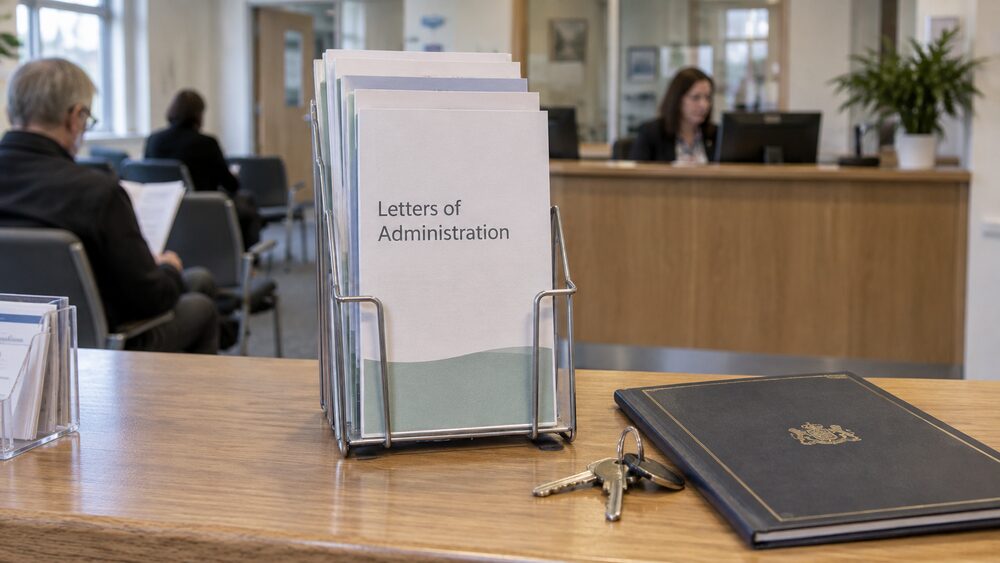
If someone dies without leaving a will, the document that gives you the legal authority to deal with their money, property and possessions is called Letters of Administration. It is the equivalent of a Grant of Probate, but it applies where there is no will, or where the will does not name anyone able or willing to act as executor1.
If someone dies without leaving a will, the document that gives you the legal authority to deal with their money, property and possessions is called Letters of Administration. It is the equivalent of a Grant of Probate, but it applies where there is no will, or where the will does not name anyone able or willing to act as executor1.
In England and Wales, you apply for Letters of Administration using form PA1A, either online or by post, with restrictions on who can apply online3. In Northern Ireland, the same grant is used where there is no will, and you might not need one at all if the estate is worth less than £10,000 and contains no land, property or shares, or if everything is held in joint names3. In Scotland, the process is different again: the document is called Confirmation, and it is applied for through the sheriff court4.
The grant matters because banks, building societies and other institutions will usually ask to see it before releasing money from the estate. Without it, you have no legal standing to close accounts, sell property or settle debts in the deceased's name.
Letters of Administration: probate when there is no will
Probate and Letters of Administration are two names for the same kind of legal permission, issued in different circumstances. A Grant of Probate is issued where the deceased left a valid will and named executors who are able and willing to act. Letters of Administration are issued instead where there is no will, the will is not valid, no executor is named, or the named executor cannot or is unwilling to act6.
The practical effect is the same: the grant is the document that proves to banks, pension providers and the Land Registry that you have the authority to deal with the estate. Without it, institutions will not release funds or transfer assets. Nationwide Building Society, for example, says it does not usually ask to see the will to close or release funds from an account, but it may ask to see proof that you have permission to administer the estate, which it calls a grant of probate7.
If there is no will, you complete form PA1A. If there is a will, you complete form PA1P instead5. Age UK's guidance confirms that where there is no will, the PA1A form is the one to use8. The process itself is otherwise the same as applying for a Grant of Probate: you gather details of the estate, complete the form, and send it to the probate registry with the death certificate and any other required documents9.
One important distinction: if the deceased left a will but did not appoint an executor, or the named executor is unable to carry out the duty, the grant is called Letters of Administration with Will annexed10. This gives the administrator the same authority as an executor would have had, but the will still governs who inherits.
When you need Letters of Administration instead of probate
You need Letters of Administration rather than probate in four situations: there is no will, the will is not valid, there are no executors named in the will, or the executors cannot or are unwilling to act6.
Whether you need a grant at all depends on the size and composition of the estate. If the estate is worth above a certain amount, the executor or administrator will need special permission, called probate or letters of administration, before they can deal with the assets11. You may not need Letters of Administration if the value of the estate is small, property is held jointly (which passes automatically to the surviving owner), or the estate is insolvent3.
Banks and building societies set their own thresholds for when they will release funds without a grant. Some will release small balances on production of a death certificate and proof of identity alone. Others require a grant for any value over a set limit, or where the claim is not straightforward12. If you are unsure whether a grant is needed, the bank holding the account can tell you its threshold.
If the estate is insolvent, meaning debts exceed assets, a grant may not be necessary because there is nothing to distribute. Creditors can apply for an insolvency administration order within five years of a person dying13.
Who can apply: the legal next of kin
The person who applies for Letters of Administration is called the administrator. To apply, you need to be eligible according to the intestacy rules, which normally means being the closest living relative7. The next of kin can apply, but the law decides who inherits what, not the applicant14.
Where there is no will, an administrator takes over the management of the estate. This is usually a relative or friend, or a solicitor acting on behalf of the family11. The administrator's role is to collect in the assets, pay any debts and taxes, and distribute what remains according to the intestacy rules.
The order of priority under the intestacy rules determines both who can apply for the grant and who benefits from the estate. A surviving spouse or civil partner normally has the first claim, followed by children, then parents, then siblings and more distant relatives. If there are no surviving relatives, the estate passes to the Crown.
"If there isn't a will, the next of kin can apply for a 'letter of administration' but the law decides who inherits what."
If you are applying on behalf of someone else, for example as an appointee or under a power of attorney, you may have a legal right to apply for them15. However, a power of attorney is no longer valid after the donor has passed away, so it cannot be used to administer the estate16.
What the grant lets you do with the estate
Once the grant is issued, the administrator has the legal authority to deal with the estate. This includes closing bank accounts, transferring or selling property, claiming pensions and life insurance, and paying any debts owed by the deceased.
The grant is also the document that institutions require before they will release funds. Banks, building societies and pension providers will ask to see either a Grant of Probate or Letters of Administration before releasing money from the estate17. Some institutions may also require proof and documentation from all executors and administrators dealing with the deceased17.
If Inheritance Tax is due, the grant may be issued on credit, which allows the personal representatives to postpone payment of Inheritance Tax until after probate has been granted18. To apply for a grant on credit, you send a signed and completed form IHT 400 and any supplementary pages or supporting documents to HMRC, plus form IHT421 in Northern Ireland or Confirmation form C1 in Scotland, along with a letter confirming you are unable to release funds from the estate and stating the maximum amount you can pay19.
The administrator is personally responsible for administering the estate correctly. This includes paying the right amount of tax, settling debts in the correct order, and distributing the estate to the right people. If the administrator makes a mistake, they can be held personally liable.
Scotland and Northern Ireland: what applies instead
The system differs across the UK. In Scotland, the equivalent document is called Confirmation, and the certificate issued is the Certificate of Confirmation20. An application for Confirmation is made to the sheriff court4. If there is no will, or no executor has been appointed, the sheriff court can appoint one, and the court will normally appoint someone who has an interest in the estate, in many cases a surviving spouse or civil partner4.
In Scotland, the grant of representation is called a grant of confirmation21. The Scottish version of a Grant of Probate or Letters of Administration is the Certificate of Confirmation20. If someone is named as executor in the will, they can apply for confirmation, which is the authority to deal with the estate of someone who has died1.
In Northern Ireland, the grant of letters of administration is used where the deceased has not left a will21. You might not need one if the estate is worth less than £10,000 and does not contain land, property or shares, or if the whole estate is held in joint names3. If the estate is worth less than £10,000, there is no fee to apply for letters of administration3. If the estate is worth more than £10,000, it costs £326, plus an additional £81 personal applicant fee if you apply without a solicitor3.
What happens if the will is not valid
If the will is not valid, the estate is treated as intestate, meaning the rules of intestacy apply as if there were no will at all. A relative might need to apply to the court to get Letters of Administration, and the money and assets will go to relatives in a set order of priority22.
A will can be invalid for several reasons: it was not properly witnessed, the person lacked mental capacity when they made it, it was made under duress, or it was revoked by a later will or by marriage. If you are unsure whether a will is valid, legal advice may be needed.
If the will is valid but does not name an executor, or the named executor is unable or unwilling to act, the grant is called Letters of Administration with Will annexed10. In this case, the will still governs who inherits, but the administrator is appointed by the court rather than named in the will.
Where to get help
Free, impartial help is available. Citizens Advice Scotland provides guidance on dealing with an estate after a death4. Age UK offers information on what to do when someone dies and dealing with the estate8. The Financial Ombudsman Service can help if you have a complaint about a financial firm's handling of a power of attorney or estate matter16.
If you are dealing with a small estate, you may not need a grant at all. If you are unsure, the bank or building society holding the account can tell you its threshold. For estates that are more complex, or where there is disagreement among relatives, a solicitor specialising in probate and estate administration can advise.
Sources22 cited
- Things to do after a death Independent Age, 2026-09-26
- Bereavement jargon Nationwide Building Society, 2026
- Intestacy rules Which?, 2026-07-28
- After death: dealing with an estate Citizens Advice Scotland, 2026-09-26
- What is probate Age UK, 2026-09-21
- Bereavement guide Cambridge Building Society, 2026-09-26
- Estate, wills and probate Nationwide Building Society, 2026
- Dealing with the estate Age UK, 2026-09-21
- Bereavement support NBK, 2026
- First steps Cumberland Building Society, 2026
- Debt when someone dies nidirect, 2026-06-26
- Bereavement support Virgin Money, 2026
- Bereavement Accord Mortgages, 2026-09-26
- What to do when someone dies HSBC, 2026
- Inheriting property Fidelity International, 2026-09-26
- Power of attorney complaints Financial Ombudsman Service, 2026-09-26
- Are my savings safe? Which?, 2025-12-01
- Inheritance Tax on pensions HM Revenue & Customs, 2025-07-21
- Applying for a grant on credit for Inheritance Tax HM Revenue & Customs, 2024-04-01
- Help and guidance following bereavement Accord Mortgages, 2026-01-19
- IHT400 notes HM Revenue & Customs, 2026
- How do I make a will or trust fund Mental Health and Money Advice, 2024-02-13





 MoneyHelperFree, impartial money and pensions guidance, set up by government
 Citizens AdviceFree advice on money, consumer and legal problems in England and Wales
 Turn2usFree benefits calculator and grants search from a charity
 GOV.UKOfficial information on tax, benefits and government services