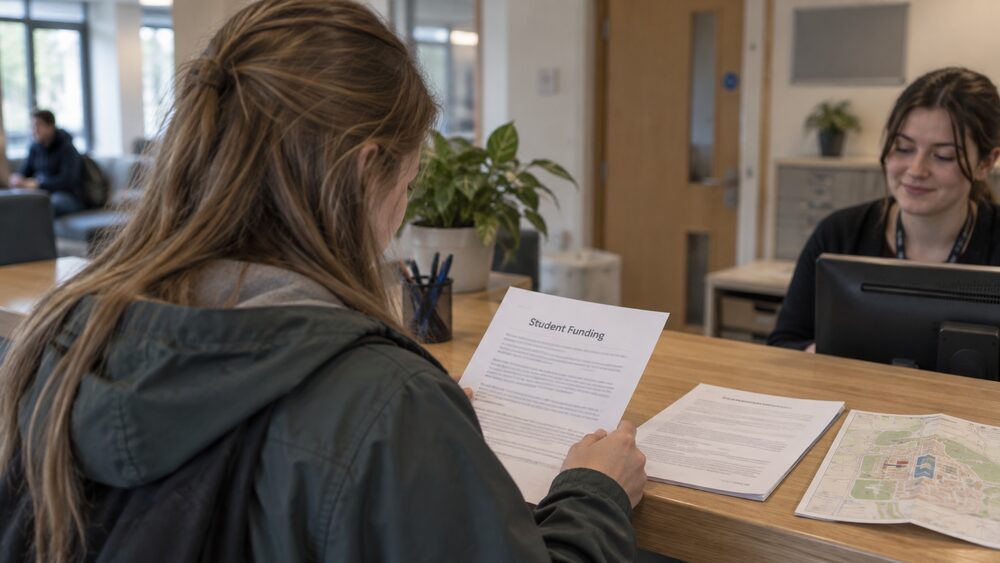
If you live in Scotland and are heading to university or college, your student funding comes from the Student Awards Agency Scotland, usually called SAAS, which manages student funding north of the border1. SAAS can pay your tuition fees in full, and it also offers a loan to help with living costs and, for many students, a bursary on top2. The headline difference from the rest of the UK is tuition: eligible Scottish students studying in Scotland do not pay tuition fees, because SAAS covers them3.
The two living cost payments behave very differently. The loan has to be repaid once you are earning enough, while the bursary does not have to be paid back, with one exception if you leave your course during term time2. How much you get of each depends largely on your household income, your course type and whether you study full time or part time2.
What SAAS pays for: fees, loans and bursaries
SAAS funding comes in three main parts. The first is tuition fee support: if you live and study full time in Scotland, SAAS may pay your tuition fees, so most full time courses at Scottish universities are free for people who meet the residency conditions set by the Scottish Government1. The second is a loan to help with living costs, which new and existing students can apply for, with the amount depending on household income, course type and whether study is full time or part time2. The third is a bursary, which you can also apply for, in addition to your student loan, again with the amount depending on your household income2.
SAAS decides how much it will pay using a number of factors: your age, your family situation, where you study, whether you will study full or part time, whether you have taken any previous courses, and what course you will take2. Full time students can apply for a loan or bursary to help with living costs depending on their circumstances, and generally young people leaving school can apply for the maximum1.
Beyond the standard package, SAAS provides grants in certain circumstances, including for some student carers and lone parents1. Students who have lived in care can apply for a bursary they do not have to repay, instead of a loan, and some people in kinship care arrangements may also qualify1. One point to watch: if someone has had funding in the past, they may have to pay tuition fees for further study1.
Tuition fees are paid if you live and study in Scotland
The tuition fee position is the part of Scottish student funding that differs most sharply from England, Wales and Northern Ireland. Eligible Scottish students studying in Scotland do not pay tuition fees, which are covered by SAAS3. Most full time courses at Scottish universities are free for people who meet the residency conditions set by the Scottish Government, and most full time courses at Scottish colleges are free if someone has lived in the UK for the last three years and is resident in Scotland1.
The position changes if you come from elsewhere in the UK. Students from the rest of the UK studying in Scotland will typically pay up to £9,535 in tuition fees (2025 to 2026)3. So the free tuition arrangement is tied to living in Scotland, not simply to studying there, and where you are ordinarily resident is what decides which funding body handles your application: a student from Scotland deals with SAAS5.
There is also a group of students who qualify for tuition fee funding only. If that applies to you, you will not be eligible for funding to help with living costs6. And if you are eligible to apply for NHS bursaries that do not depend on household income, you cannot apply for student finance from SAAS at all, and would instead apply to NHS Student Bursaries, including for Disabled Students' Allowance6.
Household income decides how much you get
Most of the living cost support from SAAS is income assessed. Household income can include income from your parents and step parents, your partner or spouse, and your own unearned income such as pensions2. The Independent Students' Bursary is available if your household income is below £21,000 per year4.
Not all income counts the same way. Earnings from work you do while studying do not affect the money you get from SAAS. Child Maintenance and benefits paid for children, such as Child Benefit or the child element of Universal Credit, are not counted. But some unearned income, including pensions, property income and benefits paid for you, such as Maternity Allowance and the standard allowance of Universal Credit, is taken into account and could decrease your award4.
Two parts of the package sit outside the income test. Tuition Fee Loans and Disabled Students' Allowance do not depend on household income6. DSA in particular depends on your individual needs, not your household income8.
If your parents or partner are asked to share information about household income and do not, there is a direct consequence: you will only get the minimum amount of student finance5. So the income assessment is not optional if you want the full amount you are entitled to.
Student finance can also interact with benefits. Bursaries available to full time students who started their course in September 2006 or later are counted as income for benefits if they are not for course related costs or childcare, but bursaries that are for course related costs or childcare are not counted as income9. The Student Loan for Tuition Fees is not counted as income9. Benefits for students depend on personal circumstances such as income and savings, and student finance income may be too high to qualify9.
The loan is repaid, the bursary is not
The living cost loan and the bursary look similar when they arrive in your bank account, but they are different in kind. The loan needs to be repaid but the bursary does not4. Official guidance is blunt about the split: you need to pay back Tuition Fee Loans, Maintenance Loans for living costs and postgraduate loans, while you do not need to pay back other student finance, for example grants and bursaries10. The Independent Students' Bursary does not need to be repaid, and nor does the Lone Parent Grant, which is paid out by SAAS rather than by your college or university4.
How the loan and the bursary differ in how the amount is set and whether it is repaid.
Repayment of the loan works through the tax system. Scottish students who started their course on or after 1 September 1998 will be on repayment plan 4, and repayments start in the April after the course is completed and are included in your tax4. When you start repaying, and how much you pay, depends on which repayment plan you are on10.
One further point on money you do not have to repay: if you receive more of any type of student finance than you are entitled to, you will have to repay the overpayment10. This can happen if your circumstances change during the year and SAAS is not told.
HNC, HND and postgraduate courses
Funding does not stop at degrees. For HNC or HND courses you need to apply to SAAS for tuition fee funding1. Disabled Students' Allowance covers a wide range of publicly funded courses, including first degrees, Foundation Degrees, Certificates and Diplomas of Higher Education, HNCs, HNDs, PGCEs and postgraduate courses7.
At postgraduate level, Scottish postgraduate loans are funded by SAAS12. Taught Masters degrees and postgraduate diplomas (PGDip) are covered by Scottish postgraduate loans, but PhDs are not eligible for SAAS funding12. There are some specific rules worth knowing:
- If the course is part time, it must be studied in Scotland, as SAAS does not provide support for part-time courses elsewhere12.
- You can now receive SAAS Masters funding if you study via distance learning, although previously this was not possible12.
- EU nationals can access the full postgraduate funding package, including the tuition fee loan and living cost loan12.
- You cannot get the tuition fee loan if you have previously received SAAS Masters funding, but you can still access the living cost loan12.
SAAS offers a loan of £7,000 to help pay for the tuition fees of a part time or full time postgraduate course, or £3,500 per year for a two year course4. You can now apply for postgraduate Master's Loan funding for the 2026 to 2027 academic year13, and the closing date for applications for 2026/27 is 31 March 202712. Repayment of a Scottish postgraduate loan follows plan 4, and any outstanding balance is written off 30 years after the April you were due to repay12.
Students combining study with caring should also know that Carer Support Payment is available to students aged 16 to 19 studying part time courses at any level, or full time for an advanced qualification such as an HNC, HND or a degree14.
Disabled Students' Allowance through SAAS
Disabled Students' Allowance, or DSA, is support to cover the study related costs you have because of a mental health problem, long-term illness or any other disability8. It is not means tested: the type of support and how much you get depends on your individual needs, not your household income8. You do not need to pay DSA back, and it does not affect your other benefits8.
In Scotland, you apply to SAAS for DSA for any course15. SAAS is responsible for payment of DSAs, and if you agree in writing, SAAS can make payments direct to suppliers or service providers15. Most payments will be sent directly to your suppliers, depending on what support you have been awarded8. For part time students, the allowance is pro rata, so the maximum amount you are eligible to receive is based on the intensity of your study15.
To be eligible, you must be an undergraduate or postgraduate student, qualify for funding from Student Finance, and be on a higher education course that lasts at least a year7. Disabled students taking courses at National Level 7 or above can apply, and the allowance covers educational support costs such as assistive technology, adapted equipment or communication support workers1. The costs DSA can help with include specialist equipment, for example a computer, non-medical helpers, taxi travel to and from your course or placement, and other disability related study support8.
How you apply depends on your situation. If you are a full time student applying for other student finance, you can apply for DSA at the same time from your online account; if you want to apply for DSA only and no other type of student finance, you complete a DSA1 application form downloaded from the Student Finance or SAAS website15. Postgraduate students need to apply by completing a DSA paper application form7. If you are eligible for financial support from the NHS, you apply to NHS Student Bursaries for your DSA instead7.
There are limits to what DSA covers. It is not intended to pay for disability related costs you would have whether or not you were a student, such as personal care support; it cannot reimburse items already bought; and it cannot pay for support the university should provide15. DSA also cannot be paid after you have left your course15.
How to apply: every year, before you accept your place
Whatever level of loan or bursary you get, you will need to make an application every year for as long as your course lasts, and applications are made before confirming your place or starting your studies2. SAAS asks students to apply as soon as possible after receiving an offer of a place at university or college, because late applications could delay funding4. The rule is the same across student finance: you reapply for student finance for each year of your course5.
The SAAS application cycle repeats for every year of your course.
Timing depends on when your course starts. If you are starting a higher education course on or after 1 January 2027, you can apply for student finance from September 202616. Under the Lifelong Learning Entitlement, you apply for funding for each course you study, and if a course lasts longer than a year, you only need to reapply for each year you want funding17.
If you have had a break from study, the process starts again. If you are returning after 12 months or more away, your previous application will have been closed; you apply through the existing student finance service for a course that started before 1 January 2027, or apply for Lifelong Learning Entitlement funding for a new course or module on or after 1 January 202717.
Keep your details current once your application is in. Check your bank details are accurate and up to date in your online account, because payments go to the account on file. If you have asked the Student Loans Company to make changes to your bank details, it will send you a text message to confirm these changes18. Students are urged to stop and think before you click when student finance payments begin, and SLC also sends an SMS to customers in England if a change has been made to their bank details, asking them to confirm the change18. If you believe your student finance account may have been compromised, contact SLC using the official contact details on GOV.UK18.
Leaving your course: when a bursary must be paid back
Leaving or suspending your course changes what you owe. You will have to pay back a proportion of your bursary if you withdraw from your course during term time2. How much you need to repay, and when, depends on what type of student finance you have, when in the academic year you leave your course, and whether you are planning to return to your course20. In all cases you must repay any student finance you are not entitled to20.
The loan part follows the standard repayment rules rather than an immediate bill: your first repayment will be due in the April after you leave your course21. DSA stops with your course, as it cannot be paid after you have left15.
If you leave the UK after your studies, tell the Student Loans Company. If you do not tell SLC, you could build up debt, known as accruing arrears, on your account and need to pay those arrears back on top of your regular repayments10.
Student loan repayment, bankruptcy and write-off
Repayment of a Scottish student loan runs through the tax system on plan 4, for students who started their course on or after 1 September 19984. When you start repaying and how much you pay depends on which repayment plan you are on10. The legal machinery behind this sits in the Education (Student Loans) (Repayment) Regulations, most recently amended in 2022 under powers including sections 73(f) and 73B(1) and (3) of the Education (Scotland) Act 198022.
Loans do not last forever. For those with a plan 4 postgraduate loan, any outstanding balance you still owe 30 years after the April you were due to repay will be written off12. For loans under the Lifelong Learning Entitlement system, loans are written off 40 years after the April you are first due to repay23.
Bankruptcy does not clear a student loan. In bankruptcy in Scotland, specific debts including student loans, fines and debts incurred through fraud cannot be included24. These remain your responsibility to pay25.
Overpayments and refunds have their own rules. You will have to repay any overpayments if you receive more of any type of student finance than you are entitled to10. The Student Loans Company does not refund any voluntary payments you have made unless you have finished repaying the loan and these are in fact overpayments26. Under the Education (Student Loans) (Repayment) Regulations there are four refund scenarios, and where one applies you can apply to the Student Loans Company for a refund of all repayments made in the applicable year, or simply the overpayments27. More than 11 million customers have used SLC's digital refund service27. Some borrowers can claim repayments back through specific schemes, such as the teacher student loan reimbursement scheme, though it is not possible to claim back any voluntary student loan repayments you made, or repayments made through any other jobs28.
The scale of the system is tracked in official statistics. Student Loans in Scotland: 2025 to 2026, published 18 June 2026, covers loan outlays, repayments and borrower repayment status for Scotland domiciled students studying in higher education in the UK and EU students studying in Scotland29. The equivalent 2023 to 2024 publication is accredited official statistics30.
Where to get help
If your funding is delayed, your circumstances change or you are unsure what you are entitled to, the first stop is SAAS itself, which manages student funding in Scotland1. For repayment questions, overpayments and refund claims, contact the Student Loans Company using the official contact details on GOV.UK, and be alert to scams: SLC urges students to stop and think before they click when payments begin, and to stay alert as January payments approach18.
Free, independent support is available from organisations such as Business Debtline, whose student money and debt guide covers SAAS funding and what happens if you withdraw2, and One Parent Families Scotland, which publishes guidance on money to live on while studying, including SAAS loans, bursaries and grants for lone parents4. If someone receiving student finance dies, you can contact the SLC, as student loans are cancelled when a customer dies, and the Tell Us Once style reporting routes on GOV.UK explain which organisations need to be told31. For wider money questions around study and beyond, the life events guide covers the financial changes that come with each stage, and the main student finance page explains how tuition fee and maintenance loans work across the UK.
Sources31 cited
- Finance education in Scotland Contact, 2025-10-20
- Student money and debt in Scotland Business Debtline, 2026-09-26
- Armed Forces Bereavement Scholarship Scheme guidance GOV.UK, 2024-04-12
- Money to live on while studying One Parent Families Scotland, 2026-04-06
- Student finance calculator GOV.UK, 2026-09-26
- Student finance: how you're assessed and paid 2026 to 2027 GOV.UK, 2026-03-23
- Disabled Students' Allowances (DSAs) Scope, 2026-04-01
- Disabled Students' Allowance GOV.UK, 2026-09-26
- Benefits for higher education students nidirect, 2026-06-30
- Repaying your student loan GOV.UK, 2026-09-25
- Student money and debt (Scotland) National Debtline
- Postgraduate loans in Scotland Prospects, 2026-09-26
- Postgraduate Master's Loan GOV.UK, 2026-09-26
- Help spread the word on financial help for student carers Social Security Scotland, 2026-09-14
- Applying for Disabled Students' Allowances (DSAs) Disability Rights UK, 2026-03-19
- Going back to uni or repeating a year GOV.UK, 2026-09
- Apply for student finance: Lifelong Learning Entitlement GOV.UK, 2026-09-26
- Students urged to stop and think before you click as student finance payments begin GOV.UK, 2026-09-01
- Students urged to stay alert for scams as January student finance payments approaches GOV.UK, 2025-12-29
- Student finance if you suspend or leave your course GOV.UK, 2026-09-26
- Student loans nidirect, 2026-06-04
- The Education (Student Loans) (Repayment) (Amendment) (No. 4) Regulations 2022 legislation.gov.uk, 2022-12-13
- Student finance on or after 1 January 2027 GOV.UK, 2026-09-26
- Bankruptcy information document Accountant in Bankruptcy, 2026
- What happens to my debts Accountant in Bankruptcy, 2026-07-15
- Repaying student loans more quickly and getting refunds nidirect, 2026-06-04
- More than 11 million customers have used SLC's digital refund service GOV.UK, 2025-10-29
- Teachers: claim back your student loan repayments GOV.UK, 2026-06-01
- Student Loans in Scotland: 2025 to 2026 GOV.UK, 2026-06-18
- Student Loans in Scotland: 2023 to 2024 GOV.UK, 2024-06-20
- Report a death without Tell Us Once GOV.UK, 2026-09-28






 MoneyHelperFree, impartial money and pensions guidance, set up by government
 Citizens AdviceFree advice on money, consumer and legal problems in England and Wales
 Turn2usFree benefits calculator and grants search from a charity
 GOV.UKOfficial information on tax, benefits and government services