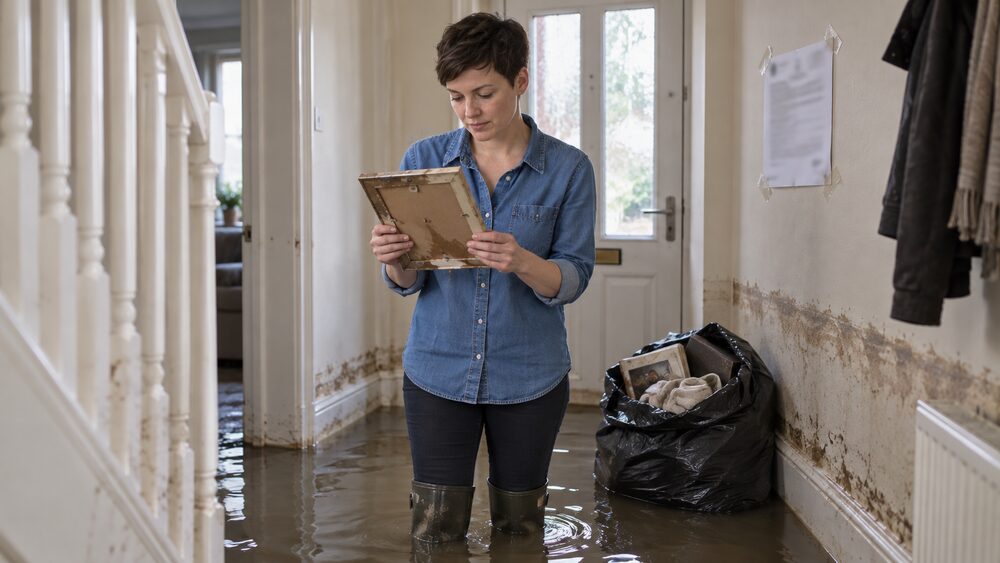
The short answer is no, not without checking with your insurer first. Guidance for households dealing with a flood is explicit: before disposing of damaged items, check with your insurer, and be careful not to put everything straight into a skip before a loss adjuster has inspected the damage1. The reason is practical rather than bureaucratic. Your insurer needs to see what was damaged, and how badly, before it can settle the claim.
The short answer is no, not without checking with your insurer first. Guidance for households dealing with a flood is explicit: before disposing of damaged items, check with your insurer, and be careful not to put everything straight into a skip before a loss adjuster has inspected the damage1. The reason is practical rather than bureaucratic. Your insurer needs to see what was damaged, and how badly, before it can settle the claim.
That timing matters because a loss adjuster may not come immediately if there has been a lot of flooding in your area2. Days can pass with a house full of ruined belongings. The rule is not that a household must live among them indefinitely, but that the insurer's instructions on what to do before anything leaves the property come first.
What you can do straight away is document everything. Official guidance for flooded homes sets out a clear list of steps to take before the loss adjuster visits, and they are all about creating a record2.
How your insurer settles a flood claim: repair, replace or pay cash
When a home insurance claim is settled, the Financial Ombudsman Service describes three routes: repairing the damage, replacing something lost or damaged, or paying cash to cover the cost of repair or replacement3. Which one applies is set by your policy. A typical term reads:
"We will decide whether to repair, replace, pay cash or reinstate the damaged part of the building."
That wording puts the choice with the insurer, not the policyholder. It is worth knowing before you start negotiating, because it shapes what happens next.
If you would rather have the money than the repair, there is a catch. Where the customer insists on cash but the insurer is willing to repair or replace, the insurer will only pay the amount it would cost them, and because insurers get discounts from suppliers and contractors, that figure is usually less than market rates4. In practice, taking cash can leave a shortfall between what you receive and what it costs you to put things right.
The loss adjuster's role sits alongside this. Your insurance company will send a loss adjuster to assess the damage to your home2. Their job is to assess the financial loss, identify the work needed to reinstate the property, and record damaged contents1. They report; the insurer decides.
If you used an insurance broker, they may be able to take some of this on. A broker might speak to loss adjusters and claims departments on your behalf5. That is one of the practical differences between buying through a broker and buying direct, and it matters most when a claim is large or disputed.
Buildings and contents: which part of your policy covers what
Home insurance is usually made up of two main parts: cover for the building itself and cover for the contents within it4. After a flood, which part pays depends on what was damaged, and the dividing line is not always obvious.
The test the Financial Ombudsman Service uses is removability. If an item can be reasonably removed and taken to another home, it is usually part of the contents and will not generally be covered by a buildings policy4. Carpets fitted to the floor, kitchen units and built-in wardrobes sit on the buildings side. A sofa, a television and a washing machine sit on the contents side.
Contents insurance covers the cost of repairing or replacing the items in your home that have been stolen, or damaged by events such as a flood, fire or storm, including household goods and personal effects owned by you or your family, and any high value items named on the policy6. Another insurer describes the same cover as protecting against the cost of repairing or replacing household goods and personal belongings when they are in the home, if stolen or damaged by events such as fire, flood and storm7. What counts as contents varies with the level of cover, but can include the television, furniture, pots and pans and gadgets, and can extend to accidental damage, theft and loss outside the home8.
If you rent, the split falls differently. Your landlord is responsible for arranging buildings insurance, and you need your own contents policy for your personal belongings9. Your landlord is not responsible for replacing or repairing any of your personal belongings that are flood damaged10.
| What was damaged | Which policy normally responds |
|---|---|
| Fitted kitchen, built-in wardrobes, fitted carpets | Buildings4 |
| Sofa, TV, washing machine, clothing | Contents6 |
| Your belongings, if you rent | Your own contents policy, not the landlord's9 |
| Garden furniture left out within your boundaries | Contents in the open, where the policy includes it11 |
Where flood cover may not apply
Flood cover is not uniform, and the gaps tend to appear in the same places.
Groundwater flooding is the clearest example. Home insurers will usually cover groundwater flooding if it has built up rapidly, but not where it has risen gradually9. Some policies exclude it altogether11. Others include it: one insurer's buildings cover lists groundwater flooding as included12, and another lists it as included in buildings cover13. The only way to know which applies to you is your own policy wording.
Properties used for business purposes are another gap. Flood Re, and hence many insurers, does not cover properties used for business purposes, which means properties where business rates are paid9. The scheme also does not cover buildings insurance for a block of more than three leasehold flats14, and it is not possible or appropriate to extend it to cover businesses15.
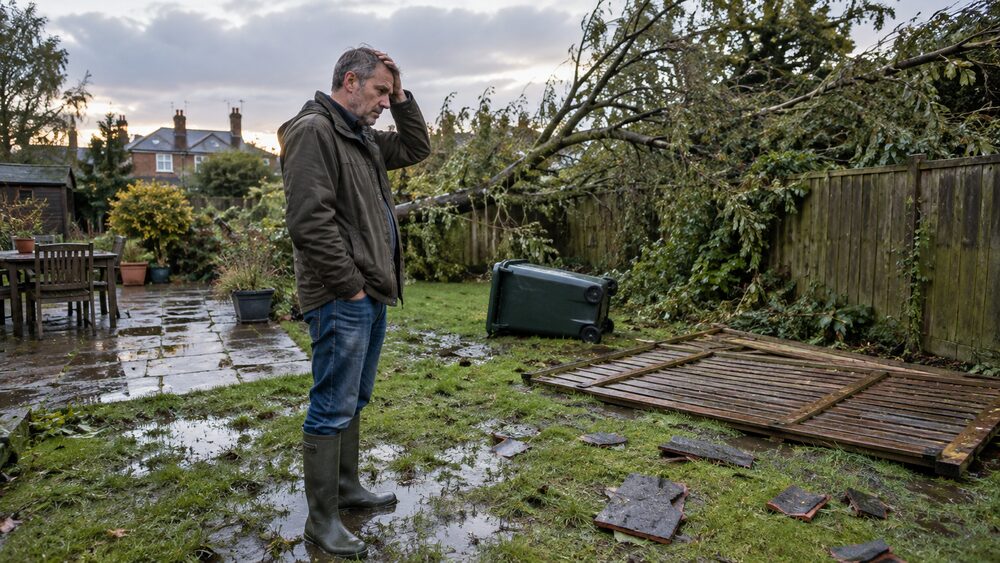
Garden items vary widely. Storm damage is covered, but fences, gates and outbuildings are often excluded16. One insurer's policy does not cover fences, gates or hedges, or fixed items in the open such as outdoor hot tubs12. Another excludes loss or damage to plants, trees and shrubs caused by storms or floods, collisions, falling trees or accidental damage17. Some policies include cover for garden furniture, trees, hedges, lawns and fences, while others do not18.
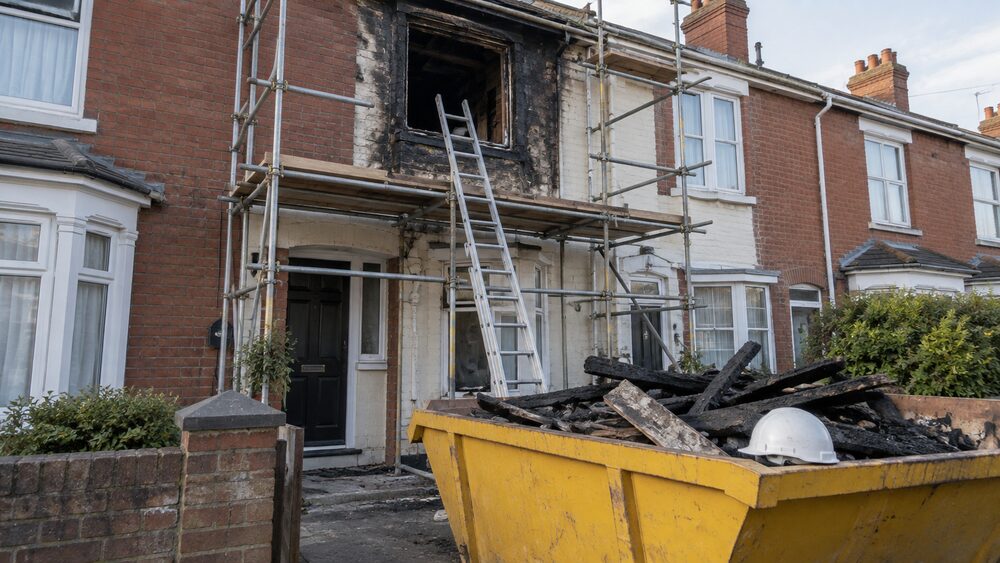
Unfinished work is a further trap. One insurer excludes storm or flood damage to unfinished extensions or alterations19. If building work was part-way through when the flood came, that exclusion could bite.
Should I photograph damaged belongings before getting rid of them?
Yes, and the guidance is specific about what to capture. Before the loss adjuster visits, official advice is to use a permanent ink pen to mark the highest level that the flood water reached on the walls of each room, take photographs or a video of the flood damage, list details of all flood damage in your home, and list food you had to throw away because it was contaminated or has gone off2.
That evidence has a second use. If a claim is disputed and goes to the Financial Ombudsman Service, the evidence it considers can include expert opinions, photos of the damage, a report including photos from a surveyor, loss adjuster or other expert, and customer testimony21. Photographs taken on the day carry weight that a description written weeks later does not.
Keep a record of your contact with your insurer too. Official guidance says to keep a record of dates and times you contact your insurer2. If there is later disagreement about what was agreed and when, that log is the record.
Alternative accommodation if your home cannot be lived in
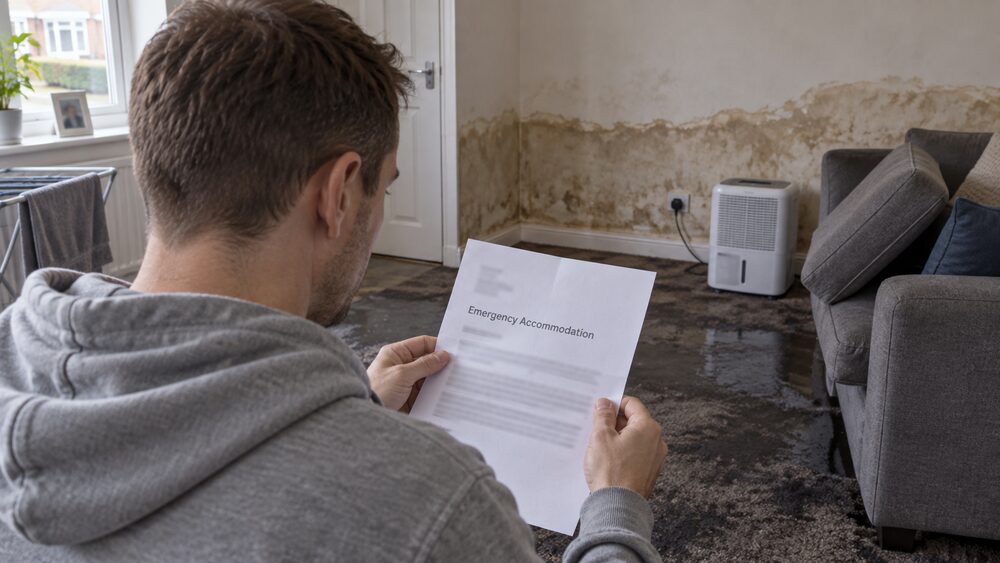
If your home is unsafe or uninhabitable, your policy might provide alternative accommodation while the problem is being fixed22. Flood cover generally includes temporary accommodation if your home has been made uninhabitable9, and official guidance lists temporary alternative accommodation among what you may be able to get, alongside flood damaged items replaced and professional help to clean up2.
The distinction that catches people out is between a home that is damaged and a home that is merely evacuated. If you are evacuated as a precaution and your property has not been damaged, temporary accommodation is typically arranged through the local authority23. Home insurance responds to damage, not to a precautionary evacuation.
If you rent, there is a separate route. Councils and housing association landlords might have to give you somewhere to stay if flooding in your home is an emergency hazard10. Housing Rights can also help you find suitable alternative accommodation if you are not able to stay in your home24.
Home emergency cover is a different product and should not be confused with this. It does not usually cover any damage the emergency has caused22, so it is not the route to repairing a flooded kitchen.
Keeping your cover right before the next flood
The single most important habit is disclosure. Always disclose previous flooding or flood risk when asked26. Withholding it risks the claim being refused when you need it most, and it is the kind of omission insurers check.
Beyond that, it is worth knowing what your policy does and does not include before water arrives. Accidental damage cover is an add-on for more complete cover of everything else under buildings or contents20. It responds to things a standard policy will not: spillages or stains on carpet, bed or sofa, children's breakages and damage such as drawings on wallpaper, and DIY damage27. General wear and tear is not included20.
Garden cover is worth checking line by line. Garden contents cover runs from storm damage to theft as part of contents cover28, but the exclusions listed above still apply, and policies differ on whether trees, hedges, lawns and fences are included at all18.
If your home has flooded before, the cost of cover is a live question. After a flood and making a claim, householders may see a jump in their prices from low hundreds of pounds to high hundreds or a thousand or more15. That is a reason to think about resilience measures as well as cover. Under Build Back Better, householders can access funds up to the value of £10,000 to install property level protection measures as part of repairs after a flood14.
Home insurance is not a legal requirement29, though a mortgage lender might make buildings insurance a condition of the loan30. Where a property is at high flood risk, the practical question is not whether cover is compulsory but whether it is available and at what price.
The order of events matters: evidence first, then the adjuster's visit, then the insurer's decision.
If you have no insurance, or the claim is refused
Without home insurance there is no claim to make, and the cost falls where it lands. If you own your home, you are usually responsible for repairs due to flood damage10. If you rent, your landlord is not responsible for replacing or repairing your personal belongings that are flood damaged10.
If a claim is refused or settled in a way you think is wrong, the Financial Ombudsman Service can look at it. It considers evidence including expert opinions, photos of the damage, reports from a surveyor or loss adjuster, and your own account21. Complaints about home insurance are one of the service's established areas of work4.
For free, impartial help, MoneyHelper offers guidance on when to use an insurance broker5, and the National Flood Forum publishes advice for households before and after a flood1. Shelter advises on housing help if your home is flooded10, and StepChange covers council tax arrears25.
Sources30 cited
- After a flood National Flood Forum
- After a flood: making an insurance claim nidirect, 2024-08-29
- Settling home insurance claims Financial Ombudsman Service, 2026-09-26
- Home insurance complaints Financial Ombudsman Service, 2026-09-26
- When to use an insurance broker MoneyHelper, 2026-09-25
- Buildings and contents insurance Bank of Scotland, 2026-09-27
- What is contents insurance? Halifax, 2026-09-27
- Insurance and protection guide Leeds Building Society, 2026-09-26
- Home insurance and flooding Which?, 2026-09-17
- Housing help if your home is flooded Shelter, 2025-10-27
- 5 winter risks your home insurance might not cover Which?, 2026-09-26
- Tesco home insurance review Which?, 2026-09
- Nationwide home insurance review Which?, 2026
- Insurance and flood: a Wales perspective Welsh Government, 2025-03-17
- Flood insurance: a Wales perspective consultation report Welsh Government, 2025-11
- 6 questions to ask before you choose a home insurance policy Which?, 2025-10-15
- Garden contents cover AXA, 2026-09-26
- ABI advice on wildfires across the UK Association of British Insurers, 2026-07-31
- Will your insurance cover home improvements? Which?, 2025-07-26
- Do you need home insurance add-ons? Which?, 2026-09-17
- Accidental damage complaints Financial Ombudsman Service, 2026-09-26
- Home emergency insurance Financial Ombudsman Service, 2026-09-26
- ABI advice following wildfires Association of British Insurers, 2026-08-14
- Mortgage arrears or payment difficulties nidirect, 2025-11-07
- Council tax arrears StepChange, 2026-09-25
- Home insurance National Flood Forum, 2026-09-26
- Accidental damage cover Post Office, 2026-09-15
- Optional extras AXA, 2026-09-26
- Santander home insurance review Which?, 2026-09-17
- Is self-insurance ever a good idea? Which?, 2026-02-25



 MoneyHelperFree, impartial money and pensions guidance, set up by government
 Financial Ombudsman ServiceFree, independent help when a complaint about a firm is not put right
 FSCSProtects your money if a bank, insurer or investment firm fails
 Citizens AdviceFree advice on money, consumer and legal problems in England and Wales
 GOV.UKOfficial information on tax, benefits and government services