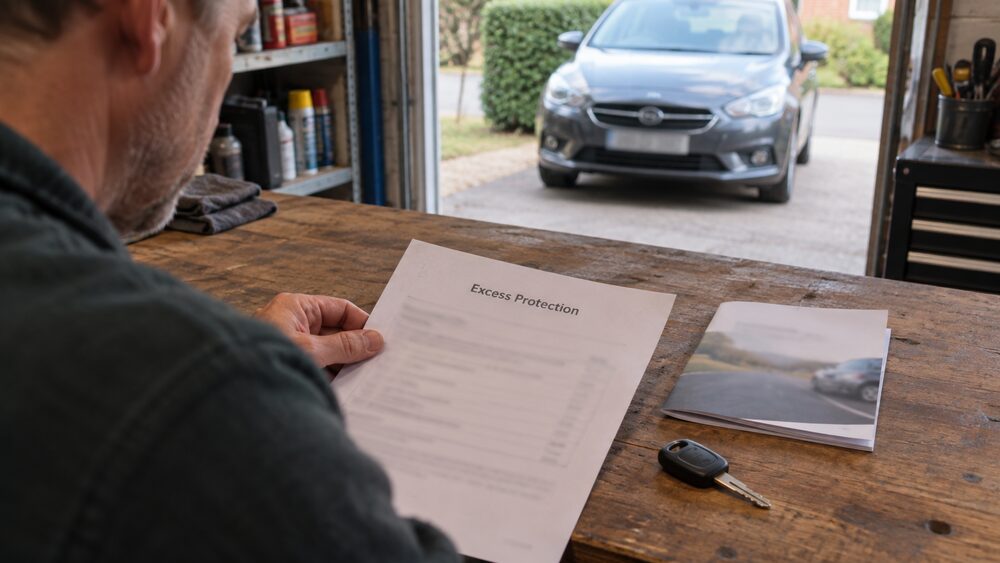
An excess is the amount you agree to pay towards a claim before your insurer pays anything. It is set when you take out the policy and shown in the documents1. Excess protection is separate, stand-alone cover that refunds that excess after you have paid it. It is sold for car insurance in particular, and it is not the same thing as your main policy.
An excess is the amount you agree to pay towards a claim before your insurer pays anything. It is set when you take out the policy and shown in the documents1. Excess protection is separate, stand-alone cover that refunds that excess after you have paid it. It is sold for car insurance in particular, and it is not the same thing as your main policy.
The cover is capped. One widely sold excess protection policy pays up to a maximum of £1,000 per claim and allows one claim per policy year2. It covers all drivers on the policy, with the excess payable by the main driver refunded2. It excludes windscreen only claims2.
Excess protection is not the only way to deal with an excess. You can pay it and try to recover it from the at-fault driver's insurer, choose a lower voluntary excess in the first place, or buy a policy with an excess waiver built in. Each has a different cost and a different risk.
What an insurance excess is and when you pay it
An excess is a pre-agreed amount of money you need to pay if you make a claim4. The Financial Ombudsman Service puts it the same way: a policy excess is an amount you have to pay towards making a claim1. It is agreed when you take out the policy and set out in the policy documents1.
You pay it at the point of claim, not at the point of buying. On a home policy, the excess is the amount you must pay before the company pays a claim for damage, and the same applies to contents claims5. On a motor policy, it comes off whatever the insurer pays out for repairs or a write-off.
The excess is not a fee and it is not a penalty. It is the share of every claim you carry yourself, which is why insurers charge less for policies with a bigger excess. Independent guidance describes it as the amount you agree to pay when you make a claim, before the insurance provider pays anything, and notes that increasing it may make the policy cheaper but can leave you out of pocket6.
Excesses vary widely by policy and by type of cover. On private health insurance, for example, excesses can vary between £0 and more than £1,0003. On a legal expenses policy, an upfront excess of £250 can apply to employment disputes7, and £250 can apply to property infringement, property damage and sale and purchase disputes7. The size of the excess is one of the levers that sets the premium.
Compulsory and voluntary excess: how the two add up
Most motor policies have two excesses stacked on top of each other. The compulsory excess is set by the insurer and applies whatever you choose. The voluntary excess is the amount you agree to pay on top, and you pick the level when you take out the policy8.
The two add together. If your policy has a compulsory excess of £150 and you add a voluntary excess of £100, you pay £250 if you make a claim9. Another insurer gives the same arithmetic with different numbers: a compulsory excess of £200 plus a voluntary excess of £300 means paying £500 before the insurer covers the rest4.
The voluntary excess is capped by the insurer. One car insurer allows a voluntary excess of up to £500 on top of the compulsory excess10. Independent guidance warns that compulsory excesses may already apply, so the voluntary figure is never the whole story11.
How excess protection refunds your excess
Excess protection works as a reimbursement. You claim on your main policy, pay the excess to the repairer or the insurer, then claim the same amount back from the excess protection policy. It does not stop the excess being charged in the first place.
The cover is usually sold as an add-on to a car policy rather than as a stand-alone product bought separately, though the two are functionally the same. One excess protection policy covers all drivers on the policy, with the excess payable by the main driver refunded2. That matters on a policy with several named drivers, because the refund follows the excess, not the driver.
Some insurers build the equivalent into the main policy instead. An excess waiver is selected as an add-on when taking out the policy, with the premium calculated with it included, and it can also be added later to an existing policy through the insurer's self-service portal12. The effect is the same: the excess is not charged, rather than charged and refunded.
There is a parallel in other kinds of cover. On private health insurance, if there is an excess to pay, the insurer will usually contact you to settle it3. On travel policies, an excess can be payable per insured person, for each and every incident, under each and every section of cover, which is how one ombudsman case described the terms13. The structure of the excess decides how much a refund product is worth.
Excess protection limits: up to £1,000, once a year
The limits are the part of excess protection that catches people out. One widely sold policy pays up to a maximum of £1,000 per claim and allows one claim per policy year2. A second excess protection policy sets the same £1,000 maximum, paid on the combined excess applicable to the main driver14.
One claim a year is a real restriction. If you have a bump in March and a second incident in September, the second excess is yours to carry. The number of claims allowed is not standard across the market, so it belongs at the top of any comparison.
The £1,000 cap is generous relative to most excesses, but not all. Excesses on private health insurance can run from £0 to more than £1,0003, and a new-build structural warranty can ask for an excess of up to £1,000 to proceed with a claim depending on the nature of the claim and the period of cover15. Where the excess itself can reach four figures, a £1,000 refund cap may not cover it in full.
For context on how cover limits vary across insurance generally, personal accident cover on motor policies ranges from £1,000 to £150,000, with enhanced cover available up to £150,00016. Home emergency cover is typically much smaller: one policy provides cover up to £1,500 including VAT per claim with no annual maximum limit on claims17, while another gives up to £1,000 for labour, parts and materials per incident18. Excess protection sits at the smaller end of that range.
Where excess protection does not pay out
The exclusions decide whether the cover is worth having. One widely sold excess protection policy excludes windscreen only claims2. Windscreen cover on a comprehensive car policy is normally subject to its own excess19, so a chip or a cracked screen is a common claim that a stand-alone excess policy will not refund.
There is also a threshold condition. One excess protection policy requires the cost of repairing the damage to be greater than the applicable excess2. If the repair is cheaper than the excess, there is nothing to refund, because you would not claim on the main policy at all. Some repairs may be covered under personal possessions insurance instead, though the cost of those repairs is worth weighing against the cover20.
The claims deadline is another trap. One excess protection product sets a six-month window to claim, while another sets 31 days.
If someone else caused the accident
An excess is payable on your own policy even when the accident was not your fault. You can pay the excess and then pursue the insurer of the other driver to reimburse it once the claim is settled, or take the other driver or their insurer to the small claims court21. That route costs time and depends on the other side accepting liability.
Excess protection short-circuits that. You claim the excess back from the excess protection policy rather than chasing the third party, which is the main practical argument for the cover. The trade-off is the premium, the £1,000 cap and the one-claim-a-year limit.
Where the other driver is uninsured or untraced, the recovery route is different again, and the excess may not be recoverable at all. That is a separate question from excess protection, which pays regardless of fault as long as the claim meets its conditions.
What excess protection costs and who it suits
Excess protection is priced as an add-on, so the cost is folded into the premium rather than quoted separately. The same is true of an excess waiver: the insurer calculates a premium for the cover with it included12. That makes the cost hard to compare directly, and it means the cheapest-looking main quote is not always the cheapest once the add-on is included.
The alternative is to self-insure the excess by choosing a lower voluntary excess and paying a higher premium. Independent guidance is clear that a higher voluntary excess usually lowers your premium22, and that the higher the voluntary excess, the lower the premium will be, with compulsory excesses almost always sitting beneath the voluntary one23. Insurers offer discounts for taking on an additional voluntary excess, with £100 given as an example amount11.
So the choice is between paying more premium now for a smaller excess, or paying a smaller premium now and carrying a bigger excess, with or without excess protection on top. Excess protection tends to suit drivers who have chosen a high voluntary excess to keep the premium down and want the excess refunded if they claim. It suits less well anyone whose excess is above £1,000, anyone likely to claim more than once a year, and anyone whose likely claim is a windscreen repair.
Where to get help
If a claim on an excess protection policy is rejected, or the refund is smaller than expected, the insurer's own complaints process comes first. If that does not resolve it, the Financial Ombudsman Service can look at the complaint free of charge. The ombudsman has published cases on excesses being charged unfairly, including one where an insurer would not refund a £50 excess it had charged on an unfinished repair24.
For free, impartial guidance on insurance and on whether an add-on is worth buying, MoneyHelper and the consumer bodies cover the ground without selling anything. For anyone struggling with the cost of cover, independent guidance on shopping around for insurance sets out how to compare policies on the terms that matter rather than the headline price6.
Sources24 cited
- Travel insurance policy excesses and limits Financial Ombudsman Service, 2026-09-26
- Excess Protection esure, 2026
- Claiming on your health insurance Which?, 2026-07-09
- What is excess? Post Office, 2025-05-14
- After a flood: making an insurance claim nidirect, 2024-08-29
- Shopping around for insurance Independent Age, 2026-09-26
- Family Legal Protection esure, 2026
- Getting a car insurance quote NFU Mutual, 2026-09-26
- Home insurance first direct, 2026
- Car insurance Sainsbury's Bank, 2026-09-25
- How much will it cost? British Insurance Brokers' Association, 2026-09-26
- Excess waiver Post Office, 2026
- Our insurer is charging us too much for our baggage claim Financial Ombudsman Service, 2026-09-26
- Motor policy booklet esure, 2025
- Understand your cover Premier Guarantee, 2026
- Car insurance add-ons, fees and charges Which?, 2026-01-22
- Home insurance Leeds Building Society, 2026-09-26
- Buildings and contents insurance first direct, 2026
- Electric vehicle insurance Santander, 2026
- Mobile phone insurance esure, 2026
- I've been in a car accident: do I have to claim on my insurance? Which?, 2026-03-31
- Are you properly protected? YourMoney.com, 2026-01-05
- How black box car insurance works Which?, 2026-01-22
- Home emergency insurance Financial Ombudsman Service, 2026-09-26









 MoneyHelperFree, impartial money and pensions guidance, set up by government
 Financial Ombudsman ServiceFree, independent help when a complaint about a firm is not put right
 FSCSProtects your money if a bank, insurer or investment firm fails
 Citizens AdviceFree advice on money, consumer and legal problems in England and Wales
 GOV.UKOfficial information on tax, benefits and government services