
A power of attorney is a legal document that gives another person the authority to make decisions for you, or to act on your behalf, when you cannot or do not want to do so yourself1. The person who gives the permission is called the donor, and the person who receives it is called the attorney2. You can formally appoint a friend, a relative or a professional, and you can appoint more than one person1.
There are several types of power of attorney in the UK, and the one that matters depends on where you live and on what you want it to cover. In England and Wales the most common is the lasting power of attorney, or LPA, which comes in two versions: one covering property and financial affairs and one covering health and welfare3. Scotland has three types, and Northern Ireland uses a different document again, the enduring power of attorney4. The critical difference between the types is what happens if the donor loses mental capacity: some powers stop dead, while others carry on.
What a power of attorney lets someone do for you
At its simplest, a power of attorney is when someone gives another person legal permission to act on their behalf8. The Financial Ombudsman Service describes it as a legal document that gives a third party the authority to make financial decisions for someone else2. What that means in practice depends on which type is in place and what the document says, but a property and financial affairs power typically lets the attorney handle money and property: managing a bank or building society account, paying bills, collecting benefits or a pension, and in some cases selling the donor's home9.
The person appointed can be a friend, relative or professional1. A power of attorney is usually a written document, often drawn up by a solicitor, naming the attorney and setting out what they may do10. It is not a transfer of ownership: the money and property still belong to the donor, and the attorney is managing them on the donor's behalf, not for their own benefit.
A financial power of attorney can be used to help someone deal with debts, mortgaged property and investments8. It can also cover practical, everyday things: collecting a pension or benefits for someone who cannot get to the post office or bank themselves, or keeping bills paid during a stay in hospital. Some people set one up while they are perfectly well, purely as a safety net; others set one up because illness, disability or time abroad makes managing money harder. The common thread is that the donor chooses who acts, and the document sets the limits of that person's authority.
The main types: ordinary, lasting and enduring
Three types of power of attorney come up most often in the UK, and they behave very differently when the donor loses the ability to make decisions.
An ordinary power of attorney, sometimes called a general power of attorney, gives an attorney authority over financial decisions, but it stops being legal authority the moment the donor loses mental capacity11. Age UK notes that it is useful for temporary situations, such as a long stay abroad or a spell in hospital, but it is not a long-term safeguard12.
A lasting power of attorney is the most common form in England and Wales3. Unlike the ordinary version, an LPA is still valid after the donor loses mental capacity, though it must be set up while they still have capacity12. It must be registered with the Office of the Public Guardian before the attorney can use their authority11.
An enduring power of attorney, or EPA, is the older form, which has now been replaced by the LPA and can no longer be made13. EPAs signed and witnessed before October 2007 remain valid, and if the donor loses mental capacity the attorney must register the EPA before continuing to use it14.
The type that is right for a particular family depends on what the power is for. For a short, known period of incapacity or absence, an ordinary power may be enough. For planning ahead against the possibility of dementia, serious illness or accident, only a lasting or enduring power will keep working. The comparison of ordinary and lasting powers of attorney sets the two side by side in more detail.
Lasting power of attorney: financial affairs or health and welfare
In England and Wales there are two types of LPA: one for making financial decisions and another for health and care decisions5. They are separate documents, covering separate parts of life, and a person can have one, the other, or both.
The property and financial affairs LPA gives the attorney power over money and property: managing a bank or building society account, paying bills, collecting benefits or a pension, and selling the donor's home9. It can be used while the donor still has capacity, if the document allows it, which makes it useful as well as protective: a donor who finds paperwork tiring can let the attorney take over day to day while keeping the final say.
The health and welfare LPA covers personal and healthcare decisions rather than money15. It only comes into effect when the donor has lost the capacity to make those decisions themselves, so it cannot be used to take over everyday choices while the donor is well.
Because the two types are separate documents, registering both costs twice as much as registering one: £92 for each LPA, so £184 in total5. Many families decide both are worth having, since the events that take away the ability to manage money, such as dementia or a stroke, are often the same events that take away the ability to make care decisions. The step-by-step guide to making and registering a lasting power of attorney covers the process for both.
Enduring powers of attorney made before the switch to LPAs
Enduring powers of attorney were replaced by the property and financial affairs LPA in October 2007, and no new EPA can be made14. But an EPA that was signed and witnessed before October 2007 can still be used, and it can still be registered if it has not been already5. Families regularly come across EPAs made decades ago by a parent or grandparent, and they are still legally effective documents.
The key rule is what happens when the donor loses mental capacity. At that point the attorney must register the EPA with the Office of the Public Guardian before they can make any decisions on the donor's behalf5. Registration involves a fee, currently £9213. Before that point, the EPA can be used straight away, much like an ordinary power of attorney.
There are limits to what an EPA covers. It deals with property and financial affairs only, so a family relying on an old EPA has no equivalent of a health and welfare LPA unless they have made other arrangements. If the donor still has the capacity to make decisions, they can cancel the old EPA and register a new LPA instead, which is the route many take to add welfare coverage16. An existing EPA cannot be changed: the official guidance is to cancel it and set up an LPA instead14. The guide to enduring powers of attorney explains using and registering an existing one.
How the rules differ in Scotland and Northern Ireland
England and Wales, Scotland and Northern Ireland all have different legal systems for power of attorney17. A document made under one system does not automatically work in another: LPA documents follow the laws of England and Wales, and one bank states it cannot accept LPA documents for accounts in Northern Ireland18.
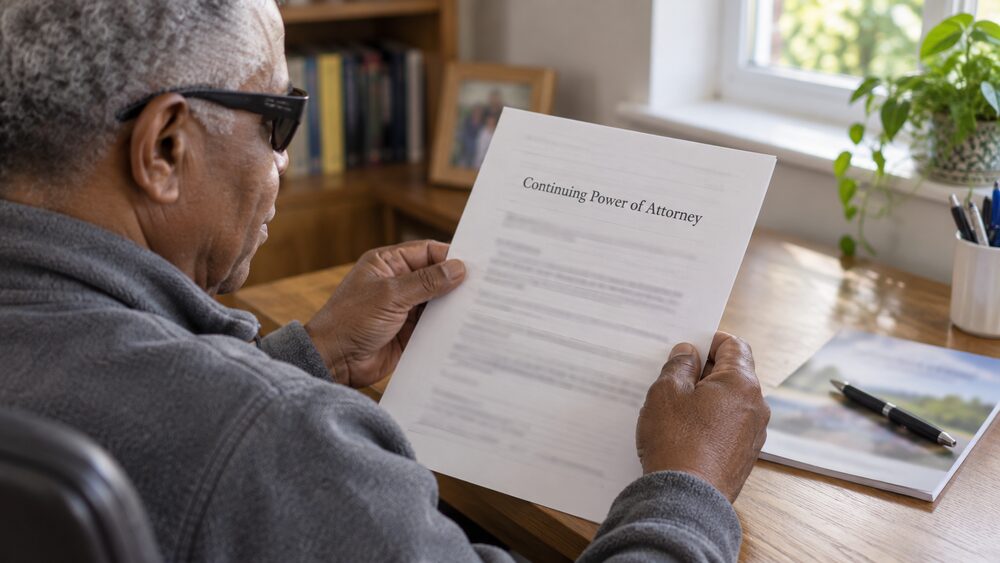
In Scotland there are three types of power of attorney: a continuing power of attorney covering financial matters, a welfare power of attorney covering personal and healthcare matters, and a combined power covering both4. A Scottish power of attorney can therefore include continuing powers covering financial matters and welfare powers covering personal and healthcare matters17. Scottish continuing and combined powers must be registered with the Office of the Public Guardian in Scotland before they can be used19. One point of history: powers of attorney executed in Scotland before 2 April 2001 do not need registration and continue even if capacity is lost, unless the document says otherwise20.
In Northern Ireland there are two main types: a general power of attorney and an enduring power of attorney4. The Northern Irish EPA gives the attorney authority over property and financial affairs only, not health and welfare17. It can be used as soon as it is signed and witnessed, but the attorney must register it with the Office of Care and Protection once the donor loses mental capacity, paying a separate fee to that office21. The guides to power of attorney in Scotland and power of attorney in Northern Ireland cover each system in full.
Who can be an attorney and how several attorneys act together
The donor chooses who acts, and can appoint as many attorneys as they like, including replacement attorneys who step in if an original attorney cannot continue5. Most people choose between one and four22. Guidance differs on the minimum age: one provider says anyone over 16 can be an attorney, while another says a person must be 18 or older and able to make decisions for themselves and for the donor, and the documents do not resolve the point10. There is one firm restriction: a person who is an undischarged bankrupt may not act or be appointed as an attorney for a donor's property and financial affairs23.
Where several attorneys are appointed, the document must say how they act, and there are two main arrangements24:
- Jointly: the attorneys must all agree on every decision, and if one disagrees, the decision cannot be made. Some firms require all joint attorneys to sign for transactions and to write in together25.
- Jointly and severally: attorneys can make decisions on their own or with the other attorneys, which is more flexible if one is often unavailable25.
It is also possible to mix the two, requiring joint decisions for some matters and allowing independent action for others5. Joint appointment gives the donor tighter control but carries a practical risk: if one joint attorney dies or becomes unable to act, the arrangement can break down, which is why naming replacements matters. The choice should reflect how the attorneys get on, where they live, and how quickly decisions might need to be made.
How to make and register a lasting power of attorney
You can only set up a power of attorney while you have mental capacity6. A diagnosis of dementia does not by itself prevent someone making one: the Alzheimer's Society explains that a person can still set one up provided they have the mental capacity to understand the document, their choice of attorneys and the consequences of the decision17.
In England and Wales, the forms come from the Office of the Public Guardian: they can be downloaded, ordered by phone, or completed through the online service on GOV.UK5. A solicitor is not required, though some people use one for complex situations. The donor chooses the type of LPA and the attorneys, and the document is signed and witnessed according to the prescribed process.
Before the attorney can use their authority, the LPA must be registered with the Office of the Public Guardian11. Registration currently takes 8 to 10 weeks in England and Wales, including a statutory 4-week waiting period6, though some firms quote up to 20 weeks26. If an application is rejected, there are three months to apply again and pay a repeat application fee of £4627.
Once registered, the LPA is ready to use, but each bank, building society or insurer will want to see it before letting the attorney act. The document itself, or a properly certified copy, is what firms need: the original, a copy stamped by the Office of the Public Guardian on every page, or a copy signed on every page by the donor, a solicitor or a notary to confirm it is true11. The page on certified copies explains who can certify them.
LPA fees: £92 to register, with reductions and exemptions
Registering an LPA in England and Wales costs £92 per document, so £184 in total for both a financial and a health and welfare LPA5. The fee has risen over time: earlier guidance put it at £82 per LPA, and one provider still quotes around £82, so figures in circulation differ28. The £92 figure is the more recent one, and registering both types costs £184 under the new fees27.
There are two main forms of help with the cost:
- A reduction of half the fee if you earn less than £12,000 a year28. The reduced fee has been reported as £41, rising to £46 on 17 November27.
- An exemption, meaning no fee at all, for people receiving certain income-related benefits, such as Income Support28. A person may also pay a reduced fee or nothing if paying would cause hardship16.
The same help does not necessarily apply elsewhere in the UK: registration fees differ by nation, with Scotland charging £99 and Northern Ireland £189 for their equivalents3. The page on LPA fee exemptions and reductions sets out the qualifying benefits and how to apply.
Using a power of attorney with banks, savings and insurers
A registered power of attorney is only the legal authority; the attorney still has to present it to each firm. Banks and building societies ask for the filled-in, signed LPA form registered with the Office of the Public Guardian, plus proof of the attorney's and the donor's names and addresses if not already held11. Many firms now accept documents uploaded online, with file size and format limits, and some let the attorney register without the donor attending18.
What the attorney can then do varies by firm. Nationwide, for example, lists managing money and accounts, speaking to the bank directly, choosing how the accounts are accessed, choosing where letters and statements are sent, making cash withdrawals in branch, and paying off existing debts and mortgage payments29. M&S Bank lists access to internet and telephone banking, closing accounts no longer needed, making additional payments and ordering a replacement card19. The Financial Conduct Authority's rules for banks recognise an attorney obtaining access to an account as a form of third party access, so firms are used to handling these arrangements30.
There are common restrictions. An attorney generally cannot apply for borrowing or credit such as loans, overdrafts or credit cards in the donor's name18. Where the account is joint with someone else, the attorney may need the other account holder's written permission unless they hold power of attorney for both18. And online access is not guaranteed: Leeds Building Society states that once an attorney has been added to an online savings account, the account cannot be managed online at all, only viewed, with all other transactions by phone, post or branch31. A 2025 Which? investigation found some savings platforms do not allow third-party access at all, so donors can miss out on top rates24.
Which? does not recommend opening a joint bank account with someone for whom you also hold power of attorney, because of the way joint accounts mix ownership of the money32. The pages on registering a power of attorney with a bank, what an attorney can do and third-party mandates cover the practical side, and if a firm handles a power of attorney badly, the Financial Ombudsman Service can look at complaints about it2.
Where a power of attorney stops: capacity, death and bankruptcy
Every power of attorney ends automatically when the donor dies. The Ombudsman states plainly that a power of attorney is no longer valid after the donor has passed away2, and Nationwide adds that attorneys can no longer access the donor's accounts, give instructions or carry out transactions on their behalf29. From death onwards, the estate passes under the donor's will, which has no legal authority before death but takes over exactly where the power of attorney stops21. The attorney should notify the Office of the Public Guardian and send back the document, with a copy of the death certificate7.
Capacity affects the types differently, as the diagram above shows. An ordinary power of attorney stops being legal authority if the donor loses mental capacity11. An LPA continues12. An EPA continues, but only once registered14.
Bankruptcy cuts across powers of attorney in both directions. If an attorney responsible for the donor's money goes bankrupt or gets a Debt Relief Order, the power of attorney can end automatically22, and any power of attorney the bankrupt person holds for someone else is cancelled33. A person may not act as an attorney for property and financial affairs while an undischarged bankrupt23.
If an attorney dies or becomes unable to act, the outcome depends on how many there were. The Office of the Public Guardian will cancel the power of attorney when an attorney dies and they were the only attorney; if there are multiple attorneys, the OPG updates the document instead31. Replacement attorneys named in the document can step in; without them, a sole attorney's death can leave the donor without cover.
Ending, cancelling or changing a power of attorney
A donor with mental capacity can cancel a power of attorney at any time34. The usual method is a written statement called a deed of revocation, signed by the donor and a witness, sent to the Office of the Public Guardian with the original LPA25. Some firms accept a signed letter instead31. The donor can also ask for an attorney to be removed from their account while they still have mental capacity18.
For EPAs the position depends on registration. An unregistered EPA can be cancelled before the donor loses capacity by making a deed of revocation, keeping it with the EPA form14. A registered EPA must be cancelled through an application to the Court of Protection14. An existing EPA cannot be changed at all: the official guidance is to cancel it and set up an LPA instead14.
If capacity has already been lost, the donor can no longer cancel or change the document themselves. At that point, concerns about an attorney's behaviour are a matter for the Office of the Public Guardian or the Court of Protection rather than the donor. And if someone loses mental capacity with no power of attorney in place at all, a new one cannot be made: relatives or a trusted person must apply to the Court of Protection for a deputy to be appointed31, a slower and more involved process covered in the guide to deputyship. The page on cancelling a lasting power of attorney gives the steps in order.
Sources34 cited
- Help to collect your benefits or pension nidirect, 2026-06-26
- Power of attorney complaints Financial Ombudsman Service, 2026-09-26
- What is power of attorney Which?, 2026-02-26
- Power of attorney guide Royal London, 2025-08-28
- Power of attorney Age UK, 2026-01-09
- Helping a relative with their bank account: why you might need power of attorney Which?, 2026-04-11
- What to do when someone dies Age UK, 2026-02-16
- Power of attorney and debt StepChange Debt Charity, 2026-09-25
- What is a lasting power of attorney (LPA)? Equity Release Council, 2022-09-02
- Power of attorney Scottish Building Society, 2026-09-26
- Deputy and attorney guidance: dealing with banks GOV.UK, 2023-05-02
- Ordinary power of attorney Age UK, 2026-03-23
- Enduring power of attorney Age UK, 2026-01-09
- Use or cancel an enduring power of attorney GOV.UK, 2026-09-26
- Legal and regulatory matters Equity Release Council, 2026-09-26
- What is lasting power of attorney Mental Health and Money Advice, 2025-03-10
- Managing money after a dementia diagnosis Which?, 2026-09-20
- Guide to power of attorney Ulster Bank, 2026-09-25
- Managing money with dementia M&S Bank, 2026
- Manage a saving for an adult NS&I, 2026-04-02
- Power of attorney Which? Wills, 2026-09-26
- Power of attorney Monmouthshire Building Society, 2026-09-26
- Restrictions following a bankruptcy order GOV.UK, 2022-05-03
- Setting up power of attorney Which?, 2026-02-26
- Register a legal authority Tesco Bank, 2026-09-25
- Power of attorney PensionBee, 2026-05-27
- Power of attorney fees rise this month: what you need to know Which?, 2025-11-05
- 7 things you need to know about power of attorney Which?, 2023-03-21
- Using a power of attorney Nationwide, 2026
- BCOBS 7.5.5R FCA Handbook, 2018
- Power of attorney Leeds Building Society, 2026-09-26
- Can a joint bank account help me manage a loved one's finances? Which?, 2026-01-19
- Restrictions during bankruptcy StepChange Debt Charity, 2026-09-25
- What is power of attorney Legal & General, 2026-06-23





 Citizens AdviceFree advice on money, consumer and legal problems in England and Wales
 MoneyHelperFree, impartial money and pensions guidance, set up by government
 Financial Ombudsman ServiceFree, independent help when a complaint about a firm is not put right
 GOV.UKOfficial information on tax, benefits and government services
 StepChangeFree debt advice and solutions from a charity