
The difference between an ordinary power of attorney and a lasting power of attorney comes down to one thing: what happens when you lose mental capacity. An ordinary power of attorney, sometimes called a general power of attorney, is only valid while you still have mental capacity. If you lose it, the document automatically becomes invalid1. A lasting power of attorney is still valid after you lose mental capacity, but you have to set it up while you still have capacity to understand what you are signing1.
That single rule decides which one fits your situation. If you are going into hospital for a few weeks, travelling abroad, or finding it hard to get to a branch, an ordinary power of attorney covers the gap. If you want someone to be able to step in permanently, including if you develop dementia or have an accident, you need a lasting power of attorney.
There are three types of power of attorney in circulation: ordinary, lasting, and enduring2. Enduring powers of attorney were replaced by lasting powers of attorney in October 2007, so no new ones can be made, but existing ones can still be used3. The rest of this page sets out what each type does, what an attorney can and cannot do with your money, how to cancel one, and where to get free help.
Ordinary or lasting power of attorney: the key difference
An ordinary power of attorney is a simpler, shorter document. It lets someone you trust make financial decisions for you, but only while you can still make your own decisions. Guidance from Age UK describes it as temporary and valid only while you have mental capacity1. It covers financial affairs, not health or care decisions5.
A lasting power of attorney is a legal document that lets you appoint one or more people to act on your behalf if you become unable to do so6. It comes in two forms: one for financial decisions and one for health and care decisions4. Both need to be registered with the Office of the Public Guardian before they can be used7.
The practical difference is what happens at the point capacity is lost. An ordinary power of attorney stops being legal authority if the donor loses mental capacity or dies8. A lasting power of attorney keeps working. A registered lasting power of attorney gives a third party access whether or not you have mental capacity9.
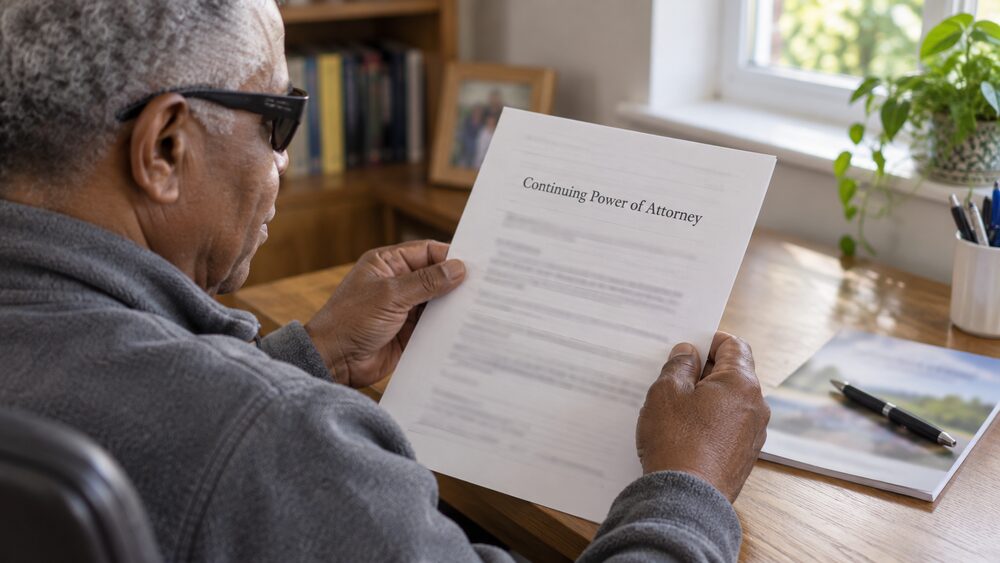
There is also a regional split. In England, Wales and Scotland there are two types of lasting power of attorney. The one most relevant to money is the property and financial affairs LPA, known in Scotland as a continuing power of attorney. In Northern Ireland there is only one type, called an enduring power of attorney10. Processes in Scotland and Northern Ireland are different from England and Wales3.
An ordinary power of attorney ends if you lose mental capacity
This is the rule that catches people out. An ordinary power of attorney becomes invalid once the donor has lost capacity11. It is not suspended or paused: it stops being legal authority8. If you lose capacity, the OPA automatically becomes invalid1.
The same applies to a general power of attorney, which is another name for the same thing. A general power of attorney automatically ends if you lose mental capacity12. A GPA does not continue if someone loses their mental capacity, but a lasting power of attorney does cover someone if they lose their mental capacity13.
There is one older arrangement that behaves differently. An enduring power of attorney is capable of continuing to be effective after the donor has become mentally incapable of managing their affairs14. If an EPA was never registered and you lose mental capacity, it is suspended, but if your attorney registers it with the Office of the Public Guardian it becomes valid again9. An EPA must be set up while you have capacity and registered by the person you trust with the Office of Care and Protection if you become incapable15.
A lasting power of attorney keeps working when you cannot decide for yourself
A lasting power of attorney is designed for exactly the situation an ordinary one cannot handle. It is a way of giving someone you trust the legal authority to make decisions on your behalf if you lose the mental capacity to do so in the future, or if you no longer want to make decisions for yourself16.
It does not expire. An LPA remains in place until you pass away or revoke authority2. Skipton Building Society puts it plainly: once it is in place, it stays in place for the rest of your life, unless you withdraw it or your chosen attorney can no longer act on your behalf7. It also ends automatically when you die14.
You can appoint as many attorneys as you like, and replacement attorneys4. A lasting power of attorney for financial decisions can be used while you still have mental capacity, or you can state that it should only come into force if you lose capacity17. That choice matters: if you want help now as well as later, you can set it up to start immediately.
A lasting power of attorney can cover decisions about the account owner's financial affairs, health, or care13. The financial one can include collecting your State Pension18. For a bank to accept it, it usually needs to be the type that covers property and financial affairs13.
What an attorney can and cannot do with your money
An attorney acting under a lasting power of attorney for property and financial affairs has real authority, but it comes with duties. Your attorney usually has to keep your money separate from theirs and keep accounts to show this4. The same rule appears in provider guidance: your attorney must keep accounts and make sure their money is kept separate from yours17.
You can limit what they can do. You can limit the power you give your attorney so that they can only deal with certain assets, for example your bank account but not your home16. That is a useful control if you want help with day-to-day bills but not with bigger decisions.
There are hard limits on who can act. You may not act or be appointed as the lasting power of attorney for a donor's property and affairs if you are an undischarged bankrupt19. If the donor is made bankrupt, the lasting power of attorney for their property and affairs will be revoked19. Professional attorneys cannot be paid unless the lasting power of attorney document authorises it20.
An attorney's authority is not unlimited. It is a legal document that lets a person choose one or more people to act on their behalf if they are unable to6. It does not give them ownership of your money, and it does not override your wishes while you still have capacity to make a decision yourself.
How to stop or cancel a power of attorney
You can cancel a lasting power of attorney at any time while you have mental capacity, by sending the original LPA document and a deed of revocation to the Office of the Public Guardian4. The same process is described by providers: if you have mental capacity, you can end your power of attorney by sending the original LPA and a written deed of revocation17.
For an enduring power of attorney made before October 2007, the process is different. To cancel an EPA before you lose mental capacity, you make a deed of revocation stating that you are cancelling it and keep it with the EPA form. You and a witness must both sign the deed of revocation21. You cannot change an existing EPA: you cancel it and set up an LPA instead21.
An LPA can also end in other ways. These include the donor dying, the attorney losing mental capacity with no other attorneys or replacements, an attorney divorcing the donor or ending their civil partnership, a sole attorney becoming bankrupt, being removed by the Court of Protection, dying with no replacements, or disclaiming, and the Court of Protection cancelling the LPA22. If a sole attorney dies and there are no replacement attorneys, the LPA ends and an entirely new one must be made if the donor still has mental capacity22.
Will my bank or pension provider accept an ordinary power of attorney?
Providers set their own rules, and they are not all the same. Some banks accept an ordinary power of attorney. Cynergy Bank says it can accept a lasting power of attorney for property and financial affairs, an ordinary power of attorney drawn in the UK and signed as a deed, and a continuing power of attorney for financial affairs8.
Others are narrower. Gatehouse Bank states that it will only accept a lasting or enduring power of attorney or a Court of Protection order, and it needs to see the original or a certified copy23. Charter Savings Bank accepts lasting powers of attorney, enduring powers of attorney, and Court of Protection orders, and will accept an unregistered EPA unless it contains a condition that it should not be used until the donor is losing or has lost mental capacity24.
There is a registration rule that matters for lasting powers of attorney. If the donor loses mental capacity and the lasting power of attorney is not registered, Cynergy Bank will not be able to accept it8. A lasting power of attorney must be registered with the Office of the Public Guardian before it can be used with NS&I, and setting it up can take up to 20 weeks11.
For pensions, the picture is similar. A lasting power of attorney can cover collecting your State Pension18. For benefits and pensions in Northern Ireland, there is separate guidance on helping someone collect their benefits or pension25.
What happens if I lose mental capacity and have no lasting power of attorney?
If you lose mental capacity with only an ordinary power of attorney in place, no one has authority to manage your money. The ordinary power of attorney stops being legal authority at that point8. An unregistered enduring power of attorney is suspended until the attorney registers it with the Office of the Public Guardian9.
Without a valid arrangement, the route is usually an application to the Court of Protection for someone to be appointed as a deputy. The official guidance on managing a bank account for someone else covers attorneys appointed under a lasting power of attorney or enduring power of attorney, and deputies appointed by the Court of Protection to manage the property and affairs of someone who lacks mental capacity26.
There are other, lighter-touch options for helping someone with their money, but they have limits. These include a third party withdrawal mandate, a letter of authority, information sharing arrangements, a lasting power of attorney, and a Court of Protection deputyship27. A third party mandate or letter of authority is not a substitute for a lasting power of attorney if capacity is lost.
If you are setting up a lasting power of attorney, you can still do so after a dementia diagnosis, provided you have the mental capacity to understand the document, your choice of attorneys and the consequences of the decision22. That window closes once capacity is lost.
Where to get free help and guidance
The Office of the Public Guardian is the starting point for lasting powers of attorney. You can get LPA forms and an information pack from the Office of the Public Guardian, download them online, order by calling 0300 456 0300, or use the online service on GOV.UK4.
There is also a refund scheme for people who paid more than the current fee. Refund claims can be made online by completing a 10-minute form, needing the donor's UK bank account number and sort code, or by calling the Refunds Helpline on 0300 456 030028. The fee for applications received by the Office of the Public Guardian changed from 17 November 202529.
For free legal advice, the Royal Courts of Justice Advice Bureau can provide free ongoing legal advice if you are involved in any civil case in the County Court, High Court, or Court of Appeal across England and Wales30. Court duty advisers offer free legal help at the court30.
If debt is part of the picture, a power of attorney can be useful for people who find it hard to contact the people they owe because they are abroad or in prison31. Free debt advice charities can help with the underlying problem as well as the authority to act.
Sources31 cited
- Ordinary power of attorney Age UK, 2026-03-23
- What is power of attorney? Which?, 2026-02-26
- What is a lasting power of attorney (LPA)? Equity Release Council, 2022-09-02
- Power of attorney Age UK, 2026-01-09
- 7 things you need to know about power of attorney Which?, 2023-03-21
- Power of attorney Barclays, 2026-09-26
- Power of attorney Skipton Building Society, 2026-09-26
- Power of attorney Cynergy Bank, 2026-09-26
- Third party access FAQ HSBC UK, 2026
- Banking with dementia: how to manage your money and access support Which?, 2025-04-13
- Manage saving for an adult NS&I, 2026-04-02
- Power of attorney Virgin Money, 2026
- Third party access Metro Bank, 2026-09-25
- Bank accounts and finances Marie Curie, 2023-12-20
- Dementia and managing money nidirect, 2026-09-03
- Guide to power of attorney Ulster Bank, 2026-09-25
- Enduring power of attorney Age UK, 2026-01-09
- Nominate someone to collect State Pension GOV.UK, 2026-09-26
- Restrictions following a bankruptcy order GOV.UK, 2022-05-03
- Power of attorney PensionBee, 2026-05-27
- Use or cancel an enduring power of attorney GOV.UK, 2026-09-26
- Managing money after a dementia diagnosis Which?, 2026-09-20
- Gatehouse Bank Savings Terms and Conditions Gatehouse Bank, 2025-12-01
- Power of attorney Charter Savings Bank, 2026-09-25
- Help collect your benefits or pension nidirect, 2026-06-26
- Manage a bank account for someone else GOV.UK, 2023-05-02
- Need support with your finances from a friend Building Societies Association, 2018-09-13
- Millions of people owed power of attorney refund Which?, 2023-02-01
- Power of attorney fees rise this month: what you need to know Which?, 2025-11-05
- How to get free legal advice about your civil case Advicenow, 2025-11
- Power of attorney and debt StepChange, 2026-09-25




 Citizens AdviceFree advice on money, consumer and legal problems in England and Wales
 MoneyHelperFree, impartial money and pensions guidance, set up by government
 Financial Ombudsman ServiceFree, independent help when a complaint about a firm is not put right
 GOV.UKOfficial information on tax, benefits and government services
 StepChangeFree debt advice and solutions from a charity