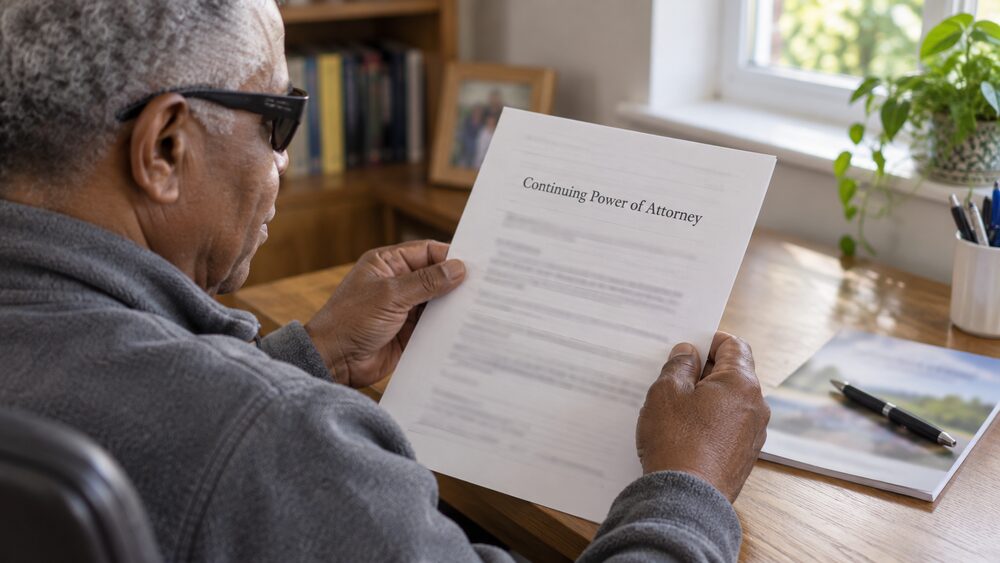
Power of attorney in Scotland comes in three forms: a continuing power of attorney covering money and property, a welfare power of attorney covering personal and healthcare decisions, or a single combined document covering both1. The person who makes it is called the granter, and the people appointed to act are the attorneys. Unlike an ordinary power of attorney, these powers are designed to keep working after the granter can no longer manage their own affairs, which is the main reason people set them up1.
A Scottish power of attorney must be registered with the Office of the Public Guardian (Scotland) before an attorney can use it, and the registration fee is £96 per document2. Registration is not instant: reported waiting times at the Office of the Public Guardian (Scotland) were 12 months for postal applications and nearly 14 months for electronic applications, with the OPG aiming to process urgent applications in five working days4. Setting one up well before it is needed avoids the gap where no one has legal authority to act.
Continuing, welfare or combined: the three Scottish powers of attorney
Scotland recognises three types of power of attorney1. A continuing power of attorney covers financial matters, a welfare power of attorney covers personal and healthcare matters, and a combined document grants both sets of powers in one place2. The choice matters because the two types behave differently in one crucial respect: a continuing power can be used while the granter still has capacity, if the document says so, whereas a welfare power can only be used once the granter lacks the capacity to make those decisions themselves6.
There is also a fourth, simpler document worth knowing about: a general power of attorney, the Scottish name for an ordinary power of attorney. It covers financial decisions only, does not need to be registered before use, but stops being legal authority the moment the granter loses mental capacity6. That makes it useful for a temporary situation, such as a long stay abroad, but not for planning ahead for illness or later life.
| Type | Covers | When it can be used | Registration |
|---|---|---|---|
| Continuing | Money and property | Straight away if the document allows, and after capacity is lost | Office of the Public Guardian (Scotland)6 |
| Welfare | Personal and healthcare decisions | Only once the granter lacks capacity | Office of the Public Guardian (Scotland)6 |
| Combined | Both | Each set of powers follows its own rule | One registered document2 |
| General (ordinary) | Financial decisions only | While the granter has capacity | Not needed before use6 |
What a continuing power of attorney lets your attorney do with your money
A continuing power of attorney is the Scottish equivalent of the property and financial affairs lasting power of attorney used in England and Wales8. It lets the attorney deal with the granter's property and affairs: running bank accounts, paying bills, managing savings and insurance, and handling income such as pensions7.
The scope is set by the document itself, so a granter can limit the powers, for example to a single account or a specific task, or grant broad authority over everything they own. Because the power continues after capacity is lost, it is the tool most families rely on when someone can no longer manage money day to day. An ordinary or general power of attorney cannot do this: it stops being legal authority if the granter loses mental capacity7.
One boundary worth knowing: a continuing power covers the granter's own money, not new borrowing in the granter's name beyond what the document allows, and it does not make the attorney responsible for the granter's debts. Guidance on managing a bank account for someone else sets out how attorneys are expected to operate accounts, keep records and act in the granter's interests7. The dedicated page on what an attorney can and cannot do covers the practical limits in more detail.
Welfare powers cover personal and health decisions
A welfare power of attorney is used when decisions are needed about someone's health and medical treatment, or their day-to-day care9. That can include where the person lives, what care they receive, and decisions about medical treatment they can no longer make themselves.
The defining feature of welfare powers is timing. A continuing power can be used while the granter still has capacity if the document allows, but a welfare power can only be used if the granter lacks capacity6. Until that point, the granter makes their own decisions, and the attorney has no authority to override them. This is deliberate: welfare powers exist for the point at which someone can no longer decide for themselves, not before.
In England and Wales the equivalent is the health and welfare lasting power of attorney, and in Northern Ireland there is no welfare equivalent at all: an enduring power of attorney there covers financial matters only2. So a family with relatives in different parts of the UK may find that what one document achieves in Scotland needs a different approach elsewhere. The comparison page on ordinary versus lasting powers of attorney explains the English and Welsh versions in more detail.
Who can make one: mental capacity is the test
The one requirement that matters above all others is mental capacity. A power of attorney can only be set up while the granter has what is known as mental capacity: the ability to understand the document, the choice of attorneys and the consequences of the decision4. Once that understanding is gone, it is too late to make one, and the family must look to the courts instead.
A diagnosis of dementia does not by itself remove that ability. The Alzheimer's Society explains that a person with dementia can still set up a power of attorney provided they have the mental capacity to understand the document, their choice of attorneys and the consequences of the decision2. Similarly, a person with dementia can still make or change a will if they can show they understand its effect10. Capacity is assessed at the time of the decision, not on the strength of a diagnosis.
In Scotland this understanding is formally checked. Before the document can be registered, a solicitor registered to practise law in Scotland or a registered UK medical doctor must carry out an interview with the granter and confirm that they understand the nature and impact of making a power of attorney1. This certificate of capacity is a safeguard for the granter, and it is also what gives the document its weight later, when banks and others ask for proof that the power was validly made.
Choosing your attorneys: 16 or over, and trustworthy
An attorney in Scotland must be 16 or over9. Beyond age, the choice is about trust: the attorney will have access to money, property and, under welfare powers, decisions about care and treatment.
A granter can appoint more than one attorney, and can set out in the document whether they must act together, act separately, or a mixture of both. Naming a substitute attorney is also possible, so that if the first choice dies or can no longer act, someone else can step in without a new power being made.
The person appointed should be someone who will keep records, act in the granter's interests and be willing to take on the role, which can last for years. Guidance on managing money for someone else notes that a power of attorney is only useful if the person granting it has mental capacity at the time, which is a reminder that the choice of attorney deserves as much care as the decision to make the power at all11. If the person you are minded to appoint handles money badly, or has conflicts of interest with the granter's affairs, those are warning signs worth acting on while the granter can still choose freely.
How to set up and register a power of attorney in Scotland
The process has a fixed order, and the capacity interview is the step that cannot be skipped.
First, the document is drafted, setting out whether it grants continuing powers, welfare powers or both, and naming the attorneys1. Second, a solicitor registered to practise law in Scotland or a registered UK medical doctor must carry out an interview with the granter and confirm that they understand the nature and impact of what they are doing1. Third, the granter signs while they still have capacity. Fourth, the document is registered with the Office of the Public Guardian (Scotland), either online using the EPOAR portal or by post with a registration form and the fee1. The registration fee is £96 per document3.
Many people use a solicitor for the whole process, since the solicitor can both draft the document and conduct the capacity interview. It is also possible to register the document yourself once it is signed. The general guide to powers of attorney explains the background, and the page on making and registering a lasting power of attorney covers the separate English and Welsh process.
Registration with the Office of the Public Guardian (Scotland) and how long it takes
A continuing power of attorney must be registered with the Scottish Office of the Public Guardian before it can be used, and a welfare power must be registered too6. Registration is what turns a signed document into something a bank, care home or doctor will accept.
The fee is £96 per document, payable to the Office of the Public Guardian (Scotland)3. A combined continuing and welfare document is one document with one fee; separate documents would each carry the fee.
Waiting times are the part that catches families out. Reported figures showed a 12 month wait for postal applications and nearly 14 months for electronic applications, with the OPG aiming to process urgent applications in five working days4. Where an urgent need exists, for example a granter who is losing capacity quickly or a house sale that cannot wait, it is worth asking the OPG about expedited processing rather than assuming the standard wait applies.
Using a power of attorney with banks, savings and insurance
Once the power is registered, the attorney deals with each firm individually. Banks and building societies generally want to see the registered document and register the power on their own records before the attorney can operate the account, and the page on registering a power of attorney with a bank sets out that process. Guidance for attorneys dealing with banks explains what firms can ask for and how accounts should be run7.
Some providers add their own requirements. NS&I, for example, states that a lasting power of attorney needs to be registered with the Office of the Public Guardian before it can be used with it, and that setting up third-party access can take up to 20 weeks5. A 2025 Which? investigation found some savings platforms do not allow third-party access at all, so donors may miss out on top rates4. The practical lesson is to check access arrangements with each provider early, not at the point of crisis.
For benefits and pensions, there are separate routes. A person can nominate someone to collect their State Pension for them, which is a simpler arrangement than a power of attorney12. For a child's Junior ISA, applications in Scotland need to be made to the Office of the Public Guardian in Scotland13.
One caution from consumer guidance: Which? does not recommend opening a joint bank account with someone for whom you also hold a power of attorney or its Scottish equivalent, because it changes who owns the money and can cause problems with care funding and inheritance14. The comparison of a third-party mandate or joint account explains the trade-offs.
If a bank treats an attorney badly, the attorney can complain, and the Financial Ombudsman Service can consider complaints brought by attorneys about how a firm has dealt with a power of attorney15. The page on complaining on behalf of someone else explains how.
When a power of attorney ends or can be cancelled
A power of attorney is no longer valid after the granter has passed away15. At that point the attorney's authority stops and the estate passes to the executors, who deal with it through confirmation, the Scottish equivalent of probate16.
Before death, a granter who still has capacity can cancel the power. In Scotland, a power of attorney can be revoked after the document has been registered by giving notice in writing to the Office of the Public Guardian1. This means a granter who no longer wants a particular attorney to act, for example after a family falling out or a divorce, can remove them, and can make a new power naming someone else, provided the capacity requirement is still met.
The different types also end differently in one respect. An ordinary or general power of attorney stops being legal authority if the granter loses mental capacity, whereas a registered continuing or welfare power is designed for exactly that situation16. So the type of document determines whether incapacity ends it or activates it.
How Scotland differs from England, Wales and Northern Ireland
England and Wales, Scotland and Northern Ireland all have different legal systems for power of attorney, with different terms and processes, though the same principles apply2. The table shows how the main documents compare.
| Nation | Financial power | Welfare power | Who makes it | Registration |
|---|---|---|---|---|
| Scotland | Continuing power of attorney | Welfare power of attorney | The granter | Office of the Public Guardian (Scotland)6 |
| England and Wales | Property and financial affairs LPA | Health and welfare LPA | The donor | Office of the Public Guardian before use7 |
| Northern Ireland | Enduring power of attorney (financial only) | None | The donor | Registered once the donor lacks capacity5 |
The vocabulary differs too. In Scotland the donor is called the granter5, and the financial power is called a continuing power of attorney rather than a lasting power of attorney8. In Northern Ireland an enduring power of attorney covers financial matters only, not health and welfare2. In England and Wales, a lasting power of attorney must be registered with the Office of the Public Guardian before the attorney can use their authority7, whereas Scottish enduring powers made before 2 April 2001 never needed registration5.
These differences matter in two situations. If a granter moves between countries, the document does not become invalid, but firms in the new country may take time to recognise it, and making a local power is an alternative worth considering with a solicitor. And if a family is arranging powers for relatives in different nations, each person needs the document for where they live. The pages on power of attorney in Northern Ireland and enduring powers of attorney cover the other systems, and the nations overview explains where Scottish money rules differ more widely.
Where to get help
A solicitor registered to practise law in Scotland can draft the document, conduct the capacity interview and handle registration, and many people use one for the whole process1. A registered UK medical doctor can also conduct the capacity interview if the drafting is done another way1.
Free help is available too. Citizens Advice Scotland, Age Scotland and local authority welfare rights teams can all help people navigating these arrangements17, and anyone can get an independent advocate to support them with related applications18. For someone who has already lost capacity, the sheriff court can grant intervention orders and guardianship orders, and the page on deputyship explains the equivalent process in England and Wales. Free, impartial money guidance is listed on the site's page of free consumer advice.
Sources18 cited
- What is power of attorney Which?, 2026-02-26
- Managing money after a dementia diagnosis Which?, 2026-09-20
- Power of attorney fees rise this month: what you need to know Which?, 2025-11-05
- Helping a relative with their bank account: why you might need power of attorney Which?, 2026-04-11
- Manage a saving for an adult NS&I, 2026-04-02
- 7 things you need to know about power of attorney Which?, 2023-03-21
- Manage a bank account for someone else GOV.UK, 2023-05-02
- Bank accounts and finances: planning ahead Marie Curie, 2023-12-20
- Power of attorney and debt StepChange Debt Charity, 2026-09-25
- Dementia and managing money nidirect, 2026-09-03
- Managing money for someone else Scope, 2025-11-27
- Nominate someone to collect your State Pension GOV.UK, 2026-09-26
- Manage a Junior ISA account GOV.UK, 2026-09-28
- Can a joint bank account help me manage a loved one's finances? Which?, 2026-01-19
- Complaints about power of attorney Financial Ombudsman Service, 2026-09-26
- Help to collect your benefits or pension nidirect, 2026-06-26
- Advice for people applying for disability benefits Social Security Scotland, 2025-07-22
- Consultation support mygov.scot, 2023-09-18




 Citizens AdviceFree advice on money, consumer and legal problems in England and Wales
 MoneyHelperFree, impartial money and pensions guidance, set up by government
 Financial Ombudsman ServiceFree, independent help when a complaint about a firm is not put right
 GOV.UKOfficial information on tax, benefits and government services
 StepChangeFree debt advice and solutions from a charity