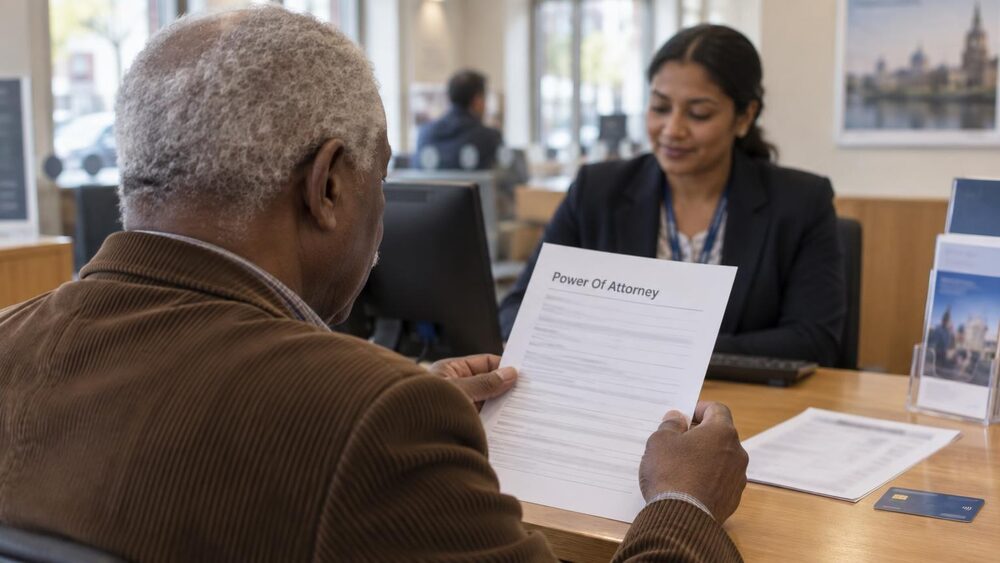
Extra support from a bank means practical changes to how the firm deals with you, not a different product. Banks have to make their information and services as accessible as possible for their disabled customers1, and if you have a disability, financial businesses must make reasonable adjustments so that you can use their services2. The duty sits in equality law: under the Equality Act 2010, your bank must provide equal access to all of its products and services3.
The adjustments can be concrete and everyday. Independent guidance lists examples such as communicating in an accessible way, having a quiet meeting space, providing bank accounts without an overdraft, and offering appointments so you can avoid queues4. Support is not only for disability: firms are expected to help customers whose circumstances make banking harder, whether that is bereavement, illness, a low income or difficulty with phones and technology.
This page covers what you can ask for, how to ask, the accessible formats and channels banks offer, what to do if security checks are a barrier, and the formal ways someone else can be allowed to act on your account, from a simple helper arrangement to a power of attorney.
What extra support from your bank means
Extra support is the collective name for the changes a bank, building society or other financial firm can make so that a customer who finds standard banking difficult can still use their account. It is not a special account and it does not cost anything. It covers how the firm communicates with you, how it verifies who you are, how it handles your money when things go wrong, and how it lets a trusted person help.
The foundation is legal. Banks have to make their information and services as accessible as possible for their disabled customers1, and under the Equality Act 2010 a bank must provide equal access to all of its products and services3. The Financial Ombudsman Service, which settles disputes between consumers and financial firms, puts it plainly: if you have a disability, financial businesses must make reasonable adjustments so that you can use their services2.
What "reasonable adjustments" means in practice depends on the person. Scope, the disability charity, lists the kinds of changes banks should make: communicating in an accessible way, having a quiet meeting space, providing bank accounts without an overdraft, and offering appointments to avoid queues4. So a customer who finds crowded branches overwhelming can ask for a booked appointment in a quiet room; a customer who cannot use an overdraft responsibly, or does not want one, can ask for an account without that facility.
Support also covers how a firm behaves when money is tight or when something has gone wrong, and the ombudsman takes a customer's vulnerability into account when it looks at a complaint, including whether the bank contacted the customer to offer support7. In other words, extra support is not a favour a bank may grant or refuse at whim: it is a duty, and a complaint about a failure to make adjustments can be taken further.
Anyone whose circumstances make banking harder can ask
You do not need a diagnosed disability to ask for help. The duty to make adjustments is strongest for disabled customers, but firms are expected to support anyone whose health, life event or circumstances make their services harder to use. Carers can ask too, on behalf of the person they look after or for themselves.
The idea of asking for extra support runs through public services, which gives a sense of how ordinary it is. HMRC offers extra help if you cannot use its online services, and lets you register a friend or relative to help with your tax8. Carers UK notes that if someone you care for has a physical or mental disability, or you have one yourself, you may be able to claim extra money by applying for a disability benefit9. In Scotland, you can still apply for Child Disability Payment without a bank, building society or credit union account by contacting Social Security Scotland to agree how you want to be paid10.
Some support is financial rather than practical. You do not have to pay VAT on certain goods and services if they are just for your own use and you are disabled or have a long term illness11. In Scotland, the Carer Additional Person Payment provides extra money to those who get Carer Support Payment and care for more than one person12.
The relevance to banking is direct. A person who cannot easily get to a branch, use an app, or pass a phone security check is not excluded from financial life: the firm is expected to find another way. And a carer who needs to speak to a bank about the account of the person they look after has recognised routes to do so, covered later in this page.
Telling your bank what you need
The first step is simply to tell the firm. Your bank or building society should have a specialist team that can offer customers additional support13, and some banks have a specific page on their website for disabled customers, which Scope suggests using as a guide to what you could ask your own bank for3. Asking one bank for something another already offers is a perfectly reasonable approach.
You only need to share what is relevant. A bank does not need your medical records to send statements in large print; it needs to know the format you require. MoneyHelper, the free government-backed money service, sets out ways to make your money easier to manage yourself, including asking for documents in Braille, large print and audio formats1.
It helps to be specific about the outcome you want rather than only the difficulty. For example: "I need statements in audio format", "I cannot use the app, please set up telephone access", or "I need appointments in a quiet room". If the first person you speak to cannot help, ask for the specialist team. If the firm refuses an adjustment you believe is reasonable, that can be the basis of a complaint, and the ombudsman can look at whether the firm discriminated against you2.
Accessible ways to bank: formats, branches, phone and app
The main accessible formats are the ones already mentioned: bank statements and other documents in Braille, large print and audio formats1. Beyond documents, the adjustments banks should make include communicating in an accessible way, having a quiet meeting space, providing accounts without an overdraft, and offering appointments to avoid queues4.
Digital banking has its own accessibility layer. In one case examined by the Financial Ombudsman, the design of a bank's desktop platform allowed customers, including those with accessibility needs, to access their account from a browser on a mobile phone14. That matters because a customer who cannot use a bank's app may still be able to use its website, perhaps with a phone's own accessibility features such as screen readers and text zoom.
Where someone else is helping, access varies by channel. Most banks give telephone and online access to a person acting for an account holder, plus branch instructions, but only a small number give access to the mobile app15. So a helper who can manage an account by phone and in branch may still not be able to use the app, and the account holder or helper should check what each channel allows rather than assuming.
Some banks have a specific page for disabled customers and specialist teams that can support people who have access needs3. British Sign Language users and customers with other communication needs can ask what the bank offers, such as relay services or appointments with communication support; the underlying duty is the same, equal access to products and services under the Equality Act 20103.
Security checks, and what happens if you cannot use a mobile phone
Banks run security checks on every contact, and these can become a barrier: codes sent by text, app-based approval, or voice identification all assume a customer can use a phone in the standard way. If a check is difficult for you, tell the bank why and ask what alternatives it offers. Firms are expected to make adjustments, and a customer who cannot pass a standard check is not left without options.
One warning applies before anything else. If you are worried about your account security, contact your bank directly using the number on your card or by calling 15916. The 159 number connects you to your bank safely, which matters because fraudsters exploit exactly this situation: a call claiming to be from your bank's security team, asking you to move money or read out codes. Never use a number someone gives you in an unexpected call.
If the difficulty is opening an account at all, there are defined routes. Where a person does not meet the opening criteria for a standard account, which might include a credit check, the usual outcome is that the bank offers a basic bank account17. A bank can refuse to open a basic bank account for reasons such as not agreeing to a credit check, failing the ID check, suspected unlawful or fraudulent use, or being threatening, abusive or violent towards staff, and the reason is given to the applicant unless the bank suspects fraud or money laundering18.
For existing customers, the practical steps are to ask the bank's specialist support team what alternatives exist to its standard checks, and to make sure a trusted person's access, if any, is set up formally so that they can verify their own identity rather than relying on yours.
Money worries: breathing space and help with debts
Extra support also covers how a firm treats you when you cannot pay. If you are struggling to make ends meet, your bank or building society should have a specialist team who can offer additional support13, and telling the bank before payments fail is generally better than after.
Formal protections exist for problem debt. The Debt Respite (Breathing Space) Scheme provides temporary legal protections from creditor enforcement action for people experiencing problem debt, including pauses on enforcement action and freezes on most interest and charges19. In Northern Ireland, the scheme has been extended by UK statutory instrument19. A Commons Library briefing records the government considering how to introduce a breathing space period for those with problem debt20, and the documents differ on how settled the policy picture is, so check the current position for where you live.
Specific forms of help have defined limits. Support for Mortgage Interest is available for interest payments for up to £200,000 of the outstanding loan or mortgage21. In Scotland, the Home Owners Support Fund can apply where your bank or mortgage lender wants to claim the rest of the money you owe22. For electricity prepayment customers in a vulnerable situation, "Additional Support Credit" means a fixed amount of credit provided when a customer's prepayment meter credit runs low or runs out, to ensure continuity of supply23.
Free, impartial help with debts is available: MoneyHelper offers guidance on money troubles and scams16, and the debt section of this site sets out the full range of debt solutions and where to get free advice.
Letting someone act for you: helpers, mandates and power of attorney
There are several ways someone else can be allowed to help with your account, and they differ in how formal they are and how much control they hand over.
The simplest is naming a helper. Most account providers will allow you to permanently or temporarily name a helper to access your account on your behalf, and you contact your bank, building society or other account provider for instructions5. Most banks, building societies and other account providers allow a third party access to your account, for example with a second card24.
The formal version is a third-party mandate. nidirect, the Northern Ireland government service, describes it as a way to set up a third-party mandate, which gives someone else access to your bank account, and you can specify how much access to give25. Scope defines it as a document telling your bank that someone you trust is allowed to run your personal accounts3.
"From a named helper for one task, to a mandate to run the account, to a power of attorney: the levels of access differ in formality and scope."
The most far-reaching is a power of attorney, which continues to work where a mandate would not. For an enduring power of attorney, you or your attorney will need to show signed copies of your EPA to banks and financial providers so your attorney can manage your accounts26. The detailed guides on third-party mandates, powers of attorney and registering a power of attorney with a bank cover each route step by step.
Power of attorney or third-party mandate: how each one works
The two formal routes are often confused, and the difference matters most at the point where it is hardest to fix.
A third-party mandate is for handling the account of someone who has mental capacity, and it is not appropriate if the account holder is losing the ability to make relevant decisions themselves. That is its central limit: it works while the account holder can still make and understand decisions, and it stops being the right tool when capacity is being lost. A power of attorney, by contrast, can be made in advance and used when the person can no longer manage, which is why guidance on dementia and managing money points to it for the longer term25.
Registration is a practical hurdle of its own. There is no consistency between firms when it comes to registering power of attorney, and each has its own process: some require in-person registration, others by post or online, and registration must be repeated for each bank15. So an attorney dealing with three banks should expect three registrations.
Use is less common than people might assume. Official statistics from the FCA's Financial Lives survey show that 1% of UK adults with a day-to-day account used a branch to add a third party or a power of attorney to an account in the last 12 months (2024)28. The side-by-side guide to third-party mandate versus power of attorney compares them in more detail, and what an attorney can do sets out the limits on an attorney's powers.
Where support has limits
Extra support is a duty to make services usable, not a promise that every barrier can be removed or every cost waived, and it helps to know where the edges are.
Some limits are mechanical. Most banks have a daily limit on how much you can pay, set by the customer's bank, so it is worth checking with your bank before a large payment29. Some are legal: a power of attorney does not automatically give access to everything. In one ombudsman case, a power of attorney did not entitle "Joanne" to use her mum's login, because the bank's design allowed customers, including those with accessibility needs, to access their account from a browser on a mobile phone, and the login itself was personal to the account holder14. An attorney manages an account through the channels the bank provides for attorneys, not by borrowing the account holder's own credentials.
Some limits are about consent. A packaged bank account comes with extra benefits, like insurance and roadside assistance, but also charges fees, and in one case a bank upgraded a customer's account without permission, which the ombudsman treated as a complaint about an unauthorised change30. Extra support never means a firm can add products or fees you did not ask for.
And some limits are about eligibility. A bank can refuse a basic bank account on defined grounds, including failing an ID check, and the reason is given to the applicant unless the bank suspects fraud or money laundering18. Where a limit is genuinely unreasonable, the complaint routes in the next section apply.
If your bank gets it wrong: complaints and the Financial Ombudsman
If a bank fails to make a reasonable adjustment, mishandles a helper's access, or gets something else wrong, the route is the same as for any financial dispute.
The first step is to complain to the firm. The Financial Ombudsman Service can help if you have made a complaint to the financial business and you are not happy with their answer6. The ombudsman deals with problems across banking: issues such as account closures, disputed transactions, IT failures, and problems with switching services31. Its easy-read leaflet lists bank accounts and bank cards, insurance, and problems with loans among what it covers6.
Scams are covered too. If you have lost money to a scam and are unhappy with how your bank or payment services provider handled things, the ombudsman may be able to help, and it can also look at complaints about the bank or payment service provider that received your money33.
If a complaint is upheld, the ombudsman can ask the business to make changes to a product or account, pay compensation for financial loss, make changes to a credit file, or do things differently for the customer in future, and it can also ask the business to compensate the consumer for distress or inconvenience7. In banking cases its redress can include refunding overdraft fees or interest, paying out a cheque the bank did not honour, returning money paid to the wrong person, and compensation for distress or inconvenience34. Complaints that involve discrimination, including failures over disability adjustments, are within its scope2.
The service is free. The guide to writing an effective complaint covers the first step, complaining on behalf of someone else covers helping a relative, and free consumer advice lists where to turn if a dispute stalls.
Sources34 cited
- Make your money easier to manage by yourself MoneyHelper, 2026-09-25
- Complaints that involve discrimination Financial Ombudsman Service, 2026-09-26
- Accessible banking and financial services Scope, 2026-08-17
- Managing money for someone else Scope, 2025-11-27
- Help to collect your benefits or pension nidirect, 2026-06-26
- Financial Ombudsman Service easy-read leaflet Financial Ombudsman Service, 2026-09-26
- Supporting customers in vulnerable situations Financial Ombudsman Service, 2026-09-26
- Tell HMRC if you have a new job or more than one job GOV.UK, 2025-01-16
- Help with health and care costs Carers UK, 2026-09-26
- Child Disability Payment: what you need to apply mygov.scot, 2025-08-21
- Financial help if you're disabled GOV.UK, 2026-09-26
- Help spread the word on financial help for student carers Social Security Scotland, 2026-09-14
- Support with living costs Carers UK Scotland, 2026-09-26
- Power of attorney didn't entitle Joanne to use mum's login Financial Ombudsman Service, 2026-09-26
- Setting up power of attorney Which?, 2026-02-26
- Types of scam MoneyHelper, 2026-09-25
- Choosing a bank account for your Universal Credit payment MoneyHelper, 2026-09-25
- Basic bank accounts MoneyHelper, 2026-09-25
- Extension of the Debt Respite (Breathing Space) Scheme to Northern Ireland Northern Ireland Executive, 2026-04-29
- Research briefing on problem debt and breathing space House of Commons Library, 2026-07-08
- Support for Mortgage Interest guidance HM Government deposited paper, 2025
- Home Owners Support Fund: who can apply mygov.scot, 2026-07-14
- Notice of modification: self-disconnection and self-rationing, electricity Ofgem, 2020-10-19
- Nominate someone to collect your State Pension GOV.UK, 2026-09-26
- Dementia and managing money nidirect, 2026-09-03
- Use or cancel an enduring power of attorney GOV.UK, 2026-09-26
- Manage a bank account for someone else GOV.UK, 2023-05-02
- Financial Lives Survey 2024: retail banking Financial Conduct Authority, 2024
- Pay from a bank account NS&I, 2025-12-01
- Consumer complains bank upgraded account without permission Financial Ombudsman Service, 2026-09-26
- Banking and payments complaints Financial Ombudsman Service, 2026-09-25
- Complaints about valuations and surveys Financial Ombudsman Service, 2026-09-26
- Scams where you've been tricked into making a payment Financial Ombudsman Service, 2026-09-27
- Cheques and banker's drafts Financial Ombudsman Service, 2026-09-26





 Citizens AdviceFree advice on money, consumer and legal problems in England and Wales
 MoneyHelperFree, impartial money and pensions guidance, set up by government
 Financial Ombudsman ServiceFree, independent help when a complaint about a firm is not put right
 GOV.UKOfficial information on tax, benefits and government services
 StepChangeFree debt advice and solutions from a charity