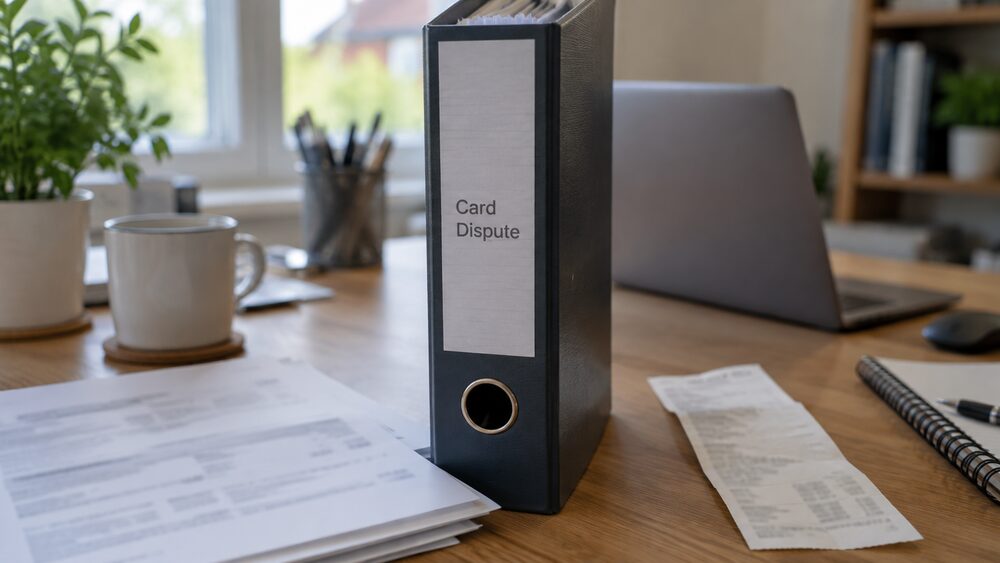
If something you paid for by card goes wrong, the first thing you want to know is how long it will take to get your money back. Most banks aim to resolve a card dispute within 60 days, and the first response usually comes within 7 to 10 working days of you submitting the claim1. The form itself is quick: several banks say their online card payment dispute form takes approximately 5 minutes to complete, with automatic updates while the claim runs3.
If something you paid for by card goes wrong, the first thing you want to know is how long it will take to get your money back. Most banks aim to resolve a card dispute within 60 days, and the first response usually comes within 7 to 10 working days of you submitting the claim1. The form itself is quick: several banks say their online card payment dispute form takes approximately 5 minutes to complete, with automatic updates while the claim runs3.
The clock that matters most, though, is the one for raising the dispute in the first place. Many card disputes must be raised within 120 days, counted either from the transaction date or from the date you expected to receive the goods or service2. Miss that window and the bank may not be able to look into it at all.
What follows is what happens at each stage, the deadlines that apply, what to do while a payment is still pending, and where to take it if the bank's answer does not resolve things.
Most card disputes are resolved within 60 days
The 60-day figure is the aim most banks work to, not a legal guarantee. One bank says it tries to get things sorted out within 60 days1. Within that period there are two distinct stages: the bank's own review of your claim, and then, if the claim goes to the card scheme as a chargeback, the scheme's adjudication.
The scheme stage can be the slower part. Under the Mastercard Scheme Rules, a chargeback dispute can take up to 45 days to adjudicate, according to one card provider's terms8. That 45 days sits inside the wider 60-day aim, which is why a dispute that looks straightforward can still run close to the outer limit.
If the bank does not resolve your complaint, the rules tighten. For a complaint about a card payment or direct debit, the business must look into things and get back to you within 15 days, and then send a final response within 35 days7. That final response must tell you how to contact the Financial Ombudsman Service if you are still unhappy10.
It helps to know which of the two processes you are in. A dispute raised directly with your bank is a claim under its own procedures. A chargeback is a scheme-level process the bank runs on your behalf. The deadlines differ, and so does who decides the outcome.
The first 7 to 10 working days: your bank's review
Once you submit a dispute, the bank reviews it and responds. One bank says it will review the dispute and respond within 7 to 10 working days2. Another aims to review your case and any documentation within 10 working days, excluding Saturdays, Sundays and bank holidays4. For customers of its international arm, the same bank quotes 20 working days for the review11.
That first review is where the bank checks whether your claim meets the conditions for a dispute. One bank lists them plainly: you have contacted the merchant and they have not solved your issue, you have waited 7 days and the transaction is showing as completed, you have waited 5 days since an ATM withdrawal where some or all of the money was missing, and you have all the evidence ready to start a dispute2.
Getting the evidence together before you start is what keeps the review short. Receipts, order confirmations, delivery tracking and any messages with the merchant all help the bank decide without coming back to you for more.
Time limits for raising a dispute: 30 or 120 days
The deadline for raising a dispute depends on what went wrong, and it is the single most important number on this page.
For goods or services not received, one bank sets the limit at 120 days from the expected delivery or service date2. For a problem with a recurring payment, the same bank sets it at 120 days from the transaction date2. Another bank says the limit is usually 120 days from the purchase date, but that this can vary12.
Where no delivery date was given, the rules change. One bank says the dispute can only be raised 30 days after the purchase was made2. Another asks customers to wait 15 days from the purchase date before raising a dispute where no delivery date was given13.
Chargeback has its own window. It is typically 120 days from the date of purchase or from when you expected to receive the goods or services, though longer periods may apply in certain scenarios14. The financial regulator's guidance puts it at 120 days from the expected delivery date of the goods or services not being provided15.
| What went wrong | Typical deadline | Counted from |
|---|---|---|
| Goods or services not received | 120 days2 | Expected delivery or service date |
| Recurring payment problem | 120 days2 | Transaction date |
| No delivery date given | 30 days2 | Purchase date |
| Chargeback claim | 120 days14 | Purchase or expected delivery date |
Pending transactions: wait up to 10 days on debit, 32 on credit
A payment that is still showing as pending is not yet a dispute you can raise. One bank says that if a transaction is marked as pending, it cannot raise a dispute, and that pending transactions normally clear after 7 days2. Another says pending transactions normally take 1 to 2 working days to process16.
How long a pending payment takes to clear depends on the card. One bank says this can take up to 10 days for debit cards and 32 days for credit cards6. That is the waiting period before a dispute can even begin, and it sits outside the 60-day resolution aim.
If a refund is due rather than a dispute, there is a separate trigger point. One bank says that if you have not received a refund after 30 days from the date on your refund receipt, it may be able to help18.
A pending payment has to clear before the dispute clock starts.
What if no delivery date was given for my order?
When a retailer gives no delivery date, the law fills the gap. Under the Consumer Rights Act 2015, goods must be delivered without undue delay and, in any event, not more than 30 days after the day the contract is entered into19. Independent guidance states the same rule: deliveries must happen within 30 days unless agreed otherwise20, and at the very latest not more than 30 days from the day after the contract is made or the item is purchased21.
That 30-day rule is what a bank will lean on when there is no delivery date to point to. One bank states that before a dispute begins, the delivery times quoted by the retailer are checked, because the dispute cannot be started until after that date22. Another states that if a delivery date was not specified, 30 days from the date of the transaction are allowed for the goods or services to arrive23.
For vouchers and gift cards, the same 30-day rule applies: if no date was given or agreed, the trader must get your purchases to you within 30 days of the order being placed24.
How long do I have to dispute a recurring payment?
A recurring payment, such as a subscription or a membership taken by card, follows the same broad window as other card disputes. One bank sets the limit at 120 days from the transaction date for a problem with a recurring payment2.
The practical difficulty with recurring payments is that the problem often shows up months after the first payment. If a subscription you cancelled keeps being charged, each charge is its own transaction, and the 120-day window runs from each one. That means the most recent charge is usually the easiest to dispute, and older ones may fall outside the window.
If the payment was taken by Direct Debit rather than card, different rules apply, including the Direct Debit Guarantee. The deadlines and the refund route are not the same as for a card dispute.
If the bank's answer does not resolve it
If the dispute comes back in the bank's favour and the customer disagrees, the next step is a formal complaint. The bank has at least eight weeks to try to resolve the complaint, and it should then send a final decision letter telling the customer how to contact the Financial Ombudsman Service10.
For a complaint about a card payment or direct debit, the timetable is shorter. The business must look into things and get back to you within 15 days, and then send a response within 35 days7. Under the Payment Services Regulations, the reply must be provided within an adequate timeframe and at the latest 15 business days after the payment service provider received the complaint25.
If the bank has not resolved things within eight weeks, or has sent a final response you disagree with, the Financial Ombudsman Service can look at the complaint10. The ombudsman is free to use and its decision is binding on the bank.
If the bank's answer does not settle it, the complaint route has its own deadlines.
Where to get free help
If a dispute stalls or the bank's answer does not make sense, free and impartial help is available. The Financial Ombudsman Service looks at complaints about banks and payment services and its service is free to consumers7. Citizens Advice can explain your rights when something has gone wrong with a purchase paid for by card or PayPal26, and can help you check whether a financial service has followed the rules27.
For a complaint that needs to be put in writing, a template letter can help you set out the facts and the outcome you are asking for28. If you are in Northern Ireland, the Consumer Council provides complaint help29.
The main thing to keep track of is the deadline. The 120-day window for raising a dispute, and the 30-day rule where no delivery date was given, are the points at which a claim can be lost entirely. Everything else, including the 60-day resolution aim, is about how long the process takes once it has started.
Sources29 cited
- Card payment dispute RBS, 2026-09-25
- Disputing a transaction Chase, 2026-09-25
- I haven't received my goods or services RBS, 2026-09-25
- I have a problem with a debit or credit card purchase RBS, 2026-09-25
- I've been charged more than once or the wrong amount RBS, 2026-09-25
- Card payments help first direct, 2026
- IT problems at banks Financial Ombudsman Service, 2026-09-25
- UK personal terms and conditions Monese, 2025-10-06
- UK personal terms and conditions Monese, 2026-09-08
- Overdrafts and other bank debts nidirect, 2025-11-07
- Card payment support RBS International, 2026-09-25
- Disputes explained M&S Bank, 2026
- Disputing a credit or debit card transaction Santander, 2026
- Chargeback rights and Section 75 UK Finance, 2026
- Cancellations and refunds: helping consumers with rights and routes to refunds FCA, 2020-10
- How we protect your money Chip, 2026
- Disputing a payment Nationwide, 2026
- Understand your statement Ulster Bank, 2026-09-25
- Consumer Rights Act 2015 legislation.gov.uk, 2015-03-26
- Your consumer rights when buying goods and digital Consumer Council, 2026
- My delivery or online order hasn't arrived Which?, 2026-04-14
- Goods not received Danske Bank, 2026-09-25
- Credit card chargeback TSB, 2026
- Gift cards and vouchers Resolver, 2026-09-26
- Regulation 101: Dispute resolution legislation.gov.uk, 2017
- Getting your money back if you paid by card or PayPal Citizens Advice, 2026-09-25
- Check if a financial service has followed the rules Citizens Advice, 2026-09-25
- Letter to report a problem with something bought on credit card Which?, 2025-06-18
- Safer ways to pay Consumer Council, 2026







 Citizens AdviceFree advice on money, consumer and legal problems in England and Wales
 MoneyHelperFree, impartial money and pensions guidance, set up by government
 Financial Ombudsman ServiceFree, independent help when a complaint about a firm is not put right
 GOV.UKOfficial information on tax, benefits and government services
 StepChangeFree debt advice and solutions from a charity