
Leaving a phone or broadband contract early usually means paying an early exit fee, but there are several routes out that cost nothing. The most reliable is the cooling-off period: you have 14 days to cancel most distance and off-premises contracts, which covers anything arranged online, over the phone or by mail order1. Broadband providers also treat the first 14 days of a contract as charge-free2.
Leaving a phone or broadband contract early usually means paying an early exit fee, but there are several routes out that cost nothing. The most reliable is the cooling-off period: you have 14 days to cancel most distance and off-premises contracts, which covers anything arranged online, over the phone or by mail order1. Broadband providers also treat the first 14 days of a contract as charge-free2.
After that, whether you can leave free depends on why you are leaving. If your provider raises the price in a way that does not benefit you, mobile customers get at least one month's notice and a right to exit without penalty3. If your broadband speed falls below the guaranteed minimum and the provider has signed Ofcom's voluntary code, you may be able to exit without charge2. If you simply want to leave, an early exit fee applies, and for UK broadband customers wanting to leave contract these have been reported at over £2004.
When you can leave a phone or broadband contract without paying a fee
There are four main routes out of a contract without an early exit fee. The first is the cooling-off period, which applies to most contracts arranged at a distance1. The second is a price rise that does not benefit you: for mobile contracts, the provider must give you at least one month's notice and a right to exit without penalty3. The third is a failure of service, where your broadband speed drops below the level the provider guaranteed2. The fourth is reaching the end of your minimum term, after which you are out of contract.
Social tariffs are a separate protection. If you are on a broadband or mobile social tariff, you are protected from mid-contract price rises and can avoid any leaving fees5. These tariffs are designed for people on certain benefits, and the protection is built into the tariff rather than negotiated case by case.
Outside these routes, leaving early means paying. An early exit fee may apply if you leave at any time before your contract ends, or only during certain times in your contract, depending on the terms6. The fee is not a penalty for leaving as such; it is the provider recovering the cost of the discount you were given for committing to a term.
The 14-day cooling-off period for new contracts
The cooling-off period is the simplest protection and the one most people never use. You have the right to cancel most distance and off-premises contracts, and the cancellation period is 14 days1. For services arranged online, over the phone or by mail order, that 14-day cooling-off period applies1. Broadband providers apply the same window: unless you are in the first 14 days of your contract, a cancellation charge may apply2.
The period does not always start on the day you sign. Under the rules for financial services distance contracts, the period runs either from the day the contract is concluded, or from the day you receive the contractual terms and conditions and any other required pre-contractual information, if that is later7. The firm must tell you about the right to cancel in good time before, or immediately after, you are bound, and must give you practical instructions for exercising it, including the address to send your cancellation to7.
For contracts that involve an initial agreement followed by successive operations, the right to cancel applies only to the initial agreement8. That matters if you have a service with add-ons bought later: the add-on may have its own cooling-off period, or none.
Slow broadband: your right to cancel depends on when your contract started
If your broadband is slower than promised, you may be able to leave without charge, but the right is not automatic. Under Ofcom's voluntary broadband code of practice, if your speeds drop below a certain level, you may be able to exit your contract without charge2. The code is voluntary, so it only binds providers that have signed up to it.
The condition is specific. If your provider has signed the code, and your after-sale information letter, email or online account says you can exercise the right to exit when your speed issue has not been resolved and is still below the minimum guarantee, you can request to leave the contract immediately and without penalty as outlined in the code10. If your provider has not signed the code, or your paperwork does not mention the right, you are relying on your contract terms and on general consumer law.
Contracts starting on or after 1 March 2019 use the Minimum Guaranteed Access Line Speed route for cancelling over slow internet. Contracts that started before that date are handled differently, so the date your contract began matters to which route applies.
If you are pursuing this, put it in writing. A template letter of complaint about broadband speed sets out the argument: if the provider cannot resolve the issue, the customer considers the provider in breach of contract and will write to request to leave immediately10. That framing matters, because it shifts the cancellation from a choice to a remedy for the provider's failure.
Mid-contract price rises and other changes to your terms
A price rise mid-contract is one of the clearest grounds for leaving without a fee, but the protection is not identical across phone and broadband. For mobile phone contracts, if the change does not benefit you, the provider must give you at least one month's notice and a right to exit the contract without penalty3. That is a firm rule for mobile terms.
For broadband, the position depends on your contract and on whether you are on a social tariff. Social tariffs protect you from mid-contract price rises5, which means the price you agreed is the price you pay for the term. If you are not on a social tariff, check your terms for what happens when the provider changes the price, and whether the change is one you can leave over.
There is a related rule for payment services. Under the Payment Services Regulations 2017, the user may terminate a framework contract without charge at any time before the proposed date of entry into force of changes11. That applies to payment accounts rather than broadband, but it shows the principle: where terms change, the customer gets a free exit before the change takes effect.
If you withdraw from a regulated contract, any related credit agreement is automatically terminated at no cost to the consumer9. That matters if you bought a phone or a service on credit attached to the contract.
Early termination fees and when they apply
An early exit fee is what you pay when you leave a fixed-term contract before the term ends. For broadband, an early exit fee may apply if you leave at any time before your contract ends, or only during certain times in your contract6. The wording matters: some contracts allow a free exit in the final months, others do not.
The fee is meant to reflect the provider's loss, not to punish you. Under the rules for payment service framework contracts, the provider may not charge for termination after the expiry of six months of the contract, and earlier charges must reasonably correspond to actual costs12. That is a payment services rule, but it illustrates the principle that early termination charges should be cost-based.
For internet connections, you may have to pay charges if you want to end your contract early while still in contract with your provider13. The amount is usually the remaining monthly charges for the rest of the minimum term, sometimes discounted. Reported exit fees for UK broadband customers wanting to leave contract have been over £2004.
Do you have to pay a fee if you move house?
Moving house is not, by itself, a free exit from a phone or broadband contract. If you are still inside a fixed term and your provider cannot supply the same service at your new address, an early exit fee may apply. Some providers let you take the contract with you; others treat the move as a termination.
The position is different for other kinds of contract, which is worth knowing because the comparison shows how unusual the broadband position is. If any part of a package holiday is changed significantly, including accommodation, transport, departure place or destination, or advertised facilities, you can cancel without paying termination fees14. If the price rises by 8% or more after you have booked and paid, you can also cancel without fees14. Those protections are specific to package holidays.
For broadband, the practical step is to ask your provider before you commit to a move. If they can supply the same service at the new address, the contract usually continues. If they cannot, ask what the exit fee would be and whether they will waive it. Some providers waive it when they cannot supply the service; others do not.
How much notice do you need to give?
If you are not in a fixed-contract period, you may need to give sufficient notice to change or leave, normally 28 days2. That is the standard broadband notice period. If you are inside a fixed term, notice runs alongside the early exit fee, so giving notice does not avoid the fee.
Notice is not the same as cancellation. You need to tell the provider you are leaving, in the way the contract requires, and you need to keep proof. The Consumer Contracts Regulations allow you to cancel in writing, by fax or by email, though it is sensible to stick to writing9. A letter or email should include your name, account number, the date, the reason you are cancelling, the date you want the contract to end, and a request for written confirmation.
If you are cancelling a credit agreement before it starts, a template letter asks the firm to confirm within 14 days that the agreement has been terminated and that any monies paid will be refunded15. That structure is a useful model for any cancellation letter: state what you are cancelling, when, and what you expect back.
If your provider refuses: complaints and the ombudsman
If your provider refuses to let you leave without a fee, or disputes your grounds, you can complain. Start with the provider's formal complaints process. If you are not satisfied with the outcome, or the timeframe has passed, you can take your complaint to the free Financial Ombudsman Service16. The ombudsman is free to use and can look at complaints about financial firms.
For energy complaints, the Energy Ombudsman is independent and free to use, and has the power to force an energy supplier to take action, which could be practical steps, an apology or compensation17. That is a useful comparison for what an ombudsman can do, though broadband and mobile complaints go to different schemes.
If you are not getting help from the company, you can take your case to the free Financial Ombudsman Service18. For card payments, if you try to use chargeback and do not get your money back, you can complain to the Financial Ombudsman Service if your card provider says they will not appeal to the trader's bank19.
Should you cancel the Direct Debit when you cancel the contract?
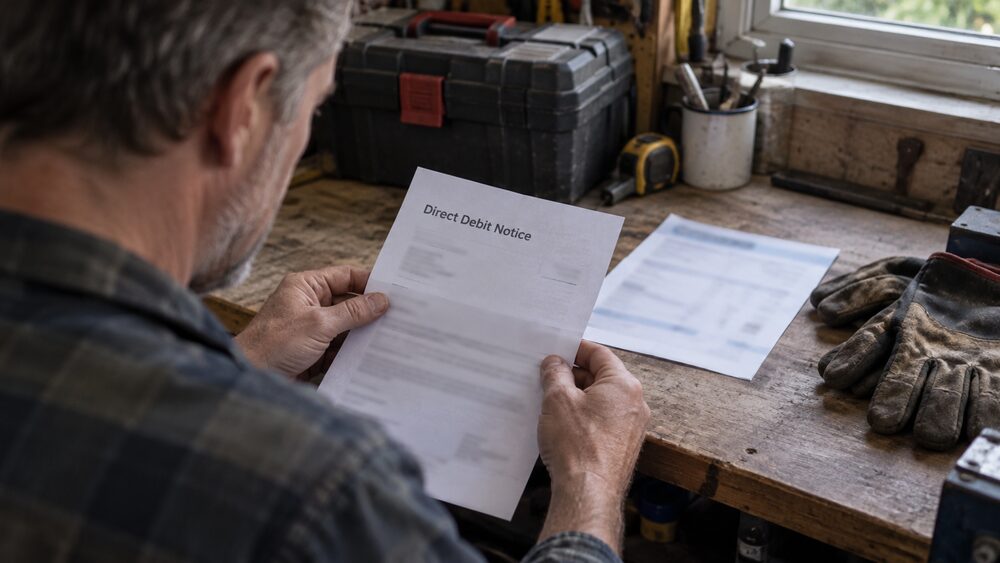
Cancelling the Direct Debit is not the same as cancelling the contract, and doing it in the wrong order can cause problems. A Direct Debit can be cancelled at any time by contacting the bank or building society, and written confirmation may be required; the organisation also needs to be told20. If a Direct Debit is cancelled, the bank should ensure that no payments are taken20.
But cancelling the payment does not cancel the debt. If you still owe money under the contract, the provider can pursue it, and missed payments can affect your credit file. The safer order is: cancel the contract, get written confirmation, settle any final bill, then cancel the Direct Debit.
Some providers cancel the Direct Debit automatically when the contract ends. Barclays, for example, cancels the Direct Debit automatically once a mortgage is fully repaid21. The DVLA cancels the Direct Debit automatically if you pay vehicle tax by Direct Debit22. But that is not universal, so check.
If you are struggling to pay, the advice is to keep paying if you can afford it. Only cancel the Direct Debit if it seems likely the payment will bounce or if taking the payment would cause you more financial difficulty23. Cancelling a payment you cannot afford does not solve the underlying problem, and it can make the debt worse.
Sources23 cited
- Cancelling a service you've arranged Citizens Advice, 2026-09-25
- Broadband rights guide Resolver, 2026-09-26
- EU exit and mobile roaming Consumer Council, 2026
- The benefit of certainty: inflation-linked MCPRs report Which?, 2023
- Social tariffs Independent Age, 2026-09-26
- Save money on broadband, digital TV and satellite StepChange, 2026-09-25
- COBS 15.2 The right to cancel FCA Handbook, 2026-04-06
- COBS 15.6 FCA Handbook, 2026
- Consumer Credit Act 1974 (as amended) legislation.gov.uk, 2010-12-11
- Letter of complaint about broadband speed Which?, 2025-06-18
- The Payment Services Regulations 2017, Part 6 legislation.gov.uk, 2026
- The Payment Services Regulations 2017, Part 6 (made) legislation.gov.uk, 2026
- Getting online for less Independent Age, 2026-09-26
- Can I cancel my package holiday? Which?, 2026-03-10
- Letter to cancel a credit agreement before it starts Citizens Advice, 2026-09-25
- Shop safely online MoneyHelper, 2026-09-25
- How to complain about your electricity, gas or energy bill Which?, 2026-07-30
- How to complain if you've been mis-sold car finance Which?, 2026-03-10
- Getting your money back if you paid by card or PayPal Citizens Advice, 2026-09-25
- Direct Debits and standing orders explained Which?, 2026-03-05
- Pay off your mortgage early Barclays, 2026
- Vehicle tax refund GOV.UK, 2026-09-25
- Cost of living: making the most of your money Business Debtline, 2026






 Citizens AdviceFree advice on money, consumer and legal problems in England and Wales
 MoneyHelperFree, impartial money and pensions guidance, set up by government
 Financial Ombudsman ServiceFree, independent help when a complaint about a firm is not put right
 GOV.UKOfficial information on tax, benefits and government services
 StepChangeFree debt advice and solutions from a charity