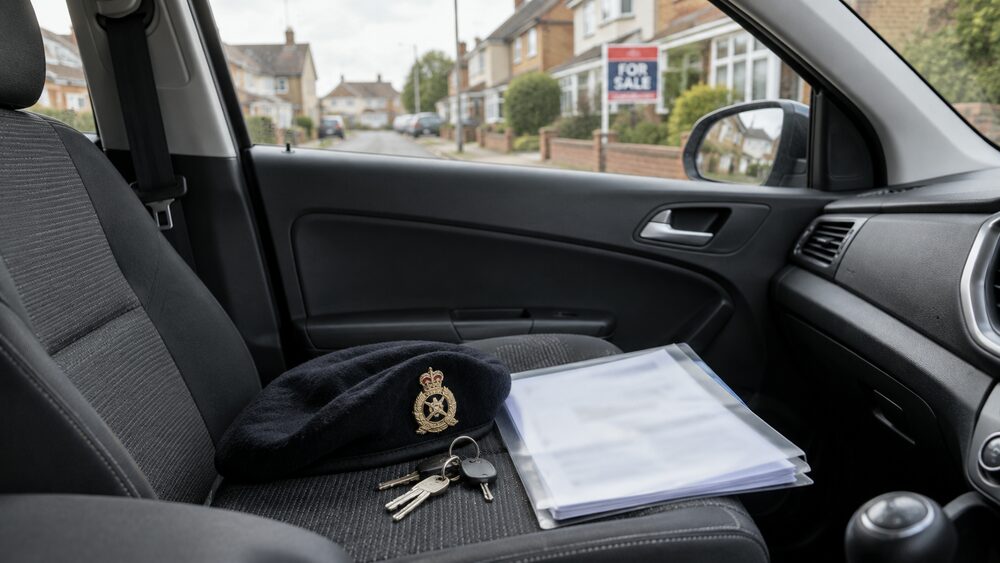
Forces Help to Buy (FHTB) is a Ministry of Defence scheme that lets regular armed forces personnel borrow money towards buying a home. The loan is worth up to 50% of the applicant's salary, capped at £25,000, and it is interest free1. The scheme's stated purpose is to help service people buy their first home or move to a new location2.
It is not a mortgage and it is not a bank loan. It is an advance of salary: the money comes from the MOD and is paid back through the service person's pay over time. Because no interest is charged, the amount borrowed is the amount repaid, which is what separates it from almost every other way of borrowing for a deposit. The scheme was introduced in April 20142.
An interest-free advance of salary from the MOD
The defining feature of Forces Help to Buy is where the money comes from and how it goes back. The scheme enables service personnel to borrow up to 50% of their salary, up to a maximum of £25,000 interest free, towards the purchase of a home1. The Ministry of Defence is the lender, and the repayment is collected through the pay system rather than by direct debit to a bank.
That structure has practical consequences for a buyer. An interest-free loan means the £25,000 borrowed is £25,000 repaid, with no interest adding to the bill over the years, which is not how any commercial borrowing behaves. It also means the loan is tied to service pay: the repayments come out of salary, so the scheme works only while the salary it was advanced against keeps arriving. The scheme was set up in April 2014 as an advance of salary scheme for regular armed forces personnel, and monthly statistics on its applications and payments have been published on GOV.UK since 20162.
The loan sits alongside a mortgage, not instead of one. A buyer using FHTB typically puts the advance towards a deposit and takes a mortgage from a normal lender for the rest of the purchase price. The lender's own affordability checks still apply to the mortgage, and the FHTB repayments coming out of salary are part of the household's outgoings. The scheme's purpose, as described in official material, is to let regular armed forces personnel borrow money in order to buy their first home or move to a new location2, which reflects the reality of service life: postings move people around the country, and buying near a new base is a different exercise from buying a first home.
How much you can borrow: 50% of salary, capped at £25,000
The headline figures are simple. A service person can borrow up to 50% of their salary, and the loan is capped at a maximum of £25,000, interest free1. Both limits work together: the lower of half your salary and £25,000 is the most the scheme can advance.
The cap does most of the work for anyone on a moderate salary. Half of a salary reaches £25,000 once the salary itself reaches £50,000, so for many applicants the 50% rule, not the cap, is the binding limit. For those earning more, the cap applies no matter how high the salary is. The published guidance states the two figures together, as one rule: up to 50% of salary, up to a maximum of £25,0001.
What the guidance does not do is break down which elements of pay count towards the salary figure. The rule is stated as a percentage of salary without detail on how specialist pay, allowances or bonuses are treated, so an applicant whose pay includes those elements has a live question to put to the scheme's administrators before relying on a particular figure. The safe approach is to ask for the salary figure the scheme will use, in writing, before working out what the loan will be.
Set against today's house prices, £25,000 is a deposit-sized sum rather than a purchase-sized one. It can be the difference between a 5% deposit and a 10% deposit on a moderately priced home, which changes the mortgage deals available and the interest charged on them. The costs of buying a house and how much deposit do I need pages set out what else a buyer needs to budget for, from stamp duty to legal fees.
Who is eligible and who is not
The scheme is for regular armed forces personnel. Official material describes it as allowing "regular armed forces personnel" to borrow money in order to buy their first home or move to a new location2, and the scheme was introduced in April 2014 as an advance of salary scheme for regulars2. On that wording, Reservists are outside the group the scheme covers, because the advance is repaid through regular service pay.
Service life interacts with other home-buying schemes in ways worth knowing. Any period spent in armed forces accommodation can count towards the three-year qualifying period for Right to Buy and towards the discount qualifying period, although a person who currently lives in armed forces accommodation has no Right to Buy3. That matters for service tenants weighing up whether to buy their forces home or buy on the open market with an FHTB loan.
Two further points sit around the edges of eligibility. A person who is an un-discharged bankrupt, has a bankruptcy petition pending against them, or has obtained a debt relief order is not eligible for Right to Buy3, and severe financial problems of that kind will bear on any mortgage application too. Separately, someone injured or disabled while serving in the armed forces may be able to get compensation through the armed forces compensation route4, which is separate from the home-buying scheme but can affect the money available for a purchase.
What the loan can be used for
The scheme's purpose is buying a home: official statistics describe it as letting regular armed forces personnel borrow money in order to buy their first home or move to a new location2. Those two purposes, a first purchase and a move driven by a posting, are what the advance exists for.
It is worth being clear what this loan is not, because the words "interest-free loan" appear in several government schemes with very different rules. A Social Fund Budgeting Loan, for people on certain benefits, can pay for things like a washing machine, advance rent or moving house5, and its full permitted list runs to furniture or household equipment, clothing or footwear, advance rent and removal costs when moving to a new home, travelling expenses within the UK, things to help you look for or start work, improving, maintaining or securing your home, and maternity or funeral expenses6. A Budgeting Loan can help with essential household items such as furniture, essential household equipment, clothing, footwear or home improvements7. Forces Help to Buy is narrower and bigger: it is a single-purpose advance for a property purchase, not a flexible loan for household costs.
In practice, the FHTB money goes towards the costs of the purchase itself: the deposit, and the outgoings that come with buying. A buyer combining it with a mortgage will find the lender wants a clear picture of where the deposit comes from, and an MOD advance is a documented source. The pages on gifted deposits and family help buying a home cover how lenders treat other sources of deposit money, and buying a home jointly covers what changes when two people buy together, which many service households do.
How Forces Help to Buy compares with other home-buying help
Forces Help to Buy is one of several government-backed routes into home ownership, and they work on different principles. The FHTB loan is a fixed cash advance against salary. The equity loan schemes, by contrast, give the buyer a stake in the property's value: Help to Buy, Wales is an equity mortgage from the Welsh Government that you put towards the cost of buying a newly built home8, and the Welsh scheme aims to provide support to people who would not be able to get onto the property ladder without it8.
The English Help to Buy equity loan is no longer open: the second iteration of the scheme, Help to Buy 2, was active from 2021 to scheme end in 2023, and Help to Buy 2 restricted access to first-time buyers11. The Welsh scheme continues, with applications for Help to Buy, Wales to be submitted by 31 March 202712, and a recent extension is giving up to 400 more households the opportunity to purchase a new build home with a smaller deposit13. Help to Buy, Wales support is available to all home buyers, not just first-time buyers, who wish to purchase a new home but may be constrained in doing so14.
Scotland's First Homes Fund is a contribution rather than a loan against salary, and it comes with its own conditions: a buyer must not be buying a property to rent out15, and where people buy together, at least one of them must be a first-time buyer, with any property currently owned by one of them sold before the purchase completes16. The first-time buyer schemes page gathers the schemes available in each nation, and there are separate guides to the Help to Buy equity loan in England, Help to Buy - Wales and the First Home Fund in Scotland.
The comparison that matters for a service person is between a cash advance and a shared equity stake. An FHTB loan is repaid in pounds, whatever happens to house prices: if the home rises in value, the borrower keeps the gain, and if it falls, the borrower still owes what they borrowed. An equity loan shares in the property's value both ways. Which suits a particular buyer depends on their salary, posting plans and attitude to that price risk, and the two are not mutually exclusive in principle, though a lender's affordability assessment will take all borrowing into account.
Where the home is and who lives in it
The FHTB scheme's purpose, buying a first home or a home in a new location2, points to a property the buyer will live in. Comparable government schemes make the occupancy rule explicit, which shows how seriously this condition is treated across home-buying support. Under Help to Buy, Wales, the home you purchase must be your only home17. The First Homes Fund excludes people who are buying a property to rent out15.
Other schemes show the same pattern from other angles. Scotland's Home Owners Support Fund, when a separated couple applies, requires that one of them must still be living in the property18. Crisis Grant rules require an applicant to be resident in the local authority's area, about to become resident, or homeless19. And when ownership of a Help to Buy home changes, any homeowner who stays on the contract will need to show that they can afford it20. None of these rules is an FHTB rule, but together they show the direction of travel in government housing support: the money is for a home, occupied by the person who borrowed.
For a service person this raises a real question that civilian buyers do not face: postings move people, sometimes at short notice. A home bought with an FHTB loan near one base may end up far from the next posting. The scheme's purpose of "moving to a new location"2 recognises this, and the practical position for anyone whose circumstances change after buying is a question to raise with the scheme's administrators and with a mortgage lender before, not after, a posting notice arrives. The pages on negative equity and on renting out a home bought with government support, such as subletting an equity loan home, cover the harder versions of this problem.
First-time buyer tax reliefs that may sit alongside the loan
Buying a first home with an FHTB loan can also trigger property tax reliefs, because the tax rules are separate from the loan scheme. In England and Northern Ireland, First Time Buyers' Relief was introduced in November 2017 and applies to purchases of dwellings for £500,000 or less, provided the purchaser has never owned a property and intends to occupy the property as their only or main residence21. A service person buying their first home with the loan can qualify for that relief on the same terms as anyone else.
Scotland has its own first-time buyer relief within Land and Buildings Transaction Tax, and its conditions are set out in full: the property must be residential and include a dwelling; the buyer must be a first-time buyer, meaning a first-time owner of a property who has never previously owned a residential property anywhere in the world; the buyer must intend to occupy the dwelling as their only or main residence; the transaction must not be a linked transaction; and it must not be one to which the Additional Dwelling Supplement applies22. Where there is more than one buyer, the relief is available only if each buyer meets all the criteria22. The "anywhere in the world" wording matters for service people who may have owned property overseas during a posting.
The reliefs have edges. First-time buyer relief only applies to purchases of entirely residential property23, and a buyer who qualifies for Multiple Dwellings Relief does not qualify for first-time buyer relief and would be subject to the Additional Dwelling Supplement23. The definition of who counts as a first-time buyer for property tax has its own page at who counts as a first-time buyer, and the main tax pages, Stamp Duty Land Tax, first-time buyer relief, LBTT in Scotland and Land Transaction Tax in Wales, set out the rates and thresholds in each nation.
Where the protection stops
Forces Help to Buy is a Ministry of Defence advance, not a regulated mortgage, and that shapes what protection sits around it. The Financial Conduct Authority's mortgage rules apply to firms, not to the MOD: MCOB 11 requires a firm to treat customers fairly and act in accordance with the Consumer Duty by assessing whether the customer will be able to repay the sums borrowed and interest24. That rule bites on the mortgage a buyer takes from a lender alongside the FHTB loan. It is the lender's affordability assessment, not the MOD's, that decides whether the combined borrowing is sustainable.
Depositor and borrower protection also runs through the regulated side of the arrangement. Under the FSCS rules, an eligible claimant is any person who at any material time did not come within the excluded categories in COMP 4.2.2R, or did come within them but satisfied the relevant exception25. Protection questions arise with the bank or lender, not with the MOD advance. Government lending has its own character: Support for Mortgage Interest, for example, is a government loan scheme helping with the interest costs of mortgages and certain home loans26, offered as a repayable loan rather than a benefit, which shows how government housing support is increasingly structured as money to be paid back.
Repayment obligations survive changes of circumstance. Someone who leaves their course early still has to repay their student loan27, and the same principle applies to an advance of salary: leaving the Armed Forces does not extinguish the balance. If repayments become unaffordable, help exists. Homeowners on certain benefits may be able to get help towards mortgage interest payments, called Support for Mortgage Interest28, which can help towards mortgage interest payments for a mortgage, a loan to buy or to improve your home29. In Scotland, the Home Owners Support Fund can help where a bank or mortgage lender wants to claim the rest of the money owed18. Mortgage arrears and payment difficulties have their own guidance, and early contact with the lender matters28. Free, impartial money help is available from MoneyHelper, and the debt section of this site sets out the full range of options if repayments of any kind start to slip.
Sources29 cited
- Forces Help to Buy: Commons Library briefing CBP-10611 House of Commons Library, 2026
- Forces Help to Buy Scheme monthly statistics 2017 GOV.UK, 2017-02-23
- Your Right to Buy your home: a guide GOV.UK, 2026-04-08
- Financial help if you're disabled GOV.UK, 2026-09-26
- Debt and money Scottish Government cost of living campaign, 2026-09-25
- Social Fund Budgeting Loan nidirect, 2026-06-25
- Claim a Social Fund Budgeting Loan nidirect, 2026-08-18
- Help to Buy, Wales post-sale information leaflet Welsh Government, 2025-06
- Buying a home Citizens Advice, 2026-09-25
- Supporting people to buy their first home Scottish Government, 2026-08-13
- Evaluation of the Help to Buy scheme: evaluation findings report GOV.UK, 2026-09-16
- Help to Buy, Wales: complaints Welsh Government, 2026
- Hundreds of households benefit from extension to three key schemes Welsh Government, 2026-07-28
- Help to Buy, Wales shared equity loan scheme quality report Welsh Government, 2024-06-04
- First Homes Fund: how to apply, eligibility gov.scot, 2026-06-24
- First Homes Fund: before you apply mygov.scot, 2026-08-31
- Help to Buy, Wales buyers guide, phase 3 extension Welsh Government, 2024-09
- Home Owners Support Fund: who can apply mygov.scot, 2026-07-14
- Scottish Welfare Fund statutory guidance gov.scot, 2026-03-25
- How to change ownership of your Help to Buy home GOV.UK, 2021-05-05
- Quarterly Stamp Duty Land Tax statistics: commentary GOV.UK, 2025-12-19
- LBTT first-time buyer relief Revenue Scotland, 2025-11-19
- Review of Land and Buildings Transaction Tax: independent external policy analysis 2025-26 Scottish Government, 2026-03
- MCOB 11: Responsible lending Financial Conduct Authority Handbook, 2026-06-26
- COMP 4.2: eligible claimants Financial Conduct Authority Handbook, 2026
- Support for Mortgage Interest: Commons Library briefing SN06618 House of Commons Library, 2026-09-26
- Repaying your student loan GOV.UK, 2026-09-25
- Mortgage arrears or payment difficulties nidirect, 2025-11-07
- Repaying your mortgage: interest on low income nidirect, 2026-09-01






 MoneyHelperFree, impartial money and pensions guidance, set up by government
 Citizens AdviceFree advice on money, consumer and legal problems in England and Wales
 ShelterFree housing advice from a charity
 GOV.UKOfficial information on tax, benefits and government services
 Financial Ombudsman ServiceFree, independent help when a complaint about a firm is not put right