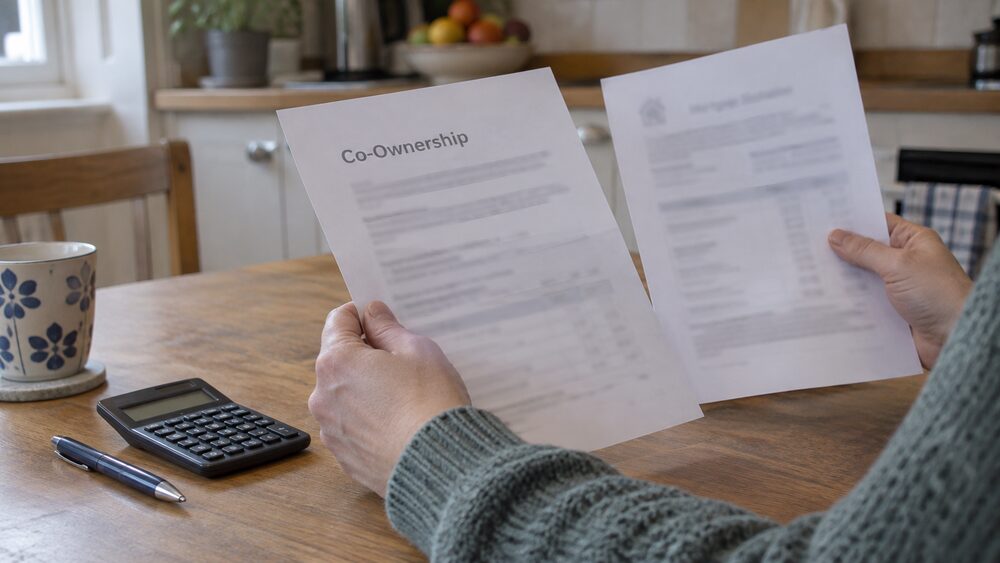
Co-Ownership is a Northern Ireland scheme that lets you buy part of a home and rent the rest. Through Co-Own you buy a share of a home between 50% and 90% and Co-Ownership buys the remaining share. You pay a mortgage on your share and rent on theirs1. It is aimed at people who cannot afford to buy a home outright2.
The practical difference from a standard mortgage is the size of the loan. When you buy through Co-Own, you are getting a mortgage on your share of the property, not the whole value3. On a 60% share of a £150,000 home, you need a mortgage on £90,000, not £150,0003. The trade-off is that you never stop paying for the part you do not own: rent to Co-Ownership continues until you buy that share out.
Co-Ownership's own illustration puts the monthly difference at £743 against £1,074. In its comparison example, a Co-Own buyer pays a £566 mortgage plus £177 rent, a total of £743, while buying the same home outright means a total monthly mortgage of £1,0741. Those are illustrative figures from the scheme, not a quote for any particular buyer.
How Co-Own differs from a standard mortgage
With a standard mortgage you borrow the whole purchase price minus your deposit, and every payment reduces a debt secured on the entire property. With Co-Own you borrow only against your share. Co-Ownership owns the rest and charges you rent on it1.
That split changes three things. First, the mortgage is smaller, so affordability tests apply to a smaller loan. Second, there are two payments each month rather than one: your mortgage to your lender, and rent to Co-Ownership on their share3. Third, you are not the sole owner. Co-Ownership's share is real ownership, not a loan, and it is bought back rather than repaid.
The share range is wider than in shared ownership elsewhere in the UK. Co-Own runs from 50% to 90%1. In England the new national model for shared ownership runs from 10% to 75%, with reduced rent on the rest7, and older guidance describes shares usually between 25% and 75%9. Scotland's shared ownership schemes work differently again, with a mortgage payment for the share you own and a monthly occupancy charge10.
Co-Ownership also runs a separate product, Co-Own for Over 55s, where there is no mortgage involved: you buy a share of between 50% and 90% using savings or equity from your current home when you sell it1.
Monthly costs compared: £743 with Co-Own against £1,074 on a full mortgage
Co-Ownership's own comparison example sets out the two monthly positions side by side. On the Co-Own side, a £566 mortgage plus £177 rent comes to £743. On the full ownership side, the total monthly mortgage is £1,0741.
Those figures illustrate the shape of the difference rather than a rate. The mortgage element is smaller because you are borrowing less, and the rent element is the price of not owning the whole property. Co-Ownership describes monthly costs as the mortgage on the share you own, paid directly to your lender, rent to Co-Ownership on the share it owns, plus all your household bills and costs6.
For Co-Own for Over 55s, where there is no mortgage, monthly costs are made up of rent to Co-Ownership on its share, plus all your household bills and costs, just like any homeowner6.
Two things follow. The rent is not fixed forever in the way a repayment mortgage payment is broadly predictable, and buying more shares reduces it. Co-Ownership states that if you have a mortgage through Co-Own, you will still pay that until it is cleared, but you will no longer pay rent to Co-Ownership once you own the whole home6.
Deposit and mortgage size on a £170,000 home
The deposit question is where Co-Own changes the arithmetic most. Because you only mortgage your share, the deposit is calculated against that share rather than the full price.
Co-Ownership's worked example is a 60% share of a £150,000 home, needing a mortgage on £90,000 rather than £150,0003. Two unresolved illustrative figures for a £170,000 property also appear: a property value of £170,000 against £161,500, and a deposit of £943 against £8,500.
For comparison, on a standard mortgage the deposit is a percentage of the whole price. A 10% deposit on a £250,000 house is £25,000, and on a £350,000 house it is £35,000. A 15% deposit on a £250,000 house is £37,500, on a £300,000 house £45,000, and on a £350,000 house £52,50011. Those figures date from 2020 and are given as illustrations of how deposit percentages scale, not as current market rates.
The effect is straightforward: a smaller mortgage means a smaller deposit requirement in cash terms, because the deposit is a percentage of the amount you are buying. There is a separate page on whether you need a deposit for Co-Ownership.
Who can use Co-Own instead of a standard mortgage
Co-Ownership is for people who cannot afford to buy a home outright2. The Northern Ireland Co-ownership scheme is described in official guidance in exactly those terms12.
Co-Ownership itself is clear about the limits of its role: it cannot give mortgage advice, though it can explain how the process works with Co-Own3. That matters because the mortgage itself is a separate transaction with a lender, and the lender's affordability rules apply to the loan on your share.
Where more than one person is buying, the usual joint-buying questions apply. You are both responsible for the whole loan if you have a joint mortgage, so you will have to discuss how to handle the repayments13. Sharing a mortgage means you have joint debts, and action can be taken against either of you14. Joint mortgages are usually shared by two people, but some lenders will allow up to four borrowers to share a mortgage15. Buyers should also check the legal difference between buying as joint tenants or as tenants in common15; tenancy in common is typically used by friends or relatives buying together15.
There is a separate page on buying a home with someone else, and on whether Co-Ownership is only for first-time buyers.
Property limits: up to £230,000 on new build homes
Co-Ownership sets maximum property values, and they differ between new builds and existing homes. The maximum property value is £230,000 for new build properties and £215,000 for existing properties4. A second property value limit of £230,000 is being introduced for new build properties alongside the existing £215,000 limit, to help more people buy a new build home5.
The two limits interact depending on the approval you hold. Up to £215,000, you will be offered a single property value that applies to both existing properties and new builds. Between £215,001 and £230,000, you can choose an existing property up to £215,000 or a new build property up to the property value shown on your approval5. The increased limit for new build homes includes homes only available through Co-Ownership, as well as other eligible new build homes up to £230,0005.
Co-Ownership buys new build homes anywhere in Northern Ireland4. New builds must have a suitable 10-year structural warranty, and existing properties under 10 years old must have the balance of their original structural warranty4. The home must have an Energy Performance Certificate4. You must declare any incentives you are offered by the seller or developer, and Co-Ownership may not agree to them4.
There are also property types Co-Ownership does not accept, including homes with no central heating, non-standard or unconventional construction, mobile homes or temporary structures, houses in multiple occupation, homes with an annex, homes with Japanese Knotweed, properties sold incomplete or "as is", underpinned or defective properties, homes with agricultural use restrictions, properties with a private water supply, and homes that do not front onto an adopted road4.
Service charges are capped in Co-Ownership's expectations: usually no more than £200 per year for a house and no more than £1,000 per year for an apartment4.
Buying more of your home: staircasing in 5% steps to full ownership
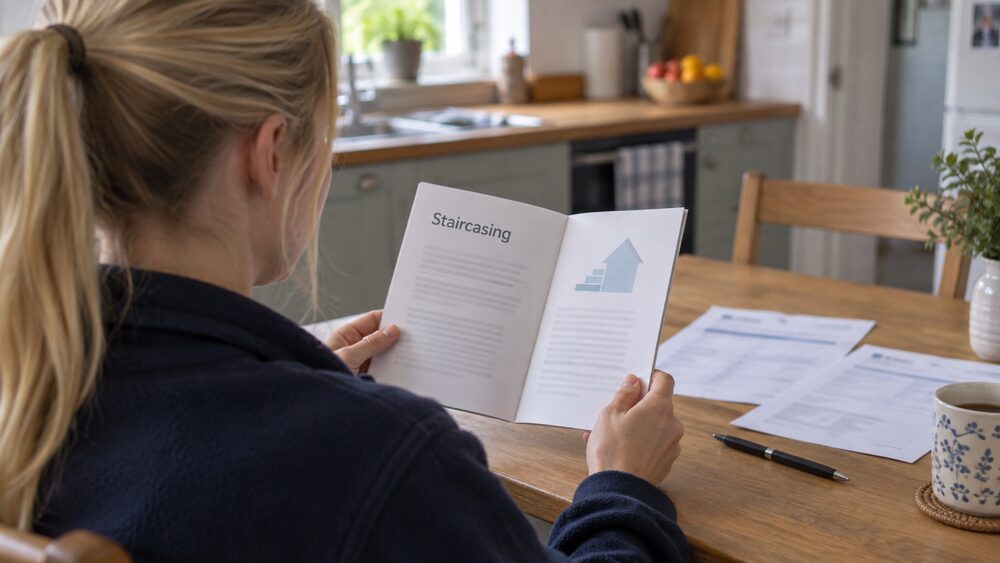
Buying more of your home is called staircasing, and with Co-Ownership you can do it in steps or buy Co-Ownership out completely, with no fixed timeline1. You can buy in 5% steps or larger blocks, depending on what works for your finances6.
The 5% minimum is now the standard across shared ownership schemes. The minimum additional share purchase has been reduced from 10% to 5%16, and other staircasing transactions are reduced to a minimum of 5% rather than 10%7. In Northern Ireland, the House Sales Scheme allows you to increase your equity share in multiples of five per cent at any time17.
There is a practical route through remortgaging. When you remortgage, you can borrow additional funds to buy more of your home from Co-Ownership. Your monthly mortgage payment will increase, but your rent to Co-Ownership will decrease3. That is the trade at the heart of staircasing: more debt, less rent.
Take-up is modest. Around 4,000 to 5,000 shared owners a year staircase to full ownership7. Co-Ownership reports that in 2025/26, 770 customers bought additional shares to reach 100% ownership of their homes.
If you have a mortgage through Co-Own, you will still pay that until it is cleared, but you will no longer pay rent to Co-Ownership once you own the whole home6. There is more on staircasing: buying more shares in a shared ownership home.
Costs and responsibilities that stay with you either way
Some costs do not change with the ownership structure. Buying a home brings new and ongoing costs such as paying the mortgage, rates, repairs and service charges12. Those apply whether you own 60% or 100%.
Repairs and service charges are the ones people underestimate. Co-Ownership's own expectations cap service charges at no more than £200 per year for a house and no more than £1,000 per year for an apartment4, but those are expectations about what is reasonable, not a limit on what you can be charged. On new builds, the building warranty will usually cover the cost of structural repairs in the first 10 or 12 years18.
If you have other debts secured on the home, such as a second mortgage, those creditors may be entitled to a share of the proceeds, but the debt to the mortgage lender is paid first19.
Where a partner lives in the home but is not on the mortgage, they may not be legally responsible for paying it but will probably need to ensure it is paid in order to protect their home20. That is a common source of difficulty when relationships change. There is guidance on what happens to an owned home after separation and on finances after a death in the household.
If payments become difficult, speak to your mortgage lender, as they may be able to reduce your payments for a period or alter the way your mortgage is paid, for example interest only21. Most lenders will usually expect you to meet your regular mortgage repayments for at least six months before agreeing to capitalise arrears22. Possessions remain significantly below the long-term average23.
When you sell or leave: how Co-Ownership's share is paid back
Selling a Co-Own home means settling two things: your mortgage and Co-Ownership's share. Co-Ownership's share is not a loan that you repay on a schedule; it is an ownership stake that is bought out when the property is sold or when you staircase to full ownership.
Co-Ownership's own sale process is not set out in detail, so the mechanics of valuation, fees and timescales should be checked with Co-Ownership directly. What is stated is that when you sell your property, the proceeds are split according to the ownership shares agreed in your lease24. For example, if you own 60% and Co-Ownership owns 40%, and the property sells for £100,000, you receive £60,000 (minus any outstanding mortgage balance and fees) and Co-Ownership receives £40,00024. There is a separate page on selling a shared ownership home.
What can be said is what happens to the money. If you have other debts taken out with your home as collateral, such as a second mortgage, those creditors may be entitled to a share of the proceeds, but the debt to the mortgage lender is paid first19. Your mortgage is cleared from the sale proceeds before Co-Ownership's share is settled.
If you are selling because of a change in circumstances rather than by choice, there are routes that do not involve selling at all. The Mortgage to Rent scheme in Wales, for example, means you would no longer own your own home and in most cases you would be given an assured or an assured shorthold tenancy25. Mortgage rescue schemes exist for homeowners in difficulty26.
If a lender takes possession and sells the home, the sale is handled by the lender27. If you are being contacted about arrears, you can complain directly to a bailiff or enforcement agent if they are treating you unfairly or harassing you, and you can also complain to the creditor they work for, then take the complaint to the governing body if it is unresolved28.
Where to get help and how to complain
Start with Co-Ownership itself on anything to do with the scheme, the share, the rent or the property criteria. On the mortgage, raise the complaint formally with the lender29.
If a complaint about a mortgage is not resolved, the Financial Ombudsman Service can look at it. The ombudsman publishes quarterly complaints data: in the first quarter of 2025/26 it recorded 157 buy-to-let mortgage complaints, 23% of which were upheld30. In the first quarter of 2026/27 it recorded 153 buy-to-let mortgage complaints31. Those figures cover the buy-to-let category and are given as an indication of complaint volumes, not of Co-Ownership specifically.
Free, impartial help is available. StepChange provides debt advice for homeowners and sets out the debt solutions available to people with a mortgage14. Shelter Cymru and Shelter Scotland provide housing advice, and Citizens Advice covers buying and selling a home24. For anyone considering releasing equity from a home later in life, the Equity Release Council explains how those products work and what happens if you move into long-term care32.
Sources33 cited
- What is Co-Ownership Co-Ownership, 2026-09-26
- Equity sharing nidirect, 2026-02-18
- Getting a mortgage Co-Ownership, 2026-09-26
- Property criteria Co-Ownership, 2026-09-15
- Property value limits Co-Ownership, 2026-09-15
- Costs and responsibilities Co-Ownership, 2026-09-26
- Shared ownership National Housing Federation, 2026-09-26
- Shared ownership National Housing Federation, 2026-09-26
- How much deposit do you need for a mortgage Which?, 2026-04-02
- Affordable home ownership Shelter Scotland, 2024-07-25
- Government pledges 95% mortgages Which?, 2020-10-18
- Low cost home ownership schemes nidirect, 2026-02-18
- Relationships and your money Independent Age, 2026-08-14
- Debt solutions for homeowners StepChange, 2026-09-25
- Joint tenants vs tenants in common Which?, 2026-06-08
- The new national model for shared ownership House of Commons Library, 2026-07-08
- Buying a home: step by step guide nidirect, 2025-08-22
- Repairs and home improvements GOV.UK, 2026-09-28
- Sale by mortgage lender Shelter Cymru, 2026-08-28
- Finances after a death Shelter Cymru, 2026-08-14
- What happens to an owned home after separation One Parent Families Scotland, 2025-02-13
- Arrears on a repayment mortgage Shelter Cymru, 2026-08-28
- Help to buy a home mygov.scot, 2026-06-24
- Buying a home Citizens Advice, 2026-09-25
- Housing costs rules entitledto, 2026-09-26
- Housing costs rules under 60 entitledto, 2026-09-26
- Housing costs more information entitledto, 2026-09-26
- Harassed by creditors StepChange, 2026-09-25
- How to make a consumer complaint Finance & Leasing Association, 2026-09-25
- Equity release complaints Financial Ombudsman Service, 2026-09-26
- Quarterly complaints data Q1 2025/26 Financial Ombudsman Service, 2025
- Do I risk losing my house with equity release Equity Release Council, 2026-01-16
- Equity release and long-term care Equity Release Council, 2026-01-16


 MoneyHelperFree, impartial money and pensions guidance, set up by government
 Citizens AdviceFree advice on money, consumer and legal problems in England and Wales
 ShelterFree housing advice from a charity
 GOV.UKOfficial information on tax, benefits and government services
 Financial Ombudsman ServiceFree, independent help when a complaint about a firm is not put right