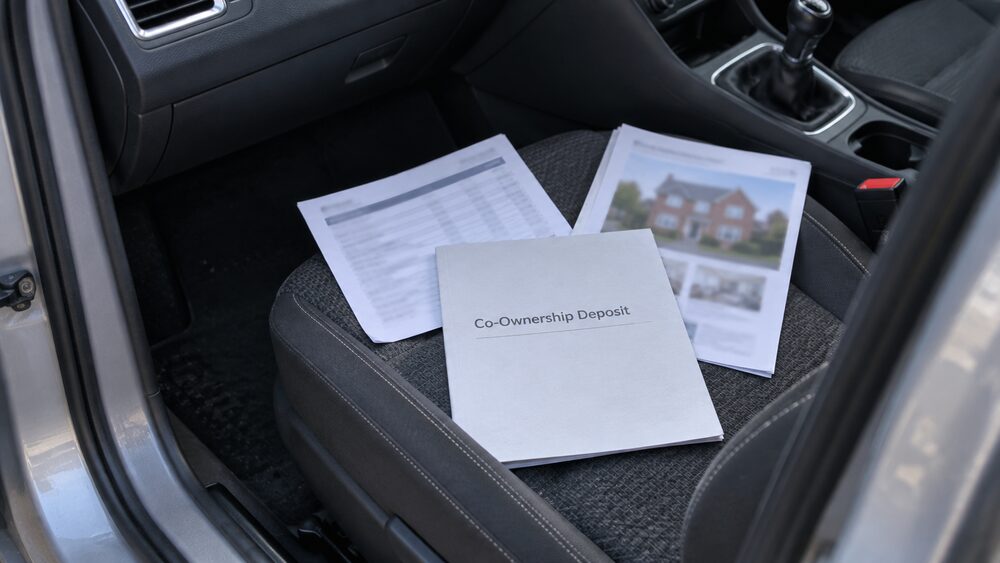
Co-Ownership in Northern Ireland works differently from shared ownership in England, and the deposit question is one of the clearest differences. There is no fixed percentage deposit rule written into the scheme itself. What you need depends on how you are funding your share of the home.
Co-Ownership in Northern Ireland works differently from shared ownership in England, and the deposit question is one of the clearest differences. There is no fixed percentage deposit rule written into the scheme itself. What you need depends on how you are funding your share of the home.
If you are buying your share with a mortgage, the lender sets the deposit requirement, and Co-Ownership asks you to show evidence of the savings, inheritance or equity you are putting in. If you are buying your share outright with savings or, under Co-Own for Over 55s, with the equity from selling your current home, there is no mortgage deposit to find, but you still have to show where the money is coming from1.
The property you can buy is capped. Co-Ownership's maximum property value is £215,000 for existing properties and £230,000 for new builds, and it does not support any purchase above those amounts2.
Savings and funds Co-Ownership asks you to show
Co-Ownership does not publish a single minimum deposit figure for its own scheme. Instead, it asks applicants to evidence the funds they are using. If you are using savings, inheritance, or equity from a property sale to fund your share, you need to show evidence such as bank statements or solicitor letters. Co-Ownership notes that the equity-from-a-sale route is relevant for Co-Own for Over 55s applicants1.
Where a mortgage is part of the purchase, the deposit requirement comes from the lender rather than the scheme. For comparison, shared ownership schemes elsewhere in the UK commonly require a deposit of at least 5% of the share you are buying, and some government-backed schemes put the range at 5% to 10% of the share7. Co-Ownership itself asks for evidence of savings, inheritance, or equity from a property sale where these fund the share, such as bank statements or solicitor letters, with equity from a property sale relevant for Co-Own for Over 55s applicants only1.
The practical point is that the deposit is calculated on the share you are buying, not on the full property value. If you buy a 50% share of a £200,000 home, a 5% deposit applies to the £100,000 share, not the £200,000 price. Co-Ownership's own application fee covers a check of your income, outgoings and credit history11.
Property value limits: up to £230,000 for new builds
Co-Ownership operates two property value limits. For existing properties the maximum is £215,000. For new build properties the maximum is £230,000, a limit that increased in September 20262.
The way the limits interact depends on your approval. If your approval supports up to £215,000, you get a single property value that applies to both existing properties and new builds. If your approval is between £215,001 and £230,000, you can choose an existing property up to £215,000 or a new build up to the property value shown on your approval2.
Co-Ownership states plainly that it does not support any purchase above these amounts13. For context, other first-time buyer schemes in the UK have different caps: the First Homes scheme in England covers new-build properties valued at up to £250,000, or £450,000 in London14.
Documents and credit checks for your application
To complete a Co-Ownership application you upload proof of identity, proof of current address, the last three months of payslips for all employment if you are employed, and the last three months of bank statements for all accounts15. Co-Ownership's wider guidance describes the same core set: proof of identity, proof of address, and evidence of your income, with recent payslips and bank statements for employed applicants and the last two years of tax calculation summaries and tax year overviews for self-employed applicants or company directors4.
Depending on your circumstances you may also need to provide residency documentation, proof of savings such as savings statements, proof of any other income such as benefit award letters, or a decree absolute, separation agreement or financial settlement documents15.
On credit, Co-Ownership's application fee covers a check of your income, outgoings and credit history11. Where a mortgage is involved, lenders run a credit check on each applicant before granting the loan, and if one party has a poor credit score it could affect the lender's decision16. Some landlords and rental companies also run credit checks and may not rent to someone with bad credit, and they need your permission to check your credit history when you apply to rent17.
Does my rent payment history help my Co-Ownership credit check?
Credit checks carried out by landlords and letting agents do not show whether you have missed rent payments in the past, though they usually show bankruptcy or county court judgments19. A soft credit search by a landlord or agent does not tell them if you have missed rent payments, though some landlords might check on landlord websites20.
Co-Ownership says your rent payment history can be recorded on your credit file21. That means paying rent on a Co-Ownership home can build a record over time, in the same way that other credit commitments do. If you are applying for a mortgage as part of the purchase, the lender's own credit check is the one that matters most, and it looks at your wider credit history rather than rent alone.
If you are worried about your credit record before applying, one official tip is to register to vote with your local council, as some banks use this as part of their checks, and to check your credit score and correct any errors before applying22.
Buying a bigger share later in 5% steps
Co-Ownership lets you increase your share in 5% steps or lump sum amounts, or buy out the entire Co-Ownership share whenever you want6. There is no obligation to buy more. You can stay at your initial share for as long as you like, though rent is charged on the share Co-Ownership still owns.
The 5% step is worth noting because the wider shared ownership model in the UK has moved in the same direction. Official guidance on the new national model for shared ownership says it is possible to staircase in larger increments with the minimum additional share purchase reduced from 10% to 5%7.
How long the process takes
Co-Ownership says most applications take between three and six months from application to completion, although this can vary5. The online application itself takes around 30 minutes to complete, and you can save your progress and return to it later1. Once all your documents are in, application review takes around five working days on average4.
Your Co-Ownership approval is then valid for four months for Co-Own applicants4. From an accepted offer to completion typically takes between 8 and 12 weeks, similar to any house purchase4. The mortgage application itself varies by lender, but typically takes between two and six weeks25.
| Stage | Typical time |
|---|---|
| Online application form | around 30 minutes1 |
| Application review, once documents are in | around five working days4 |
| Approval validity | four months4 |
| Mortgage processing | two to six weeks25 |
| Offer to completion | 8 to 12 weeks4 |
| Application to completion | three to six months5 |
Co-Own for Over 55s and using equity from a sale
Co-Own for Over 55s is designed for people aged 55 and over who buy a share of their new home using savings or the equity from selling their current home26. Shares are available between 50% and 90%27. Co-Ownership describes the option as being for anyone aged 55 and over using savings, or equity from the sale of their current home4.
Because the funding comes from savings or a sale rather than a mortgage, there is no lender deposit to find in the same way. But you still have to evidence the funds, and Co-Ownership asks for bank statements or solicitor letters where savings, inheritance or equity from a property sale are funding your share1.
For comparison, other later-life shared ownership schemes in the UK, such as the Older Persons Shared Ownership scheme, usually require a deposit of between 5% and 10% of the share you are buying where a mortgage is used9. The Home Ownership for people with a Long-term Disability scheme works on the same basis, with a deposit usually between 5% and 10% of the share you are buying10.
Where to get help
If you are unsure whether Co-Ownership fits your circumstances, or you are worried about your credit record or existing debts, free and impartial help is available. MoneyHelper offers guidance on money decisions, and debt advice charities such as StepChange can help if you are struggling with existing borrowing18.
If you are comparing Co-Ownership with other routes onto the property ladder, our guide to buying a home in Northern Ireland sets out the wider process, and Co-Ownership compared with English shared ownership explains how the two schemes differ. For the documents you will need, see what documents do I need to apply for Co-Ownership?, and for how the rent on the share you do not own is worked out, see how is Co-Ownership rent calculated?.
Sources27 cited
- Application process explained Co-Ownership, 2026-09-26
- Property value limits Co-Ownership, 2026-09-15
- What type of property can I buy Co-Ownership, 2026
- Starting the process Co-Ownership, 2026-09-26
- Step by step process Co-Ownership, 2026-09-26
- Increasing your share Co-Ownership, 2026-09-26
- The new national model for shared ownership House of Commons Library, 2026-07-08
- Right to Shared Ownership GOV.UK, 2026-09-26
- Older Persons Shared Ownership GOV.UK, 2025-12-03
- Home Ownership for people with a Long-term Disability GOV.UK, 2025-12-03
- Fees, costs and rent Co-Ownership, 2026-09-26
- Property criteria Co-Ownership, 2026-09-15
- Can I bid on any type of property Co-Ownership, 2026-09-26
- 7 first-time buyer schemes available now Which?, 2026-03-26
- Acceptable documents Co-Ownership, 2026-09-26
- Mortgage types explained Which?, 2026-04-02
- How does debt affect a credit file StepChange, 2026-09-25
- Debt solutions if you own your home StepChange, 2026-09-25
- Credit checks Shelter England, 2026-05-01
- How landlords and letting agents check tenants Shelter England, 2026-05-01
- Paying your rent Co-Ownership, 2026-09-26
- Choosing a bank account for your Universal Credit payment MoneyHelper, 2026-09-25
- Property assessment explained Co-Ownership, 2026-09-26
- Finding a property Co-Ownership, 2026-09-26
- Getting a mortgage Co-Ownership, 2026-09-26
- Homes only available through Co-Ownership Co-Ownership, 2026-09-26
- What is Co-Ownership Co-Ownership, 2026-09-26









 MoneyHelperFree, impartial money and pensions guidance, set up by government
 Citizens AdviceFree advice on money, consumer and legal problems in England and Wales
 ShelterFree housing advice from a charity
 GOV.UKOfficial information on tax, benefits and government services
 Financial Ombudsman ServiceFree, independent help when a complaint about a firm is not put right