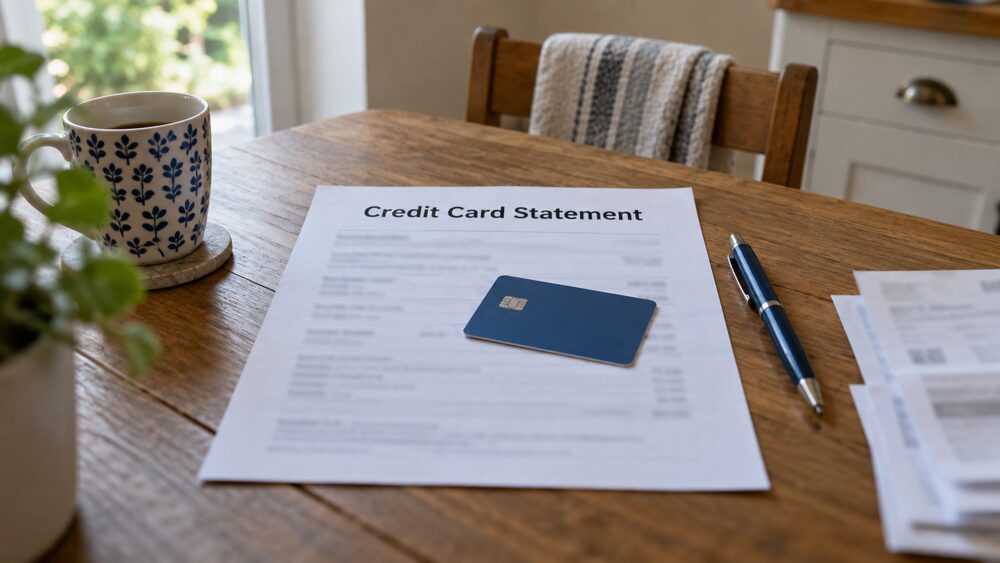
A credit card statement is the regular record your card provider sends you of what you owe, what you have spent, and what you must pay and by when. For most common types of debt, creditors are legally obliged to send a statement at least once a year1, and credit card statements normally arrive every month while you owe a balance. Reading it properly matters, because it tells you the minimum you must repay, the date the money has to arrive, the interest and charges being added, and the warnings your provider is required to give you.
The rules behind the statement come from the Financial Conduct Authority (FCA) and the Consumer Credit Act. Since April 2011, for new credit card contracts, firms must set the minimum repayment at a level that covers the interest and fees on the account plus 1% of the amount outstanding2. When you make a payment, the firm must first allocate it to the debt with the highest rate of interest, then the next highest, and so on3. Those two rules shape most of what appears on the page in front of you.
What a credit card statement shows
A statement is a snapshot of your account over a set period, usually about a month. It sets out what you spent, what you repaid, the balance you still owe, the interest and charges added, the minimum repayment required and the date it is due. Under the Consumer Credit Act, a statement of account should be signed by the creditor and tell you how much you have paid if you borrowed a fixed amount, how much you still owe, and what you still have to pay and when4.
The main parts of a statement, and what each one is for:
| Part of the statement | What it tells you |
|---|---|
| Statement period | The dates the statement covers, usually about a month4 |
| Opening and closing balance | What you owed at the start and end of the period4 |
| Transactions | What you spent and repaid during the period4 |
| Interest and charges | The interest rate applied and the amounts added6 |
| Minimum repayment | The smallest payment the provider will accept2 |
| Payment due date | When at least the minimum must reach the account4 |
The statement is also the document your provider uses to meet its duty to keep you informed. FCA rules require firms to provide or make available to a banking customer, on paper or in another durable medium, such regular statements of account as are appropriate to the service provided6. For a credit card, that means the statement is not just a courtesy: it is part of the legal framework that keeps you sighted on the debt.
Two figures on the statement are often confused:
- Statement balance: what you owed at the statement date. This is the figure to check against your own record of spending.
- Current balance: shown in your app or online account, it moves every day as new purchases and payments land. Anything spent after the statement was produced will not be on it.
If you are checking a statement against your bank account, remember that a payment you made near the end of the statement period may not yet appear on the statement itself.
If you ever need a formal record of the account, you can ask for a statement of account under section 77b of the Consumer Credit Act. There is no fee for this4, and the same right exists across England, Wales, Scotland and Northern Ireland, with guidance available for each nation7.
Outstanding balance and minimum repayment
The outstanding balance is everything you owe at the statement date: purchases, any cash withdrawals, interest and charges. The minimum repayment is the smallest amount the provider will accept without treating the account as being in arrears. The FCA requires that, for regulated credit card agreements made on or after 1 April 2011, the minimum repayment must be at least the amount that repays the interest, fees and charges applied to the account, plus 1% of the amount outstanding3.
Providers set their minimums in different ways within that floor:
| Source | How the minimum is described |
|---|---|
| Which? | A percentage of your balance, typically 1%8 |
| Citizens Advice | Typically around 3% of the balance due or £5, whichever is higher9 |
The difference comes from how each provider structures its minimum: some take the regulatory floor plus a small buffer, others set a higher percentage or a flat amount.
What matters for you is what the minimum actually achieves. StepChange is blunt about it:
"minimum payments usually only cover the interest and charges on a debt"
Which?'s repayment calculator guidance makes the same point from the other direction, noting that opting to pay only the minimum rather than a set amount can impact the time it will take you to repay what you owe11. Paying more than the minimum, where you can, is what shortens the debt.
Payment date: when your money has to arrive
Every statement shows a due date for at least the minimum repayment. Miss it and the account is in arrears: charges can be added10, and lenders assessing you in future will see a small number next to each late payment on your credit file showing how many months late it was13.
The date on the statement is the date the money has to have reached your account, not the date you posted a cheque or tapped send. Payment systems take time to clear. Official guidance on payments between accounts gives a sense of the timescales involved: it can take up to three working days for a payment to appear in a bank account14, and up to 5 working days for money to reach an account depending on your bank15. Card payments made by direct debit avoid this risk because the provider collects the money itself, but a manual transfer sent on the due date may arrive late.
The safest reading of the due date is therefore as a deadline for the funds to be cleared, with a margin built in for the transfer. If you pay by direct debit, check that the mandate covers at least the minimum, because a direct debit that fails leaves you in the same position as not paying at all. Recurring card payments, which a company sets up using your debit or credit card details rather than your current account details16, are a different mechanism again: the company takes the payment, and you cannot vary the amount as you can with a direct debit.
Interest rates, fees and charges on your statement
The statement shows the interest rate applied to your balance and the interest charged in the period. The interest rate of any credit card should be clearly displayed on any application form and promotional material as well17, so the figure on your statement should never be a surprise. What often is a surprise is how interest is charged: if you don't pay off the full amount every month, you'll be charged interest on the whole lot, not just the unpaid amount17.
Fees appear on the statement too. Citizens Advice lists the usual ones9:
- going over your credit limit
- using the card abroad
- late payments
Some credit card companies also charge a balance transfer fee to take over your unpaid debt, which can be a flat fee or depend on the amount transferred17. Most 0% balance transfer cards charge such a fee, as Which? has reported18.
Where a card is linked to a payment account, the rules on the statement of fees set a clear standard for what must be shown. It must specify at least all fees incurred during the period, the unit fee for each service and the number of times it was used, package fees, total fees, the overdraft and overrunning interest rates applied, total interest charged, the credit interest rates applied, total interest earned and total fees charged19. The interest disclosure part of that rule requires the statement to show the interest rates applied during the relevant period and the total interest charged20.
For a fuller explanation of how interest builds up day by day, see how credit card interest is charged, and for the charges themselves see credit card fees and charges.
Your payment goes to the most expensive debt first
If your card charges different rates on different balances, for example a 0% rate on a balance transfer but the standard rate on new purchases, the statement may show more than one interest rate. The rule on where your money goes is fixed by the FCA: a firm must first allocate a repayment to the debt subject to the highest rate of interest, and then to the next highest rate and so on, for the outstanding balance on a credit card or store card3. Which? puts the same rule in plain terms: when you make a payment towards your credit card bill, your provider will allocate this to the most expensive debt first21.
This matters most when you are carrying a cheap promotional balance alongside expensive new spending. Suppose you transferred a balance at 0% and then made purchases at the card's standard rate. Any payment you make above any fixed instalment goes to the purchases first, because they carry the higher rate. The 0% balance sits and waits.
The rule also covers newer card features. Where a card has a fixed-sum credit element or fixed instalment plans, the allocation rule applies to repayments beyond the fixed instalments3. So if you have converted a purchase into an instalment plan, the instalment is paid as agreed, and any extra you pay clears the most expensive remaining debt. The dedicated page on credit card instalment plans explains how these work, and paying a credit card bill covers the practical steps.
Paper or online: two ways to get your statement
You can normally choose how your statement arrives. Guidance for people using online banking notes that you'll still receive monthly bank statements in the post, or you can opt to go paperless and receive statements by email or download them from your online account22. The same choice generally applies to credit cards: the FCA's rules require statements to be provided or made available on paper or in another durable medium6, which covers both a posted sheet and a PDF in a secure app.
There are two things worth knowing about the paper option. First, the method of communication used to provide the statement of fees must be agreed with the consumer, and the statement of fees must be provided on paper upon the request of the consumer23. So if you have gone paperless and want a paper record of fees, you can ask for one. Second, paper statements matter for people who do not use the internet, and some advice services ask for a letter or statement showing details about the debt, or a screenshot of your online account, when helping you24: either form counts.
If you are struggling to access statements, whether paper or online, charities and local advice services can help. Some, like Toynbee Hall's City Advice, help with credit and store card debts alongside other money problems25.
How often statements arrive
For most common types of debt, your creditors are legally obliged to send a statement at least once a year1. Credit cards normally do better than that: statements come monthly while you owe a balance, because interest is calculated and charged each month and the provider must show you the running total.
The frequency does not stop just because your circumstances change. If you enter a debt solution such as a debt relief order, creditors may still send you balance statements of any outstanding amount you owe for up to 12 to 18 months, because they are required to by law26. Receiving a statement after a debt solution is in place does not mean the debt is being chased outside the process.
Statements also carry warnings on a schedule set by regulation. Banks are obliged to send letters to customers who have been in persistent debt for 18 months, warning them about the cycle they are in18. StepChange describes who these letters reach: people making minimum payments to a credit card, store card or catalogue account27. If you get one, it is not a demand for immediate full payment but a regulatory prompt, and the page on persistent credit card debt rules explains what follows.
What your card provider must show clearly
The FCA's banking conduct rules set the baseline. A firm must provide or make available to a banking customer on paper or in another durable medium such regular statements of account as are appropriate to the type of retail banking service provided6. The guidance alongside that rule says a firm should indicate the rate or rates of interest that apply to the service in each statement of account provided to the customer28. So the interest rate on your statement is not optional decoration: it is part of what the provider is expected to show you every month.
Before you even sign up, the law requires pre-contract information. The interest rate of any credit card should be clearly displayed on any application form and promotional material17, and the summary box given before signing sets out the key terms in a standard format so cards can be compared like for like. The page on credit card APR and representative APR explains the headline rate and what it does and does not promise.
There are also duties around specific products. Where a firm offers a card that will not give the customer the statutory rights associated with traditional credit cards, it must provide information explaining that29. And designated credit institutions must make available to consumers, free of charge, accessible information and assistance about the specific features of the account they offer and the associated fees and conditions of use30. In practice this means the cost of the card, in fees and in interest, has to be available to you in a form you can read before and during the life of the account.
Spotting a charge you don't recognise
An unfamiliar line on a statement is one of the most common reasons to look closely. Start with the name: many retailers trade under a different legal or processing name, so a charge you do not recognise may simply be the merchant's head office or payment processor. Check the date and amount against your own receipts and emails.
If you conclude the payment was not made by you, the rules are on your side. If you claim the use of the card was not authorised by you, it is for your bank to prove otherwise31. Report the charge to your provider as soon as you can. If your card provider will not give you your money back, report them to Trading Standards31.
If the problem is that the provider gets something wrong, or you are unhappy with how it handles your report, you can complain. Where a complaint is about a card payment or direct debit, the business must look into things and get back to you within 15 days5. If you remain unhappy after the provider's final response, the Financial Ombudsman Service can look at the case, and the page on complaining about a credit card provider sets out the process. For disputed purchases where the goods or services were faulty or never arrived, Section 75 protection and chargeback may also apply.
When the statement shows a debt you can't manage
Sometimes the statement is the moment a debt problem becomes visible: the balance is not falling, the interest is large, and the minimum repayment is all you can find. Paying less than the minimum makes things worse, because your credit card company might add charges, which affects both the size of your debt and your credit score12. Extra charges are added if you miss payments10.
Free help exists and is worth taking early:
- MoneyHelper gives free, government-backed guidance to those who may be struggling with money32.
- FSCS, which protects customers when financial firms fail, also signposts free debt advice from StepChange, Which? and Citizens Advice33.
- Local services such as Toynbee Hall's City Advice help with everything from credit or store cards to council tax arrears, mortgage problems, court fines or bankruptcy25.
In Scotland, different debt solutions apply, and the page on credit card debt in Scotland covers them, as does the one for Northern Ireland.
Your provider also has obligations. When deciding what help to offer, it will look at your pattern of payments34, which is one reason the statement matters: it is the record of that pattern. If you have been making minimum payments for a long time, the persistent debt rules require the provider to contact you and offer options, and the pages on credit card minimum payments, when you cannot afford to pay more and help with credit card debt set out what those options are and where the protections stop.
Sources34 cited
- Creditors must send statements at least once a year StepChange, 2026-09-25
- FCA credit card market study findings Financial Conduct Authority, 2014-11
- CONC 6.7: repayment allocation rules FCA Handbook, 2021-10-01
- Credit agreements: getting information (Scotland) National Debtline, 2026-09-25
- IT problems at banks: complaint response deadlines Financial Ombudsman Service, 2026-09-25
- BCOBS 4.2: statements of account FCA Handbook, 2026-09-26
- Credit agreements: getting information (England and Wales) National Debtline, 2026-09-25
- Will the credit card minimum repayment option be scrapped? Which?, 2018-07-31
- Choosing and applying for a credit card Citizens Advice, 2026-09-25
- Paying off credit card debt StepChange, 2026-09-25
- Credit card repayment calculator Which?, 2026-05-11
- If you're struggling to pay your credit card Citizens Advice, 2022-09-27
- Getting a mortgage with late payments and defaults Which?, 2025-08-20
- Getting your first student finance payment GOV.UK, 2021-08-23
- Student finance: how you're assessed and paid 2026 to 2027 GOV.UK, 2026-03-23
- Direct debits and standing orders explained Which?, 2026-03-05
- Credit cards and debt nidirect, 2025-11-06
- Credit card interest rates on the rise: 5 ways to cut the cost of your debt Which?, 2023-11-07
- Payment Accounts Regulations 2015, statement of fees contents legislation.gov.uk, 2023-12-14
- Payment Accounts Regulations 2015 (PDF) legislation.gov.uk, 2015-12-15
- Credit card interest explained Which?, 2026-09-18
- Online banking Age UK, 2026-03-23
- Payment Accounts Regulations 2015, data on statement of fees legislation.gov.uk, 2020-04-06
- Debt payment programme setup: documents needed StepChange, 2026-09-25
- City Advice: help with debt problems Toynbee Hall, 2024-01-10
- Once you have a debt relief order (DRO) GOV.UK, 2023-12-19
- Persistent debt repayment StepChange, 2026-09-25
- BCOBS 4.2.2G: interest rates in statements FCA Handbook, 2016-12-01
- MCOB 6A: pre-contract information FCA Handbook, 2026-09-26
- Payment Accounts Regulations 2015, regulation 27 legislation.gov.uk, 2015
- Your payment card was used without your permission Citizens Advice, 2026-09-25
- Help to Buy equity loan arrears guidance GOV.UK, 2024-05-20
- Cost of living crisis: debt support FSCS, 2026-09-25
- Help for consumers who are in persistent credit card debt Financial Conduct Authority, 2020


 MoneyHelperFree, impartial money and pensions guidance, set up by government
 StepChangeFree debt advice and solutions from a charity
 National DebtlineFree debt advice by phone, webchat and online
 Financial Ombudsman ServiceFree, independent help when a complaint about a firm is not put right
 Citizens AdviceFree advice on money, consumer and legal problems in England and Wales