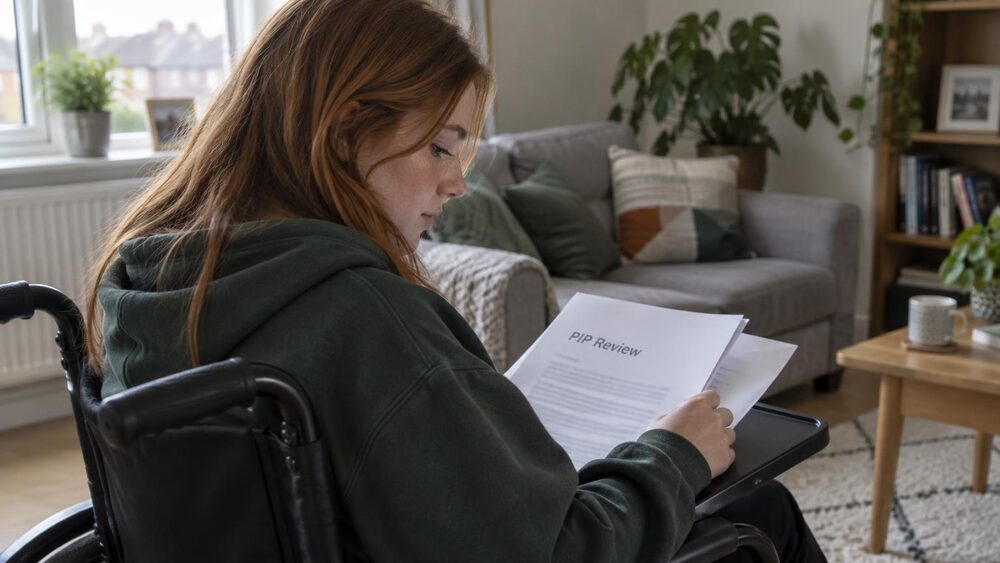
Personal Independence Payment (PIP) is a benefit for people aged 16 to State Pension age who have a long-term health condition or disability that makes everyday life or getting around difficult. It has two parts: a daily living component, for activities such as preparing food, washing, dressing and communicating, and a mobility component, for people who find it difficult to move around, plan or follow routes or leave their home1. Each part is paid at a standard or an enhanced rate, and you can get one or both3.
PIP is not means-tested: your income and savings do not matter, it is tax-free, and it is paid on top of other benefits rather than reducing them3. It was introduced in 2013 to replace Disability Living Allowance (DLA) for people of working age5.
PIP applies in England, Wales and Northern Ireland. In Scotland it has been replaced by Adult Disability Payment, and existing claims are being transferred over6. The Department for Work and Pensions (DWP) decides entitlement in England and Wales; in Northern Ireland the equivalent benefit is administered by the Department for Communities, which publishes its own guides to PIP7.
What PIP is: the daily living and mobility components
PIP is awarded based on how your health condition or disability affects your ability to carry out everyday activities and get around, not on the condition itself1. It is made up of two components, each assessed separately and each paid at one of two rates.
The daily living component is money for everyday tasks like eating, keeping clean, getting dressed, reading, taking medicine, making decisions about money, and socialising with other people10. The mobility component is money to help those who find it difficult to move around, plan or follow routes or leave their home10. You can qualify for one component and not the other, because the two are scored against different sets of activities in the assessment.
The benefit was introduced in 2013 to replace Disability Living Allowance for people aged 16 to State Pension age5. People still entitled to DLA have been invited to claim PIP instead, and the rules state that a person cannot claim DLA if they are entitled to PIP or entitled to claim it11. The guide to PIP vs DLA explains what changes when a claim moves across.
Who can claim PIP
To start claiming PIP you must be aged between 16 and State Pension age9. You do not need a medical diagnosis to claim: the assessment looks at how your condition affects you day to day, and medical evidence can help but is not required13.
You can claim PIP whether you are working or not, and it is not affected by your income or savings15. People with settled or pre-settled status under the EU Settlement Scheme can claim PIP if they meet the other criteria7. You cannot normally make a new claim once you have reached State Pension age; Attendance Allowance is the benefit to consider instead14.
If you live in Scotland, you cannot claim PIP at all and should claim Adult Disability Payment instead6. The habitual residence and right to reside tests apply to most benefits, and the page on those tests explains them.
PIP rates: £76.70 to £114.60 a week for daily living, £30.30 to £80.00 for mobility
From April 2026 the weekly rates are:
| Component | Standard rate | Enhanced rate |
|---|---|---|
| Daily living | £76.70 | £114.60 |
| Mobility | £30.30 | £80.00 |
The figures come from independent guidance on the 2026/27 rates17. Which rate you get depends on the points you score in the assessment: 8 to 11 points for the standard rate of a component and 12 or more points for the enhanced rate18. Payments are usually made every four weeks, directly into your bank or building society account, or through the Payment Exception Service if you do not have an account19.
A PIP award can also unlock other help. Getting the standard rate mobility component can increase amounts in Housing Benefit, with a disability premium of £44.85 a week for single people and £64.00 a week for couples under State Pension age21. The page on passported help sets out what else a qualifying award unlocks, and how rates rise each April explains uprating.
How to claim PIP, including for someone else
A PIP claim starts with a phone call to the PIP claim line. If you are eligible, the DWP will send you either a paper form by post or an email link to an online form, and it is up to you which you choose6. You do not have to send extra documents to the DWP to claim PIP, unless you are claiming under the special rules for terminal illness22.
You can start the claim for someone else if you are with them when you phone, or if they are terminally ill6. For people who cannot manage their own money or communications, an appointee can act for them, in which case PIP payments are made into the appointee's account20. The page on appointees and third parties explains how that arrangement works and what an appointee can and cannot do.
The form asks how your condition affects each of the assessment activities, so it is worth taking time over it and giving real examples of what happens on bad days as well as good ones. If you are awarded PIP, you will receive backdated money from the date you submitted your claim, possibly as a lump sum covering the time between the claim and the decision14. Easy read guides published by the government cover what PIP is, how to get help from it, how to claim and what to expect at the assessment24.
The PIP assessment: activities, descriptors and points
PIP uses a points-based system to decide whether someone qualifies for the benefit, and if so, at what rate25. The points you score for each activity are added together to work out whether you qualify1. There are 12 activities in total: 10 for daily living and 2 for mobility14.
Each activity has a set of descriptors, and the one that best matches how you manage that activity determines the points. For example, in the preparing food activity, someone who needs to use an aid or appliance to prepare or cook a simple meal scores two points, and someone who needs supervision or assistance to either prepare or cook a simple meal scores four points26. The mobility activities are planning journeys and moving around1.
| Component | Standard rate | Enhanced rate |
|---|---|---|
| Daily living | 8 to 11 points | 12 points or more |
| Mobility | 8 to 11 points | 12 points or more18 |
Points are only awarded if you satisfy the descriptor for more than 50% of the qualifying period, which matters for conditions that vary from day to day7. The assessment itself is normally a phone call, but it can be a home visit or take place in person at an assessment centre14. Claimants should normally get 7 days written notice of the assessment unless they agree a shorter period7. You can take someone with you, and they can take part in discussions and take notes for you22.
After the assessment, the DWP makes a decision about your claim18. The decision letter tells you whether your claim has been successful, which components you have been awarded, whether you have the standard or enhanced rate, and how many points you scored in the assessment18. It also states how much you will get, when you will be paid, and the date your PIP will be reviewed22.
Special rules for terminal illness
There are exceptions for claimants who are terminally ill and not expected to live for more than 12 months10. Under the special rules, the usual disability tests do not apply to either component27, and you automatically qualify for the enhanced rate of the daily living component17. The DWP should fast-track the application, with no application form to complete in the usual way and no face-to-face assessment15.
To claim under the special rules, an SR1 form must be completed by your doctor or another health professional6. A special rules claim is made by phoning the PIP Centre7. Official statistics for April 2026 show special rules new claims being decided in a median of 4 working days from registration to decision, against 18 weeks end to end for normal rules new claims28.
In Scotland, the equivalent provision under Adult Disability Payment gives a person with a terminal illness automatic entitlement to the highest rate of both the daily living and mobility parts, regardless of how long they have had the illness, with a lifetime award reviewed only on a change of circumstances and paid weekly in advance29. The narrow page on special rules for terminal illness covers the process in detail.
PIP does not reduce other benefits and is not means-tested
PIP is not means-tested: it is not affected by your income, capital or savings16. It is a tax-free benefit paid regardless of income or savings7. You can get the full amount of PIP on top of other benefits or tax credits16.
Getting PIP will not reduce your other benefits, and it could even increase them3. PIP is never treated as income for other benefits27, so a means-tested award such as Universal Credit is worked out without counting it. A PIP award can also entitle you to more money in means-tested benefits, and if someone in your household gets PIP, the benefit cap will not apply to your household15.
Award lengths, reviews and changes you must report
All PIP awards are time-limited, and the maximum award length is 10 years, but most awards are much shorter10. Awards can be made for one year, two years, three years, five years or ten years, depending on how likely your needs are to change10. Since April 2026, most new awards to people aged 25 or over are for 4 years with a review after 3 years, and subsequent awards following a successful review are for 6 years with the review taking place after 5 years28.
Before your award ends, you will receive a PIP review form14. For fixed period awards, the Department will normally contact the claimant approximately 8 months before the award is due to end7. If the award was made for 18 months or less, it is up to the claimant to make a fresh claim: the Department will advise that the award is coming to an end but will not conduct a renewal7.
Official statistics show that between May 2021 and April 2026, 78% of planned award reviews resulted in an increase or no change to the level of award28. A review can also go the other way: your PIP award could stay the same, increase, decrease, or be awarded for a shorter period28. The page on reporting a change of circumstances explains what must be reported and when.
If you are over State Pension age, you continue to receive PIP indefinitely without further assessments, as long as there is no change in your condition5.
Hospital and care homes: when payments stop and restart
If you claim PIP or its Scottish equivalent when you are already in hospital, it cannot be paid until you leave31. The narrow page on what happens to payments in hospital or prison covers the rules on free personal care and other payments during a stay.
Care homes work differently. If you pay for the care home yourself, the daily living part of PIP can continue32. The page on payments when you live in a care home sets out which benefits continue, stop and restart.
Challenging a PIP decision: mandatory reconsideration and appeal
If you disagree with the decision on your PIP claim, you must first ask the DWP to look at the decision again: this is called a mandatory reconsideration17. You can challenge a decision if you think it is wrong according to the rules33. The deadline is one month from the date on the decision letter9.
After the DWP has looked again, it sends a Mandatory Reconsideration Notice. You can normally only appeal after you have received that notice33. The appeal is looked at by an independent tribunal22, at a tribunal hearing where an independent panel looks at your case14. If the first tribunal did not follow the law, the case can go to an upper tribunal14.
Be aware of the risk before challenging. Your PIP award could stay the same, increase, decrease, or be awarded for a shorter period33. Official statistics show that between January 2021 and December 2025, 1% of award review outcome decisions were overturned, revised in favour of the customer, at a tribunal hearing28. The comparison page on mandatory reconsideration vs tribunal appeal weighs the two steps, and appealing after the one-month deadline covers late challenges.
Changes coming to PIP: the four-point rule and the Timms Review
Two changes were in the pipeline for PIP. Under the proposed changes to the daily living component, you would need to score at least four points in one daily living activity to qualify5. The government confirmed the changed entitlement rules would apply to new claims only36. The changes were originally due to come into force in November 2026, but the government has instead launched a wider review of the benefit5.
That review is the Timms Review. The government launched it to ensure that PIP is fair and fit for the future in a changing world, and helps support disabled people to achieve better health, higher living standards and greater independence, including through employment37. The review is expected to be published in October 2026, and the Work and Pensions Secretary has said the review is likely to lead to a change in the assessment in the future.
The context for claimants is a benefit that has become harder to get. Official statistics show that in the quarter ending April 2026, 44% of new claims with a completed assessment resulted in an award, down from 50% in April 2025; measured on new claim clearances excluding withdrawn claims, the rate was 37%, down from 43%28. By contrast, 74% of DLA reassessment clearances resulted in an award, up from 73%28.
Scotland: Adult Disability Payment has replaced PIP
PIP is not available in Scotland. It has been replaced for people in Scotland by Adult Disability Payment, delivered by Social Security Scotland rather than the DWP6. If you live in Scotland, you need to claim Adult Disability Payment instead22.
Existing PIP claims are being moved across. People should now either have their PIP transfer to Adult Disability Payment started or completed, and anyone with a Scottish postcode still getting PIP without a letter about the transfer should call 0800 182 222239. Official statistics show the scale of the change: around 310,000 people received PIP in Scotland in March 2022, and over 510,000 were receiving Adult Disability Payment in July 2026, a 65% increase in the disability payment caseload40.
The two benefits are similar in structure, and the page on moving between Scotland and the rest of the UK explains what happens to a disability payment when you cross the border.
Where to free help
Free, independent help with PIP is available from several sources. Turn2us publishes guidance on every stage of a claim, from starting it to challenging a decision6. Disability Rights UK and Scope both maintain detailed guides to PIP and to benefits for terminally ill people17. Carers UK covers PIP from a carer's perspective, including when you can claim for someone else3. In Northern Ireland, Law Centre NI publishes advice on PIP7.
For a check of what you might be entitled to overall, the page on free calculators and advisers lists the tools and services available. If a decision goes against you, the guides to challenging a decision and appealing to a tribunal set out the process, and complaining to the DWP and the Ombudsman covers service complaints as distinct from benefit disputes.
Sources41 cited
- What is the PIP test Turn2us
- Personal Independence Payment assessment Turn2us
- Personal Independence Payment Carers UK
- Personal Independence Payment (PIP) Which?
- Personal Independence Payment (PIP) Which?
- Start your Personal Independence Payment (PIP) claim Turn2us
- Advice on PIP in Northern Ireland Law Centre NI
- PIP easy read guides nidirect
- Disability benefits for adults under State Pension age Independent Age
- Personal Independence Payment (PIP) Mencap
- Personal Independence Payment Regulations 2013 legislation.gov.uk
- Social Security (Northern Ireland) Order 2016 legislation.gov.uk
- Long Covid and disability benefits Scope
- Personal Independence Payment (PIP) Scope
- Personal Independence Payment (PIP) Age UK
- How much PIP will I get Mental Health and Money Advice
- Personal Independence Payment (PIP) Disability Rights UK
- Getting a Personal Independence Payment (PIP) decision Turn2us
- How benefits and pensions are paid nidirect
- When do Personal Independence Payment (PIP) payments start Turn2us
- I get the standard rate mobility of PIP, what else can I get Turn2us
- How to apply for Personal Independence Payment Mencap
- How to claim PIP Mental Health and Money Advice, 2025
- About PIP: what it is and how to claim it, easy read guide GOV.UK
- Parent guide to Personal Independence Payment (PIP) Contact
- Personal Independence Payment Guide Entitled to
- Personal Independence Payment (PIP) Contact
- Personal Independence Payment official statistics to April 2026 Department for Work and Pensions
- Adult Disability Payment factsheet, March 2026 Social Security Scotland
- Personal Independence Payment (PIP) Which?
- Personal Independence Payment (PIP) Disability Rights UK
- Going into a care home: benefits GOV.UK
- Challenging a Personal Independence Payment (PIP) decision Turn2us
- Personal Independence Payment Disability Rights UK, 2026
- Options for challenging a PIP decision Turn2us
- Spring Statement social security changes: updated impact on poverty levels in Great Britain GOV.UK
- Timms Review of Personal Independence Payment: call for evidence summary of findings GOV.UK
- Adult Disability Payment reviews: transferred from DWP mygov.scot
- Adult Disability Payment factsheet, January 2026 Social Security Scotland
- Adult Disability Payment statistics to 31 July 2026 Social Security Scotland
- Terminally ill: benefits Scope

 Turn2usFree benefits calculator and grants search from a charity
 Citizens AdviceFree advice on money, consumer and legal problems in England and Wales
 GOV.UKOfficial information on tax, benefits and government services
 MoneyHelperFree, impartial money and pensions guidance, set up by government