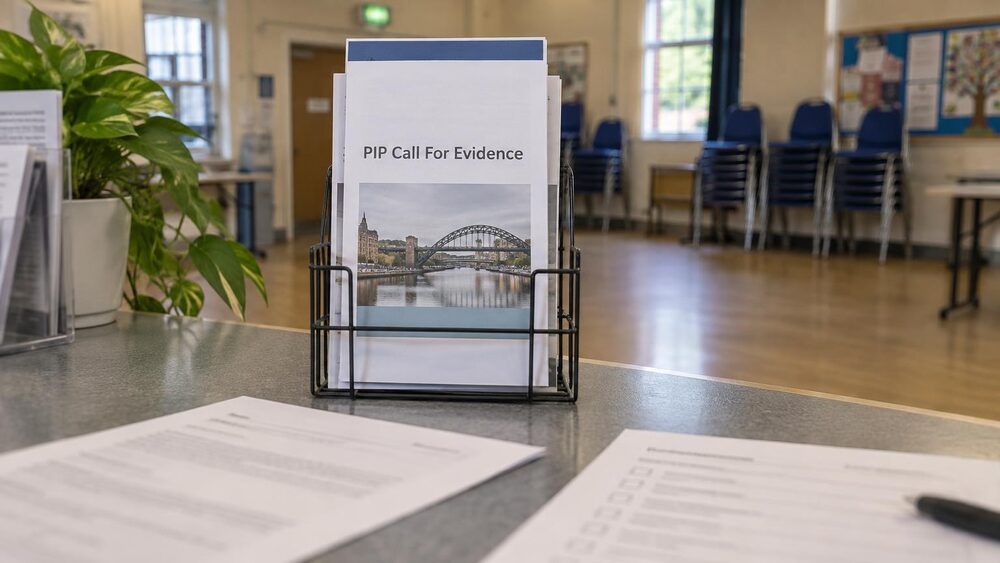
The Timms Review steering group launched a call for evidence on Personal Independence Payment on 19 March 20261. The call for evidence was administered by the Department for Work and Pensions on behalf of the steering group1. It remained open for 10 weeks, closing on 28 May 2026, and received 38,713 responses from a broad range of individuals and organisations1.
The call invited views, experiences and information across 4 themes: the role and purpose of PIP, assessment, decision-making, and the wider claimant experience1. Responses were submitted anonymously, enabling contributors to share views openly and in detail1. The published summary of findings was updated on 9 July 20261.
Respondents who chose to identify a group were counted as follows. The report states the categories overlap, percentages do not total 100% and volumes are rounded estimates, so the breakdown should be treated as indicative only1.
| Respondent group (self-identified) | % of total | Number of responses |
|---|---|---|
| Individuals (lived experience) | 70 to 75% | 27,099 to 29,035 |
| Carers | 9 to 12% | 3,384 to 4,646 |
| Organisations | 5 to 7% | 1,936 to 2,710 |
| Clinicians | 2 to 4% | 774 to 1,549 |
| Academics | about 1% | about 391 |
| Think-tanks | about 0.3 to 0.5% | 116 to 194 |
| Elected representatives (MPs) | about 0.05% | 15 |
| Unknown or not identifiable | 8 to 10% | 3,097 to 3,871 |
The Review used an Analytic Vertical Intelligence System (AVIS), described as an artificial intelligence-assisted, human-led analytical framework designed to enable large-scale analysis, with human oversight embedded throughout1.
On the content of responses, around 50% (about 19,350) reference financial adequacy, making it one of the most frequently raised topics1. Approximately 40% (about 15,485) refer to the relationship between PIP, employment and independent living1. Between 50 and 58% (about 19,400 to 22,500) of respondents express positive views about PIP as a benefit, while 36 to 40% (13,900 to 15,500) refer to concerns about the adequacy and reliability of support and how the process works in practice1.
"A common view across responses is that PIP is an important benefit. Respondents describe it as helping with the extra costs of disability, supporting independent living, and enabling people to participate in everyday life."
The report also states that responses indicate PIP is not working well in practice, with the process often described as involving a high level of effort, and some respondents describing it as repetitive, stressful and, in many cases, dehumanising1. It says a strong and recurrent message is that while the purpose of PIP is widely recognised and valued, the process of accessing and maintaining support is often described as complex and demanding1. The views expressed by respondents are not necessarily endorsed by DWP1.
Why it matters for households
The call for evidence concerns Personal Independence Payment, a benefit paid to people with disabilities and long-term health conditions. The findings report describes how respondents say awards affect housing security, health and independence, and how rising living costs mean PIP is often used for essentials, limiting its ability to meet wider disability-related needs1. It also records accounts of the process affecting wellbeing, with stress, anxiety and exhaustion reported, and in some cases existing conditions worsening1.
The report sets out barriers respondents describe, including long forms, reliance on telephone communication, rigid deadlines and limited flexibility in how people can provide information, which it says create substantial barriers particularly for individuals with cognitive impairments, mental health conditions, neurodivergence or fatigue-related conditions1. It also records concerns about assessments capturing a single point in time, inconsistency in decision-making, and outcomes varying across similar cases1.
The breakdown of respondents is indicative only, and the report notes that access to advocacy and the ability to navigate and persist within the system are seen as influencing outcomes1. The call for evidence forms part of the Review's wider evidence base and provides what the report describes as a uniquely large-scale and direct account of lived experience1.
What happens next
The call for evidence closed on 28 May 2026 and the summary of findings report was updated on 9 July 20261. The report states that respondents proposed a wide range of suggestions and reflections relating to changes that could improve how PIP works, but it does not set out a timetable for the Review's conclusions or for any changes to PIP1. No further dates for the Review have been reported in this document. For background on claiming and the assessment, see the site's guide to Personal Independence Payment and the benefits section.

 Turn2usFree benefits calculator and grants search from a charity
 Citizens AdviceFree advice on money, consumer and legal problems in England and Wales
 GOV.UKOfficial information on tax, benefits and government services
 MoneyHelperFree, impartial money and pensions guidance, set up by government