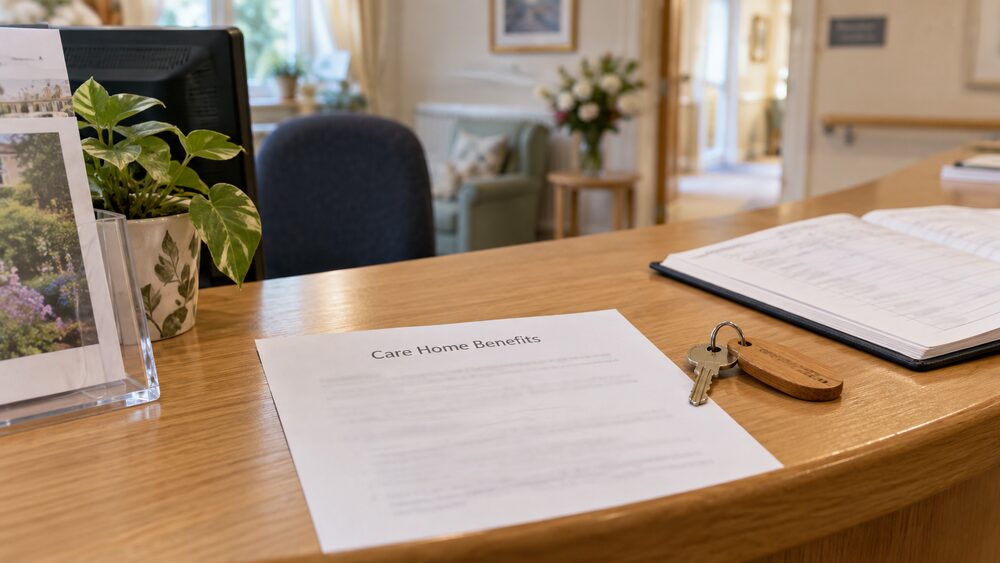
Moving into a care home does not automatically end your benefits, but it changes which ones you can keep. The single most important dividing line is who pays the fees. If you are completely self-funding, you can keep Attendance Allowance. If you get any local authority funding towards your care, Attendance Allowance stops after 28 days1.
Moving into a care home does not automatically end your benefits, but it changes which ones you can keep. The single most important dividing line is who pays the fees. If you are completely self-funding, you can keep Attendance Allowance. If you get any local authority funding towards your care, Attendance Allowance stops after 28 days1.
Attendance Allowance itself is worth either £76.70 or £114.60 a week, depending on the level of care you need3. The lower rate is for care or supervision during the day or night, and the higher rate is for frequent care throughout the day and night, or for terminal illness4.
Pension Credit works differently. Your entitlement is calculated in the same way as if you lived at home, and the home you live in does not count as capital7. The first £10,000 of savings is ignored before it affects the amount9.
Which benefits you can keep in a care home
Some benefits can still be paid when you live in a care home. Some stop once you, your partner or your child has been living in a care home for a set period of time, and others are reduced if they included amounts for your partner or a child2.
If you pay for the care home yourself, the picture is straightforward for Attendance Allowance: you keep it. But any other benefits you get will stop1. If you do not pay for the care home yourself, because you get funding from your local council, you might still be able to get the mobility parts of Personal Independence Payment and Disability Living Allowance1.
Where you get NHS funding for nursing care, you might still be able to get the care and mobility parts of Disability Living Allowance for children1.
The rules on Attendance Allowance are the ones most people run into first. If you move into a care home, you can keep getting it if you are completely self-funding, but if you get any local authority funding, the allowance will stop after 28 days2. It will also stop if you receive NHS Continuing Healthcare, but it will continue to be paid if you get NHS-funded Nursing Care and no other financial support from the state2.
Attendance Allowance: £76.70 or £114.60 a week, depending on who pays the fees
Attendance Allowance is the main disability benefit for people over State Pension age, and it comes at one of two rates. The lower rate is £76.70 a week, for people who need care or supervision during the day or night. The higher rate is £114.60 a week, for people who need frequent care throughout the day and night, or who are terminally ill3.
The rate you get depends on the level of care you need because of your disability, not on your income or savings. That is why the benefit can continue in a care home at all: it is not means-tested. What ends it is not your savings but the source of your care funding.
| Your situation | What happens to Attendance Allowance |
|---|---|
| Completely self-funding | You keep it2 |
| Any local authority funding | Stops after 28 days1 |
| NHS Continuing Healthcare | Stops2 |
| NHS-funded Nursing Care, no other state financial support | Continues2 |
Attendance Allowance also unlocks other help. You could get extra Pension Credit, Housing Benefit or Council Tax Reduction if you get Attendance Allowance12. That passporting effect matters when you are working out what a move into care does to your overall income, because losing the allowance can reduce more than the allowance itself.
If you are under State Pension age, Attendance Allowance is not the right benefit. Personal Independence Payment is for those under State Pension age who need help at home13. If you are under State Pension age, you may be eligible for Personal Independence Payment instead14.
Pension Credit when you move into care
Pension Credit gives you extra money to help with your living costs if you are over State Pension age and on a low income15. Moving into a care home does not change how it is worked out: your entitlement to Pension Credit is calculated in the same way as if you lived at home7. Where only one of a couple lives in a care home, it may be calculated separately for that person7.
There is one administrative change that catches couples out.
Pension Credit counts as income when your contribution to your residential care or nursing home fees is assessed11.
If you pay for the care home yourself, one benefit can continue: an extra amount for severe disability paid with Pension Credit1.
Moving into a home may also affect your Carer's Credit, or the Carer's Credit of someone who looks after you11. Carers over State Pension age with a low income can claim Pension Credit, which includes an extra carer addition often referred to as the carer premium, available if you qualify for Carer's Allowance or have an underlying entitlement to it16.
Savings and Pension Credit: the £10,000 limit
Pension Credit ignores the first £10,000 of your capital9. Above that, savings and investments may affect the amount you receive10. There is no upper capital limit for Pension Credit, but you may receive a reduced amount if you have more than £10,000 of capital17.
The same £10,000 lower limit applies to Housing Benefit for claimants above the qualifying age for Pension Credit9. For means-tested social security benefits generally, the first £6,000 of capital is ignored, or £10,000 for claimants of some benefits if they are in a care home9.
Your home is treated separately. You can still get Pension Credit if you own your own home, because the home you live in does not count as capital8. You can also get Pension Credit if you are living with your family, and the Pension Centre looks at your income, not theirs8. More broadly, you can get Pension Credit even if you have other income, savings or own your own home15.
Not all benefits count as income for Pension Credit. Attendance Allowance is not counted, and neither are Adult Disability Payment, the Christmas Bonus, Child Benefit, Disability Living Allowance, Personal Independence Payment, social fund payments like Winter Fuel Allowance, or Housing Benefit8.
Housing Benefit and help with rent
Housing Benefit is the means-tested help with rent for people over State Pension age. If you get the Guarantee Credit part of Pension Credit, your income and savings are not taken into account, so your rent may be paid in full18. In that case your Housing Benefit will be your weekly eligible rent, less any amounts for non-dependants living with you19.
If you do not get Guarantee Credit, you may still qualify if you are responsible for paying rent on your home, have less than £16,000 in savings or investments, and are on a low income20.
The care home itself changes this. If you move into a care home permanently, you will no longer receive Housing Benefit7. That is because the rent you were claiming for is no longer your home.
Applying is straightforward if you are already in the Pension Credit system. Apply for Housing Benefit through your local council, and you will need to request a claim form unless your local council accepts online applications18. If you are applying for Pension Credit, you can apply for Housing Benefit as part of your claim21.
Temporary or permanent stay: what changes for couples
The length and permanence of your stay decide a lot. The same applies to a hospital stay if you get benefits1.
For couples, a permanent move into a care home splits the claim. A temporary stay does not do this.
There is a long list of changes you must report to the office paying your benefit. These include moving house, people moving into or out of the place you live, the death of your partner or someone you live with, starting or stopping caring for someone, getting married or divorced, starting or ending a civil partnership, going into hospital, a care home or sheltered accommodation, and changes to your pension, savings, investments or property22.
Child Benefit has its own care home rule.
One small protection is worth knowing about. People who would ordinarily occupy premises as their sole or main residence but are in hospital, a care home or a hospice temporarily are treated as continuing to occupy those premises for the Warm Home Discount Scheme23.
What should I claim instead of Attendance Allowance in Scotland?
Attendance Allowance does not operate in Scotland. You will need to apply for Pension Age Disability Payment instead of Attendance Allowance12. Pension Age Disability Payment has replaced Attendance Allowance in Scotland, and existing claimants will be moved automatically24.
If you live in Scotland, you will need to apply for Pension Age Disability Payment instead of Attendance Allowance2. The two benefits cover the same ground, so the care home rules on funding and the 28 day stop follow the same logic, but the claim goes to Social Security Scotland rather than the DWP.
If you move between Scotland and the rest of the UK, the payment you receive changes with your address. The same applies to other devolved disability and carer payments.
Challenging a decision and where to get help
If you think a decision about your benefits is wrong, there are steps you can take. For Housing Benefit, you may be able to ask for an explanation, have the decision looked at again, or appeal against the decision25. If you do not agree with a decision about Housing Benefit, you need to contact your local authority and make a request in writing26.
The same advice applies to Carer's Allowance decisions: if you are unhappy with the decision, you can challenge it27.
Free and impartial help is available. Turn2us runs information and advice services, helps older people think about their future, and helps them live safely and well at home28. Age UK and Independent Age both publish guidance on benefits in care homes, and StepChange offers further support on housing28.
Sources28 cited
- Going into a care home: benefits GOV.UK, 2026-09-27
- Care homes and benefits Turn2us, 2026-09-26
- Perks and benefits of being retired Which?, 2026-05-20
- How much Attendance Allowance will I get Turn2us, 2025-10-29
- Attendance Allowance Independent Age, 2026
- Benefit rates Age UK, 2026-07-21
- How moving into a care home affects your pension and benefits Which?, 2026-05-13
- Income benefits and Pension Credit nidirect, 2026-06-26
- Share incentive plans and your entitlement to benefits GOV.UK, 2025-10-20
- Pension Credit technical guidance GOV.UK, 2026-04
- Residential care and nursing homes and benefits nidirect, 2026-08-05
- Attendance Allowance GOV.UK, 2026-09-25
- Dementia and managing money nidirect, 2026-09-03
- Paying for homecare Age UK, 2026-02-17
- Pension Credit GOV.UK, 2026-09-26
- Managing money after a dementia diagnosis Which?, 2026-09-20
- How your benefits are means tested Age UK, 2026-04-30
- Housing Benefit Age UK, 2026-08-26
- Housing Benefit Disability Rights UK, 2026-04-16
- Help with your rent or mortgage Independent Age, 2026-09-26
- Apply for Housing Benefit Shelter Scotland, 2025-12-12
- Report benefits change circumstances GOV.UK, 2026-09-26
- The Warm Home Discount Regulations 2026 legislation.gov.uk, 2026-03-27
- Attendance Allowance Carers UK, 2026-09-26
- What are my options Turn2us, 2026-04-13
- Challenging a Housing Benefit decision Turn2us, 2026-04-17
- Carer's Allowance Scope, 2026-04-22
- Further support: housing StepChange, 2026-09-25







 Turn2usFree benefits calculator and grants search from a charity
 Citizens AdviceFree advice on money, consumer and legal problems in England and Wales
 GOV.UKOfficial information on tax, benefits and government services
 MoneyHelperFree, impartial money and pensions guidance, set up by government