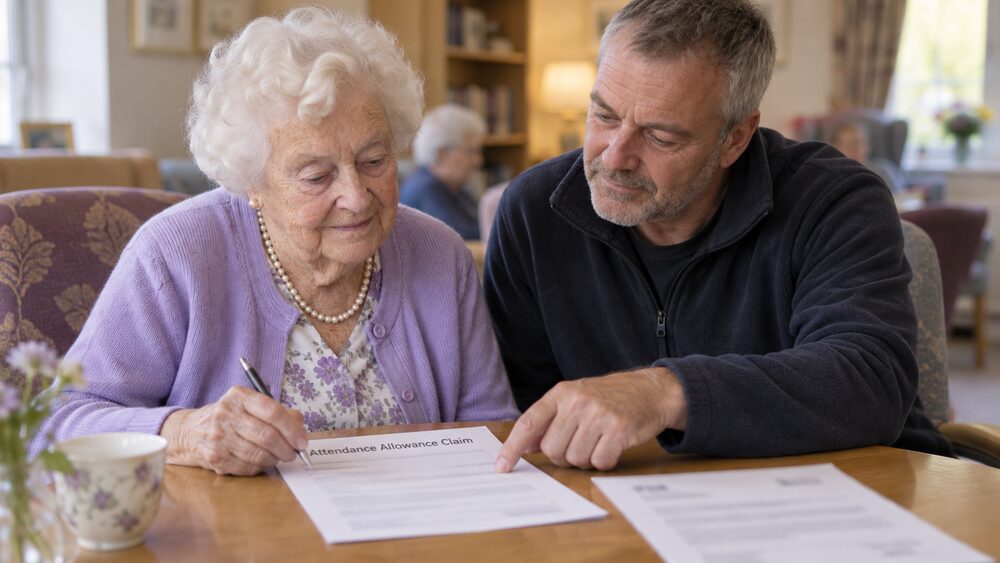
Attendance Allowance is a weekly benefit for people who have reached State Pension age and who need help looking after themselves, or supervision to keep them safe. It pays either £76.70 or £114.60 a week, depending on how much help you need1. You can claim it whatever your income and savings are, and the money is not taxable2.
It is one of the most widely claimed disability benefits for older people: the Department for Work and Pensions (DWP) was paying Attendance Allowance on around 1,803,000 claims as of March 2026, rounded to the nearest thousand3. In Northern Ireland, where the benefit is administered by the Department for Communities, there were 69,060 claimants in May 20264.
The benefit exists because care needs in later life are expensive, whether you pay for help privately or rely on family. It does not cover mobility needs, so it is not the same as the mobility part of Disability Living Allowance or Personal Independence Payment1. If you were already getting Disability Living Allowance before State Pension age, you continue on that benefit rather than moving to Attendance Allowance, which is for people of State Pension age or older who do not get DLA5.
What Attendance Allowance is for
Attendance Allowance is for people over State Pension age who need help at home. You can claim it regardless of your income and savings8. It is designed to help with the extra costs that come from needing personal support, whether that is help during the day, during the night, or both.
The benefit is sometimes described as help with "personal care", and that is the practical test: things like getting dressed, getting undressed, washing yourself or eating9. It also covers supervision, meaning someone watching over you to keep you safe, for example if you are at risk of falling or of becoming confused and doing something dangerous.
Two groups of people are sometimes put off claiming unnecessarily. The first is people who think they are "not disabled enough": eligibility is based on your care needs, not on having a particular medical condition10. The second is people who think someone must be paid to look after them: you do not need to be paying the person who looks after you, and you do not have to have someone caring for you at all in order to claim1.
Attendance Allowance sits alongside a family of disability benefits with different age ranges. Personal Independence Payment covers people below State Pension age, and Disability Living Allowance continues for those already on it, including some adults with existing claims5. The comparison between PIP and Attendance Allowance matters most around the transition at State Pension age, which is covered in PIP vs Attendance Allowance after State Pension age.
Who qualifies: care needs, not a diagnosis
Whether you qualify is not based on having a certain medical condition, but on your care needs10. Two people with the same diagnosis can get different answers, because the DWP looks at what you actually need day to day, not what the condition is called. This is why the claim form asks in detail about a typical day and night.
The core conditions are:
- You are State Pension age or older1.
- You have a physical or mental disability, illness or condition.
- You need help with personal care, such as washing, dressing, bathing or eating, or supervision to keep you safe9.
- You have needed that help, or are likely to need it, for at least six months (this qualifying period does not apply under the special rules for terminal illness, covered below)11.
You do not need to have someone caring for you in order to claim1. Many people manage alone, or rely on a spouse who does not think of themselves as a "carer", and still qualify. Nor do you need to be paying anyone: the equivalent rule is stated plainly for the related Constant Attendance Allowance, that you do not need to be paying the person who is looking after you12.
Most claims are decided on the information in the form, and there is no routine medical. You will not normally need to go to an assessment unless it is unclear how your illness or disability affects you13. That makes the form itself the most important part of the claim: it is worth describing the worst days, not the best ones, and every task that is slow, painful, unsafe or needs another pair of hands.
An easy read version of the official guidance is available for people who find plain English documents easier, covering what the benefit is, who can get it, what you will get and how to claim14.
Two weekly rates: £76.70 and £114.60
Attendance Allowance is paid at one of two weekly rates. For 2026/27 the lower rate is £76.70 a week and the higher rate is £114.60 a week2. These figures are set in the annual benefits uprating legislation and confirmed in the DWP's published rates for 2026/27, which also show the previous year's rates of £73.90 and £110.40 for comparison15.
| Rate | Weekly amount | What it is for |
|---|---|---|
| Lower | £76.70 | You need help or supervision either during the day or during the night16 |
| Higher | £114.60 | You need frequent help or supervision both during the day and at night, or you are terminally ill16 |
The distinction between day and night is what decides the rate for most people. The lower rate applies where your needs fall on one side of that line only: for example, you need help getting up, washed and dressed in the morning, but you manage at night. The higher rate applies where the needs run across both, such as help during the day and also help or supervision at night because you cannot get to the toilet safely alone or you need checking16.
Payments are usually made every four weeks17. Rates normally rise each April, and the page on how rates rise each April explains how uprating works.
Not means-tested, not taxed, and more help with other benefits
Attendance Allowance is not means-tested, so you can claim it whatever your income or savings6. It is also not taxable6. A pension, private income, savings or a continuing salary make no difference to the amount you receive.
The effect on other benefits is where an award often becomes worth more than its face value:
- Attendance Allowance does not count as income for means-tested benefits18.
- It will not reduce other benefits you receive, such as Pension Credit, Housing Benefit or Council Tax Reduction, and it may lead to higher rates of these6.
- The DWP states you could get extra Pension Credit, Housing Benefit or Council Tax Reduction if you get Attendance Allowance1.
The reason is the way means-tested benefits treat disability. Pension Credit, Housing Benefit and Council Tax Reduction include extra amounts, often called severe or enhanced disability additions, for people who receive a qualifying disability benefit. An Attendance Allowance award can switch those additions on, so a claim that succeeds can raise other payments as well. The pages on Pension Credit, help with rent and Council Tax Reduction cover each of these in detail, and passported help explains what else a qualifying award can unlock.
One caution on spending: the money is yours to spend as you like, but your local council or health and social care trust can take Attendance Allowance into account when working out how much you need to pay for care services they arrange19. So an award can increase the amount you are charged for council-arranged home care, even though it increases your income overall.
If you have a regular carer, they may be entitled to claim Carer's Allowance if you are awarded Attendance Allowance20. In Scotland the equivalent payment is Carer Support Payment21.
Claiming Attendance Allowance, and what happens next
In England, Wales and Northern Ireland you can apply online on GOV.UK, request a claim form over the phone, or download a claim form and send it by post15. The helpline number is 0800 731 0122, with a textphone service on 0800 731 03176. People who cannot hear or speak on the phone can use Relay UK by dialling 18001 before the main number19.
The start date of your claim depends on how you apply, and because a claim cannot normally be backdated, this matters15:
- If you phone to ask for a form, the date of your call is recorded. If your claim succeeds and you return the form within six weeks of the date stamped on it, payment runs from the date of the call6.
- If you download a form and post it, your claim starts from the date the Attendance Allowance Unit receives it6.
- A claim for Attendance Allowance cannot be backdated15.
After the form is received, you might have a face-to-face assessment, but only if it is unclear how your health condition or disability affects you; most claims are decided on the form information alone13. You will then get a letter about whether you will get Attendance Allowance, how much, and from what date10. An award can be made either indefinitely or for a fixed period6.
Someone else can be involved in the claim at every stage. A person given power of attorney can make a claim for you6, and a claim can be made on your behalf if you cannot manage your own affairs18. Someone else can complete the form if you can sign it; if you cannot sign, the person needs legal permission called power of attorney20. The page on appointees and third parties explains the formal arrangements for managing someone else's claim.
Special rules if you are terminally ill
There is a different, faster route if you are nearing the end of life1. If a medical professional has said you might have 12 months or less to live, you can claim under the "special rules"19. Under these rules you do not need to have had problems looking after yourself for six months, and you get the highest rate, paid weekly20.
The process needs one extra document. You complete the normal Attendance Allowance claim form and also ask a doctor or medical professional for form SR1, which confirms the diagnosis and must be included with the application19. Earlier guidance referred to a form called DS1500 for the same purpose20; the SR1 is the current form. Claims made under the special rules are handled more quickly than standard claims19.
Applications can also be made on behalf of someone with a terminal illness who is not expected to live longer than 12 months, and the special rules exist so that they can get Attendance Allowance more quickly, usually at the higher rate20. The page on special rules for terminal illness covers this route across benefits, including the equivalent fast-track process in Scotland.
In Scotland, Pension Age Disability Payment replaces Attendance Allowance
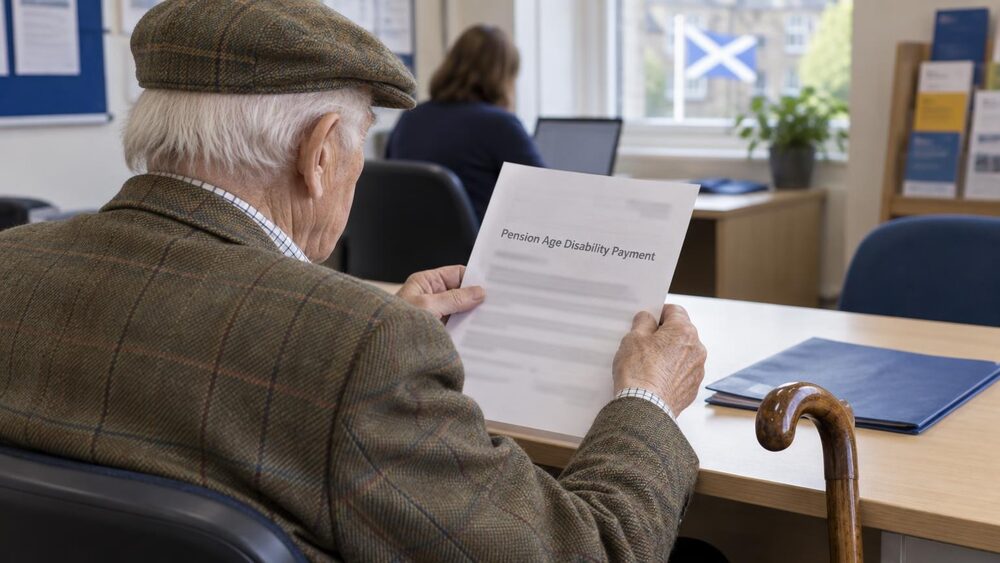
If you live in Scotland, you apply for Pension Age Disability Payment instead of Attendance Allowance1. The new benefit has fully replaced Attendance Allowance in Scotland and is delivered by Social Security Scotland13. People in Scotland over pension age have been able to apply for it rather than the DWP benefit since 22 April 202522.
Pension Age Disability Payment works on the same broad basis as the benefit it replaces:
- It is for people of State Pension age who are disabled or have a long-term health condition and need help looking after themselves or supervision to keep them safe, or who are terminally ill23.
- It is not means-tested: working or having savings does not matter23.
- It has two rates, £76.70 and £114.60 a week from 6 April 2026, set in Scottish legislation24. (Some mygov.scot pages still show the previous rates of £73.90 and £110.4025, so check the current figures when claiming.)
- It is paid every four weeks, for the previous four week period23.
- There is no mobility component23.
Applications can be made online at mygov.scot, in person, over the phone, or by paper form by post, with the freephone number 0800 182 222223. Social Security Scotland asks for one piece of supporting information from a professional where possible, but it does not have to be a diagnosis, and an application can be made without supporting information23. If your application is successful, payment is generally backdated to the date you started the application26.
Existing Attendance Allowance claimants do not need to do anything: awards are automatically transferred from the DWP to Social Security Scotland23. From 23 February 2026, anyone who moves to Scotland and was getting Attendance Allowance at the time of their move can apply for Pension Age Disability Payment21. The benefit is a new service with high demand, so some processes may take longer25. By 31 July 2026, 56,010 applications had been processed with a decision, of which 82% were authorised, 15% were denied and 3% were withdrawn27.
Hospital, care homes and going abroad: when payments stop
Attendance Allowance is tied to being at home and paying for your own care, so certain moves and absences change it. The rules are strict about time limits.
Going into hospital or a care home for less than four weeks should not affect the payment, and neither should going abroad for less than 13 weeks, or less than 26 weeks if the trip is to get medical treatment20. Beyond those limits the position changes:
- Hospital: the payment stops after four weeks as an inpatient.
- Care home with local authority funding: if you move into a care home and get any local authority funding, the allowance stops after 28 days20. In Northern Ireland, where a local health and social care trust is helping with care home fees, Attendance Allowance is paid for the first four weeks if you were already entitled to it before moving in28.
- Care home, fully self-funding: if you are completely self-funding, you can keep getting Attendance Allowance20. In Northern Ireland, if the local trust is not helping with fees, the payment usually continues28.
- NHS Continuing Healthcare: the allowance stops if you receive it, but it continues to be paid if you get NHS-funded Nursing Care and no other financial support from the state20.
The care home rules are the ones that catch people out, because the funding source decides the outcome rather than the care home itself. Someone paying all their own fees keeps the payment; someone receiving even partial council funding loses it after 28 days20. The page on payments when you live in a care home covers the wider picture, and what happens to payments in hospital or prison covers hospital stays across benefits.
You must tell the Attendance Allowance Unit about these changes. Call the helpline about changes such as going into hospital, moving to a care home or going abroad6, and the same helpline is the contact point for reporting a care home stay30.
Reporting changes, reviews and challenging a decision
You must report any changes of circumstance that might affect your entitlement, for example going into hospital or a care home, your condition getting worse or better, or moving house15. The DWP's guidance for benefit claimants is to report a change online or call the Attendance Allowance helpline31. Failing to report can mean being paid by mistake and having to pay the money back.
An award lasts either indefinitely or for a fixed period6. If it is for a fixed period, the DWP will look at it again towards the end. If your condition changes in the meantime, you can ask for the award to be looked at again, which can raise the rate as well as lower it.
If you disagree with a decision, you can challenge it. The first stage is mandatory reconsideration, where you ask the DWP, or in Northern Ireland the Department for Communities, to look at the decision again; you can appeal if you still disagree18. The pages on challenging a decision and appealing to a tribunal set out the process and the deadlines, and reporting a change of circumstances explains how to avoid problems when things change.
In Scotland the equivalent duties sit with Social Security Scotland. People getting Pension Age Disability Payment must tell Social Security Scotland about changes to the help and support they need during the day or night32. Day to day changes where overall needs stay the same do not need to be reported32. If something changes and you do not tell them, you may be paid by mistake and have to pay the money back, and you may be committing an offence under section 72 of the Social Security (Scotland) Act 201832. After a review, Social Security Scotland will tell you if your award will stop, reduce or increase, and why33. If your award changes or stops, this could affect other benefits, and your local council, HMRC and the DWP can be told about the change33.
Where to get free help
Attendance Allowance claims are decided on a long, detailed form, and free help is available at every stage. Independent Age, Age UK, Carers UK, Scope, Turn2us, Mencap and Macmillan all publish guidance on the benefit, and several offer telephone support with completing the form6. The DWP also publishes an easy read version of its guidance for people who find standard documents difficult14.
A benefits calculator is the quickest way to see whether an award would also raise Pension Credit, Housing Benefit or Council Tax Reduction in your circumstances: the page on checking what you are entitled to lists the free calculators and where to find an adviser. For the wider picture of benefits in later life, see benefits in the UK and the guide to increasing your retirement income alongside the DWP's own guidance on topping up your State Pension34.
Sources34 cited
- Attendance Allowance GOV.UK, 2026
- The Social Security (Up-rating) Order 2026 legislation.gov.uk, 2026
- Benefit and pension rates 2026/2027 Department for Work and Pensions, 2026
- Annual DWP benefits statistics compendium 2026 Department for Work and Pensions, 2026
- Benefits statistics summary May 2026 NISRA, 2026
- Attendance Allowance Independent Age, 2026
- Attendance Allowance Age UK, 2026
- Dementia and managing money nidirect, 2026
- Terminally ill benefits Scope, 2025
- Attendance Allowance Carers UK, 2026
- Disability Living Allowance (DLA) GOV.UK, 2026
- War Pension Scheme: Constant Attendance Allowance (CAA) GOV.UK, 2020
- Attendance Allowance Scope, 2026
- Easy read: Attendance Allowance GOV.UK, 2021
- How do I claim Attendance Allowance? Turn2us, 2025
- Attendance Allowance Which?, 2026
- How to have your benefits paid GOV.UK, 2026
- Attendance Allowance entitledto, 2026
- Attendance Allowance Mencap, 2026
- Attendance Allowance Macmillan Cancer Support, 2025
- Supporting clients moving to Scotland from the rest of the UK Social Security Scotland, 2026
- Public funds: which funds are accessible GOV.UK, 2025
- Pension Age Disability Payment factsheet, March 2026 Social Security Scotland, 2026
- The Pension Age Disability Payment (Modification) Regulations 2026 legislation.gov.uk, 2026
- Pension Age Disability Payment: the decision mygov.scot, 2026
- Pension Age Disability Payment questions mygov.scot, 2026
- Pension Age Disability Payment statistics to 31 July 2026 Social Security Scotland, 2026
- Residential care and nursing homes and benefits nidirect, 2026
- How much Attendance Allowance will I get? Turn2us, 2025-10-29
- Going into a care home: benefits GOV.UK, 2026
- Report a change in your circumstances GOV.UK, 2026
- Changes you need to report in a Pension Age Disability Payment review mygov.scot, 2026
- Pension Age Disability Payment reviews mygov.scot, 2026
- Increase your retirement income GOV.UK, 2026
 Turn2usFree benefits calculator and grants search from a charity
 Citizens AdviceFree advice on money, consumer and legal problems in England and Wales
 GOV.UKOfficial information on tax, benefits and government services
 MoneyHelperFree, impartial money and pensions guidance, set up by government