If you are living with a terminal illness, the Special Rules let you claim certain benefits without the usual forms, without a face-to-face assessment, and at the highest rate the benefit pays. Your claim is fast-tracked, so a decision comes sooner than it otherwise would1.
If you are living with a terminal illness, the Special Rules let you claim certain benefits without the usual forms, without a face-to-face assessment, and at the highest rate the benefit pays. Your claim is fast-tracked, so a decision comes sooner than it otherwise would1.
The rules work differently depending on where you live. In England, Wales and Northern Ireland, a healthcare professional has to confirm they think you may have less than 12 months to live. In Scotland there is no time limit at all: your illness must be expected to cause your death, but nobody has to say how long you have left3.
There are no benefits that exist only for people with a terminal illness. The Special Rules change how you claim an existing benefit, not what is available. You still have to qualify for the benefit itself, so the usual conditions on things like residence and capital apply5.
What the Special Rules do: faster claims at the highest rate
The Special Rules are a fast-track route into benefits for people who are terminally ill. Two things change. First, your claim is looked at more quickly, so you get a decision and a payment sooner. Second, you are paid at the highest rate the benefit offers, rather than the rate an assessment would otherwise have produced1.
The practical effect is that the parts of a normal claim that take the longest disappear. You will not have to fill in all the forms, and you will not have to go to a face-to-face assessment5. For Scottish benefits, Social Security Scotland aims to process cases identified as eligible under the Special Rules within 7 working days of receiving a completed application form and a BASRiS form12. Pension Age Disability Payment decisions are targeted within seven working days of receiving a completed application form and BASRiS form13.
The higher rate is automatic rather than something you argue for. For Adult Disability Payment, a person with a terminal illness is automatically entitled to the highest rate of the daily living and mobility part, regardless of how long they have had a terminal illness, and the award is a lifetime award reviewed only on a change of circumstances14. For Personal Independence Payment and Attendance Allowance claims under the Special Rules, the claim is dealt with quickly and paid at the highest rate15.
If you are caring for someone who is terminally ill, their claim can be fast-tracked and paid at a higher rate, and that in turn can open the door to Carer Support Payment16.
Who qualifies: the 12-month rule in England, Wales and Northern Ireland
Outside Scotland, the test is a time limit. The Special Rules apply to people who are likely to have less than 12 months to live3. Your healthcare professional needs to confirm that they think you might have less than 12 months to live7. The wording used across guidance is that you have a disease that gets worse over time and your healthcare professional thinks you might have less than 12 months to live17.
The qualifying period was not always 12 months. It changed from six months to 12 months from April 202318. That change matters if you have read older material, or if a form or a leaflet still refers to six months.
Two points are often misunderstood. The first is that the rule is about what a healthcare professional thinks, not about a diagnosis with a particular name. The second is that the Special Rules do not replace the benefit's own conditions. Even if you are applying under the Special Rules, you must still qualify for the benefit to make a claim5.
Scotland has a different definition, with no time limit
In Scotland the definition of terminal illness comes from the Social Security (Scotland) Act 2018, and it does not use a time limit. Your illness must be expected to cause your death, but a healthcare professional does not need to say how long they think you might live for4. Scotland does not use a fixed time limit8, and there is no set timeframe for how long you are expected to live to be classed as terminally ill15.
Social Security Scotland does not require a client's healthcare professional to determine life expectancy when supporting their application9. That removes the part of the process that people find hardest to ask for.
The Scottish definition applies to some benefits in Scotland, including Adult Disability Payment and Pension Age Disability Payment4. If you move to Scotland from elsewhere in the UK and you are terminally ill, there is no part 2 application: instead there is a dedicated Special Rules for Terminal Illness application process9. The legal basis for these payments sits in the Scotland Act 2016, as it amends the Scotland Act 1998, and the Social Security (Scotland) Act 201819.
Benefits you can claim under the Special Rules
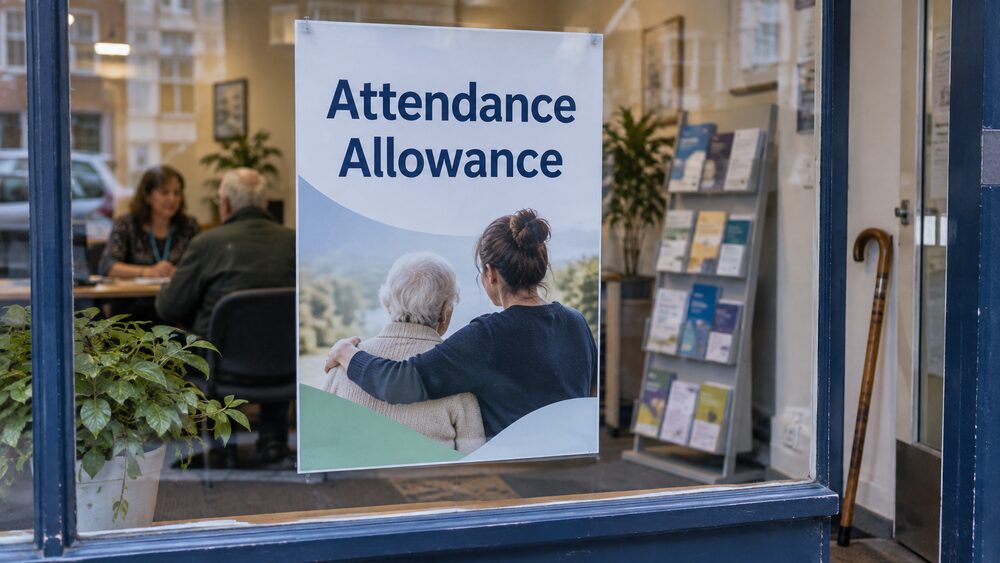
The Special Rules apply to Personal Independence Payment, Employment and Support Allowance, Universal Credit and Attendance Allowance7. Disability Living Allowance for a child can also be claimed under the Special Rules where the child has a terminal illness20. In Scotland, the equivalents are Adult Disability Payment, Child Disability Payment and Pension Age Disability Payment21.
Carer Support Payment can be paid under the Special Rules too. You can get it if either you already get a disability benefit under the Special Rules because of terminal illness, or the person you care for does2.
| Benefit | Where it applies | Medical form |
|---|---|---|
| Personal Independence Payment | England, Wales, Scotland, Northern Ireland | SR122 |
| Attendance Allowance | England, Wales, Scotland, Northern Ireland | DS150024 |
| Disability Living Allowance (child) | England, Wales, Northern Ireland | Special Rules claim20 |
| Adult Disability Payment | Scotland | BASRiS25 |
| Child Disability Payment | Scotland | BASRiS, or a DWP DS1500 or SR126 |
| Pension Age Disability Payment | Scotland | BASRiS27 |
Pension Age Disability Payment has its own quirk: the 6 months rule does not apply for people with a terminal illness claiming under special rules28. Terminal illness applications are fast-tracked, and confirmation of the terminal diagnosis from a doctor or nurse via the BASRiS form is all that is needed, with no other supporting information required27.
How to apply: the benefit claim plus an SR1 or BASRiS form
Applying under the Special Rules is two things at once. You need to apply for the benefit itself, and you need to ask a healthcare professional to complete a form to support your application under the Special Rules7. Your GP, doctor or specialist nurse completes a form saying you have a terminal illness3.
The form depends on where you live and what you are claiming. For Personal Independence Payment, an SR1 form completed by your doctor or another health professional is needed to claim under the special rules22. The SR1 is a new form, introduced in April 2024, that can be used when people with a terminal illness apply for specific benefits under the special rules10. For Scottish benefits, the form is the BASRiS form. If your child has a terminal illness, a BASRiS form goes with the application11.
Do not wait for the medical form before sending in the claim. Don't delay your claim if you're waiting for the BASRiS form: send in your claim form as soon as possible even if you are still waiting for the report to be sent5. For Child Disability Payment, if no BASRiS form was submitted initially, Social Security Scotland will confirm the individual is terminally ill over the phone with the practitioner and ask for a BASRiS form to be returned within 28 days26.
If your claim is not accepted under the Special Rules
If Social Security Scotland decides an application under the Special Rules is not proceeding, they will ask you whether you wish to proceed with a standard application for Adult Disability Payment, Child Disability Payment or Pension Age Disability Payment21. That is a genuine choice rather than an end to the claim, but a standard application follows the usual process, including the assessment the Special Rules would have avoided.
You can ask Social Security Scotland to reconsider their decision if you have been told you will not receive a disability benefit, if the amount is incorrect, or if the date you have been paid from is incorrect21. Social Security Scotland aims to make a decision as quickly as possible, in around 7 working days, if you have a terminal illness29. For benefits administered by Social Security Scotland, such as Carer Support Payment, Adult, Child or Pension Age Disability Payments, mandatory reconsideration is a slightly different process, set out on the Citizens Advice Scotland website30.
There is a separate route for overpayments. Additional evidence is not necessary where there is an award of benefit under the 'special rules' for terminal illness, though waivers will not be granted automatically and each case must be considered individually31.
"Additional evidence is not necessary where there is an award of benefit under the 'special rules' for terminal illness"
Awards under the Special Rules are lifetime awards in Scotland, and Social Security Scotland will not review them unless circumstances change9. Outside Scotland, benefits under special rules usually last for a period of 3 years3. Child Disability Payment awards can be backdated to the date of diagnosis of terminal illness, up to a maximum of 26 weeks before the date of application26.
A successful application under Special Rules for Terminal Illness will not affect any other benefits you may already be receiving2. If you need help understanding what you can claim, free and impartial guidance is available from MoneyHelper, and specialist charities including Marie Curie, Macmillan and Turn2us publish detailed guidance for people living with a terminal illness17.
Sources33 cited
- Disability Living Allowance Marie Curie, 2026-08-12
- Assistance under Special Rules for Terminal Illness mygov.scot, 2025-03-24
- Claiming benefits Macmillan Cancer Support, 2025-06-01
- What benefits can I claim Marie Curie, 2026-08-12
- Benefits if you are terminally ill Carers UK, 2026-09-26
- Terminally ill benefits Scope, 2025-10-27
- Universal Credit Marie Curie, 2026-08-12
- Money FAQs Macmillan Cancer Support, 2026-04
- Supporting clients moving to Scotland from the rest of the UK Social Security Scotland, 2026-01-27
- SR1 form Marie Curie, 2024-04-06
- Financial help for children with a disability or long-term illness One Parent Families Scotland, 2026-04-06
- Adult Disability Payment statistics to 31 July 2026 Social Security Scotland, 2026-09
- Pension Age Disability Payment and Scottish Adult Disability Living Allowance statistics to 31 July 2026 Social Security Scotland, 2026-09
- Adult Disability Payment factsheet Social Security Scotland, 2026
- Mesothelioma compensation Macmillan Cancer Support, 2026-09-26
- Carer's Credit Marie Curie, 2026-04-05
- Special rules Marie Curie, 2025-04-09
- Benefits if you are terminally ill Carers UK, 2026-09-26
- Terminal illness energy support options paper Consumer Scotland, 2026-03-15
- Disability Living Allowance Contact, 2026-08-20
- After you apply mygov.scot, 2025-03-24
- Claiming Personal Independence Payment Turn2us, 2026-08-14
- Start your Personal Independence Payment claim Turn2us, 2026-08-14
- Attendance Allowance Which?, 2026-04-06
- How to claim Adult Disability Payment Macmillan Cancer Support, 2025-06-01
- Child Disability Payment statistics to 30 June 2026 Social Security Scotland, 2026-08
- Pension Age Disability Payment factsheet Social Security Scotland, 2026-03
- Pension Age Disability Payment Macmillan Cancer Support, 2025-06-01
- Pension Age Disability Payment: decision mygov.scot, 2026-09-26
- Your guide to challenging a benefits decision Carers UK Scotland, 2026-09-26
- Overpayments in social security: the discretionary waiver Law Centre NI, 2023-02
- Overpayments in social security and the discretionary waiver Law Centre NI, 2019-10
- Disability benefits Turn2us, 2025-11-06






 Turn2usFree benefits calculator and grants search from a charity
 Citizens AdviceFree advice on money, consumer and legal problems in England and Wales
 GOV.UKOfficial information on tax, benefits and government services
 MoneyHelperFree, impartial money and pensions guidance, set up by government