
If you work for yourself, you pay tax on your profit, not on everything you take in. Your taxable profit is your self-employed income minus the expenses HMRC allows you to deduct, and that profit is then taxed as part of your overall income for the tax year, alongside anything else you earn, under the same income tax bands and personal allowance as everyone else. On top of Income Tax, most self-employed people also pay National Insurance on their profits.
The first piece of good news is the trading allowance: the first £1,000 of self-employed income each tax year is tax-free, and if your income is £1,000 or less you do not need to tell HMRC or file a tax return at all1. Above that, you register for Self Assessment, file a return each year, and pay what you owe by 31 January. Around 5.37 million individuals had at least one source of self-employment income in the 2022 to 2023 tax year, of whom 3.53 million were taxpayers2.
Who counts as self-employed for tax
HMRC's definition is broad. You count as self-employed if you are either a sole trader or an individual in a business partnership1. Being a sole trader means running your own business as an individual, and you can be one even before you have told HMRC anything: if you start working for yourself, even after State Pension age, you are classed as a sole trader from the moment you begin, and you must register and follow the rules for self-employed tax and National Insurance8.
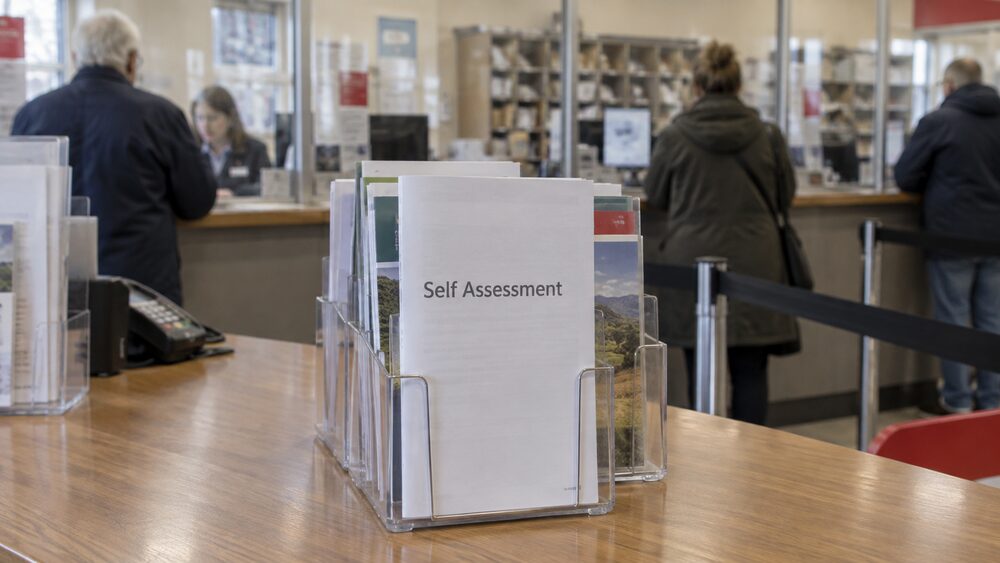
The distinction matters because it decides how your income is collected. Employees have tax taken from their pay through PAYE before they see it, while self-employed people work out their own profit, report it, and pay tax on it in arrears through Self Assessment. Self Assessment exists mainly for self-employed people and people who get money from things other than a job, such as investments or renting out property9.
The scale of the group is worth knowing. In the 2022 to 2023 tax year, the number of individuals with at least one self-employment income source fell by 1% to 5.37 million, and 3.53 million of those were taxpayers2. Many of the rest earned below the trading allowance or below the personal allowance, or offset their income with expenses.
If you are both employed and self-employed, the two are taxed separately but added together. Your employment is taxed through PAYE under your tax code, and your self-employed profit is reported on the Self Assessment return, where your total income from all sources determines which tax bands apply and whether any of your personal allowance is used up.
Trading allowance: the first £1,000 is tax-free
The trading allowance exempts £1,000 of gross self-employed income each tax year from both Income Tax and National Insurance10. It applies to individuals, not to people trading in a partnership10. The exemption is automatic: if your self-employed income is £1,000 or less, you do not need to tell HMRC or file a tax return10.
The allowance sits alongside the other tax-free slices of income HMRC lists, which include the first £1,000 of income from property you rent out (unless you use the Rent a Room Scheme), income from tax-exempt accounts like ISAs and National Savings Certificates, dividends within your dividend allowance, premium bond and National Lottery wins, and rent from a lodger below the Rent a Room Scheme limit3. The trading allowance and the property allowance are separate: each covers its own type of income.
The trading allowance and the personal allowance do different jobs and can both apply. The trading allowance removes the first £1,000 of gross trading income from tax altogether; the personal allowance, £12,570 in 2026/273, is the amount everybody can earn before they start paying Income Tax on their remaining income11. Both allowances can apply to the same trading income: the trading allowance exempts the first £1,000 of gross income, and Income Tax is then charged only on income above the personal allowance.
One point on how the personal allowance is applied in future: the income tax ordering rules change from April 2027, so that the personal allowance will be deducted against employment, trading or pension income first, before savings and dividend income12. That changes the order in which allowances soak up income, not the size of the allowances themselves.
Trading allowance or expenses: one or the other, not both
Once your income goes above £1,000, you face a choice. You can claim the higher of the trading allowance of £1,000 or your actual business expenses, but you cannot claim both10. If your expenses are less than £1,000, the allowance is worth more; if they are more, deducting the expenses gives a lower taxable profit.
The choice is made each year on your Self Assessment return. A worked example from TaxAid shows the difference: with income of £6,000 and expenses of £500, claiming expenses gives taxable profits of £5,50010. Claiming the trading allowance instead would give taxable profits of £5,000 (£6,000 minus £1,000), so in that case the allowance is the better figure. The full comparison of the two routes is set out in the £1,000 trading allowance or claiming expenses.
What counts as an allowable expense is a principle rather than a fixed list: you can deduct some of your costs to work out your taxable profit as long as they are allowable expenses13. The core rule is that costs must be for business purposes. Where an item is used for both business and personal reasons, only the business proportion can be claimed1. So a mobile phone used half for work and half for family calls has half its cost claimed, and a room used as an office for part of the week has a proportionate share of household costs claimed.
Two further rules follow from choosing the allowance. You cannot claim expenses if you use the £1,000 tax-free trading allowance, and you cannot claim capital allowances either1. Capital allowances are the relief for the cost of equipment and similar longer-life assets, so a business buying significant kit will usually find actual expenses and capital allowances worth more than the flat £1,000.
The allowance also affects losses. If your income is below the £1,000 threshold you do not need to report it, but claiming a loss requires completing a tax return, which means giving up the automatic treatment and deducting real expenses. TaxAid's example: trading income of £700 with business expenses of £900 gives a loss of £200, but only if you file a return10. HMRC's helpsheet HS227 covers claiming relief for trading losses13.
When you must register with HMRC and file a Self Assessment return
Registration is triggered by needing to file, and the deadline is fixed. People new to Self Assessment need to notify HMRC by 5 October following the end of the tax year in which they first had income that requires a return4. For the 2025 to 2026 tax year, first-time filers must register by 5 October 2026, and the deadline for submitting the return and paying any tax owed is 31 January 20274. HMRC launched an improved Self Assessment registration service in 2026 to make this step simpler4.
The trigger for most people is the trading allowance being exceeded. Anyone earning more than £1,000 from a side hustle may need to register for Self Assessment and declare their income to HMRC14. Below £1,000, no declaration is needed14. If you start earning untaxed income part-way through a year, you must let HMRC know by the 5 October after that tax year ends7.
Other situations pull people into Self Assessment too. You may need to register if you start working for yourself or have other income or gains from the UK or abroad; an employee with no other untaxed income does not need to15. Self-employed students must fill in a Self Assessment return each tax year, declaring income and expenses11. Self-employed mothers claiming Maternity Allowance must be registered for Self Assessment with HMRC, and not registering, or registering late, may lose some or all of the entitlement16.
If you pay voluntary Class 2 National Insurance rather than paying it through Self Assessment, you need to register with HMRC separately for that17. And when your circumstances change the other way, so you no longer need to complete a return, HMRC's guidance is that those who no longer need to complete a tax return should notify HMRC as soon as possible4. The process of registering, and what happens if you miss the date, is covered in when and how to register for Self Assessment.
National Insurance: Class 2 and Class 4 contributions
Self-employed people pay two classes of National Insurance, and they work quite differently. Class 2 contributions have to be paid for each week in which you are both self-employed and have relevant profits at or above the small profits threshold18. Class 4 contributions are for self-employed people whose net profits are over a certain amount18. The two classes, and how they compare with what employees pay, are set out in National Insurance: self-employed and employees compared.
Class 4 is the bigger charge for most people. The main Class 4 percentage paid by the self-employed was reduced to 6% with effect from 6 April 20246, a fall from the previous 9% rate between the Lower Profits Limit and the Upper Profits Limit in the 2024/25 tax year19. The rate above the Upper Profits Limit remained at 2% for 2024/2519. So a profitable sole trader pays 6% on the main band of profits and 2% above the upper limit, on top of Income Tax.
Class 2 matters less as a charge and more as an entitlement. Class 2 contributions entitle a self-employed person to the basic State Pension, but not the additional State Pension20. Since 2024, self-employed earners with profits above the small profits threshold are treated as having paid Class 2 NICs, which preserves that State Pension entitlement, provided the residence and presence conditions that previously had to be met to be liable are still met21. The detail is in Class 2 National Insurance: has it been abolished?.
Voluntary contributions fill the gaps. You can pay Class 2 or Class 3 voluntary contributions if you are self-employed and either have a gross income of £1,000 or less, or a gross income over £1,000 but profits of less than £7,10522. Voluntary Class 2 or Class 3 contributions are also possible for people self-employed in specific jobs, including examiners, moderators, invigilators or exam question setters, landlords eligible to pay Class 2, ministers of religion without a salary or stipend, and people making investments not as a business and without a fee or commission22. Whether paying voluntary contributions is worthwhile depends on your record and how close you are to a full State Pension, which is covered in National Insurance credits: who gets them and how to apply.
One consequence of the Class 2 system shows up if work dries up. You will not be eligible for New Style Jobseeker's Allowance if you were self-employed and only paid Class 2 National Insurance contributions, unless you worked as a share fisherman or volunteer development worker23.
Paying your tax: the January deadline and payments on account
The rhythm of self-employed tax is a year in arrears plus two payments in advance. You need to pay your Self Assessment tax bill by midnight on 31 January following the tax year you are paying for5. So tax on your profits for the 2025 to 2026 tax year is due by 31 January 2027, the same date the return itself is due4.
After your first full year, payments on account begin. You are also required to pay tax for the current year in two instalments, the first on 31 January and the second on 31 July7. Each instalment is normally half of your previous year's tax bill, so in a typical January you pay the balance owed for the year just finished plus the first payment on account for the year underway, and in July a second payment on account. The mechanics, including what happens when your income falls, are covered in payments on account.
How one year's profit turns into three payments across two calendar years.
Not everyone gets a bill through Self Assessment. HMRC has urged customers not to ignore Simple Assessment letters, where HMRC works out the tax owed itself and sends a letter instead of asking for a return; people should check the figures against their own records and pay any tax owed by 31 January 2027, unless a different date is shown25. When Simple Assessment applies, and its limits, are covered in Simple Assessment: when HMRC works out your bill for you.
A change is coming to how the bill itself is collected. Under the timely payments reform, Self Assessment taxpayers with PAYE income, such as from employment or a pension, will need to pay towards their Self Assessment tax bill through their PAYE income, where they have enough income to do so, from April 202926. For now, the January and July deadlines stand.
If you cannot pay, the worst response is silence. Business Debtline's guidance on income tax debt sets out the options for arranging time to pay with HMRC, and free debt advice is available from charities such as Business Debtline27. Missing the deadlines brings penalties and interest, covered in late filing penalties for Self Assessment.
Making Tax Digital: quarterly reporting for self-employed income
Self Assessment is moving from one annual return to a system of electronic records and quarterly updates. Under Making Tax Digital for Income Tax, you must keep electronic records and send summaries of your income and spending to HMRC every three months, within a month of the quarterly period end7. The quarterly deadlines are 7 August for quarter 1 (6 April to 5 July), 7 November for quarter 2, 7 February for quarter 3, and 7 May for quarter 47. Business Debtline lists the same pattern: period 1 runs 6 April to 5 July, or 1 April to 30 June using calendar periods, with the update due the following 7 August, and period 4 runs to 5 April or 31 March, with the update due the following 7 May27.
Who must join depends on income, and the thresholds are being lowered in stages:
The income thresholds at which quarterly reporting becomes compulsory, by start date.
Making Tax Digital for Income Tax became mandatory from April 2026 for sole traders and landlords with qualifying income over £50,00028. It will extend to those earning more than £30,000 from April 2027, and to those earning more than £20,000 from April 202828. So if your self-employed income is above £30,000, your start date is April 202727. The first quarterly update deadline for those who joined at the start has already been the subject of HMRC reminders28.
Qualifying income means your income from self-employment or property, so someone with modest trading profits but significant rental income can still be pulled in, and the two sources count together. The detail of who counts, and who is exempt, is in Making Tax Digital for Income Tax: who must join and when and the digital exclusion exemption. Penalties for missed quarterly updates work on a points system, covered in Making Tax Digital penalty points.
Keeping records for at least five years
You need to keep records if you have to send HMRC a Self Assessment tax return29. The records that matter for a self-employed person are the ones that prove both sides of the profit calculation: invoices and receipts for income, and invoices, receipts and bank statements for expenses.
The retention rule is fixed. You must keep your accounts and records for at least five years from the 31 January following the relevant tax year7. In practice that means records for the 2025/26 tax year, whose return and payment deadline is 31 January 2027, must be kept until at least 31 January 2032. HMRC can open an enquiry into a return, and without the underlying records a claim for expenses is hard to defend.
Under Making Tax Digital the records must be kept electronically, in compatible software, rather than in a shoebox of paper receipts7. That applies from the date you are required to join, so for those over the £50,000 threshold it already applies, and for those over £30,000 it applies from April 202727.
Where self-employment leaves gaps: sick pay, parental pay and pensions
The tax rules treat self-employed people much like employees; the benefits system does not. Eligible employees are automatically enrolled into a pension scheme by their employer, and self-employed people are not30. There is no employer making statutory sick pay or statutory parental payments, and statutory paternity pay depends on there being an employer who cannot pay it for any week you are at work31. Industrial Injuries Disablement Benefits are paid to employees liable to pay Income Tax under PAYE on wages, salaries or fees, and are not payable where the accident or disease was contracted during self-employment18.
Some support does survive the self-employment status. Maternity Allowance is the self-employed equivalent of statutory maternity pay, and claiming it as a self-employed person requires being registered for Self Assessment, with late registration risking loss of entitlement16. Carer's Allowance remains open to self-employed claimants, with earnings offset by work-related expenses, payments for alternative care when at work, and 50% of pension contributions32. MoneyHelper sets out the benefits available to carers, free and impartial32.
Pensions are the biggest gap to fill by yourself. Class 2 contributions entitle you to the basic State Pension, but not the additional State Pension20. Beyond that, a stakeholder pension may suit people who are self-employed and do not have a workplace pension, as well as those not working but able to afford to pay, those saving on top of a workplace pension, and those whose employer offers one as a workplace pension33. Contributions to a pension may attract tax relief from the government34. One asymmetry to note: employers do not pay NICs on pension contributions, but employees and self-employed people do30.
Changes ahead
Two dated changes will affect how self-employed tax is worked out and paid. From April 2027, the income tax ordering rules change so that the personal allowance will be deducted against employment, trading or pension income first, before savings and dividend income12. From April 2029, Self Assessment taxpayers with PAYE income, such as from employment or a pension, will need to pay towards their Self Assessment tax bill through their PAYE income, where they have enough income to do so26.
The Making Tax Digital thresholds continue to fall, reaching those with qualifying income over £20,000 from April 202828. And the quarterly reporting regime brings with it changes to long-standing special rules: childminders who must use Making Tax Digital can no longer use the special tax rules for working out self-employed expenses, including the 10% wear and tear allowance and fixed percentage household costs, from April 2027.
Sources34 cited
- Expenses if you're self-employed GOV.UK, 2026-09-26
- Personal incomes statistics 2022 to 2023 commentary GOV.UK, 2022
- Income Tax GOV.UK, 2026
- Improved Self Assessment registration service launched GOV.UK, 2026-09-09
- Understand your Self Assessment bill GOV.UK, 2026-09-26
- National Insurance Contributions (Reduction in Rates) Act 2024 legislation.gov.uk, 2024
- Self Assessment tax return guide Which?, 2026-04-06
- Tax and allowances in retirement nidirect, 2026-03-30
- Tax on your first job HMRC Tax Confident campaign, 2026-08-05
- Trading allowance TaxAid, 2025-01-24
- Working while you study: paying tax nidirect, 2025-09-10
- Changes to tax rates for property, savings and dividend income GOV.UK, 2025-11-26
- Help with self-employment on your Self Assessment tax return GOV.UK, 2025-05-28
- Say I do to getting your side hustle tax right GOV.UK, 2026-07-21
- Tax returns UK GOV.UK, 2026-09-27
- Maternity Allowance MA1 claim form notes nidirect, 2026-01
- Pay Class 2 National Insurance GOV.UK, 2026-09-26
- Guidance on Social Security abroad NI38 GOV.UK, 2026-07-07
- Family Resources Survey quality and methodology report 2024/25 NISRA, 2024
- Introduction to workplace, personal and stakeholder pensions nidirect, 2026-09-25
- The Social Security (Class 2 National Insurance Contributions) Regulations 2024 legislation.gov.uk, 2024
- Voluntary National Insurance contributions: who can pay GOV.UK, 2026-09-28
- New Style Jobseeker's Allowance nidirect, 2026-09-10
- Self-assessment tax Which?, 2026-04-06
- HMRC urges customers not to ignore Simple Assessment letters GOV.UK, 2026-07-28
- Timely payments in Income Tax Self Assessment factsheet GOV.UK, 2026-06-23
- Income tax debt guide Business Debtline, 2026-09-26
- Deadline approaches for first Making Tax Digital quarterly update GOV.UK, 2026-07-23
- Keeping your pay and tax records GOV.UK, 2026-09-26
- Employer National Insurance contributions and pensions research briefing House of Commons Library, 2026-07-08
- Statutory Paternity Pay nidirect, 2026-04-06
- Benefits and tax credits you can claim as a carer MoneyHelper, 2026-09-25
- Stakeholder pensions nidirect, 2025-09-11
- Workplace pensions GOV.UK, 2026-09-26




 GOV.UKOfficial information on tax, benefits and government services
 MoneyHelperFree, impartial money and pensions guidance, set up by government
 Citizens AdviceFree advice on money, consumer and legal problems in England and Wales
 Turn2usFree benefits calculator and grants search from a charity
 Citizens Advice ScotlandFree advice across Scotland