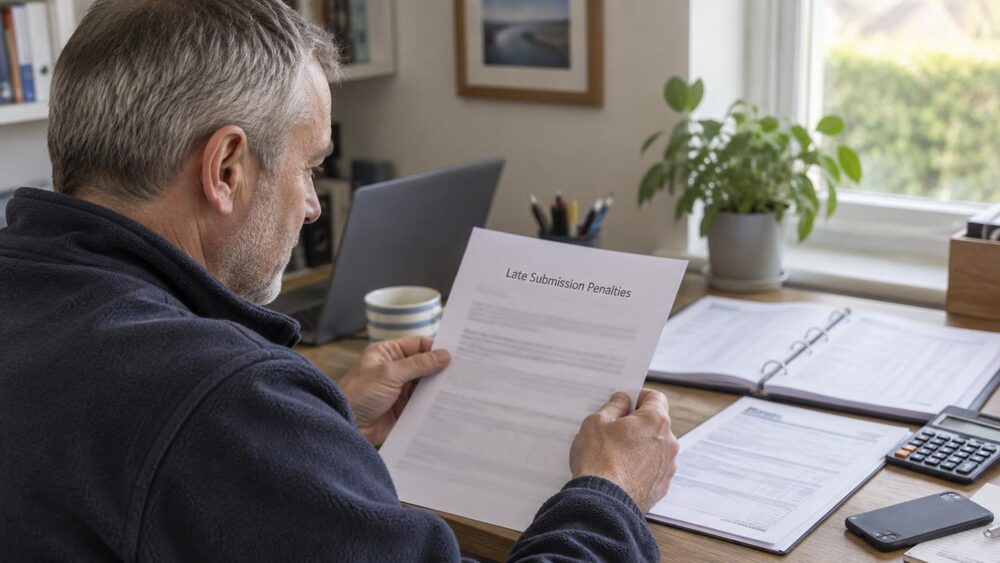
Miss the deadline for your Self Assessment tax return and HMRC charges an automatic £100 penalty from the very first day it is late. The charge applies even if you owe no income tax at all: it is a penalty for filing late, not for owing money1. If the return stays outstanding, further penalties build up, and if you also pay your bill late, a separate set of charges and interest is added on top2.
Miss the deadline for your Self Assessment tax return and HMRC charges an automatic £100 penalty from the very first day it is late. The charge applies even if you owe no income tax at all: it is a penalty for filing late, not for owing money1. If the return stays outstanding, further penalties build up, and if you also pay your bill late, a separate set of charges and interest is added on top2.
The main deadlines are 31 October for paper returns and 31 January following the end of the tax year for online returns3. You can appeal a penalty if you have a reasonable excuse, and you can ask HMRC to stop sending returns altogether if you no longer need to file one5.
The £100 penalty applies even if you owe no tax
The single most misunderstood rule is that the initial £100 penalty has nothing to do with how much tax you owe. It is charged the moment your return is one day late, whether your bill is £10,000, nothing at all, or even a refund1. HMRC's position is that the penalty is for missing the deadline to submit the return, not for the tax itself5.
This catches out two groups in particular. The first is people who owe nothing and assume there is no point filing, perhaps because their income fell or their expenses cancelled out their profit. The second is people who were sent a return by HMRC but never actually needed to be in Self Assessment. In both cases the £100 charge lands anyway, and it grows the longer the return stays outstanding1.
The charge is automatic. HMRC does not need to warn you first, and it does not check whether you owe tax before issuing it. If you have a reasonable excuse, such as serious illness or the death of a close relative shortly before the deadline, you can appeal, but the default is that the penalty stands5.
How late filing penalties build up: £100, then £10 a day up to £900, then £300 or 5%
The penalties escalate in stages the longer the return goes unfiled.
| How late | Penalty |
|---|---|
| 1 day | £100, even if no tax is owed1 |
| 3 months | £10 for each further day, up to £9001 |
| 6 months | Further penalties are triggered10 |
| 12 months | £300 or 5% of the tax due, whichever is higher1 |
After three months, the daily charge of £10 runs for up to 90 days, adding up to £900 on top of the initial £100, so a return that is six months late can cost £1,000 in filing penalties alone11. At 12 months, a further penalty of £300 or 5% of the tax due applies, whichever is higher, and in some serious cases HMRC can charge 100% of the tax due instead1.
The sources differ on the six-month point. One sets out the £300 or 5% penalty only at 12 months1, while another reports additional penalties of £300 or 5% of the tax owed at both six and 12 months13. Treat the six-month figure as reported rather than settled, but expect the total to keep rising the longer you leave it.
Filing deadlines: online, paper and through your wages
For most people the relevant deadline is 31 January following the end of the tax year, which is the date for online returns4. If you file on paper, the deadline is earlier, 31 October3. Missing either date triggers the £100 penalty, so the filing method you choose determines how long you have.
If the deadline falls on a weekend or bank holiday, your payment must reach HMRC by the last working day before it, unless you pay by Faster Payments5. Once you have filed, you can correct mistakes online within 12 months of the Self Assessment deadline without penalty14.
Some people have tax collected through their wages instead of paying it directly, but this does not remove the filing deadline itself. Employees with certain income, such as share incentives, may need to register for Self Assessment by 5 October following the tax year in which they received the income if they do not usually send a return15.
Late payment penalties and interest on top
Filing late and paying late are treated separately. If you send your return on time but pay your bill late, you face the late payment charges alone; if you do both late, the two sets of penalties stack7.
Late payment penalties are charged as 5% of the unpaid tax at 30 days, six months and 12 months after the due date, and these charges are separate from, and in addition to, any charges for filing your return late7. Interest is also charged on the amount owed from the day after the payment deadline5.
| Payment late by | Penalty |
|---|---|
| 30 days | 5% of the income tax you owe at that time1 |
| 6 months | 5% of the income tax you owe at that time, including penalties above1 |
| 12 months | 5% of the income tax you owe at that time, including penalties above1 |
One date catches people out: the 31 July payment on account deadline. There is no £100 fine for being late in July, but interest is charged on the amount owed from that date19. Interest also runs on penalties themselves: if you pay a penalty late, interest is chargeable and a further penalty may become payable5.
If you cannot pay, HMRC offers an online payment plan for Self Assessment bills, and you may be able to set one up within 60 days of the payment deadline1. Free, independent help with tax debt is available from charities such as TaxAid and Business Debt Line20.
When Self Assessment no longer applies: cancelling the return and its penalties
If HMRC sends you a return but you no longer meet the criteria to file one, the answer is to tell HMRC, not to ignore the paperwork. If you do not notify HMRC, it will likely continue sending Self Assessment returns, and ignoring them could lead to late filing fees and penalties21.
The process is straightforward: contact HMRC, explain why you no longer need to file, and ask to be removed from Self Assessment. HMRC reviews your circumstances and, if it agrees, stops issuing notices to file. Until that happens, the legal duty to file each return you are sent continues, and so does the penalty risk.
Bear in mind that penalties can also arise from the quality of what you send, not just its timing. HMRC can charge a penalty if your records are not accurate, complete and readable, and you may have to pay interest and penalties if your figures turn out to be wrong and you have not paid enough tax22. If HMRC opens an enquiry and asks for information, missing the deadline to send it can itself lead to a penalty23.
Stopping self-employment or leaving the UK: your final return
Stopping self-employment does not end your Self Assessment obligations immediately. You need to complete a final Self Assessment return covering your last period of trading, done at the end of the tax year in which you stopped21. That final return is filed and any remaining tax paid by 31 January following the tax year, as usual24.
Only after the final return is done should you ask HMRC to take you out of Self Assessment. If you skip this step, returns keep arriving and the penalties keep accruing. People working past State Pension age should note that they still need to complete a Self Assessment return for every year that they work.
If you leave the UK, your tax position depends on your residence status, and you may still owe UK tax on income from the UK. The filing deadline of 31 January still applies to returns for the years you were in Self Assessment3. If you receive a letter from HMRC you are unsure about, you can check whether it is genuine before responding, as scam messages often mimic penalty notices.
Sources24 cited
- Income tax debt (England and Wales) Business Debt Line, 2026
- Income tax debt (Scotland) Business Debt Line, 2026
- Tax on UK income if you live abroad GOV.UK, 2026
- Online tax returns Which?, 2026
- Pay a Self Assessment penalty GOV.UK, 2026
- Self Assessment tax return Which?, 2026
- Timely payments in Income Tax Self Assessment factsheet GOV.UK, 2026
- Self-employed tax return Which?, 2026
- Do you owe tax on income from Vinted or eBay? Which?, 2025
- 10 tax return mistakes to avoid this January Which?, 2026
- Late tax returns and penalties for mistakes Which?, 2026
- HMRC improves Self Assessment registration Which?, 2026
- 5 questions for pension savers filing their 2024-25 tax return Which?, 2026
- Share Incentive Plans: a guide for employees GOV.UK, 2025
- Making Tax Digital for Income Tax Which?, 2026
- Deadline approaches for first Making Tax Digital quarterly update GOV.UK, 2026
- Payment on account deadline Which?, 2025
- Self-employed tax deadline: how to avoid an interest charge Which?, 2024
- Problems paying tax debt TaxAid, 2026
- Previously self-employed TaxAid, 2025
- Keeping your pay and tax records GOV.UK, 2026
- Tax enquiries TaxAid, 2025
- Working later in life Independent Age, 2026
- Check if a letter you have received from HMRC is genuine GOV.UK, 2021






 GOV.UKOfficial information on tax, benefits and government services
 MoneyHelperFree, impartial money and pensions guidance, set up by government
 Citizens AdviceFree advice on money, consumer and legal problems in England and Wales
 Turn2usFree benefits calculator and grants search from a charity
 Citizens Advice ScotlandFree advice across Scotland