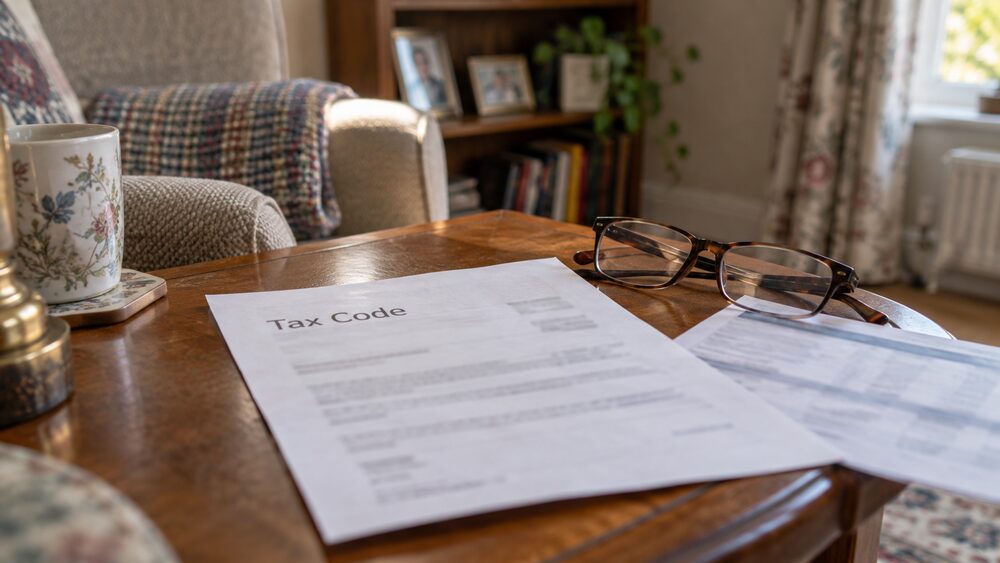
A tax code is a short mix of letters and numbers that your employer or pension provider uses to work out how much Income Tax to take from your pay. It tells them how much you can earn tax-free, and how much to take from the wages or pension above that1. It appears on every payslip, alongside your gross pay, the Income Tax and National Insurance taken off, your net pay and any workplace pension payments2.
The code is worked out by HMRC, not by your employer. When something changes in your life, HMRC recalculates the code, tells your employer, and the PAYE system adjusts the tax taken from your pay. In most cases there is nothing for you to do3. When HMRC changes your code it normally writes to you with a P2 Tax Coding Notice, which is simply the document that lets you know what your tax code is and how it was worked out4.
A tax code in one sentence, and the documents that explain it
In one sentence: a tax code is the instruction HMRC sends to whoever pays you, telling them how much tax-free pay to give you before taxing the rest. Everything else about codes, the letters, the numbers, the notices and the corrections, follows from that single idea.
Three documents carry the information a person actually receives. The first is the payslip itself, which shows the code in use, the gross pay before any tax, the Income Tax and National Insurance taken off, the net pay, and any workplace pension payments2. The second is the P2 Tax Coding Notice, which HMRC sends when it sets or changes a code. HMRC describes it plainly:
"A P2 Tax Coding Notice is simply the document that lets you know what your tax code is and how we worked it out."
The third is the P800 tax calculation, which arrives after the tax year ends if too much or too little tax was paid. If a P800 shows tax is owed, HMRC usually changes the following year's code so the money can be collected that way4. A separate document, the tax calculation sent to Self Assessment taxpayers, is a summary of the tax owed for the tax year6, and is covered in more detail on Self Assessment: who must file a return and the deadlines.
The letters and numbers each do a different job. The numbers are tied to the value of your tax-free allowances after deductions are taken off, and the letters describe your situation: which allowances apply, whether anything extra is being collected, or whether the code is only temporary. The common letters are explained on HMRC's own introduction to tax codes4, and the dedicated pages on this site go further: emergency tax codes, BR and 0T tax codes and two jobs and two tax codes.
The figures behind a tax code
The most important figure behind any code is the tax-free Personal Allowance, the amount of income a person can receive before Income Tax is charged. The amount of tax paid can also be reduced by tax reliefs if a person qualifies for them7. Income Tax itself is charged in bands: it is charged at the higher rate on income above the basic rate limit and up to the higher rate limit, and at the additional rate on income above the higher rate limit8. How those bands and rates work together is covered on Income tax: bands, rates and how your bill is worked out.
The letter L in a code shows entitlement to the standard Personal Allowance4. This is why many employees see a code ending in L, and why a code of this kind is the one most people with a single job and no special deductions recognise: its number reflects the standard Personal Allowance set by the government. Because the number in the code is tied to that allowance, it changes only when the allowance itself changes, not when a person's pay does.
Other letters carry very different meanings, and each one changes what is taken from your pay:
| Letter or suffix | What it means | What it does to your pay |
|---|---|---|
| L | Entitlement to the standard tax-free Personal Allowance4 | Tax-free pay up to the allowance, then tax on the rest |
| K | Income or deductions higher than your tax-free Personal Allowance, not already being taxed9 | Adds tax on the extra income to what is taken from your pay |
| BR | All wages from that job taxed at the basic rate of Income Tax, which is 20%3 | No tax-free pay at all from that job |
| W1, M1 or X | An emergency tax code3 | Tax worked out for that pay period only, ignoring the whole year |
The K code deserves its own explanation because it works in the opposite direction to most. Tax codes with a K mean you have income or deductions which are higher than your tax-free Personal Allowance and are not already being taxed9. HMRC lists the situations that cause it: paying tax you owe from a previous year through your wages or pension, getting the State Pension or taxable state benefits, getting company benefits you need to pay tax on such as a company car, or getting more interest on your savings than your Personal Savings Allowance9. Your employer or pension provider uses the K code so that you pay tax on that other income at the employment or pension the code is used on9. Company benefits and how they are taxed are covered on Benefits in kind: how perks from your employer are taxed.
The BR code most often appears on a second job. If you have more than one job you will have a tax code for each employment10, and because the Personal Allowance normally sits in the code for the first job, the second job's wages can be taxed entirely at the basic rate. The difference between BR and 0T codes, and what each does to your pay, is set out on BR and 0T tax codes: what the difference means for your pay.
One more figure frames everything: the tax year itself. In legislation it is defined as a period beginning with 6 April in one year and ending with 5 April in the next5. Codes run across that year, and the P800 reconciliation that follows it is what catches overpayments and underpayments.
What pushes a tax code up or down
A code changes when the facts it is built on change. HMRC lists the everyday events that do it: starting a new job, getting a pay rise or a company car, extra income from workplace or private pensions, interest on savings, or changes to work benefits like company healthcare3. Each of these either adds income that needs taxing, adds a deduction that reduces what is taxed, or changes the allowances the code can use.
The clearest way to see it is as a running balance. Allowances push the code up, because they increase the amount you can earn tax-free. Deductions push it down, because they use up part of that allowance. When deductions exceed the allowance altogether, the code flips into a K code and tax is added instead9.
From a change in your life to the tax taken from your pay, and the reconciliation at the end of the year.
Savings interest is one of the commonest pushes, and it works through the code directly. For people who are employed or get a pension, HMRC will usually collect the tax on savings interest through the tax code12. The code is also used to collect any tax owed from the previous tax year12. How savings interest fits into income tax overall, including the order in which it is taxed, is covered on How savings interest fits into your income tax and In what order savings and dividend income are taxed.
Emergency codes are the other big movement, and they go in whichever direction the missing information points. A W1, M1 or X suffix means you are on an emergency tax code3, and these usually appear when you start a new job, when HMRC is waiting for leaving details from your old employer, or when you have not filled in the new starter checklist3. An emergency code is only temporary and switches to the right code as soon as HMRC has all the right tax information for you1. If too much tax was taken while it was in use, the overpayment is refunded, usually via the next payslip or a refund from HMRC1. The full story is on Emergency tax codes: why you have one and how to fix it.
What are the rules on changing and collecting through a tax code?
The first rule is the reassuring one: in most cases, if your tax code changes, there is nothing for you to do. Your employer tells HMRC about changes in your pay and circumstances, and the PAYE system works out the new tax automatically3. The code is a mechanism for spreading tax across the year, not a bill you have to settle yourself.
The second rule concerns how much can be collected through it. HMRC can start to collect through your tax code in the current tax year, and the amounts collected are spread equally across the available months in any given tax year13. This is why a small underpayment from one year shows up as a modest extra deduction in the next, rather than a single demand. When a P800 shows you owe tax, HMRC will usually change your tax code for the following year so it can collect the money that way4.
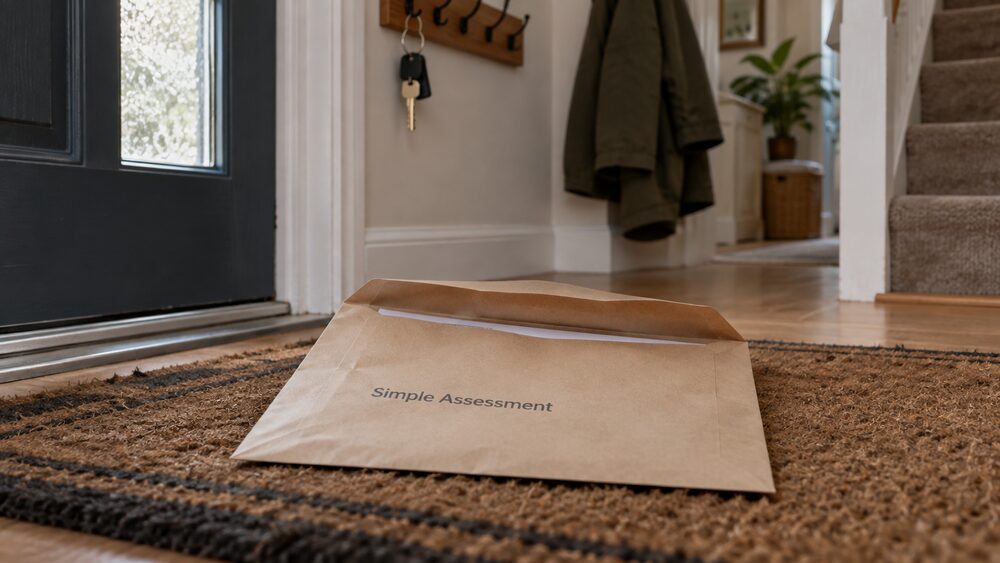
The third rule is the ceiling on what the code can handle. Some tax cannot be collected through a code at all, typically larger amounts owed, and HMRC gives the example of £3,000 or more14. In those cases a different route is used: you may get a Simple Assessment if you owe Income Tax that cannot be collected through your tax code15. The letters, known officially as PA302, set out exactly how much tax is owed and why14, and HMRC has urged customers not to ignore them. That route is explained on Simple Assessment: when HMRC works out your bill for you.
The legal machinery behind all of this is the PAYE regulations, which give HMRC the power to set and change codes. A recent example shows the system still extending: regulations made in 2026 enable HMRC to determine an individual's tax code for the purpose of collecting the Winter Fuel Payment Charge16. In other words, when a new charge or relief enters the system, the tax code is the usual way it reaches your pay.
For people with more than one job, the rule is one tax code for each employment10. Telling HMRC about a new job, or about having more than one, is what keeps those codes aligned, and the process is on How to check your tax code and the allowances in it and Two jobs and two tax codes: how your allowance is split.
Checking a code and getting a wrong one fixed
The starting point for any check is the payslip, because the code in use is printed there2. From there, HMRC provides an online tax code checker that does four things: it finds out what the letters and numbers in your tax code mean, shows how much Income Tax you are due to pay, lets you update your records if something is wrong, and explains the deductions included in your code17. You can also check it online on GOV.UK or on the HMRC app, and let HMRC know if it still does not look right3. Using the app is covered on Using the HMRC app and your online account.
The signs that a code needs a second look are practical ones. If you think the tax taken is wrong, your tax code may be incorrect2. The common triggers for a wrong code are the same as the triggers for any change: a new job, a change of benefits, pension income starting, or savings interest growing3. If the reason on your P2 notice does not match your life, the code built from it will not either.
The order to work through is simple:
- Find the code on your payslip2.
- Put it through the tax code checker on GOV.UK to see what the letters and numbers mean and what deductions are in it17.
- Use the checker or the HMRC app to update your records if something is wrong17.
- If it still does not look right, tell HMRC, who can check the underlying record and issue a corrected code3.
- At the end of the tax year, read any P800 carefully: it shows whether too much or too little tax was paid, and how the difference will be settled4.
If you have overpaid, the refund normally arrives through your payslip once the code is corrected, or as a refund from HMRC1, and the process is on Claiming a refund when you have overpaid income tax. If you have underpaid, the usual route is collection through the following year's code4. Where a disagreement with HMRC goes further, the routes are on HMRC internal review or tax tribunal: routes to challenge a decision.
How you are protected
The tax code system has its own safety nets, and they matter because a wrong code takes the wrong amount from every pay packet until it is fixed.
The first protection is the reconciliation at the end of the year. Because the code only estimates how much tax to spread across the year, HMRC checks afterwards whether the total was right, and a P800 sets out the result4. Overpayments are refunded, usually via the next payslip or a refund from HMRC1. Underpayments are normally collected gradually through the next year's code rather than as a single demand4.
The second protection is the cap on what can be collected through the code at all. Larger amounts, typically £3,000 or more, are not taken through PAYE but through a Simple Assessment letter that sets out exactly what is owed and why14. That gives a person a document to check before paying, and the basis to query it.
The third protection is the right to have errors corrected and complaints heard. If tax has been taken wrongly because HMRC or an employer used the wrong facts, the record can be updated through the checker or the app17, and complaints about how HMRC has handled things can be escalated, as explained on How to complain about HMRC and escalate to the Adjudicator.
Where the underlying issue is a tax bill that has become hard to pay, HMRC's guidance on what happens if you do not pay sets out the options, including arrangements to spread payment13, and wider debt help is on Debt: a complete guide to help, solutions and your rights.
Tax codes across England, Scotland, Wales and Northern Ireland
The PAYE system that applies tax codes is a UK-wide mechanism: whoever pays you, anywhere in the UK, applies the code HMRC issues, and the tax year runs from 6 April to 5 April in every nation5. The code itself does not change depending on where in the UK you live; what differs between the nations is the income tax rates and bands the code feeds into, which is a separate question from how the code is built and applied.
The place where residence genuinely changes the rules is leaving the UK. If you live abroad and are employed in the UK, your tax is calculated automatically on the days you work in the UK19. If you are eligible for a Personal Allowance you pay Income Tax on your income above that amount; otherwise, you pay tax on all your income19. Where the country you live in has a double-taxation agreement with the UK, you can claim tax relief in the UK to avoid being taxed twice19. These rules are on Moving abroad or to the UK: your residence status, and renting out UK property from abroad is covered by The Non-resident Landlord Scheme.
For most readers, though, the practical point is simpler: the nation you live in does not change what your code says or how to check it. The checker, the HMRC app and the P2 notice work the same way everywhere in the UK17.
Where to get help
The free, official routes are the ones HMRC itself provides. The tax code checker on GOV.UK explains what your letters and numbers mean, shows the Income Tax you are due to pay, lets you update your records, and explains the deductions in your code17. The HMRC app does the same from a phone3. Both are free, and both are the right first stop before contacting HMRC directly.
The related pages on this site cover the specific situations people most often arrive with:
- How to check your tax code and the allowances in it
- Emergency tax codes: why you have one and how to fix it
- BR and 0T tax codes: what the difference means for your pay
- Two jobs and two tax codes: how your allowance is split
- Claiming a refund when you have overpaid income tax
- Simple Assessment: when HMRC works out your bill for you
- How to complain about HMRC and escalate to the Adjudicator
The wider context, from how PAYE works to how the whole tax system fits together, is on PAYE: how tax is taken from wages and pensions and Personal tax in the UK: a complete guide.
Sources19 cited
- Tax on your first job HMRC Tax Confident campaign, 2026-08-05
- Payslips GOV.UK, 2026-09-26
- Tax code changes HMRC Tax Confident campaign, 2026-08-05
- Common tax code letters and the P2 Tax Coding Notice HMRC Tax Confident campaign, 2026-09-28
- The Tax Credits (Definition and Calculation of Income) Regulations 2002 legislation.gov.uk, 2002-07-30
- Understand your Self Assessment bill GOV.UK, 2026-09-26
- Income Tax GOV.UK, 2026-09-26
- Income Tax Act 2007, Section 10 legislation.gov.uk, 2007-03-20
- K in your tax code GOV.UK, 2026-09-28
- Tell HMRC if you have a new job or more than one job GOV.UK, 2025-01-16
- Tax overpayments and underpayments GOV.UK, 2026-09-25
- How you pay tax on savings interest GOV.UK, 2026-09-28
- What will happen if you do not pay your tax bill GOV.UK, 2021-10-18
- HMRC urges customers not to ignore Simple Assessment letters GOV.UK, 2026-07-28
- Understand Simple Assessment GOV.UK, 2026-09-25
- The Income Tax (Pay As You Earn) (Amendment No. 2) Regulations 2026 legislation.gov.uk, 2026
- Check what your tax code means GOV.UK, 2023-07-25
- Loan schemes and the loan charge: an overview GOV.UK, 2026-06-03
- Tax on UK income if you live abroad GOV.UK, 2026-09-26



 GOV.UKOfficial information on tax, benefits and government services
 MoneyHelperFree, impartial money and pensions guidance, set up by government
 Citizens AdviceFree advice on money, consumer and legal problems in England and Wales
 Turn2usFree benefits calculator and grants search from a charity
 Citizens Advice ScotlandFree advice across Scotland