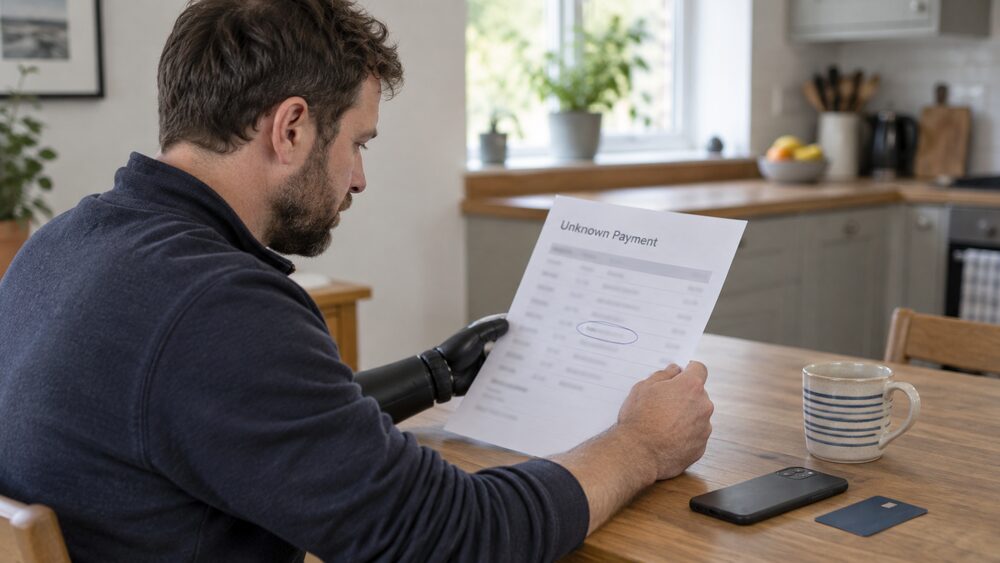
A payment you do not recognise on your statement or in your banking app is an unauthorised payment until the bank shows otherwise. The first thing to do is tell your bank, using the phone number on the back of your card or on a recent statement, or through the app if it offers that route1.
A payment you do not recognise on your statement or in your banking app is an unauthorised payment until the bank shows otherwise. The first thing to do is tell your bank, using the phone number on the back of your card or on a recent statement, or through the app if it offers that route1.
The rules are on your side. Under the Payment Services Regulations, you must notify your bank without undue delay once you become aware of an unauthorised payment, and in any event no later than 13 months after the debit date1. Once you have told the bank, you are not liable for any unauthorised payments taken after that point2. If you claim the use of the card was not authorised by you, it is for your bank to prove otherwise, not for you to prove your innocence3.
The bank must then refund the amount of the unauthorised payment and, where applicable, restore your account to the state it would have been in had the payment never happened2. That is the legal duty, not a goodwill gesture.
Tell your bank straight away
Speed matters more than anything else you do. Contact your bank immediately if you spot transactions on your statements that you do not recognise, and use the phone number printed on the back of your card or on a recent statement rather than a number from an unexpected call, text or email4. That last point is not fussiness: fraudsters routinely pose as bank staff, and a genuine bank will not mind you hanging up and calling back on the printed number.
The same instruction applies whatever the payment was. If you think you have paid for a fake ticket or shared your financial information with a criminal, contact your bank immediately6. If someone has asked you to lie to your bank about why you are moving money, that is a scam, and the advice is not to engage and to report them immediately7. If you receive a letter or email about a loan or card you did not apply for, call your bank immediately, because that is a sign someone is using your identity8.
There is a second reason to move quickly. You are not liable for unauthorised payments taken after you tell the bank that your card has been stolen or that someone else has got hold of your security details2. Every hour between noticing and reporting is an hour in which further payments can be taken and, in principle, disputed.
Report it through the app or by phone
Most banks now let you raise this in the app. At Santander, for example, the quickest route for a card payment is to tap the transaction you do not recognise and select 'Help with this transaction'9. Ulster Bank's app works differently: you click on the transaction, select 'Report a dispute, fraud or scam', then follow the remaining steps that suit the situation10. The wording varies by bank, but the shape is the same: find the payment, open it, and look for the dispute or fraud option.
If the app does not offer that, or you would rather speak to a person, phone the number on the back of your card. Independent guidance is consistent on this: if you have lost money or spotted an unauthorised transaction on your account, contact your bank immediately using the phone number on the back of your card11. Independent Age gives the same instruction, adding that the number on a recent statement works too5.
A few practical points. Check how to report your phone as lost or stolen on your banking app or website before you need to, so you know the route if it happens12. If you receive a SIM swap notification you did not request, contact your mobile provider immediately and inform any other businesses that use your mobile number for verification, including your bank13. And if you have given card details away to a fraudster, the bank is still the first call.
What your bank does once you report it
The bank's duty is set out in regulation. It must refund the amount of the unauthorised payment transaction to the payer and, where applicable, restore the debited payment account to the state it would have been in had the unauthorised payment transaction not taken place2. In plain terms: the money comes back, and any knock-on charges caused by the missing money should be put right too.
The Payment Services Regulations and the Banking Conduct of Business rules place obligations on banks and building societies to provide a refund in these circumstances4. The burden sits with the bank. If you claim the use of the card was not authorised by you, it is for your bank to prove otherwise3. That is a meaningful protection: you do not have to reconstruct your movements or account for your password.
Some firms state the same promise in their own terms. NS&I says that if you did not authorise a payment from your account, it will normally return the account to the position it would have been in had the unauthorised payment not happened14. Its Income Bonds terms add the qualification that this applies unless the customer failed to take reasonable care or did not report lost security details promptly15. That qualification is the one to watch across the market: the refund duty is strong, but it is not unconditional.
If the bank will not give your money back, you can report them to Trading Standards3. For a bank transfer scam rather than an unauthorised card payment, the route is different, and a refused refund can go to the Financial Ombudsman Service.
Keep checking your accounts for more unfamiliar activity
One unrecognised payment is rarely the whole story. Check your transactions regularly for payments you do not recognise, and turn on your bank alerts so that spending shows up as it happens16. If you see spending you do not recognise, contact your bank immediately17.
The checks worth building into a routine are these. Check bank statements regularly and report any unrecognised transactions to your bank immediately18. Check your card statements and bank account balance for unfamiliar transactions after returning from overseas, and call your bank immediately if you spot one19. Check your bank account and credit card statements regularly for transactions you do not recognise, and check your credit file frequently for unrecognised accounts or unusual credit rejections20. Regularly checking your credit report can help you spot suspicious activity, giving you a chance to report it before it goes too far21.
Watch for the wider signs of identity fraud too: purchases you did not make and charges you do not recognise on credit card and bank statements are among the warning signs22. Payments on your account that you do not remember making could be a sign a criminal has accessed your account13. Transactions you did not make are a warning sign of digital wallet fraud23. Identity fraud involving plastic cards, online banking or cheques should be reported directly to the financial institution concerned24.
If you find more unrecognised transactions after reporting the first, report those as well, and keep checking. Any further payments taken by a business after you cancel a recurring card payment are considered to be unauthorised transactions25. For a recurring payment you have cancelled, you must report it as soon as possible or, in any event, within 13 months of the date the unauthorised payment was made26. If a payment is taken after consent is withdrawn, your bank should give you a refund including any interest or charges added to your account27.
Where the protection stops
The refund duty is strong but not absolute. NS&I's terms make the standard qualification explicit: it will normally refund unauthorised payments and restore the account unless the customer failed to take reasonable care or did not report lost security details promptly15. The 13-month deadline is a hard backstop: notify later than that and the entitlement to redress falls away1.
Two situations are commonly confused with an unrecognised payment, and neither follows the same route. The first is a payment you authorised but now regret, such as a scam where you were persuaded to send money yourself. That is a different regime, with its own rules on reimbursement and its own grounds on which a bank can refuse. The second is money sent to the wrong account by mistake: if the account exists, you need to contact your bank to request your money back, and if the recipient disputes its return, the bank will investigate, with 15 business days allowed for that28.
There is also a distinction between a card payment and a bank transfer. With a credit or debit card you have some rights to get your money back; with a bank transfer, contact your bank immediately29. If you are asked to pay for something online by bank transfer, the guidance is blunt: do not do it29.
Where a bank has failed or stopped serving customers, the position is different again, and the relevant compensation scheme rather than the payment rules applies. For free, impartial help on any of this, MoneyHelper offers guidance on banking problems, and the Financial Ombudsman Service can look at a complaint once the bank has had its chance to respond.
Sources29 cited
- The Payment Services Regulations 2017, regulation 74 legislation.gov.uk, 2017
- The Payment Services Regulations 2017, Part 7 legislation.gov.uk, 2017
- Your payment card was used without your permission (distance sales) Citizens Advice
- How to get your money back after a scam Which?
- What to do if you've been a victim of a scam Independent Age
- Ticket scams Take Five
- Romance fraud Take Five
- Identity theft Take Five
- Unrecognised transactions Santander
- There's a problem with a subscription or recurring transaction Ulster Bank
- I'm a scams expert and these are my tips for reporting scams Which?, 2026
- Stolen mobile phone Take Five
- SIM swapping scams RBS
- Direct Saver brochure NS&I, 2024
- Income Bonds brochure NS&I, 2024
- Card fraud Take Five
- Type don't tap Take Five
- Cheque scam Take Five
- Holiday fraud Take Five
- Phishing Experian
- Protect your identity nidirect
- What are the warning signs Experian
- Digital wallet fraud Take Five
- Identity theft Finance & Leasing Association
- Recurring card payments FCA, 2025
- Other problems Isle of Anglesey County Council, 2025
- Payday, guarantor and doorstep loans Advice NI
- How do I get money back that I've sent to the wrong account Which?, 2026
- How to spot a fake, fraudulent or scam website Which?, 2026





 FCA Warning ListCheck whether a firm is authorised before you deal with it
 Financial Ombudsman ServiceFree, independent help when a complaint about a firm is not put right
 Citizens AdviceFree advice on money, consumer and legal problems in England and Wales
 MoneyHelperFree, impartial money and pensions guidance, set up by government