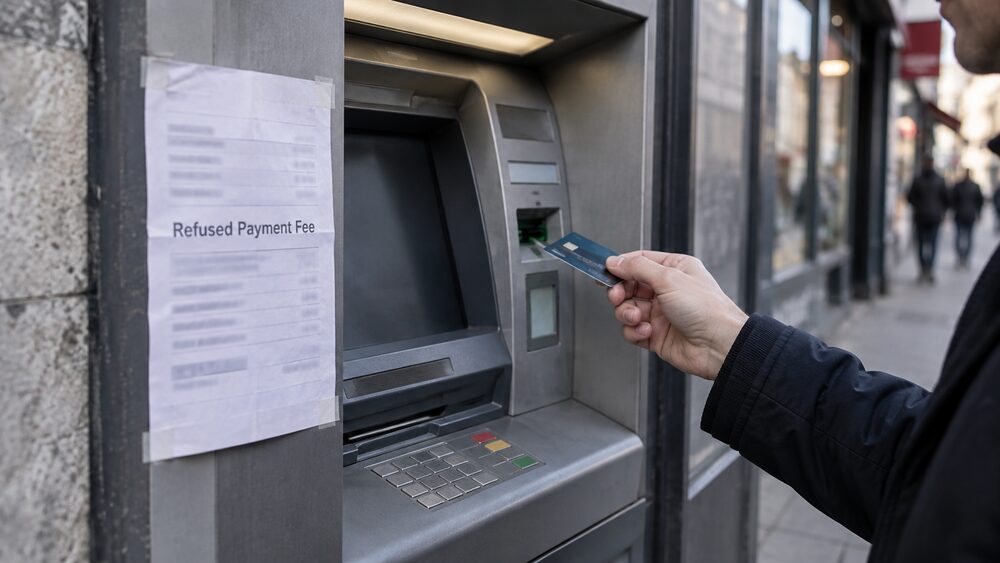
Yes, a bank can charge you when it refuses a payment because there is not enough money in your account, but only if your account terms allow it and the charge is not unfair. The rules call this a "refused payment fee", defined as any fee payable where a payment service provider refuses to execute a payment order or to initiate a payment transaction, where such a fee is permitted under the Payment Services Regulations1.
Yes, a bank can charge you when it refuses a payment because there is not enough money in your account, but only if your account terms allow it and the charge is not unfair. The rules call this a "refused payment fee", defined as any fee payable where a payment service provider refuses to execute a payment order or to initiate a payment transaction, where such a fee is permitted under the Payment Services Regulations1.
What that costs varies sharply between accounts. Bank of Ireland UK charges £1.50 for each item it refuses to pay, charged monthly, on its personal current account2. Its GMS Borrowing Account carries the same £1.50 per refused item3. Other accounts charge nothing: Virgin Money's Current Account Control lists no fee for refusing a payment due to lack of funds4, Kroo's Personal Current Account shows £0 for refusing a payment due to lack of funds5, and Virgin Money's Essential Current Account also shows £06.
So the answer to whether you can be charged is: sometimes, and it depends on which account you hold and what its terms say. The rest of this page sets out when a charge can be challenged, what the regulator can and cannot do, how refunds and redress work, and where to get free help if refused payments are a sign of wider money trouble.
Refused payment charges and the rules on unfair terms
A refused payment fee is not automatically lawful just because it appears in your terms. The Payment Accounts Regulations give a right of redress where a trader charges a fee in contravention of regulation 4, or any payee charges a fee in contravention of regulation 6A, and any provision of a contract requiring payment of that fee is unenforceable to the extent the charging contravenes those rules1.
For current accounts, the FCA's Banking Conduct of Business rules define a "refused payment fee" and set out when one can be charged1. The same rules say no charge is payable where the firm refuses a payment due to lack of funds on an excluded account10. That is why the fee is not universal: the account type decides whether the charge is permitted at all.
For credit cards, independent guidance is more concrete. Charges of more than £12 for missing a credit card repayment may be seen as unfair7. That figure is a threshold for challenge, not a cap written into law, and it applies to missed repayments rather than to refused card transactions.
The wider test is transparency and proportionality. The FCA has said it believes its rules require charges imposed by a firm on customers to be transparent, and that unfair or excessive charges are inconsistent with its principles and the Consumer Duty11. In practice, that means a charge that is buried in small print, or that is far larger than the cost the bank actually incurs, is more vulnerable to challenge than a modest, clearly disclosed one.
What the FCA can and cannot do about an unfair charge
The Financial Conduct Authority writes the rules and supervises firms, but it is not a complaints service for individuals. It has said plainly that it cannot pay compensation or order a claims management company to compensate you, even if you have received poor service12. Anyone who tells you the FCA will award you money for a bank charge is describing something the regulator does not do.
What the FCA can do is act on patterns. It can apply to court for restitution, or require restitution, where an unfair term also amounts to a rule breach causing loss to consumers13. It can also use its powers to make rules requiring authorised persons, electronic money issuers and payment service providers to establish and operate consumer redress schemes, and it can impose a requirement on a firm to run a scheme corresponding to, or similar to, a consumer redress scheme13. Those powers have been used for whole markets, not for one customer's £1.50.
The FCA also has a role in checking who is allowed to charge you at all. It is illegal for someone who is not FCA regulated to charge you for borrowing money, and such lenders are known as loan sharks14. You can check whether a firm is authorised on the Financial Services Register, though the FCA notes it cannot guarantee the register's accuracy and does not accept liability for errors or missing information15.
Getting money back: restitution and redress schemes
There are two distinct routes to getting a charge back, and they work differently.
The first is a refund because the payment should never have been taken. Where a payment transaction is unauthorised, the rules require the provider to refund the amount of the unauthorised payment transaction to the payer and, where applicable, restore the debited payment account to the state it would have been in had the transaction not taken place17. That restoration language matters: it covers charges added to your account because of the unauthorised payment, not just the payment itself. Independent guidance confirms that the Payment Services Regulations and the Banking Conduct of Business rules place obligations on banks and building societies to provide a refund in these circumstances18.
The second is redress through a complaint or a scheme. Where a firm has applied set-off unfairly, the Financial Ombudsman Service describes redress as paying any interest you would have paid and refunding any fees or charges applied19. In equity release complaints, redress might include telling a business not to apply an early repayment charge, refunding the charge if already paid, or compensation for distress and inconvenience20. The pattern is consistent: refund the charge, put the interest right, and add something for the trouble where the firm's conduct warrants it.
For scam payments, there is a limit worth knowing. If your bank or payment service provider decides to reimburse you, it may deduct an excess of up to £100 for each scam claim8. That is a deduction from a reimbursement, not a charge for a refused payment, but it is the kind of figure that catches people out.
Refused payments as a sign of money trouble
A refused payment is often the first visible sign that a budget has stopped working, and the charges that follow can deepen the problem. Extra charges are added if you miss credit card payments21, and continuous non-payment on car finance can result in formal notices of arrears and, after three or four missed payments in a row, a default notice22.
The pattern repeats across borrowing. On Help to Buy in Wales, action may be taken against you for missed payments, and you could end up paying more in interest and charges23. On parking penalty charge notices, the debt may be registered in the County Court, the local authority can use bailiffs or enforcement agents, and extra fees will be added24. Each missed payment tends to generate its own charge, which competes with the original debt for the money coming in.
There is a specific protection worth knowing if a firm keeps trying a payment that has already failed. Where a customer is in financial difficulties, the FCA's Consumer Credit sourcebook states that a firm must not request payment on a continuous payment authority more than twice on the same agreement once it has already been refused25. If a lender keeps retrying and each attempt triggers a fee, that rule is the one to quote.
If a payment is taken after you have withdrawn consent, the position is stronger. For payday loans, your bank should give you a refund including any interest or charges added if payment is taken after consent is withdrawn26. The same applies to an unauthorised continuous payment authority: your card issuer should give you a refund, including any interest or charges added because the payment was taken27.
Are high charges on people with little money seen as a poverty premium?
Yes, and the research names it directly. Independent guidance describes a poverty premium in payments, where some payment methods mean people are charged more for the way they spend their own money28. In credit, the finding is starker: people in poverty pay more to borrow money29.
The figures are modest individually and significant in aggregate. One estimate puts the cost of using fee-charging cash machines at approximately £11 per year for low-income households in Britain, down from around £20 per year as usage has fallen30. A refused payment fee of £1.50 per item, charged monthly, sits in the same category: small enough to overlook, frequent enough to matter when money is already tight.
This is why the direction of regulation has been towards limiting charges that fall hardest on people with the least. The FCA has gone some way to tackle the worst excesses of the unsecured credit market, particularly with payday lending31. On buy now pay later, the FCA banned interest charges on credit that customers had already paid off during interest-free loan periods32. Access to cash has also been treated as part of the picture, with the government giving the FCA broader powers on access to cash after the Financial Services and Markets Act 2023 became law33.
Where to get help with charges and debt
If refused payment charges are part of a wider problem, the first step is free advice rather than another borrowing product. If you are struggling with debt payments, free, confidential debt advice is available9. Charities such as StepChange and the MoneyHelper service can look at your income, your debts and your options together.
New buy now pay later rules give you specific rights when you are in difficulty. Lenders must contact you, show you where you can get free debt advice, and consider giving you longer to repay or removing extra fees34. If you are behind on essential bills, there is also help with benefits not covering your needs9.
If a debt has been passed to a collection agency, knowing what the agency can and cannot do helps. A debt collection agency can take court action if you do not pay35. In Scotland, a charge to pay or charge for payment should come with a Debt Advice and Information package setting out your rights and where to get advice36.
For a dispute about a charge itself, the route is: complain to the bank, give it eight weeks, then take the complaint to the Financial Ombudsman Service, which is free to consumers. The ombudsman can look at bank account set-off complaints19, equity release complaints20, scam payment complaints8 and complaints about cheques and bankers' drafts, including a cheque that bounced after being paid in, a bank that did not pay a written cheque or paid after cancellation, a cheque lost, stolen or forged, or a fake or missing banker's draft the bank would not refund37.
Sources37 cited
- The Payment Accounts Regulations 2015, regulation 10 legislation.gov.uk
- Personal current account charges explained Bank of Ireland UK, January 2026
- GMS Borrowing Account Bank of Ireland UK, 25 September 2026
- Current Account Control Virgin Money, 2026
- Personal Current Account fees Kroo, 28 October 2024
- Essential Current Account key document Virgin Money, 1 September 2024
- The costs and charges of credit cards Citizens Advice, 25 September 2026
- Scams you've been tricked into making a payment Financial Ombudsman Service, 27 September 2026
- Benefits not enough to meet my needs Turn2us, 26 September 2026
- FCA Handbook CONC 5C.5 FCA, 6 April 2020
- FCA Handbook MCOB 12.7 FCA, 26 June 2026
- Complain about a claims company GOV.UK, 26 September 2026
- FCA Handbook UNFCOG 1.6 FCA, 31 July 2026
- Get help with rent Shelter England, 25 June 2026
- Check if a firm is authorised FCA, 27 September 2026
- Your payment card was used without your permission Citizens Advice Scotland, 28 September 2026
- The Payment Services Regulations 2017, part 7 legislation.gov.uk, 2017
- How to get your money back after a scam Which?, 27 September 2026
- Bank accounts: the right of set-off Financial Ombudsman Service, 26 September 2026
- Equity release complaints Financial Ombudsman Service, 26 September 2026
- Paying off credit card debt StepChange, 25 September 2026
- Car finance Advice NI, 26 September 2026
- Cost of living Welsh Government, 2026
- Parking fines and debt StepChange, 25 September 2026
- Buy now pay later National Debtline, 25 September 2026
- Payday, guarantor and doorstep loans Advice NI, 26 September 2026
- Buy now pay later Business Debtline, 26 September 2026
- The poverty premium in 2026: payments Fair By Design, 28 May 2026
- The poverty premium in 2026: credit Fair By Design, 11 June 2026
- Poverty Premium 2026 University of Bristol Personal Finance Research Centre, 2026
- Consumer credit trends and debt StepChange, 25 September 2026
- Buy now pay later: trends in the UK House of Commons Library, 8 July 2026
- Access to cash Payment Systems Regulator, 26 September 2026
- Buy now pay later StepChange, 25 September 2026
- Debt passed to a collection agency StepChange, 25 September 2026
- Wage arrestment StepChange, 25 September 2026
- Cheques and bankers' drafts Financial Ombudsman Service, 26 September 2026



 Financial Ombudsman ServiceFree, independent help when a complaint about a firm is not put right
 FSCSProtects your money if a bank, insurer or investment firm fails
 FCA Warning ListCheck whether a firm is authorised before you deal with it
 MoneyHelperFree, impartial money and pensions guidance, set up by government
 Citizens AdviceFree advice on money, consumer and legal problems in England and Wales